Reviewed by Tamir Rubin, Head of Product at iPREP • Updated July 2026
What is the Watson-Glaser Critical Thinking Appraisal III (WG-III)?
The Watson-Glaser Critical Thinking Appraisal III (Watson-Glaser III / WG-III) measures how well test-takers evaluate arguments, interpret information, and draw logical conclusions from written passages for hiring and employee development. It includes 40 questions across inference, assumptions, deduction, interpretation, and argument evaluation, with employer-set timing around 30–40 minutes.Watson-Glaser Sample Question
First Type – Inference
There are three general groups of countries that show the relationship between personal income and happiness levels. In some countries (such as Germany), both personal incomes and happiness levels have increased at the same rate over the past 10 years. In others (such as China), personal incomes have doubled over the past decade, but average happiness has increased by only 0.43 points. In 43 countries (including India and the US), incomes have risen, but happiness levels have declined.
Inference – The happiness level in some countries can be higher or lower than in others with the same personal income levels.
- True
- Probably True
- Insufficient Data
- Probably False
- False
Watson Glaser Question Types
Inference
Questions assess: likelihood
- Treat passage statements as true
- Rate each conclusion as True / Probably True / Insufficient Data / Probably False / False
- Use only given facts, nothing else
- Choose the best-supported option
Recognition of Assumptions
Questions assess: assumptions
- Spot unstated premise behind statement
- Answer whether assumption is made
- Focus on what must be true
- Ignore opinions not logically implied
Deduction
Questions assess: logic
- Decide if conclusion logically follows
- Use strict rules, not plausibility
- Answer follows or does not
- Stay within stated conditions only
Interpretation
Questions assess: interpretation
- Judge whether conclusion is warranted
- Weigh evidence from the given data
- Choose whether the conclusion follows beyond reasonable doubt
- Avoid outside knowledge or assumptions
Evaluation of Arguments
Questions assess: argument strength
- Judge argument strong or weak
- Focus on relevance to question
- Prefer important, directly related reasons
- Downplay emotional or trivial points
Test Duration
Total time: varies by employer (~30–40 min), 40 questions.
Confirm your exact time limit with the employer or test administrator. Keep a steady pace across all sections and avoid spending too long on any single item.
Test Breakdown & Sample Questions
The Watson-Glaser Critical Thinking Appraisal (WG-III) includes 40 multiple-choice questions.
Question types (5)
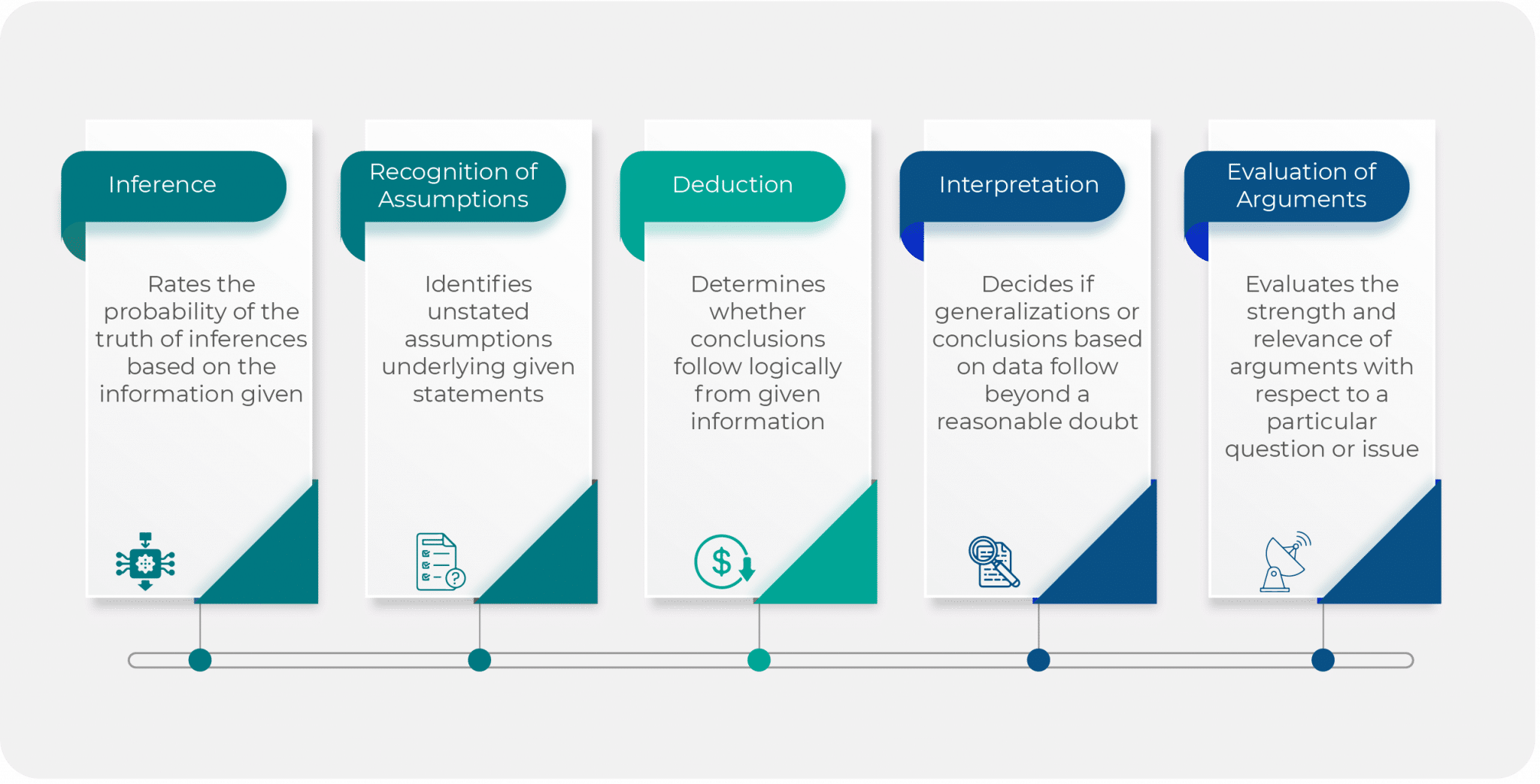
WG-III measures critical thinking across five question types:
| Question type | What it measures | Approx. number of questions |
|---|---|---|
| Inference | Rates how likely an inference is to be true, based only on the information given. | Varies by form |
| Recognition of Assumptions | Identifies unstated assumptions behind statements. | Varies by form |
| Deduction | Determines whether a conclusion follows logically from the information provided. | Varies by form |
| Interpretation | Decides whether a conclusion is warranted beyond a reasonable doubt from the given data. | Varies by form |
| Evaluation of Arguments | Judges whether an argument is strong and relevant to the question at hand. | Varies by form |
Note: Because WG-III is commonly delivered as a computer-based, item-banked assessment, the exact mix by question type (and the order you see them) may vary by employer and test setup.
Answer choices
- Inference: 5 answer choices
- All other question types: 2 answer choices
You’ll see brief instructions before each question type begins. Treat these as directions (not rest time), and stay focused on pacing.
The five question types are presented below in the same sequence as this guide. Read about each type and try a sample question.
Inference
In these questions, you are given a short passage containing textual and sometimes statistical information. Two or three inferences are offered for each passage. Your task is to rate the probability of the truth of inferences based on the information given. You should not assume anything else besides the given information. There are five options to choose from:
- True – the inference is definitely true and can be completely drawn based on the passage. This is equivalent to an answer such as: “After examining this information, what you’re saying must be true!”
- Probably True – the inference is in line with the information presented, but there is not enough evidence for you to be completely sure that it is true. This is equivalent to an answer such as: “I see what you are trying to prove, and it makes sense; yet, you cannot be sure about it.”
- Insufficient Data – The information in the passage provides no evidence to either support or undermine the inference. This is equivalent to the answer: “Based on what you have told me, I have no idea if it is true or false.”
- Probably False – the inference deviates from the information provided and interprets it in a way that seems unlikely. Yet, there is a slim chance that it is true after all. This is equivalent to an answer such as: “What you are saying seems so far-fetched based on the evidence we have. It is really unlikely that it is correct.”
- False – the inference is definitely false as the information in the passage directly contradicts it. This is equivalent to answering: “The data says one thing and you say exactly the opposite! This cannot be true!”
A Winning Inference Tip:
Though there are five possible options, you should not expect that each of the inferences will fall under one of the five options. You can definitely expect that one or two answers will appear more than once. Therefore, consider each inference anew and do not rely on previous answers you have given.
Try an Inference Sample Question
A worldwide study shows that there are behavioral shifts among consumers. 41% said that they are “increasingly looking for ways to save money.” Consumers are largely brand loyal but shop around for the best prices. Only 12% of consumers have traded down to buy cheaper brands (such as bottled water), with 11% trading up (with products such as cosmetics). There has been a big shift towards online shopping.
None of those who trade down also trade up.
- True
- Probably True
- Insufficient Data
- Probably False
- False
The correct answer is Insufficient Data.
We cannot tell from the evidence of those who trade down (12% of consumers) and those who trade up (11% of consumers), what relationship there is between the two in terms of whether there is any overlap between the two groups. Though it might seem highly unlikely that there would be an overlap, the statements allow for this with the reference to the different products (bottled water, cosmetics). Even if the word “none” had been replaced by “few” or “many,” we would still have insufficient data to draw the inference.
Recognition of Assumptions
In these questions, a quote or a short statement is presented. In most cases, even if the assumption is not explicitly stated, the speaker or provider of the information must have a couple of things he or she takes for granted or considers as necessarily true to justify the statement. Your goal is to judge whether the suggested assumption is made by the author or not. There are only two options to choose from:
- Assumption Made – the author clearly assumed the suggested assumption because, without the assumption, the statement does not make sense.
- Assumption Not Made – the author does not have to assume a proposed assumption as it either undermines the statement or is irrelevant for the justification of the statement.
A Winning Recognition of Assumptions Tip:
To assess whether an assumption is necessary and important, try for a moment to assume the complete opposite. A contradictory/negative assumption may shed light on the necessity of the original assumption. A more in-depth view of this “negative assumption” solving method is included within iPrep’s guide.
Try a Recognition of Assumptions Sample Question
Statement: “Getting a highly paid position in a top law firm is difficult, so young lawyers need to get lots of experience in the law.”
Proposed Assumption: Getting a highly paid position in a top law firm is possible.
- Assumption made
- Assumption not made
This assumption is made.
Though the statement indicates that it “is difficult” to get “a highly paid position in a top law firm,” it must be possible to do this, otherwise, the “so” part of the statement could not be given.
Check this answer, using the negative test.
Getting a highly paid position in a top law firm is not possible.
Since this does not fit with the statement (even going as far as challenging the claim that getting this type of position is “difficult”), the assumption must be made.
Deduction
In these questions, you must apply pure logic to conclude whether a proposed conclusion is definitely true based on the provided evidence/premises, or not. The evidence must be considered as utter truth, even if it is debatable in the real world. There are only two options to answer the question:
- Conclusion Follows – the conclusion definitely follows from the evidence/premises. If the premises are true, then the conclusion must be true.
- Conclusion Does Not Follow – this answer should be chosen in any other case: if the evidence contradicts, does not support, or even leaves a shred of a doubt regarding the correctness of the conclusion, choose this answer.
A Winning Deduction Tip:
Remember that the premises must be considered complete truth. In addition, remember that you cannot generalize the premises or extend their claim to areas that encompass more cases than those the premises refer to. For example, if a premise refers to accountancy firms, banks, and investment companies, you cannot generalize it to “financial institutions.”
Try a Deduction Sample Question
Some producers of renewable energy rely heavily on government subsidies. All companies that rely heavily on government subsidies will one day have to manage without them. Therefore…
Some producers of renewable energy will one day need to operate without government subsidies.
- Conclusion follows
- Conclusion does not follow
This conclusion follows the premises.
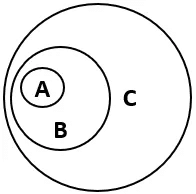
If we look at the structure of the premises in a simplified form, we get “Some A are B. All B are C.”
This diagram represents a plausible organization of groups A, B, and C:
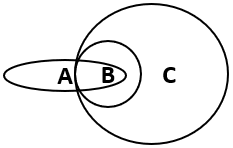
So, it must follow that some A are C.
Interpretation
In these questions, like the deduction questions, you also need to decide whether a proposed conclusion follows or not. This time, though, the standard is not “definite truth” as it is in the deduction section, but “beyond reasonable doubt.” This criterion is a strong one but it is weaker than the one used in deduction. To arrive at your conclusion, you must only consider the information provided in the passage, which for the purpose of the test is considered as true. To summarize, you must choose between two options:
- Conclusion Follows – the conclusion follows from the evidence/premises beyond a reasonable doubt, which means that it is very unlikely that it will not be true, eventually. You may be able to describe a situation in which the conclusion does not follow, but this scenario is rather unusual.
- Conclusion Does Not Follow – this answer should be chosen if the information clearly contradicts the conclusion; if there is no sufficient information to prove or undermine the conclusion; and even if there is a much greater chance that the conclusion follows but there is still a reasonable scenario in which the conclusion doesn’t follow.
A Winning Interpretation Tip:
Each passage is followed by two or three proposed conclusions. These conclusions may seem related to one another. However, when you make a decision as to whether a conclusion follows or not, you should only take into account the information presented in the passage and not any conclusions that were presented before the conclusion you currently examine. Do not let your decisions regarding previous conclusions mislead you.
Try an Interpretation Sample Question
It is predicted that, by 2055, half of today’s work activities could be automated. The activities most susceptible to automation are physical ones in highly structured and predictable environments and those involved in the collection and processing of data. In advanced economies, such activities make up 51% of all economic activities.
Half of today’s jobs will disappear by 2055.
- Conclusion follows
- Conclusion does not follow
This conclusion does not follow beyond a reasonable doubt from the premises.
The prediction given in the evidence is that “by 2055, half of today’s work activities could be automated.” This is not necessarily equivalent to half of today’s jobs disappearing since jobs could change to fit with the change in “work activities.”
Evaluation of Arguments
In these questions, you are presented with a business or social dilemma: “Should Measure X be taken?” Usually, two arguments follow each dilemma. Each argument may either advocate in favor or against the proposed action. Either way, your goal is not to justify the arguments but to analyze them and decide whether the argument is weak or strong:
- Argument Strong – for an argument to be strong, it must be both important and directly related to the question. An important argument provides social/moral/financial justification for the action. A directly related argument deals precisely with the subject and the main issue at stake. It does not over-generalize it or deal with a secondary issue.
- Argument Weak – an argument is weak if it is of minor importance or if it is related only to trivial aspects of the question. It is weak even if it is of general great importance but not directly related to the question.
A Winning Evaluation of Arguments Tip:
You must remember that your personal agreement with the argument is irrelevant in this case. As in many fields, such as state politics and social welfare, there might be strong arguments in favor or against almost any proposal. You may think of a proposal as the most ethical and reasonable solution, or condemn it wholeheartedly. On the test, however, you must disregard your emotions and perceptions and refer only to the criteria for strong and weak arguments.
Try an Evaluation of Arguments Sample Question
Should tariffs on foreign goods be used as a way of protecting domestic jobs?
No; some domestic jobs are created as a result of importing foreign goods.
- Argument strong
- Argument weak
This argument is strong.
This provides both a relevant and important challenge to the question. If the focus is on the protection of domestic jobs, then risking the reduction of foreign imports through tariffs (by consequent price-increases) could reduce the number of jobs in some domestic industries.
Did you know?
The Watson-Glaser (WG-III) assesses critical thinking using five question types: Inference, Recognition of Assumptions, Deduction, Interpretation, and Evaluation of Arguments.
Scoring requirements vary by employer and role, so there isn’t a single “good” percentage for everyone. In general, strong candidates are those who can analyze information carefully, avoid assumptions, and keep a steady pace across all five question types.
Watson Glaser Preparation Strategies
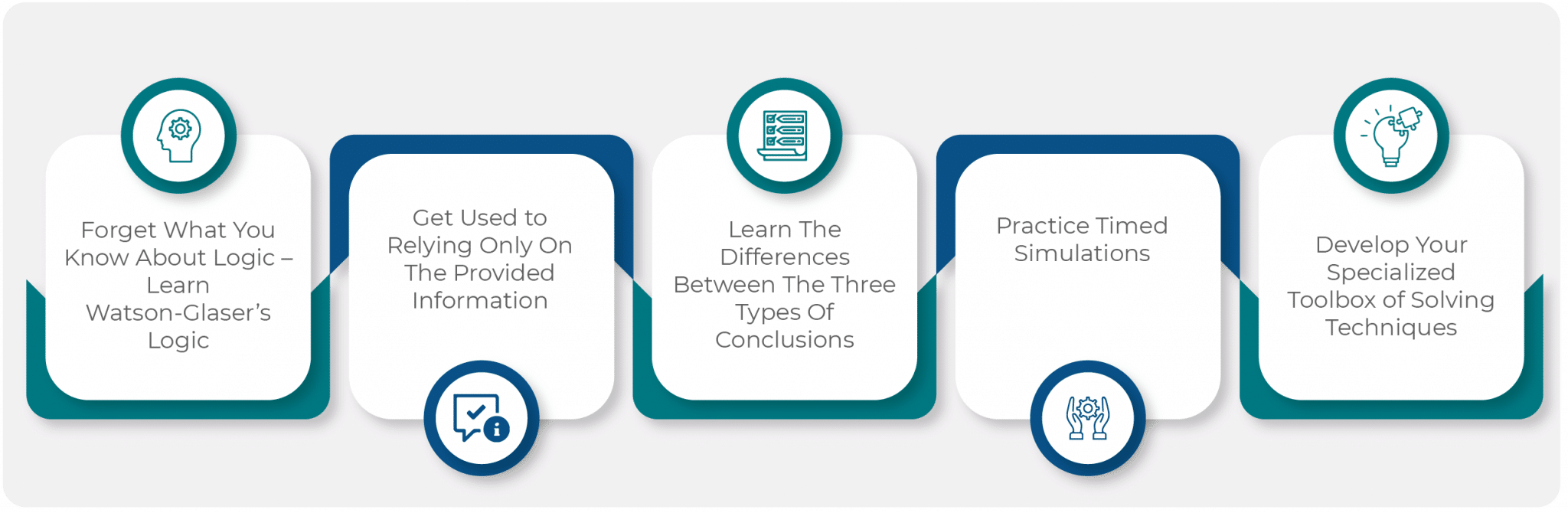
Learn the test’s rules (not “general logic”)
Watson-Glaser rewards its specific definitions and standards. Train with Watson-Glaser-style questions and explanations rather than generic logic drills.
Use only what’s on the page
Treat the passage or statements as your full “universe.”
- Don’t add outside facts, opinions, or personal beliefs.
- Even if something feels inaccurate, answer based only on the information provided.
Don’t mix up the three “conclusion” question types
These can look similar but require different levels of certainty:
- Inference: How likely is the conclusion based on the information?
- Deduction: Must the conclusion be true if the statements are true?
- Interpretation: Does the conclusion follow beyond a reasonable doubt from the given data?
Train with a timer
WG-III is timed, so practice pacing.
- Do timed sets regularly.
- If you’re stuck, choose the best available answer and move on.
Build a repeatable toolbox
Simple routines help you avoid traps and save time:
- Recognition of Assumptions: Would the statement still make sense if the assumption were false?
- Deduction: Turn statements into clear rules, then test the conclusion strictly.
- Evaluation of Arguments: Judge relevance and strength—not persuasiveness.
Test Features
Fast Facts (tl;dr)
- 40 questions total.
- Timed; employer sets limit.
- Five question types.
- Inference, deduction, interpretation.
- Assumptions and arguments too.
- RED score reporting used.
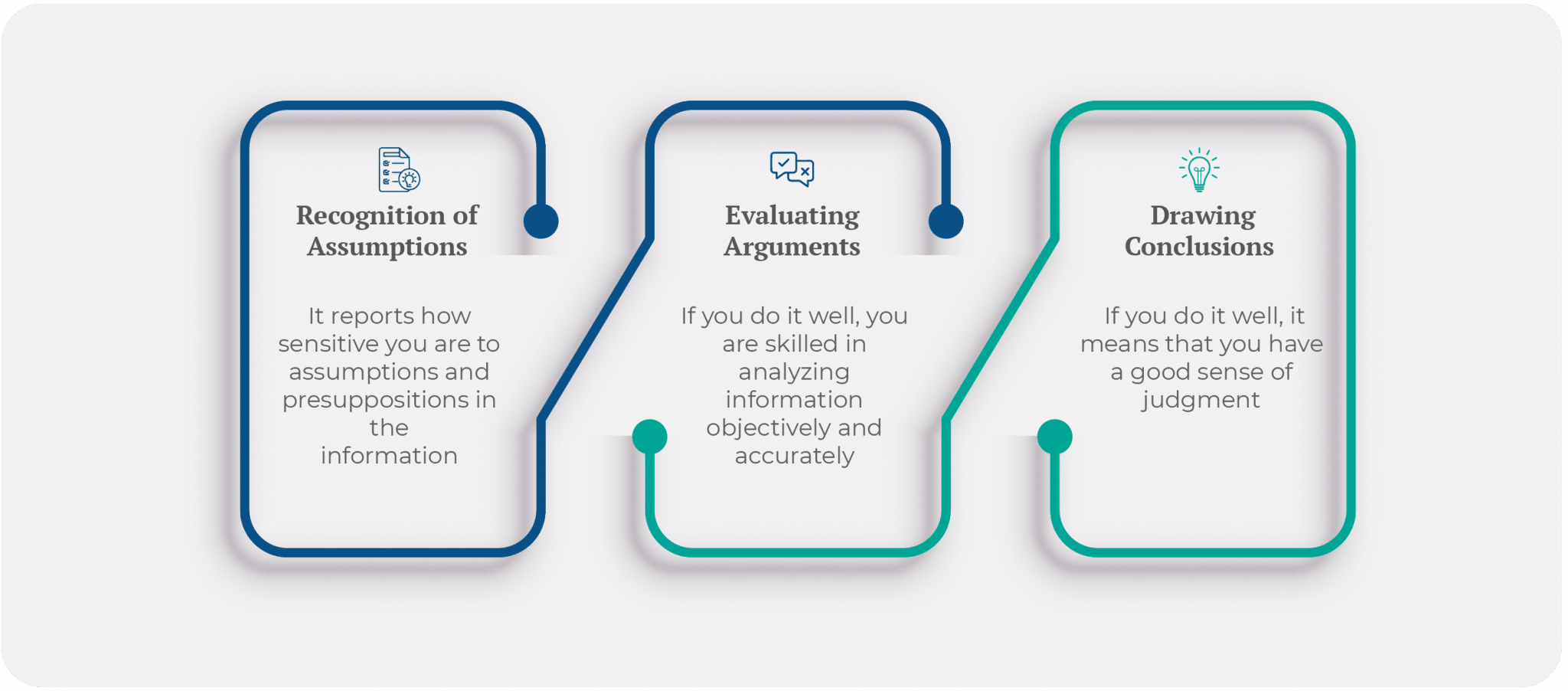
Three Scoring Scales – The RED Model
- Recognition of Assumptions:
How well you spot unstated assumptions. - Evaluating Arguments:
How well you judge relevance and strength. - Drawing Conclusions:
How well you form sound conclusions from information.
Timing and delivery
WG-III is commonly delivered as a computer-based, item-banked assessment and is usually timed. Exact timing and test rules can vary by employer, so follow your test-day instructions and practice pacing in advance.
Watson Glaser – an international test

The Watson-Glaser Critical Thinking Appraisal is published by Pearson. It measures critical-thinking and reasoning skills and is used worldwide, including in the United States, the United Kingdom, and Canada. The test is not geography-based—candidates are assessed on the same core skills everywhere—though the administration setup (delivery method, timing, and version) may vary by employer or test administrator.
Results Scale and Interpretations
Watson Glaser test results are broken down into two different reports, a profile report and a development report, which are provided to the prospective employer. Some organizations may share results with test takers, especially if the test was given for developmental purposes.
There is no penalty for guessing on the Watson-Glaser test. Most items outside Inference use two answer choices, but results are usually interpreted against employer-selected norm groups and may factor in item difficulty. There is no single raw-score percentage that counts as a good score for every candidate or role.
Profile Report
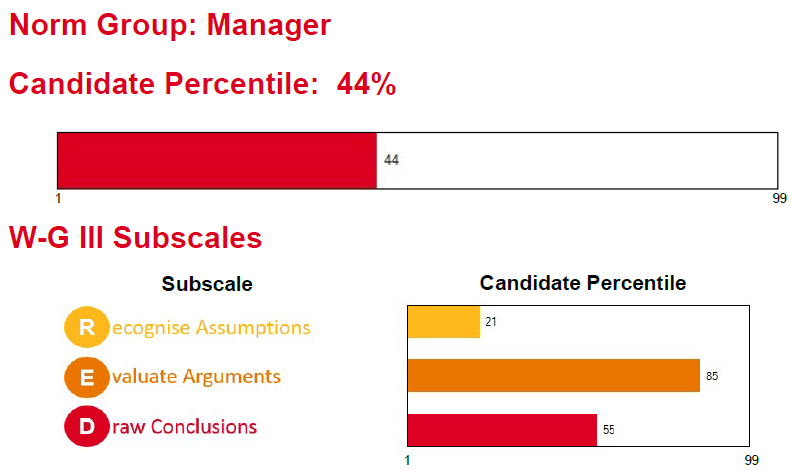
The profile report rates you with an overall percentile score, which is further broken down into the candidate percentile in three subscales:
- Recognize Assumptions: This test is all about understanding what the question states and analyzing whether the info mentioned is correct, or whether there’s any evidence that backs the stated information.
- Evaluate Arguments: Evaluating arguments means logically working with a problem and critically evaluating it. It is about symmetrically analyzing the argument and the evidence provided.
- Draw Conclusions: Candidates need to come to a logical conclusion based on the evidence provided. A candidate with strong critical thinking skills will be able to draw conclusions that would then lead to another conclusion.
While the Profile Report does include the raw number of correct answers, the percentile rank is more important. The percentile scoring system of WG-III accounts for question difficulty. It not only factors in the number of correct answers, but the difficulty of those questions as well. It also takes into account the norm group of the candidate, which provides different score distribution by occupation, position, and level of education.
For instance, here is a sample score report for a candidate for a managerial position. It reports the overall critical thinking percentile and three subscale scores according to the RED model. It portrays an overall average candidate with a high skill of evaluating arguments, average skill of drawing conclusions, and low skill of recognizing assumptions.
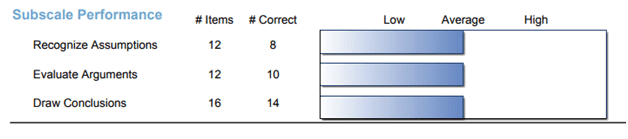
Contrary to Watson Glaser III, the WGCTA-II Profile Report also shows employers your raw scores in the three different categories, as seen below. However, this version of the test becomes less and less common, so you are not likely to encounter such a breakdown.
Watson Glaser Passing Score – by Norm Groups
Your raw score is important but it is not the deciding factor for determining whether you pass the test or not. The Watson Glaser score can be interpreted with several established norm groups – either by occupation (accountant, consultant, engineer, etc.), by position type/level (executive, manager, entry-level, etc.), or by educational background (high school, college, graduate, etc.). It is up to the recruiting company to decide which norm group to use when assessing your score. Customized norms may also be created for large organizations.
Development Report
The development report demonstrates the strengths of their employees. When given to the candidates/employees, it also guides them as to how to further explore specific skill areas and improve their skills.
Recognize Assumptions
Candidates with skilled behavior in the area will identify what is being taken for granted, and explore diverse viewpoints on the subject. Identifying the assumptions will help you reveal information gaps and enhance your understanding of the subject.
If you scored “Strength To Leverage” in this skill area, it means you possess strong skills in recognizing assumptions.

Evaluate Arguments
Candidates who can objectively and accurately evaluate arguments are likely to be hired by many organizations. Such candidates can overcome confirmation bias and also possess the capability to analyze an argument’s reasoning and supporting evidence, and explore counter-arguments even when doing so is controversial. When evaluating controversial arguments, emotions can play a negative role, as they can cloud your evaluation capabilities.
If you scored “Further Exploration” in this parameter it means that your skills are average when compared to other candidates.

Draw Conclusions
Drawing conclusions means reaching the conclusion which logically follows the evidence available for a particular problem. Furthermore, reaching a conclusion means evaluating information from diverse sources, and even changing your position on a subject when warranted by the available evidence.
If you scored “Opportunity For Development” in this parameter, it means that you are expected to improve your scores and that your skills are average when compared to other candidates.

Watson Glaser FAQs
The Watson-Glaser Critical Thinking Appraisal test measures an individual’s ability to digest information and understand situations. It is frequently administered as part of the hiring process, both for new hires and for existing employees looking to move up within their organization.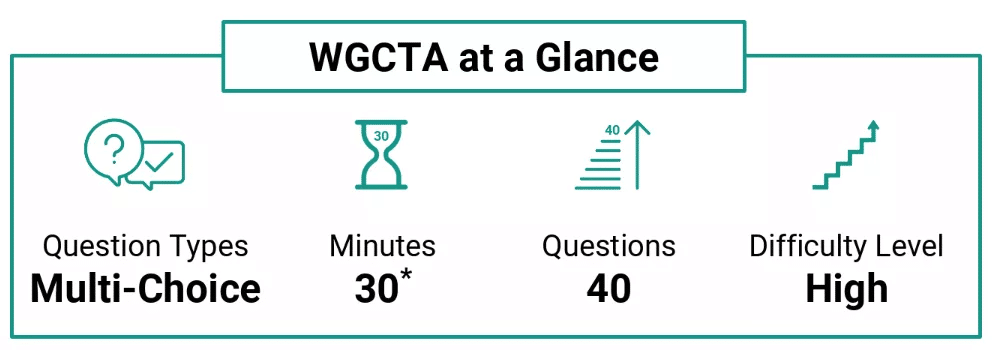
Both assess the same core critical-thinking skills, but they’re typically delivered differently. Watson-Glaser III (WG III) is often administered online and may draw from a larger item bank, so candidates may not see the exact same questions. Watson-Glaser II (Forms D & E) uses fixed forms (D or E) with a set question set per form. In both versions, timing and proctoring are determined by the employer or test administrator, and accommodations may apply where required.
A good score on the Watson-Glaser Test depends on the employer, role, norm group, and selection process. Many organizations use percentile or norm-referenced results rather than a universal raw percentage, so there is no single 75%–85% target that applies to all candidates. Note that the scoring system takes into account the level of difficulty of each question—incorrectly answering easy questions or correctly answering difficult ones has higher significance on the final score.
The Watson-Glaser test is difficult, especially for individuals who aren’t familiar with the question types in the test. Familiarizing oneself with the test through practice tests will make it easier to move through the test quickly, and the tips and tricks available through most practice test companies will help you quickly answer questions.
The most important thing you can do to pass a critical thinking test is to take a practice test beforehand. The practice test will familiarize you with the type of questions you can expect to see on the test, and help you understand what the test is measuring.
The test will measure your ability to do the following:
1. Draw Inferences
2. Recognize assumptions
3. Think critically and logically interpret information
4. Draw conclusions based on given facts
5. Evaluate arguments as weak or strong
The test is divided into 5 sections:
1. Inferences: In this section, you will be provided with possible inferences and asked to rate each one as True, Probably True, Insufficient Data, Probably False, or False.
2. Recognition of assumptions: In this section, you will encounter assumptions-based questions.
3. Deductions: You will be asked to make deductions using the information from the passage. Given a few proposed conclusions, you will be asked to decide for each if it “follows,” or “does not follow” the passage’s logic.
4. Interpreting information: In this section, you will need to interpret information from the questions to decide if each conclusion is based on the given information or not. Your answer should be based solely on the provided information and not on prior knowledge which may mislead you.
5. Analyzing arguments: To examine arguments, you will have to assess whether the provided statement is strong or weak.
Watson-Glaser includes 40 multiple-choice questions. The time limit is set by the employer and test setup, so it can vary (often around 30–40 minutes).
Watson Glaser is a critical thinking test. Critical thinking is considered a crucial factor because candidates who possess this trait are often good decision-makers and arrive at informed, precise, and objective conclusions instantly. Solid decision making, problem-solving skills, and strategic thinking set the foundation for a successful candidate, organizations use these to screen and hire talented people. Companies utilize the Watson Glaser test to hire strong, dedicated employees who will go on to become future leaders. Taking Watson Glaser practice tests will help to effectively use information and make the right decision. This, in turn, will ensure passing the test.
No. The Watson-Glaser is not a licensing requirement for practicing law, but it is still commonly used in recruitment by some leading law firms, especially in the United Kingdom. Requirements, target scores, and whether Watson-Glaser is used vary by firm and application route. The UK Bar Standards Board abolished the BCAT requirement from 31 July 2022, so candidates should check their firm or training-provider instructions.
Watson-Glaser is commonly administered as a timed test. The time limit is set by the employer and test setup, so it can vary. In many cases, you’ll have around 30–40 minutes to complete 40 questions.
The best way to prepare for the Watson Glaser test is with the types of questions you will find on the real test. You should use a prep course, such as iPrep, that will prepare you for the critical thinking questions that appear on the Watson Glaser test, and not on general critical thinking tests, as they differ.
The best way to beat the Watson Glaser test is to prepare yourself in advance, using a similar environment to best simulate the experience. If you are taking the timed version, make sure to time yourself so you can figure out which questions you need more time to answer and which questions you can breeze through.
Many different companies and law firms may use Watson-Glaser or similar critical-thinking assessments to evaluate candidates. Use varies by employer and intake, so check the current application instructions for your target organization.
Watson Glaser Test Tips
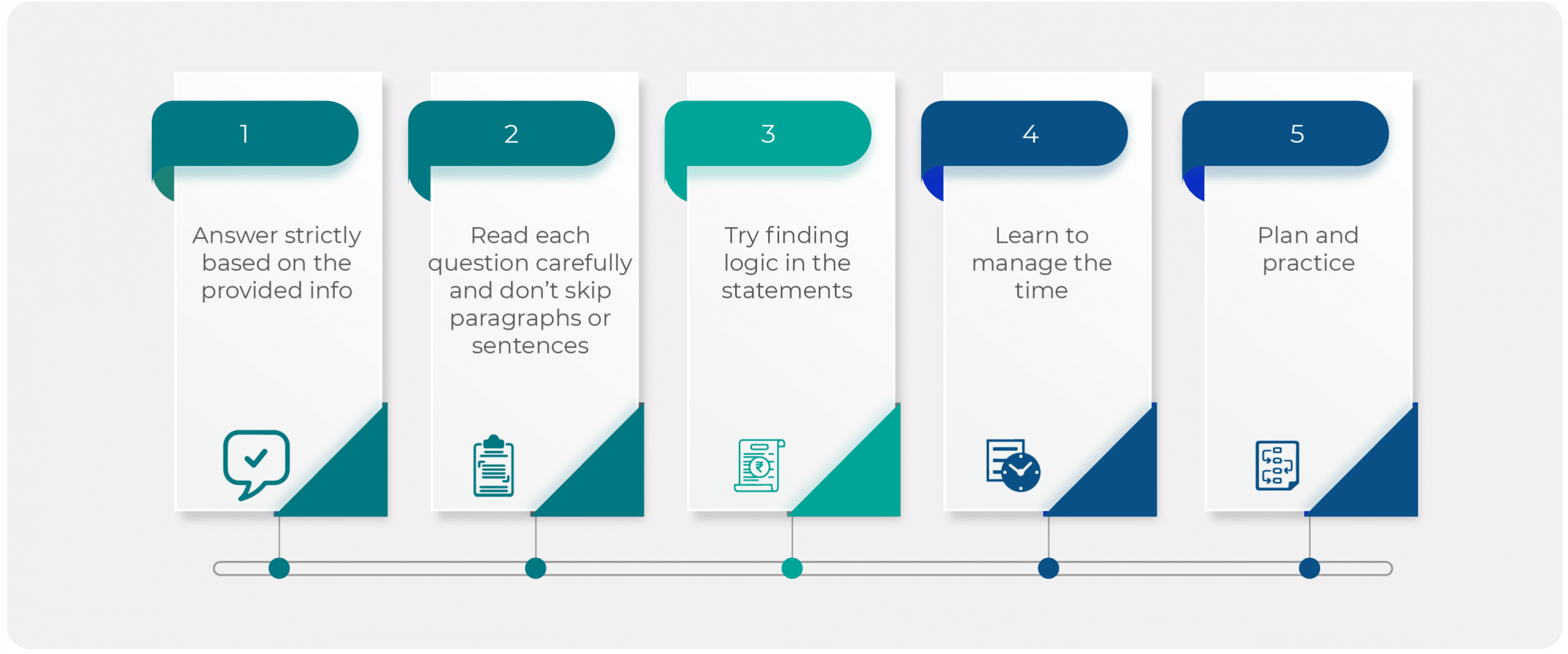
1. Answer strictly based on the provided info
Answer each question solely based on the conditions and facts provided in the question, and not by using your own industry knowledge.
2. Read each question carefully and don’t skip paragraphs or sentences
You might encounter long questions which you may be tempted to skim through. Don’t! By quickly scanning the question, you may miss valuable information you will need to get the right answer. Read thoroughly and then make your decision.
3. Try finding logic in the statements
Answering each question in the Watson Glaser test requires finding a logical connection between the statements. Analyze the statements and try to find logic between them.
4. Learn to manage the time
Since there will be both long and short questions, the time spent on each question is difficult to assess in advance. However, through practice, you should know how to manage time without skipping any question. Learn to pace and compete with time.
5. Plan and practice
Lastly, to ace any test, precise planning and continuous practice are a must! Therefore, practice as many questions as you can beforehand.
Administration
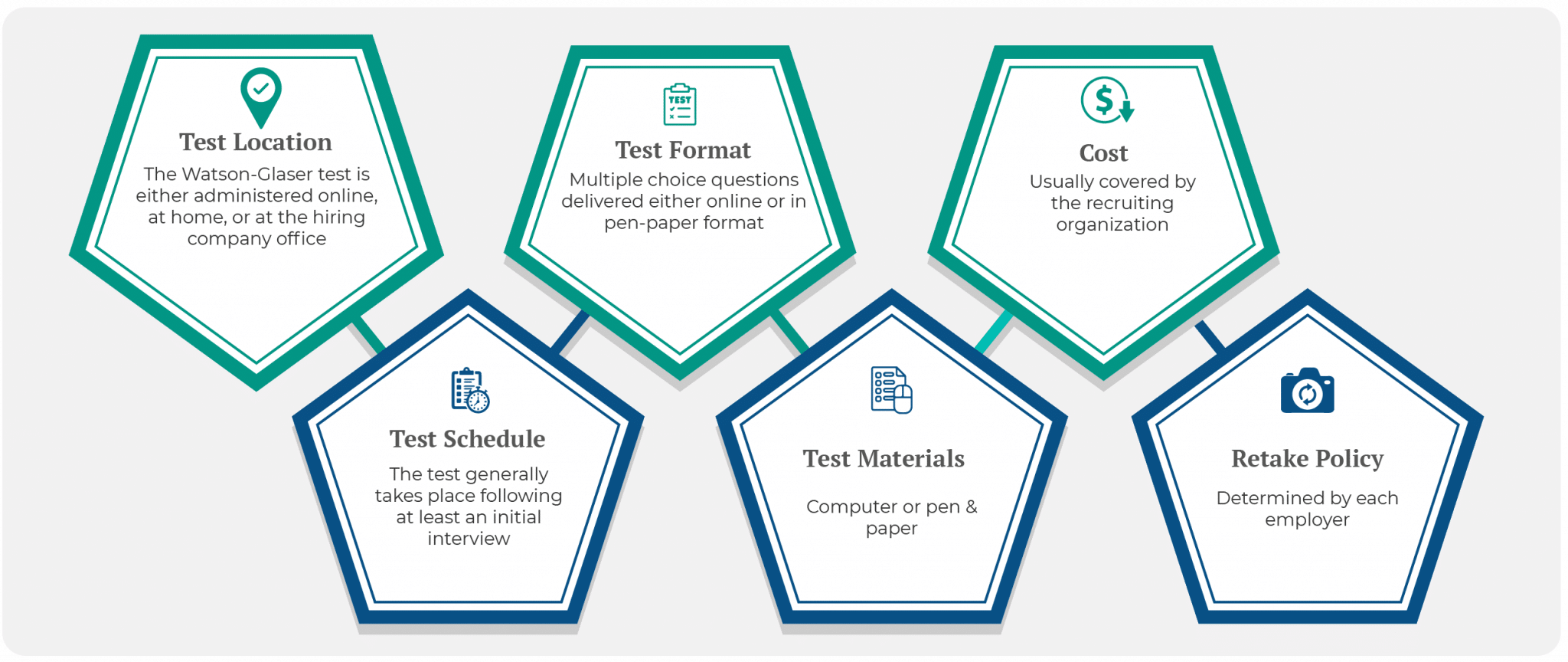
Test location: The Watson-Glaser test may be administered online (including remotely at home via a link sent to the candidate) or onsite at the employer’s office or a designated test location.
Test schedule: The test is typically used during the hiring process, often after an initial screening or interview.
Test format: Multiple-choice questions delivered online or on paper, depending on the employer/test administrator and the Watson-Glaser version used.
Test materials: Computer (for online testing) or pen & paper (for paper-based testing).
Cost: Usually covered by the recruiting organization.
Retake policy: Determined by each employer.
Test Provider
The Watson-Glaser test is owned and published by Pearson, one of the largest educational organizations in the world. It is part of the Pearson Talent-Lens portfolio, which focuses on pre-employment talent assessment and employee growth. The test was initially developed by Goodwin Watson and Edward Glaser.
With more than 80 years of experience in the assessment field, Pearson’s Clinical Assessment group offers innovative and comprehensive products and services. Some of the company’s brands include the Wechsler and Kaufman families of products, MMPI, BASC, OLSAT, CELF, and PLS. Pearson serves 300,000 customers in the U.S. with assessments for psychologists, speech-language, pathologists, occupational therapists, and related professionals.
Information Sources
Disclaimer – All the information and prep materials on iPrep are genuine and were created for tutoring purposes. iPrep is not affiliated with Pearson’s Clinical Assessment Group, which is the owner of the Watson-Glaser test.
Free Watson-Glaser Practice Test
Start with free Watson-Glaser practice test questions that give you a clear feel for the critical thinking skills measured on the real assessment. The free practice introduces common Watson-Glaser-style tasks such as drawing inferences, recognizing assumptions, making deductions, interpreting information, and evaluating arguments.
Use the free practice to understand the question format, pacing, and level of reasoning required before moving into full preparation. For complete practice, iPREP’s full Watson-Glaser course includes realistic practice questions, detailed explanations, video lessons, and targeted practice for the main Watson-Glaser question types.
Question 1 of 5
First Type – Inference
There are three general groups of countries that show the relationship between personal income and happiness levels. In some countries (such as Germany), both personal incomes and happiness levels have increased at the same rate over the past 10 years. In others (such as China), personal incomes have doubled over the past decade, but average happiness has increased by only 0.43 points. In 43 countries (including India and the US), incomes have risen, but happiness levels have declined.
Inference – The happiness level in some countries can be higher or lower than in others with the same personal income levels.
- True
- Probably True
- Insufficient Data
- Probably False
- False
The correct answer is Probably True.
Given that the relationship between personal incomes and happiness levels is shown to have three different correlations, it is probably true that countries with the same personal income levels can be correlated with both those with higher and lower happiness levels. Though one cannot infer this with complete certainty, given that the evidence does not enable such as definite inference, there is sufficient evidence here of the three different correlations between income levels and happiness to make it probably true that these correlations include the possibility given here.
Question 2 of 5
Second Type – Recognition of Assumptions
Statement: “Those companies that are especially vulnerable to high levels of cyberattacks should invest more in data security, either internally or by bringing in external experts.”
Proposed Assumption – Companies that are especially vulnerable to high levels of cyberattacks do not invest in data security.
- Assumption made
- Assumption not made
This assumption is not made.
The recommendation of the need to “invest more in data security” does not require the belief that companies do not already invest. It is just that they need to invest more.
The negative test shows that, since the negative version isn’t a problem for the statement, this is not assumed.
Companies that are especially vulnerable to high levels of cyberattack do invest in data security.
Question 3 of 5
Third Type – Deduction
Premises: If resources are used to limit future global warming, then spending on current welfare is reduced. If we reduce spending on current welfare, then people’s well-being will be lower. So, if we use current resources to limit future global warming, …
Conclusion – The risk of global warming will be reduced.
- Conclusion follows
- Conclusion does not follow
This conclusion does not follow the premises.
The structure of the premises is “If A, then B. If B, then C. So, if A…” This must lead to “…then C.”
This diagram represents a plausible organization of groups A, B, and C:
“The risk of global warming will be reduced” is not equivalent to C, being a further claim, such that it becomes D.
Question 4 of 5
Fourth Type – Interpretation
Economic forecasters tend to perform well with three-four-month predictions, but become much less successful beyond this timescale, especially with 22 months or more. The biggest errors occur ahead of economic contractions. This is because, though economies normally have steady but slow growth, when they contract, they do so sharply.
Conclusions – Not considering economic contractions risks overstating the possible growth of economies.
- Conclusion follows
- Conclusion does not follow
This conclusion follows beyond a reasonable doubt from the premises.
Given the explanations for why errors in economic forecasting are made, the evidence is sufficient for this conclusion to be drawn, since economic predictions based on the normal “steady and slow growth” of economies will be inaccurate unless contractions are taken into account. In this way, the evidence is sufficient for this conclusion to be drawn beyond a reasonable doubt.
Question 5 of 5
Fifth Type – Evaluation of Arguments
Question: Should all those aged 22-45 be required to save at least 5% of their income in a public savings plan?
No; people aged over 45 would also benefit from saving.
- Argument strong
- Argument weak
This argument is weak.
This does not give a relevant reason against the proposal as such but is more of a reason to extend it. As such, it is not an important issue for the argument itself.
About the course
Includes 15 practice tests (5 full-length simulations)
20 Learning hours · 15 Practice tests · 650 Questions · 200 Videos
This course prepares you for the Watson-Glaser III (WG-III) by teaching the rules behind each question type, then building skill through targeted drills. You’ll practice treating passage statements as true, avoiding outside assumptions, and choosing the best-supported option. The course finishes with full simulations and a structured review process to help you spot recurring patterns in your reasoning.

Skills you will learn
Inference · Recognition of Assumptions · Deduction · Interpretation · Evaluation of Arguments
Curriculum
Course Introduction
- Pre-Course Assessment — timed, practice, enhanced
Section 1: Understanding the Watson Glaser III
- What the test measures
- Question types and answer rules
- Given facts vs outside knowledge
Section 2: Mastering Critical Thinking Skills
- Inference — rate likelihood from given facts
- Recognition of Assumptions — spot unstated premises
- Deduction — decide if conclusions must follow
- Interpretation — warrant beyond reasonable doubt
- Evaluation of Arguments — judge strong vs weak
Section 3: Test-Taking Strategies
- Pacing across mixed question types
- Avoid overreach and common traps
- Stay strict to the instructions
Section 4: Practice Tests and Feedback
- Mock Tests — full simulations, multiple modes
- Post-Test Analysis — review patterns and errors
Course Conclusion
- Final review and readiness checklist
Appendix – Glossary of Key Terms
- Key WG-III terms and definitions
Reviews

Engle K*****
April 24, 2026 at 5:52 AM
If it was not for the study prep, I’m sure I would not have passed the exam. The study tips, the practice exams were spot on.
Lamyae A*****
August 8, 2025 at 2:50 PM
The French version is so poor, it seems to be translated word by word from EN to FR, I do not recommend for French people,
Nick W****
May 23, 2025 at 1:47 PM
Very helpful. Breaks each questions down. Did find some mistakes in the answers vs questions, so I submitted error reports.
Chad M*****
November 2, 2024 at 12:34 PM
Excellent course. I highly recommend completing before taking your Watson Glaser test. The instructions and explanations are easy to follow.
Keigan P******
October 22, 2024 at 9:38 PM
this is a great resource to have in preparation for the exam. i purchased this one day before I took the exam and I got a great score after completing the full study guide. thank you iPrep!
Richard J******
October 17, 2024 at 8:42 PM
After researching the competition., I determined this is the most comprehensive course available. I highly recommend using iPrep. They're the best price too!
Ibrahim O****
September 25, 2024 at 12:17 PM
This is a very comprehensive course, it definitely helped improve my understanding of the test and my results, highly recommended.
Adithi A*******
August 14, 2024 at 11:47 AM
I think this course is harder than the actual Watson Glaser test. Hopefully, I will be able to ace the test, considering the scores I am getting in these practice tests.
Nitin B****
April 21, 2024 at 11:55 PM
The lesson plan sample questions are analyzed in great detail giving you the confidence of assessing the choices. If you follow the logic you will do well in the final test
Pritam D**
January 29, 2024 at 10:32 AM
Awesome Experience. I really like the material provided in the course. Hope it will help me acing upcoming Watson Glaser Test.