Reviewed by Tamir Rubin, Head of Product at iPREP • Updated February 2026
Topics Covered
High-level content areas
- Attention, inhibition, and impulse control
- Risk tolerance and reward tradeoffs
- Working memory and recall accuracy
- Learning adaptability across changing rules
- Planning strategy under time pressure
- Emotion recognition from faces, brief stories
- Trust, fairness, and altruistic choices
Test Duration
Total time: varies by employer (often up to ~35 min)
Each game typically lasts 1–3 minutes; full required sets are commonly about 25 or 35 minutes including instructions/registration. Confirm whether your invitation includes additional required games and/or steps.
Test Breakdown & Sample Questions
What you’ll take
- Core Pymetrics Assessment (most candidates):
12 short, game-based tasks that measure work-relevant cognitive and behavioral traits (for example, attention, risk tolerance, learning style, and decision-making). - Optional Add-On (only in some hiring processes):
4 Pymetrics Numerical & Logical Reasoning Games
These are separate from the core 12 games, and most candidates are not asked to complete them.
What the games measure
The assessment builds a profile based on your gameplay patterns—how you approach tasks and make decisions—so employers can compare candidates in a consistent way.
Scoring and results
- No traditional “test score”: Pymetrics isn’t graded like a standard exam with one numeric score. Instead, your gameplay is analyzed and summarized into a profile.
- Results timing varies: In some processes you may see a report after completing the games, while in others results are shared later (or only with the employer).
Pymetrics 12 Core Games
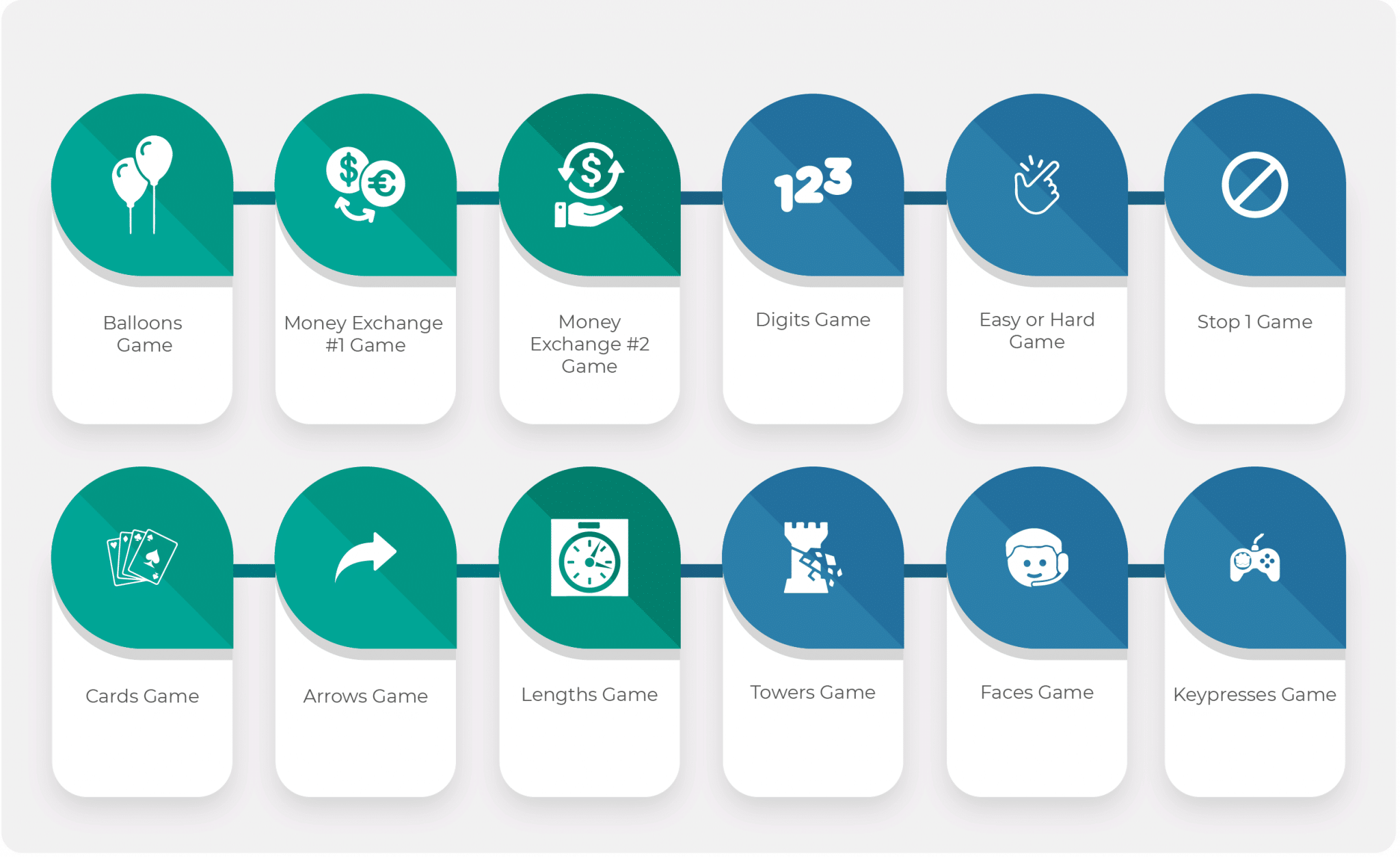
If you are reading this, you’re likely about to take the pymetrics test, an engaging set of 12 mini-games, each taking only 2 to 3 minutes to complete. In total, you’ll spend about 20 to 30 minutes playing. Each game has its own unique goal and measures specific traits to understand your strengths and personality. These fun, interactive games focus on assessing your emotional and cognitive attributes to pinpoint jobs that fit you perfectly. The results of this test remain valid for 330 days. So give it your best shot the first time around, as many employers will have access to your performance.
| Game Name | Description | Assessed Traits |
| Balloons | Pump balloons to accumulate money. If they pop, the money is lost. Your goal is to gather as much money as possible. | Risk tolerance, decision-making, pattern recognition |
| Money Exchange #1 | Engage in a monetary transaction with an AI-based partner | Trust, risk tolerance |
| Money Exchange #2 | Engage in another monetary transaction with an AI-based partner | Altruism |
| Digits | Memorize and recall ever-growing sequences of digits – how many digits can you remember? | Memory, retention |
| Easy or Hard | Choose between easy and hard tasks, each with corresponding rewards. Aim to earn as much money as possible while exerting a reasonable amount of effort. | Motivation, effort, strategic decision-making |
| Stop 1 | React to the red stimulus and avoid reacting to the green stimulus. | Attention span, reaction time, task switching |
| Cards | Draw cards that carry rewards and penalties from four different decks, aiming to end the game with the maximum amount of money. | Risk affinity, pattern recognition, learning ability |
| Arrows | Identify the direction of specific arrows based on their color and pattern formation. | Learning, adaptivity, attention |
| Lengths | Decide if the smile on each face icon is long or short. | Attention to detail, motivation, learning ability |
| Towers | Arrange disks on three poles to match a target image, using the fewest possible moves. | Problem-solving, planning abilities |
| Faces | Identify the emotion conveyed by a person’s facial expression, taking into account any accompanying story. | Emotional intelligence, perception |
| Keypresses | Repeatedly press the spacebar key as quickly as you can. | Ability to follow instructions, impulsivity, motor function |
Now, let’s take a look at every game individually to better understand what they are all about –
Game 1 – Balloons Game
What’s the Task
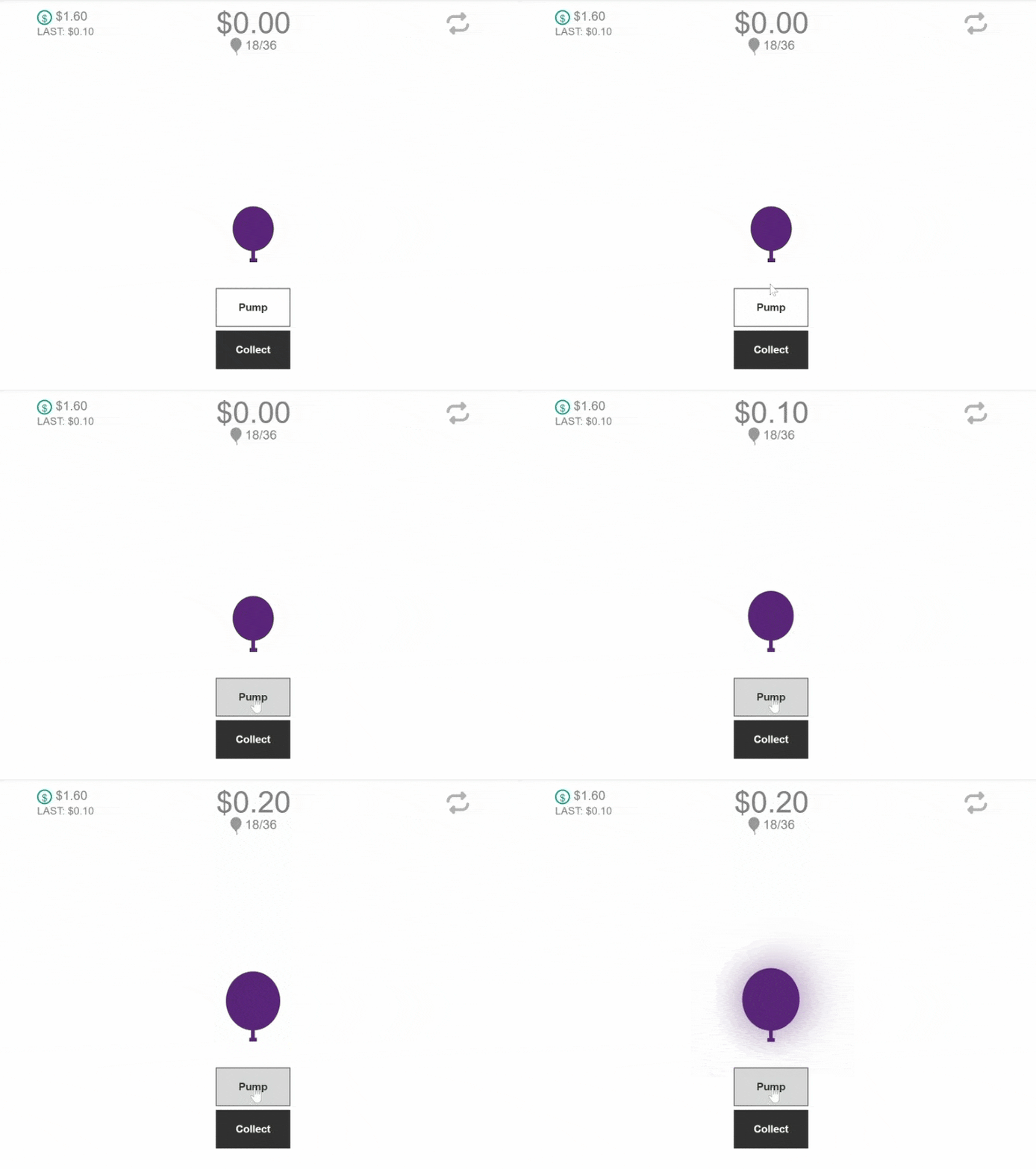
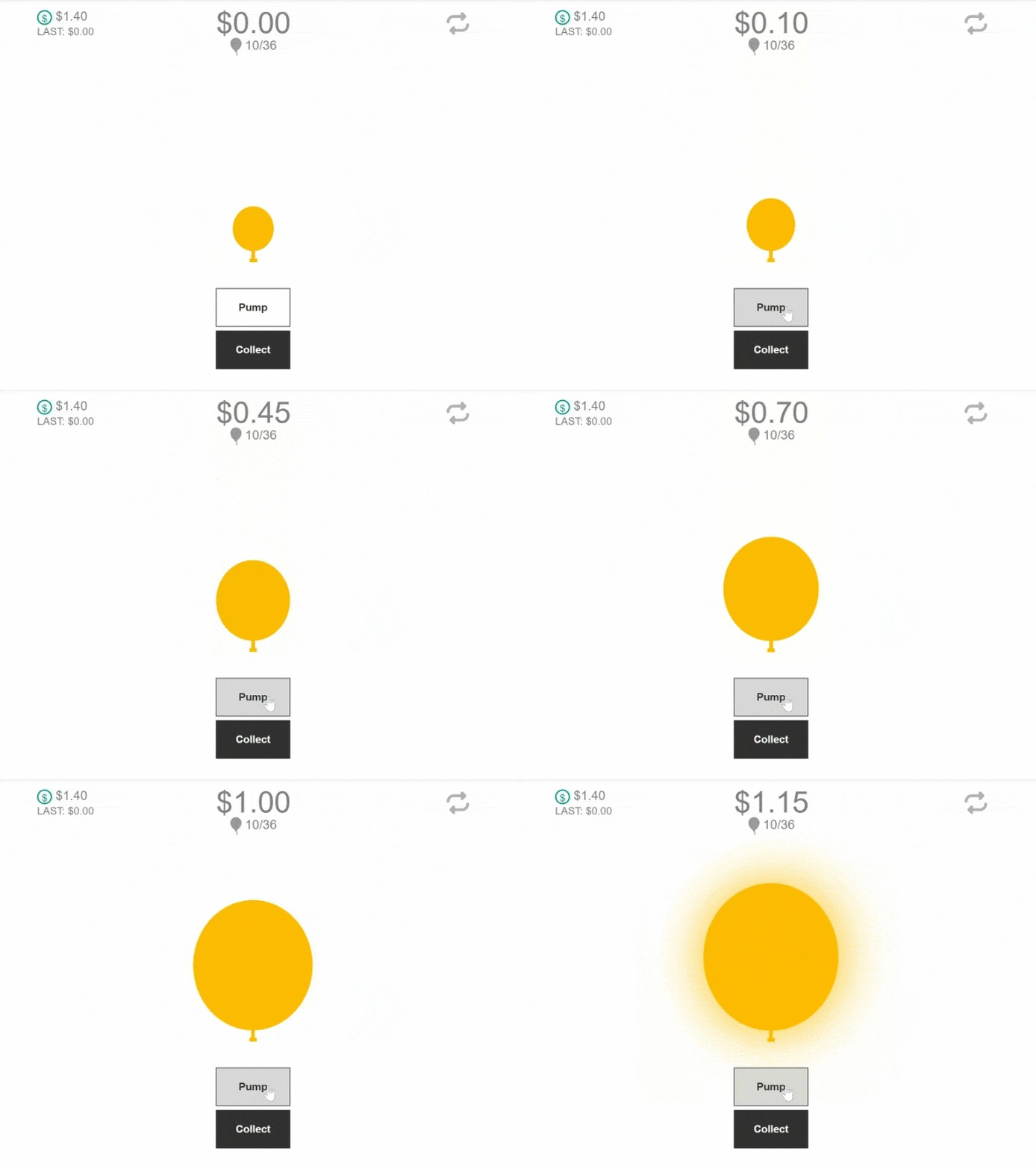
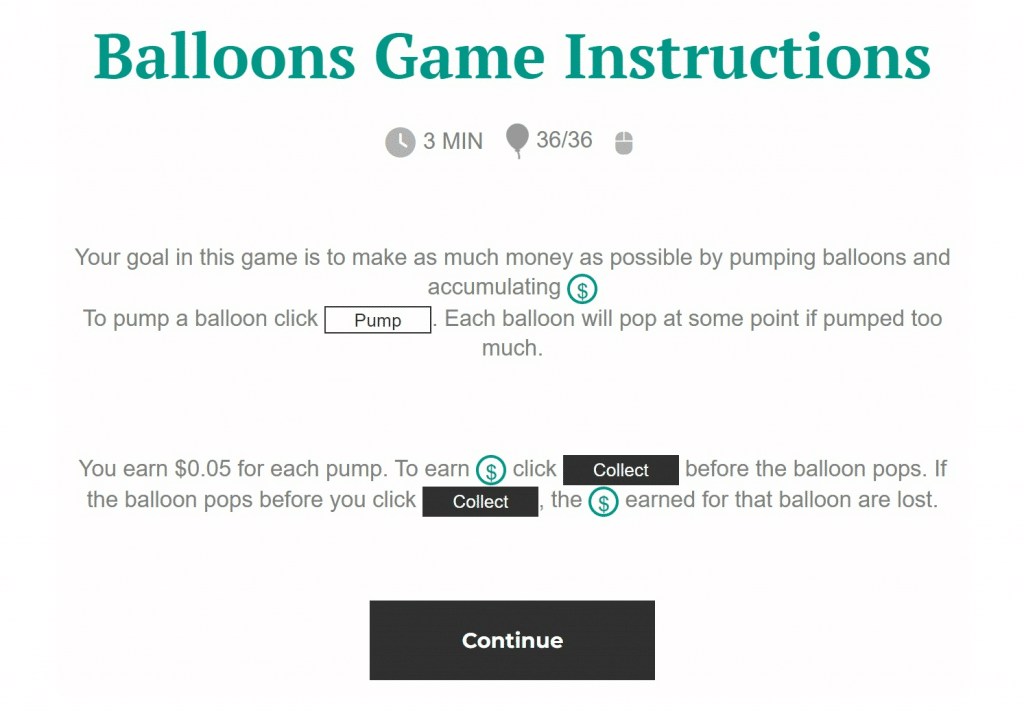
Maximize Your Earnings: In this game, your goal is to inflate balloons to earn money. Each pump increases your potential earnings but also raises the risk of the balloon exploding. The key is knowing when to stop and collect your earnings before a balloon pops.
Some balloons might pop just after a couple of pumps
Other balloons may significantly inflate before popping
Your goal is to find the sweet spot and collect your earnings on time
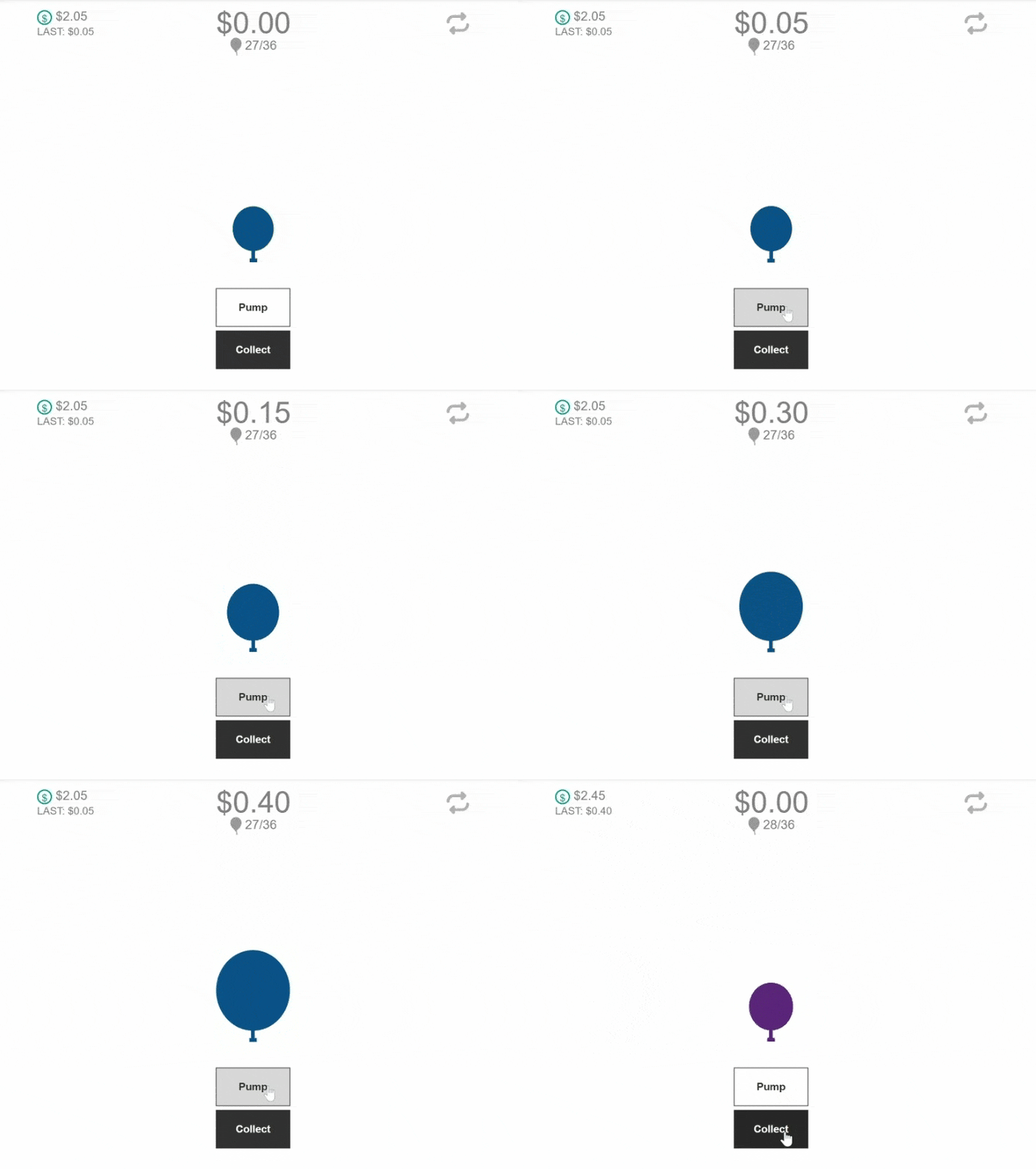
Pymetrics-Style Balloons Game Sample Screens, by iPREP.
Skills You’ll Showcase
- Your Risk-Taking Ability: This game will assess your knack for balancing the risk of bursting balloons against the potential rewards.
- Your Learning and Pattern Recognition: It measures how quickly and effectively you can identify and adapt to the varying explosion probabilities of different colored balloons.
Strategies and Career Implications
- Understanding Explosion Probability: Mastering this reveals your strategic thinking skills, crucial for roles in areas like project management or entrepreneurship.
- Balancing Risk and Reward: How you manage this balance in the game mirrors decision-making skills needed in high-stakes environments like investment banking.
- Adaptation and Learning: Your ability to quickly adapt to the game’s nuances reflects the learning agility important in dynamic industries, such as technology or consulting.
- Aligning Your Risk Profile: The way you handle risk in the game can indicate your suitability for different professional roles, from high-risk areas in sales to more risk-averse positions in accounting.
How much money do you believe you could accumulate in this game? Test your skills with this free pymetrics-style Balloons Game and find out for yourself:
Game 2 – Money Exchange #1
What’s the Task
In the game Money Exchange #1, there are several steps:
- You are randomly paired with an AI-based candidate and must make certain transactions with him or her.
- You earn $5 when the game starts as does your partner.
- Then one partner is given an additional $5 at random.
- The partner given the money will have the option to transfer some of their money to their partner.
- Next, your partner sends you back an amount of money of their choosing.
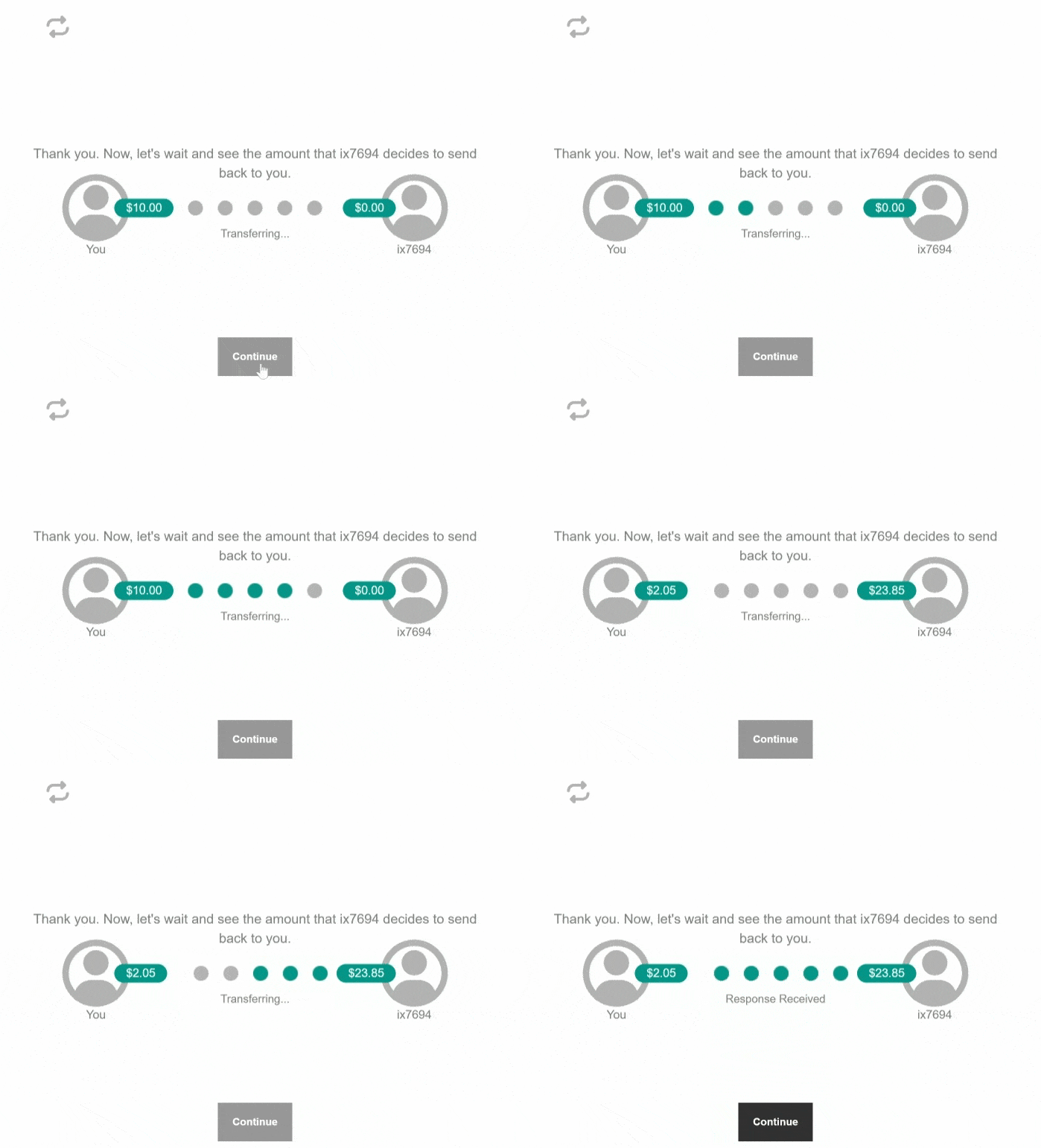
Pymetrics-Style Money-Exchange Game Sample Screen, by iPREP.
Skills You’ll Showcase
- Trust Evaluation: Your decision to share a certain amount reflects your level of trust and comfort with uncertainty.
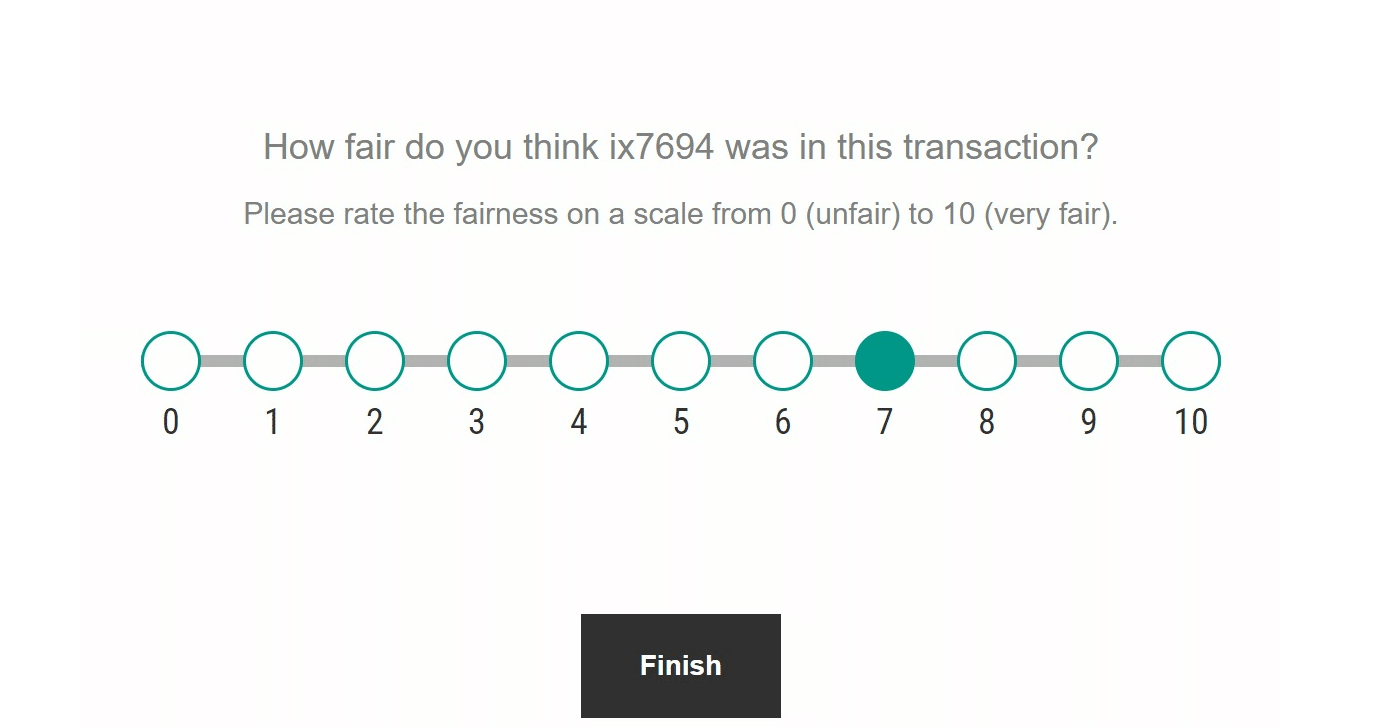
- Fairness Perception: How you perceive the returned amount – whether as fair or unfair – further illuminates your trust levels and expectations of reciprocity.
Strategies and Career Implications
Here are some examples of donations and fairness ratings and how they may reflect on your job suitability:
- Low Donation with Unfair Fairness Rating: Indicates a cautious approach, suitable for meticulous roles like auditing, but consider the benefits of occasional collaboration.
- Average Donation with Balanced Fairness Rating: Reflects a balanced trust level, aligning with strategic or negotiation-focused roles.
- High Donation with Fair Rating: Shows high trust and openness, ideal for leadership or team management positions, though it’s wise to maintain a degree of skepticism.
Game 3 – Money Exchange #2
What’s the Task
The Money Exchange #2 game has a similar interface and appearance to Money Exchange #1 but it has two rounds:
Round 1:
- The game pairs you with a random AI-based partner that you must transact with.
- You and your partner both have $5 at the start of the game.
- One of the players will receive an extra $5.
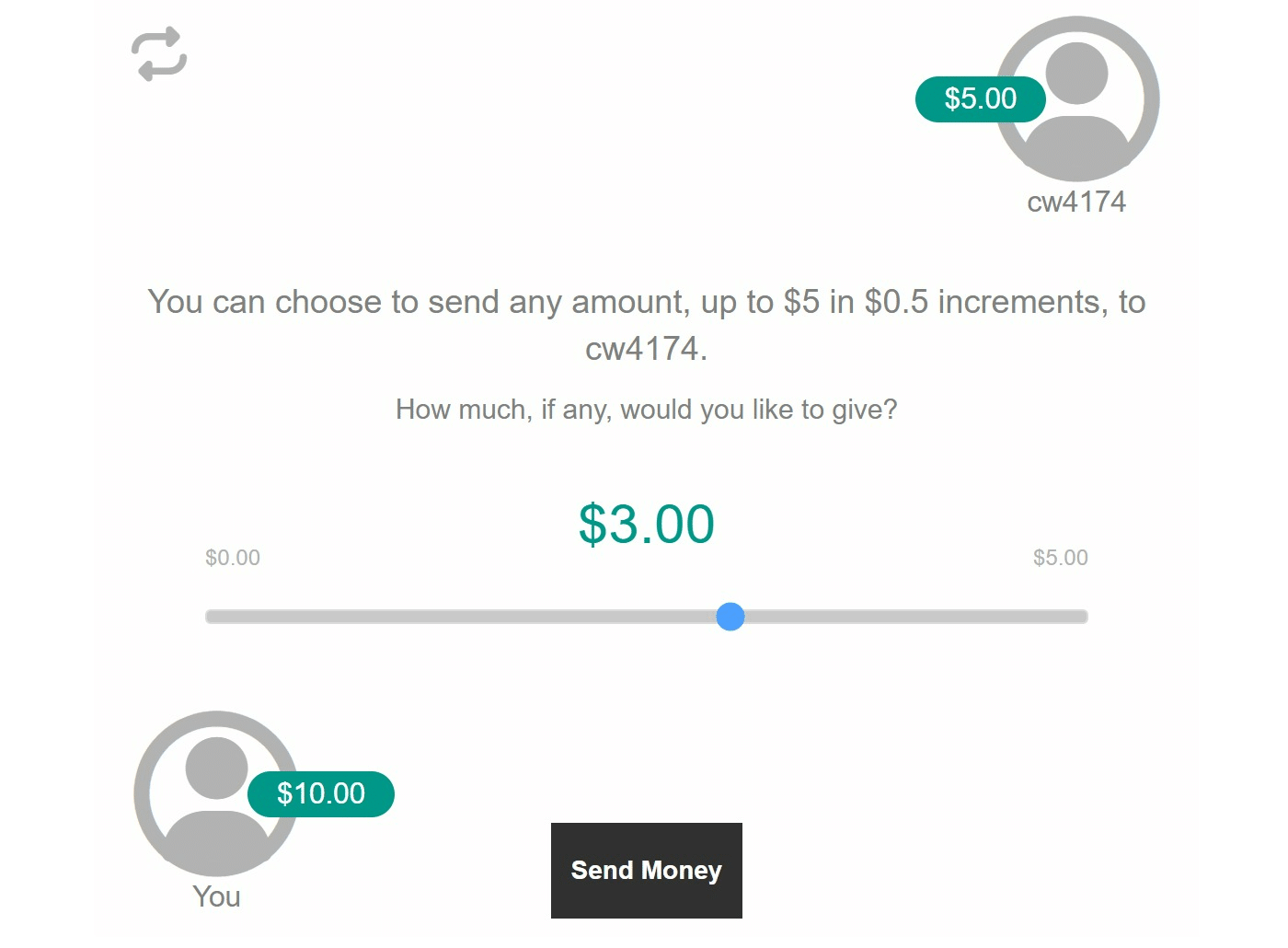
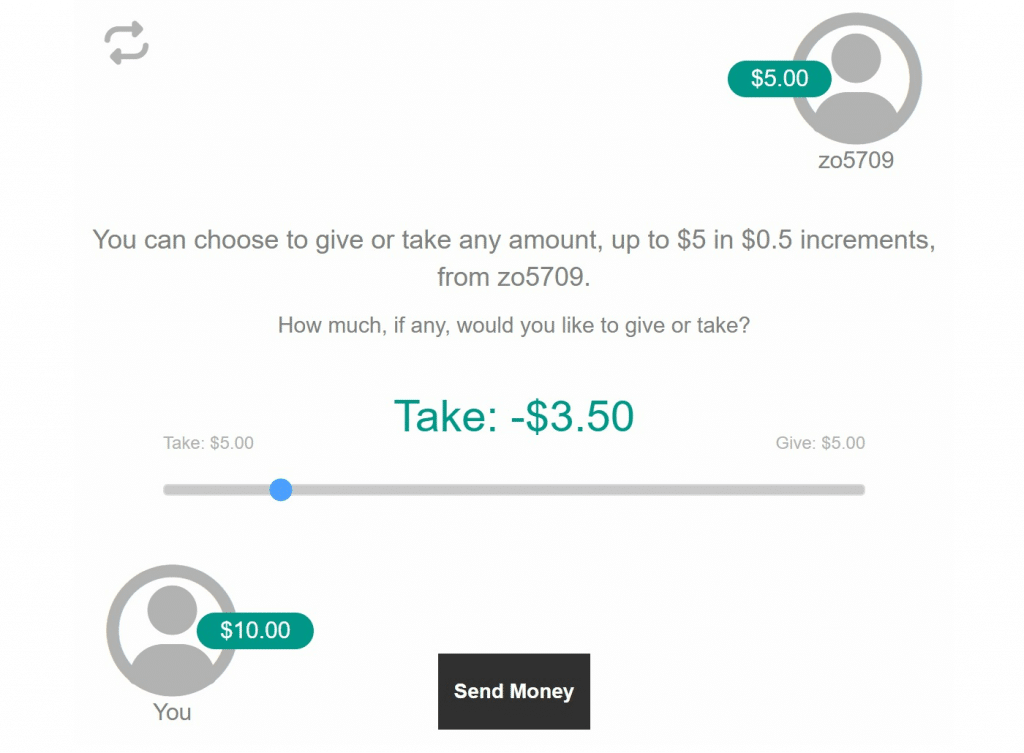
- That player will choose to donate money to their partner with a max limit of $5.
Round 2:
- In the second round, the entire scenario repeats itself, but this time, you are also given the option to take money from your partner.
Skills You’ll Showcase
- Altruism and Fairness Perception: Your choices reflect your level of altruism and how you perceive the fairness of transactions, particularly when given the power to take as well as give.
- Contextual Decision-Making: The introduction of the option to take in round two adds complexity, showing how your altruistic actions change in different scenarios. Your donation consistency across rounds reflects either a steadfast altruistic principle or adaptable decision-making based on context.
Strategies and Career Implications
- Low to Average Altruism: Suitable for roles requiring self-reliance and independence, like consulting, with a need for occasional collaboration.
- High Altruism: Indicates a fit for empathetic and selfless roles, such as social work or healthcare, while highlighting the importance of maintaining personal boundaries.
Game 4 – Digits
What’s the Task
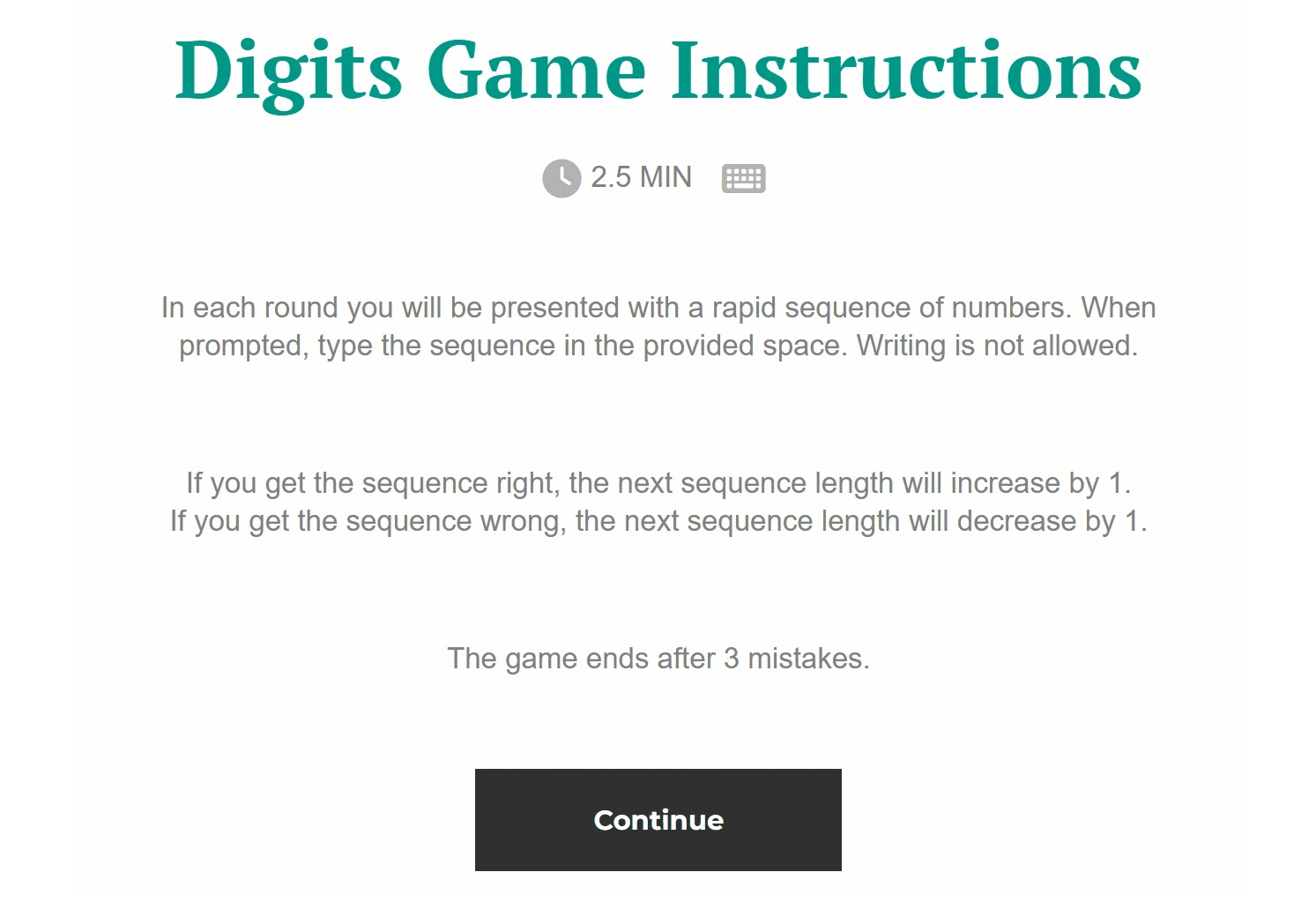
The pymetrics Digits game measures memory and retention. A sequence of digits quickly flashes across your screen. You must memorize them as well as you can. Once they disappear, you must recall and write down the digits in the correct order. Here is an example of a rather short sequence:

Pymetrics-Style Digits Game Sample Screen, by iPREP.
The number of digits increases by one in each round, progressively making the game more difficult. However, if you enter an incorrect sequence, the next round will feature one fewer digit. The game ends after three incorrect entries. Here is an example of an incorrect number entry. Do you think you could remember it?

Skills You’ll Showcase
- Working Memory: Your ability to remember and reproduce the digits in the exact order they appeared assesses your working memory, which is crucial for decision-making, problem-solving, and learning.
Strategies for Success
- Verbalization: Enhance memory retention by reading the digits aloud as they appear.
- Chunking: Group digits into larger units or ‘chunks’ to make them easier to remember.
- Game Pattern Recognition: Identify the pattern in which the digits appear to aid the memory recall process.
- Be Cautious of Writing: While writing down digits might seem like a good strategy, be aware that pymetrics may have the technology to recognize this method.
You might be curious about the longest sequence of digits you can remember. Don’t just guess – try this free pymetrics-style Digits Game sample and discover for yourself:
Game 5 – Easy or Hard
What’s the Task
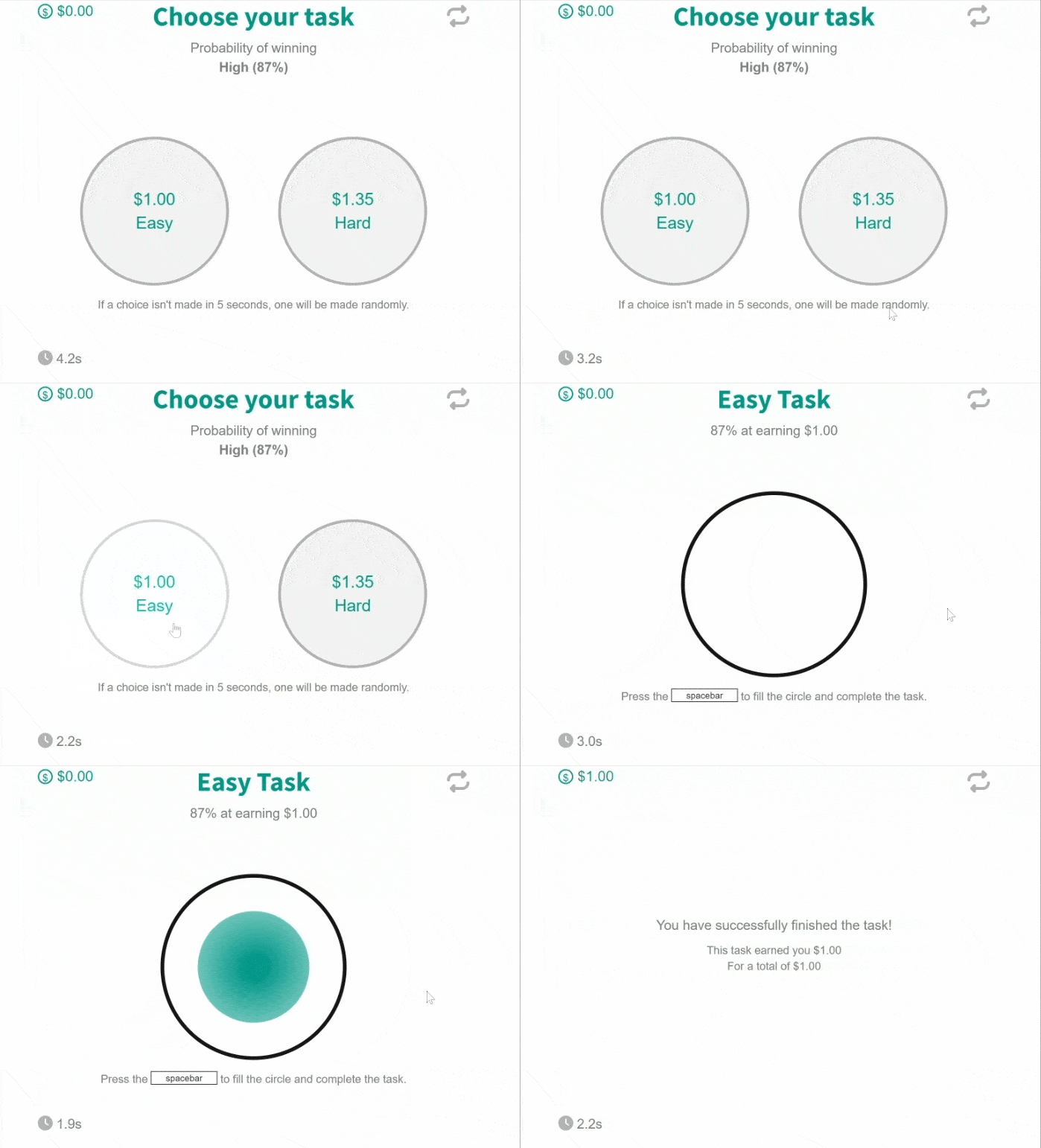
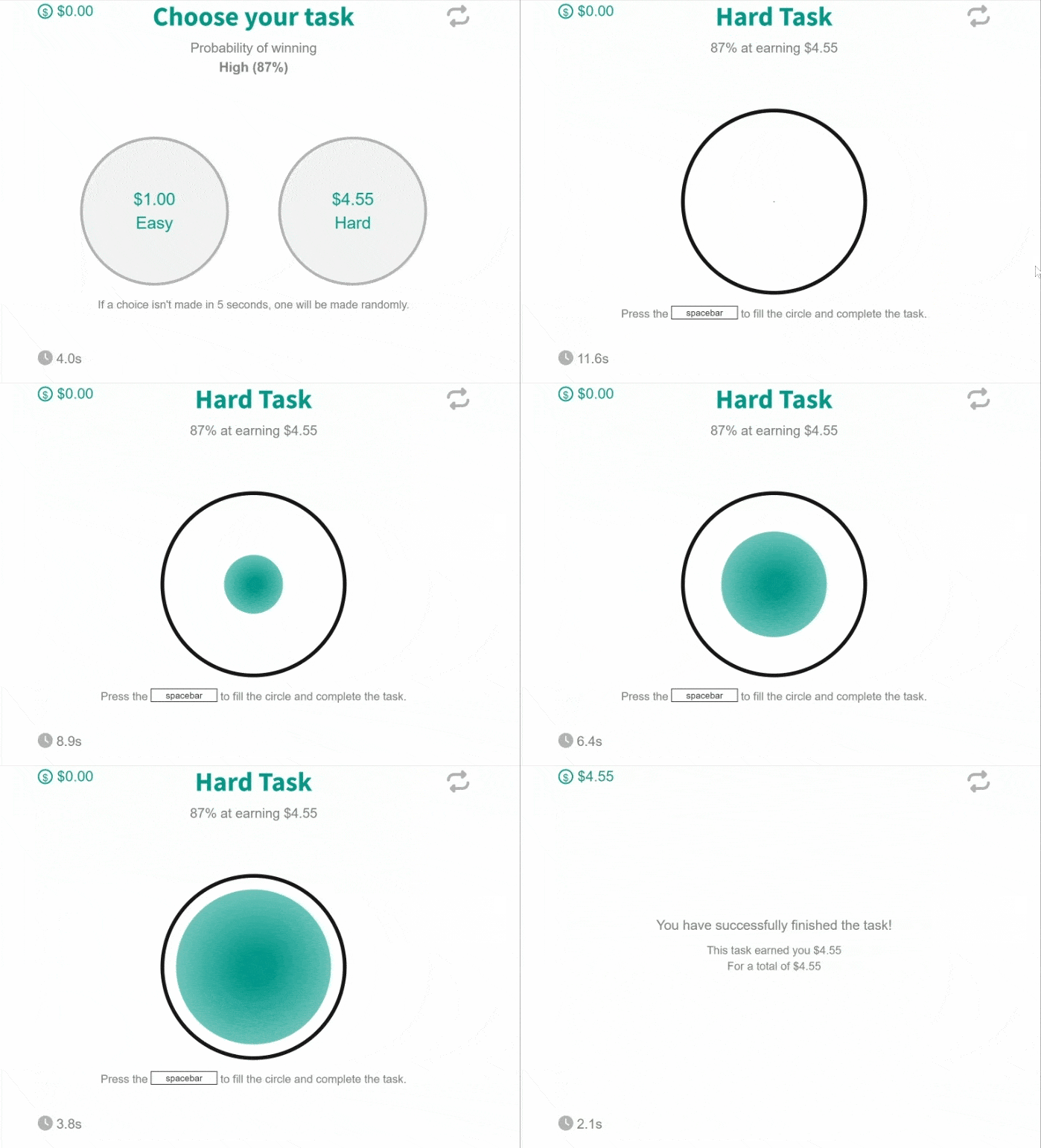
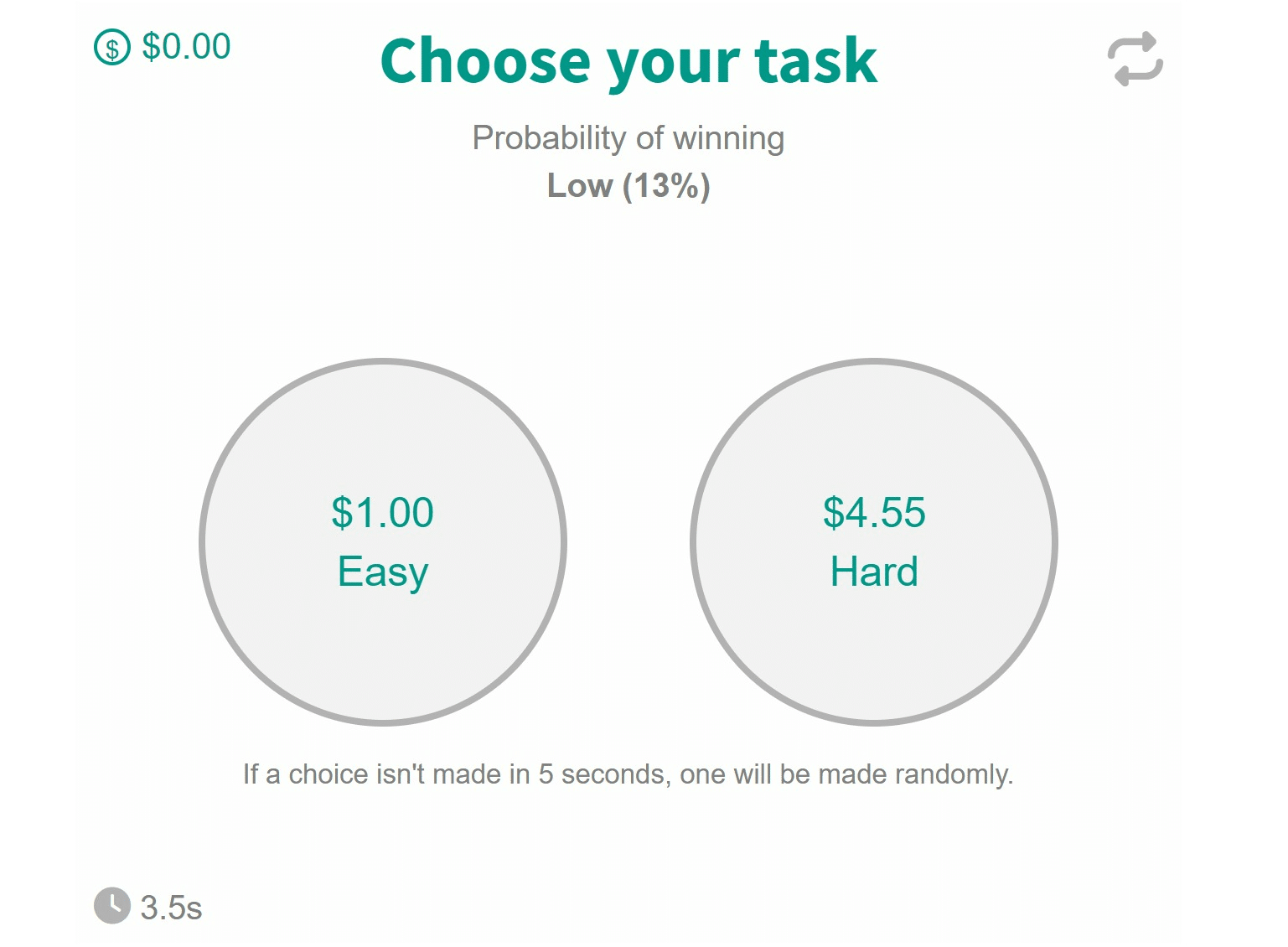
Choosing Your Task Wisely: In this 2-minute game, decide repeatedly between an Easy task and a Hard task. Your task choice and completion earn monetary rewards, with the Hard task offering more but at a higher risk of earning nothing if not completed in time.
Easy Task: Consistent throughout the game, requires pressing the spacebar five times in three seconds.
Hard Task: Also consistent throughout the game, involves pressing the spacebar 60 times in 12 seconds.
Variables Affecting Decision-Making
- Probability of Winning the Prize:
- This variable affects both the Easy and Hard tasks.
- The probability can be categorized as low, medium, or high.
- Monetary Reward for the Hard Task:
- The amount offered as a reward for completing the Hard task varies.
- The key consideration is whether the reward justifies the additional time and effort compared to completing multiple Easy tasks.
Strategic Question
- “Is it worth investing time in tackling the Hard task, or should you opt for completing many Easy tasks to maximize efficiency?“
What would you choose in a scenario where the hard task offers a high monetary reward but has a low probability of winning the money?
Strategies and Career Implications
- Understanding Task Dynamics: Recognize the time and reward associated with each task to make informed decisions.
- Examples of Task Selection Strategies:
- High-Stakes Challenger: Regularly choosing the Hard task, even under uncertain success rates, indicates a preference for challenging scenarios, suitable for roles requiring problem-solving and resilience, like R&D or entrepreneurship.
- Efficient Executor: Consistently opting for the Easy task for quick and steady gains shows efficiency, aligning with roles in fast-paced environments like operations or sales.
Game 6 – Stop 1
What’s the Task
The Stop-1 game is a test of your reflexes and focus. Your task is straightforward:
- Red Circle: Hit the spacebar immediately upon seeing it.
- Green Circle: Do nothing.
It sounds simple, right? But picture doing this for two straight minutes. Take a look at the gif below to get a sense of the game’s speed and the level of attention required.

Pymetrics-Style Stop 1 Game Sample Screen, by iPREP.
Skills You’ll Showcase and Career Implications:
- Focus: Your success rate in pressing for red circles and not for green ones measures your ability to stay focused and accurately follow instructions. A high score in Focus indicates strong attention to detail and the ability to concentrate on the task at hand — qualities valuable in roles requiring precision and meticulousness.
- Perseverance: How consistently you maintain or improve this success rate throughout the game assesses your perseverance, especially as the task may feel repetitive or challenging. Strong performance in perseverance may suggest the ability to maintain consistent performance over time, crucial in jobs where tasks can be monotonous or extended.
Game 7 – Cards
What’s the Task
Strategic Card Drawing: Engage in a unique challenge of drawing cards from four distinct decks, each with different odds of winning and losing. Your goal is to manage your initial $2,000 balance through strategic decisions, evaluating risk and reward with each card drawn.
Here’s an example showing how different decks can result in varying sums of winnings and losses:
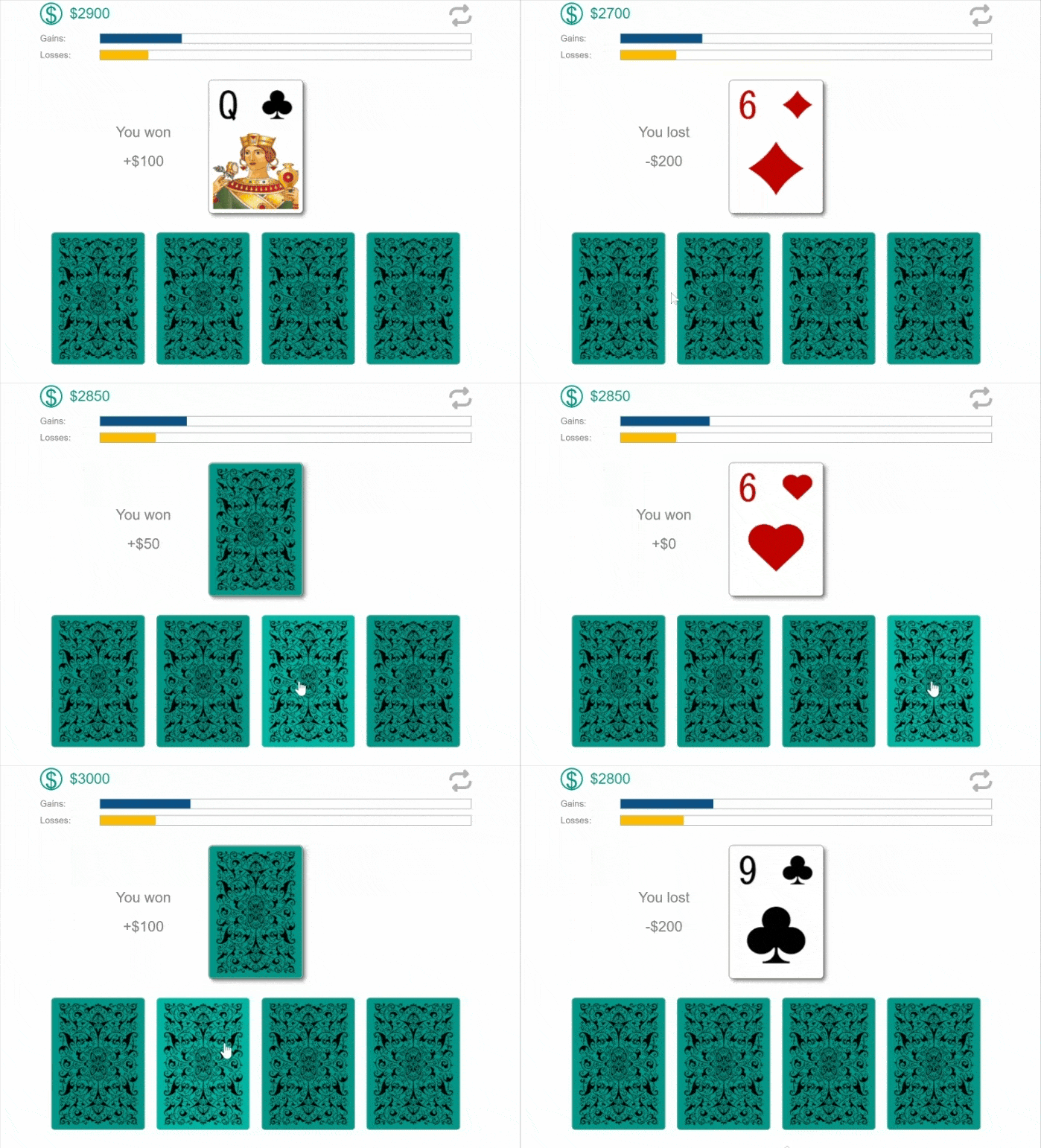
Pymetrics-Style Cards Game Sample Screen, by iPREP.
Skills You’ll Showcase
- Methodicalness: This trait is assessed by your tendency to stick with consistent choices or actions throughout the game.
- Risk Strategy: The game provides insight into your willingness to engage with risk for potential rewards.
Strategies and Career Implications
- Pattern Recognition & Deck Experimentation: Initially, draw from each deck to discern their distinct risk-reward profiles.
- Deck Preferences & Their Implications: Your preference for a particular deck reflects your approach to winning and losing probabilities. Consistently choosing one deck indicates a specific risk strategy, while experimenting with multiple decks shows adaptability and willingness to balance risk.
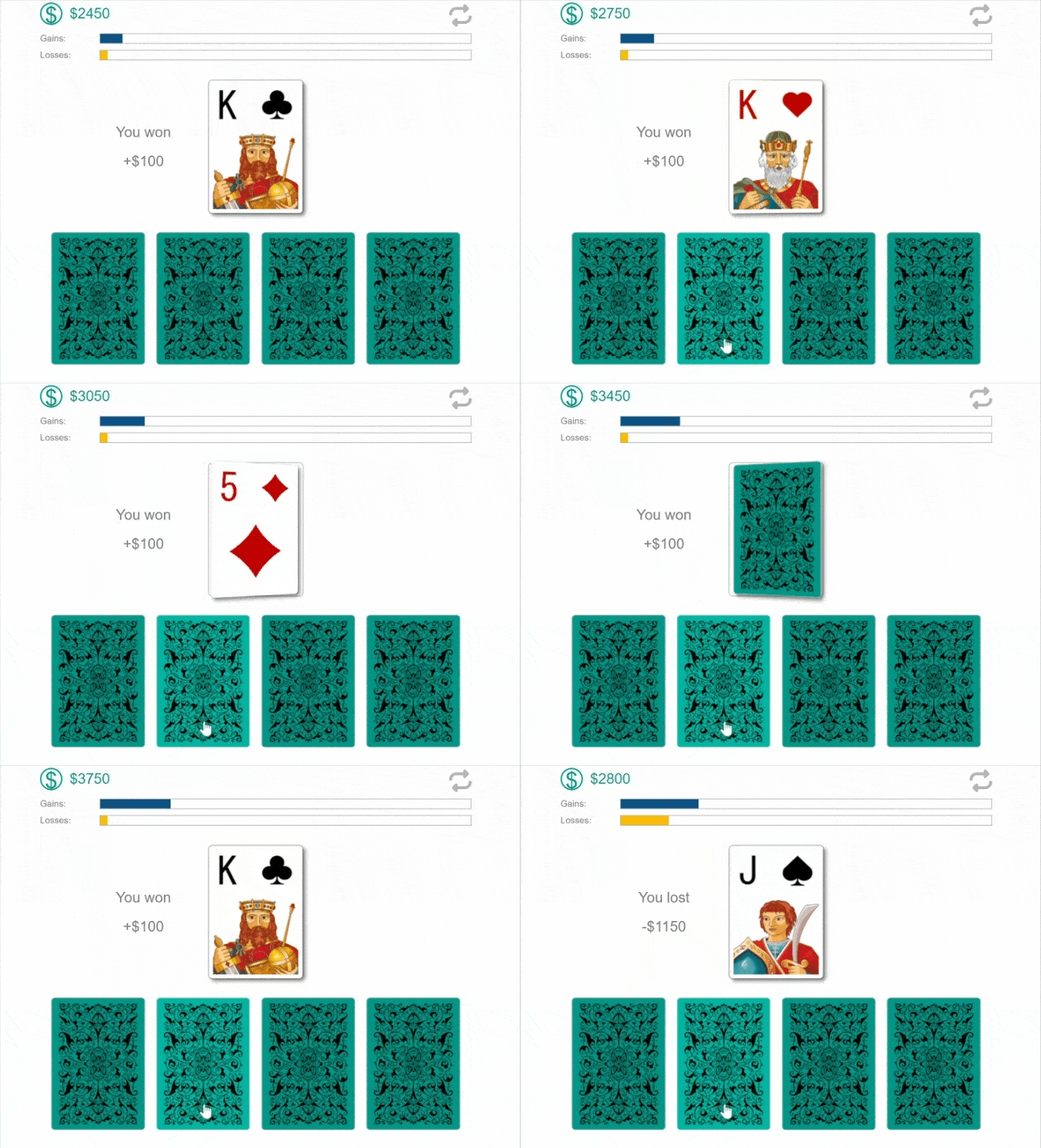
- Risk Affinity: The deck you frequently choose reveals your comfort level with risk. This preference can guide you towards careers that align with your risk-taking style, from high-risk environments like trading or start-ups to more balanced or stable roles in fields like marketing or government.
Here is an example of someone with a high-risk affinity: This individual embraces the slim chance of significant losses for the opportunity of a high probability to win large sums.
Game 8 – Arrows
What’s the Task
Rapid Response to Changing Stimuli: In this game, you’ll engage in a series of 135 arrow sequences. Each sequence requires quick and accurate responses based on the arrows’ color and direction, testing your mental agility. Use the keyboard arrow keys to indicate the direction of specific arrows, according to their color:
- Red Arrows: Press the arrow key that matches the direction of the side arrows.
- Blue or Black Arrows: Press the arrow key corresponding to the direction of the middle arrow.
Note that the center arrow may point in a different direction than the side arrows. In the image below, the relevant arrows are highlighted within a black box:
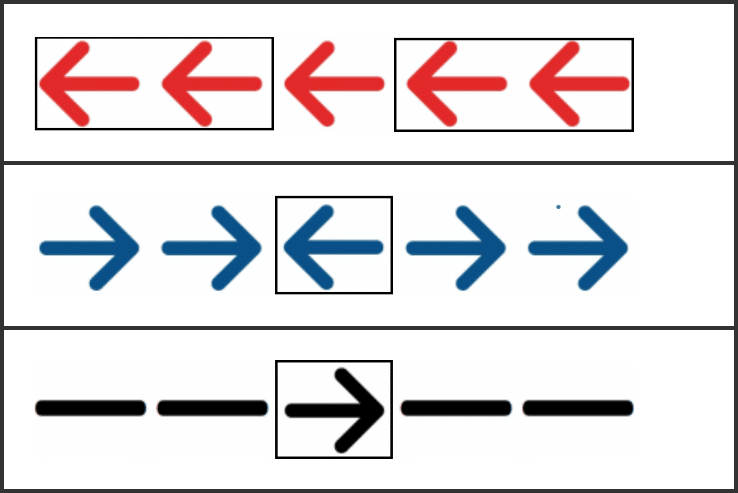
Pymetrics-Style Arrows Game – Red, Blue, and Black – You must mark the direction of the arrows highlighted within the black box. Source: iPREP.
The game’s pace is rapid, requiring you to respond quickly, adapt your response pattern to changing colors, and swiftly recover from any failed attempts. Watch this screen recording to grasp the challenge that lies ahead:

Pymetrics-Style Arrows Game Sample Screen, by iPREP.
Skills You’ll Showcase
- Cognitive Flexibility & Task-Switching: Your ability to adapt to rule changes as the arrow colors shift tests your cognitive flexibility.
- Perceptual Learning: The game assesses your skill in quickly recognizing and interpreting visual patterns, like the direction of arrows.
- Combined Speed and Accuracy: Your efficiency in making fast and precise decisions is evaluated, reflecting your capability to process information swiftly under pressure.
Career Alignments Based on Performance
- High Cognitive Flexibility: Indicates suitability for roles involving strategic planning and multitasking.
- Strong Perceptual Learning: Aligns with positions in data analysis, design, or quality assurance.
- Speed and Accuracy: Ideal for jobs requiring rapid responses and precision, such as operations management or emergency services.
Game 9 – Lengths
What’s the Task
You’ll be presented with faces having either long or short smiles. Your task is to accurately identify the length of each smile, demanding acute attention to detail and precision. Can you tell the difference between these smiles?
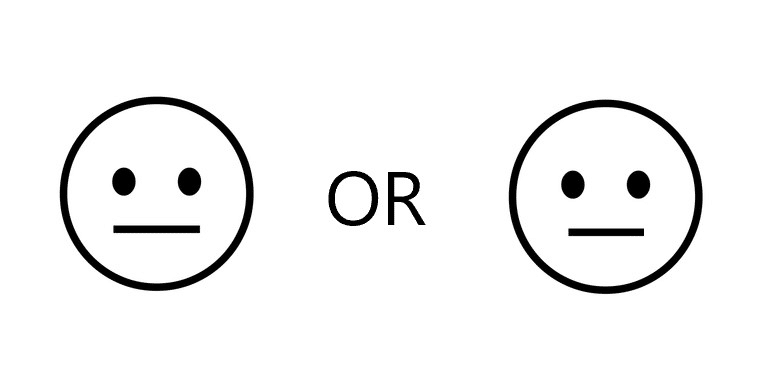
In every round, you need to decide if the mouth is long or short:
- If you think the mouth is long, press the right arrow key.
- If you think the mouth is short, press the left arrow key.
- If you make the correct choice, you’ll see a success indicator. Otherwise, you’ll immediately move on to assess the smile of the next face.

Pymetrics-Style Lengths Game ‘You win some, you lose some’ Sample Screen, by iPREP
You have the opportunity to earn money for each correct answer! You’re encouraged to earn as much as possible. How does this affect your motivation to succeed in the task?

Pymetrics-Style Lengths Game Winnings Streak Sample Screen, by iPREP.
Skills You’ll Showcase
- Attention to Detail: Your ability to discern subtle differences in mouth sizes reflects your attention to detail.
- Motivation Styles: The game evaluates how your performance varies with different types of reinforcement, revealing your intrinsic or extrinsic motivation tendencies.
Strategies and Career Implications
- Focus on Key Features: Concentrate on specific points, like the corners of the mouth, to better judge smile lengths.
- Cultivate Intrinsic Motivation: Strive to maintain consistent performance regardless of external rewards or penalties. This self-driven approach is valued in many professional roles and encourages resilience.
Game 10 – Towers
What’s the Task
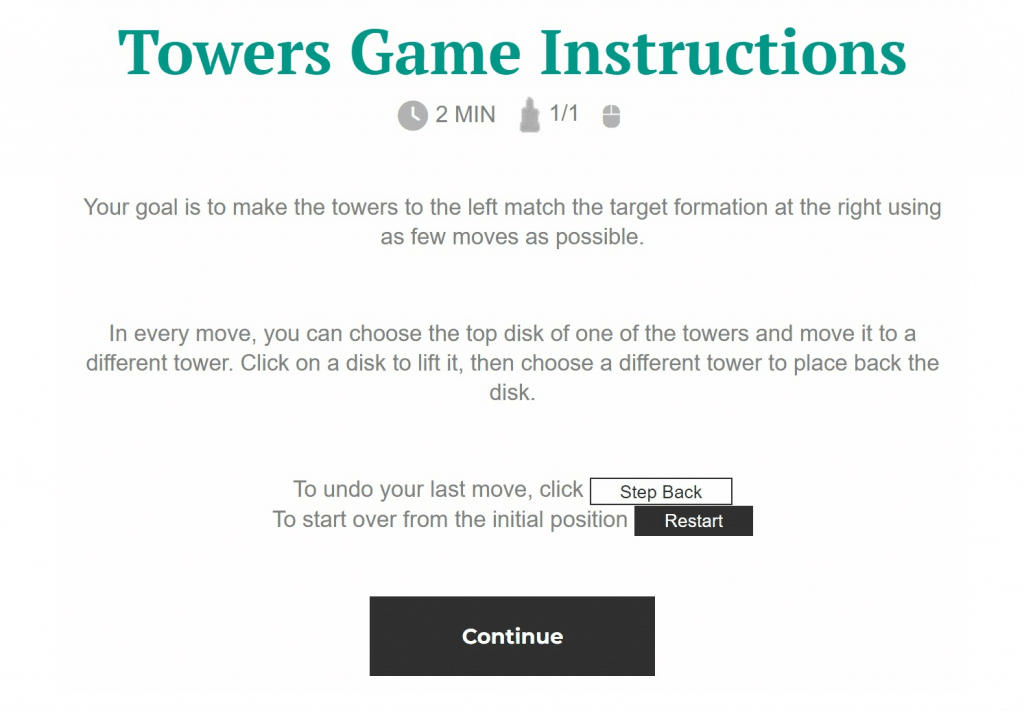
Strategic Problem-Solving: Inspired by the popular Hanoi Towers game, your task involves arranging colored disks on three towers to match a target image. You must accomplish this using the fewest moves possible and within a two-minute time limit. This challenges your ability to plan and strategize efficiently under pressure.
You can only move one disk at a time, and it must be the top disk on any of the towers. All three towers are available for you to use in arranging the disks into the correct sequence. Additionally, you have options to undo your previous move or reset to the initial setup.
Take a look at this gameplay – do you think you could have performed better?
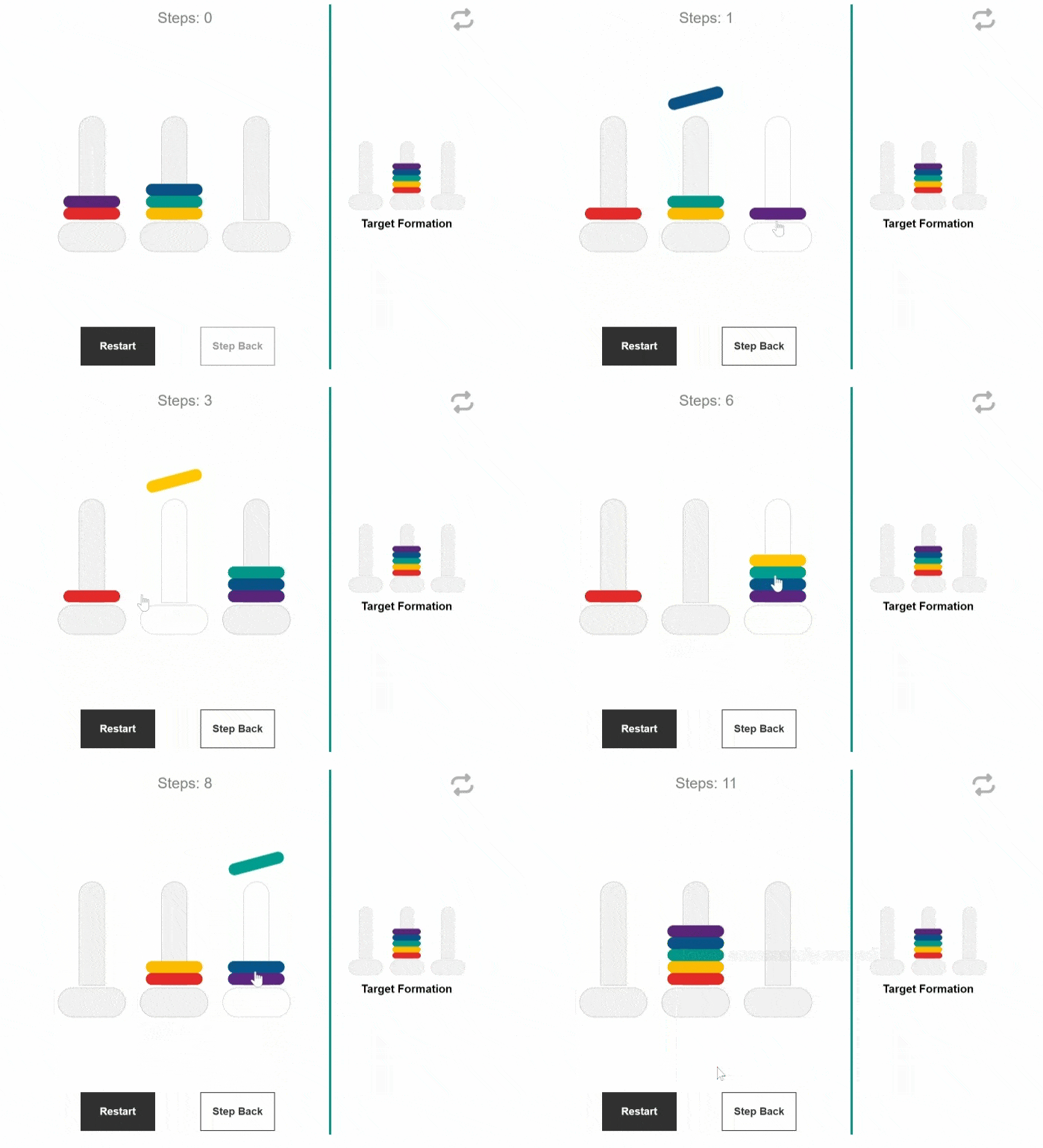
Pymetrics-Style Towers Game Sample Screen, by iPREP.
Do you believe you could plan more effectively or work faster? You can put it to the test with this free pymetrics-style Towers game and see for yourself:
Skills You’ll Showcase
- Planning: The number of moves you make to complete the task reflects your planning efficiency. Efficient planning indicates a strategic approach and the ability to devise an optimal solution.
- Mental Agility: Your completion time assesses your mental agility, revealing how quickly you can adapt, reassess, and execute your strategy.
Strategies and Career Implications
- Effective vs. Ineffective Planning:
- Effective Planning: Demonstrated by minimal, deliberate moves and a clear strategy, aligning with roles in strategic planning or analytics.
- Ineffective Planning: Characterized by hasty, unnecessary moves or frequent use of the undo option, suggesting a need for improvement in roles requiring meticulous planning.
- Mental Agility: Quick completion suggests suitability for fast-paced, adaptable roles, while slower times might indicate a preference for methodical, structured environments.
Game 11 – Faces
What’s the Task
This game is unlike any other in the pymetrics bundle as it focuses on emotional traits instead of cognitive ones.
- You will see photos of people with various facial expressions.
- At the bottom of the screen, you will see a choice of 10 adjectives.
- You must choose the adjective you feel best describes the person’s expression.
- Some photos include a short story about the situation which may have produced the expression. In these instances, you will get 30 seconds to respond. Even though you may find some stories to be similar, they all tell different stories.
- Other photographs will appear without a story. These must be answered in 7 seconds.
Skills You’ll Showcase
- Emotional Intelligence: Your ability to understand and identify emotions from facial expressions and contextual information reflects high emotional intelligence, essential in many professional settings.
- Contextual Interpretation: The game also assesses your skill in integrating facial cues with textual scenarios to gauge emotions accurately, a critical aspect in roles involving interpersonal interactions.
What emotion would you say this woman is feeling?
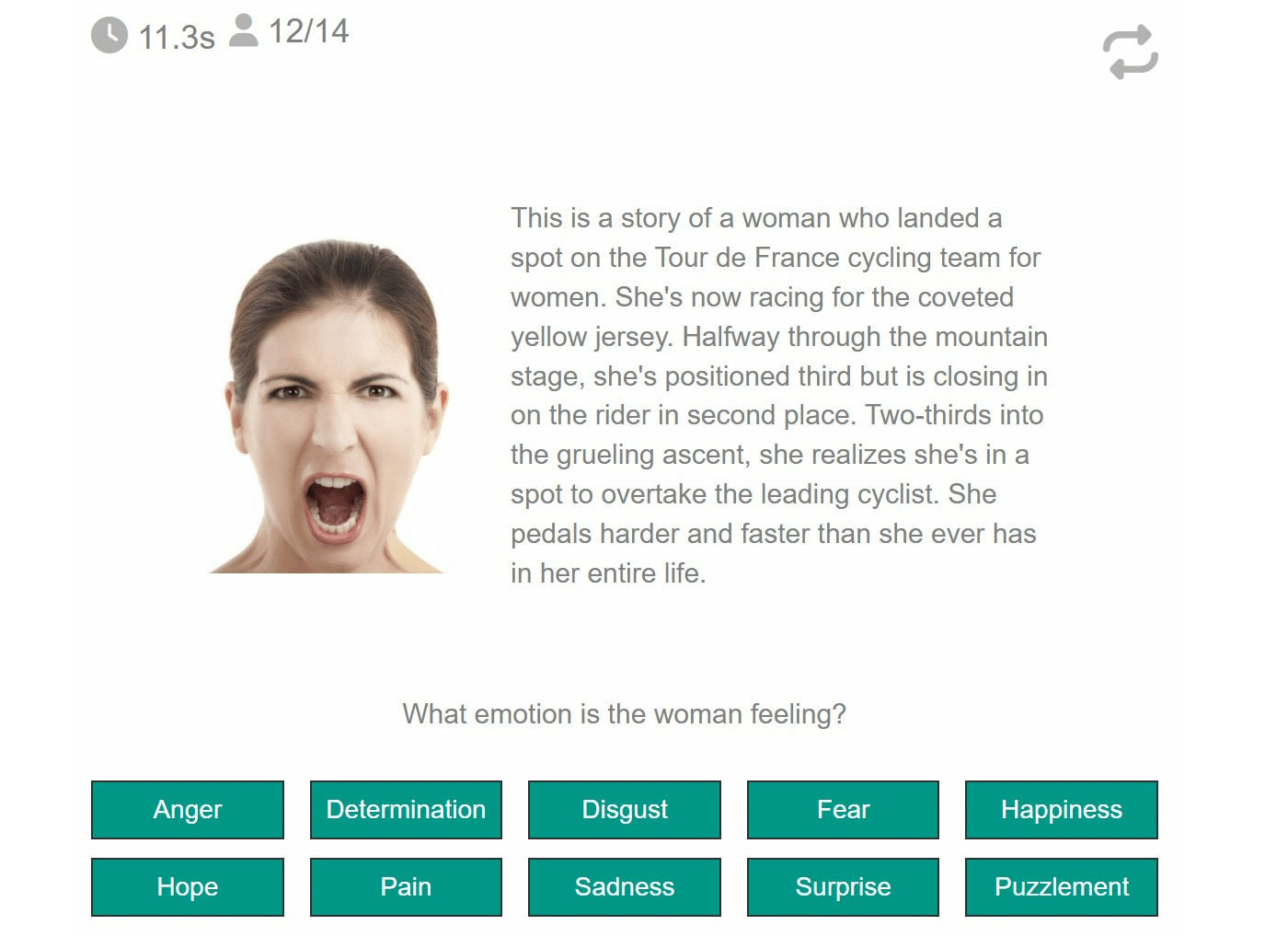
Pymetrics-Style Faces Game Sample Screen, by iPREP.
Strategies and Career Implications
- Balanced Recognition (Both Face and Story): If you’re good at reading both facial expressions and story contexts, it means you’re adaptable in how you communicate. This skill is great for jobs in counseling, sales, or marketing where understanding people is key.
- Focusing on the Story: If you’re better at interpreting the story than facial expressions, you’re likely good at analytical thinking. This ability fits well with jobs in research or technical writing, where understanding and analyzing information is important.
- Focusing on Facial Expressions: If you’re skilled at quickly understanding people’s facial expressions, you’re suited for jobs that require a fast, instinctive understanding of others, like customer service or law enforcement.
Game 12 – Keypresses
What’s the Task
Speed and Precision: Your task is simple yet challenging. Hit the spacebar as quickly and accurately as you can when you see the “GO” command. It is as simple as this screen recording:

Pymetrics-Style Keypresses Game Sample Screen, by iPREP.
The keypresses game tests your processing speed, reaction time, focus, and ability to follow instructions under pressure.
Skills You’ll Showcase
- Quick Response: How fast you hit the spacebar after the “GO” command assesses your reaction times and focus.
- Task Completion: The speed at which you complete around 40 key presses measures your motor skills and coordination.
- Adherence to Instructions: Starting to press before the “GO” command or continuing after the task ends can indicate your tendency to anticipate or your difficulty in stopping an action, reflecting on your ability to follow guidelines accurately.
Strategies and Career Implications
- Balance Speed with Accuracy: While quick responses are good, accuracy is equally important – do you start on time or try to cut corners and start in advance? This mirrors jobs where precision and attention to detail are key.
- React Swiftly and Accurately: Stopping the keypresses as soon as the task ends is crucial. This is especially important for roles that demand quick adaptation to changes.
- Consider Your Actions: Think about how your gameplay strategy aligns with desired traits in your prospective job. Whether it’s anticipation and forward-thinking or strict adherence to rules, your approach in the game can reflect your fit for various roles.
4 Pymetrics Numerical & Logical Reasoning Games
Optional Add-On (only in some hiring processes):
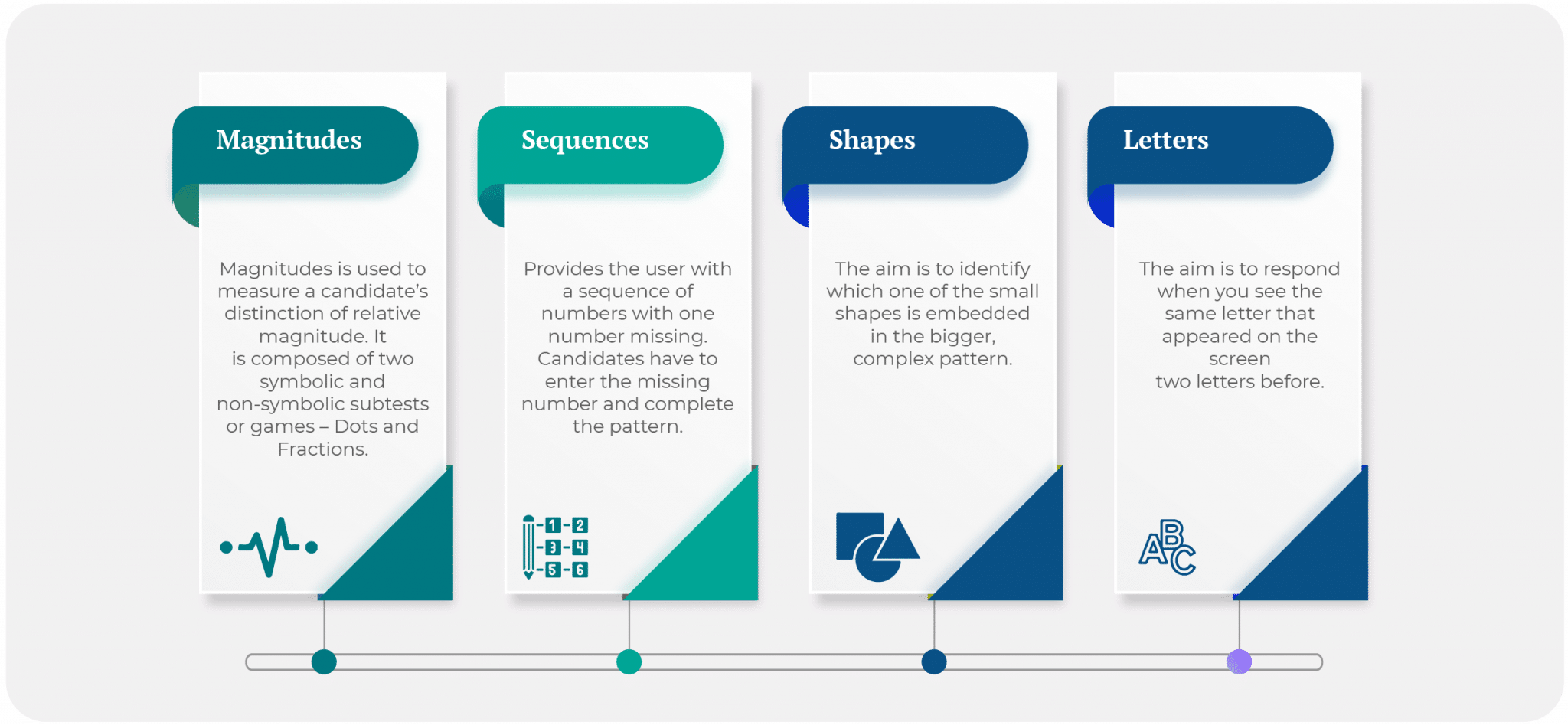
The pymetrics numerical and logical reasoning test is composed of four different games that focus on measuring the Approximate Number Sense that’s involved in quantity estimation, processing of numbers, and the grasp of math and number concepts. It requires you to make immediate decisions based on symbolic and non-symbolic items. For example, you may be asked to make decisions on the output of non-symbolic dots, symbolic fractions, numerals, etc.
The tests are given in addition to the twelve tasks described above and include:
- Magnitudes: Which is divided into Dots and Fractions subtests
- Sequences
- Shapes
- Letters
| Game Name | Description | Assessed Traits |
|---|---|---|
| Magnitudes – Dots | Candidates compare two sets of yellow and blue dots and choose the set with a bigger proportion of yellow dots. | Approximate Number Sense (ANS), interpretation of relative magnitude, accuracy, response time |
| Magnitudes – Fractions | Candidates compare two whole-number fractions and choose the one that is bigger in magnitude. | ANS acuity, response time |
| Sequences | Candidates complete numerical patterns by filling in the missing number in a sequence. | Numerical reasoning, pattern recognition |
| Shapes | Candidates identify a smaller shape embedded in a complex pattern among multiple simple shapes. | Spatial reasoning ability |
| Letters | Candidates respond when they see the same letter that appeared two letters before in a sequence, ignoring other letters. | Memory, response times |
Read on for a description of each.
Game 1 – Magnitudes
Magnitudes is used to measure a candidate’s distinction of relative magnitude. It is composed of two symbolic and non-symbolic subtests or games – Dots and Fractions. Dots will always proceed Fractions for every single candidate.
Dots
What’s the Task
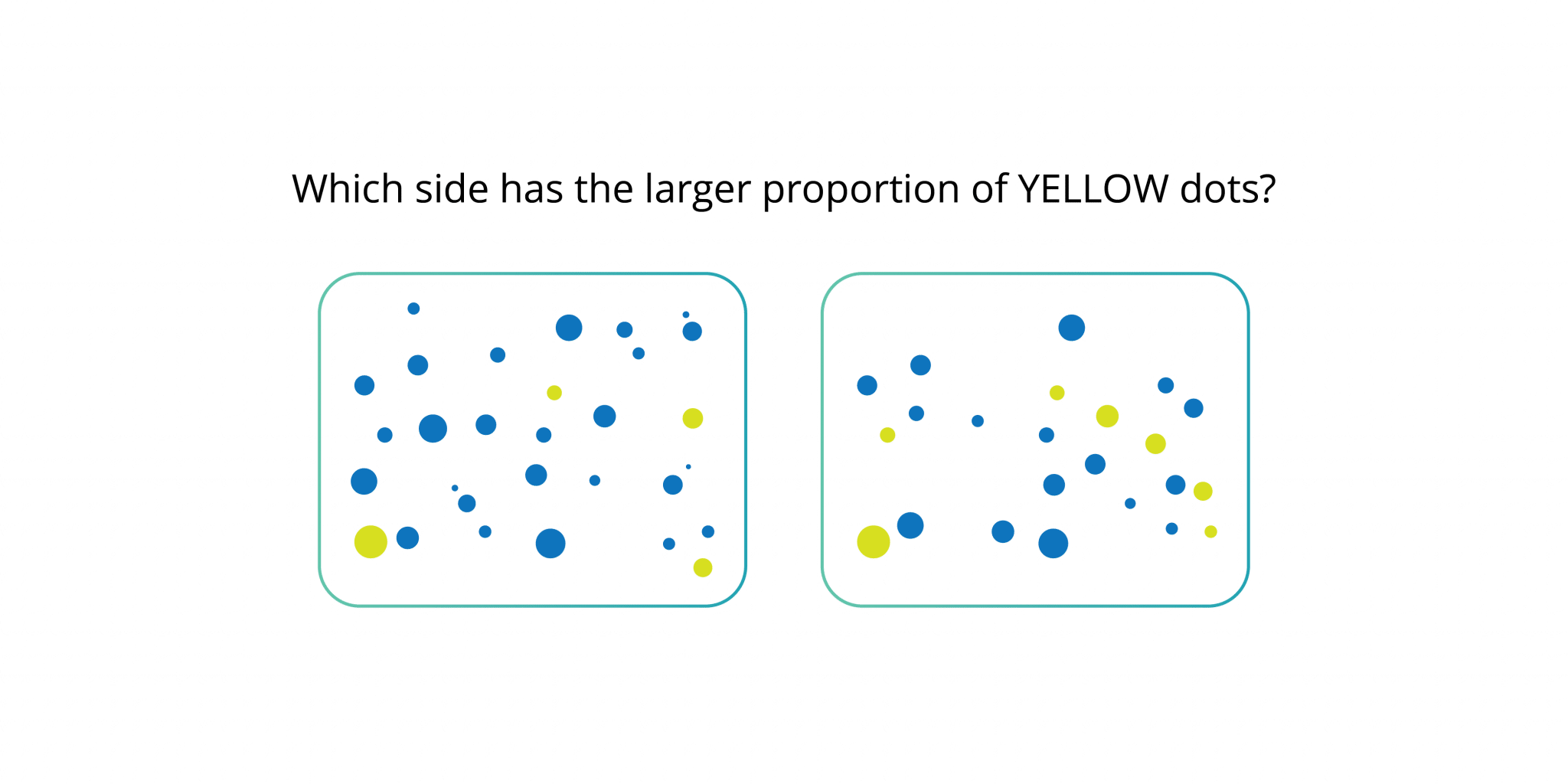
In the Dots test, candidates are shown two squares that contain a mix of yellow and blue dots of different sizes spread out in various patterns. The user must choose the set displaying a bigger proportion of yellow dots. Every display is uniquely generated and there are no overlapping dots. Each participant had 40 trials where the sets of dots are displayed for 1500ms and the response window is 5000ms.
Appearance
The Dots Game shows two boxes, each filled with blue and yellow dots of varying sizes spread out in different patterns. The user is made to pick the set with the bigger proportion of yellow dots. After doing so, a new set of dots will appear. This action will continue until the game is over.
What does it Assess
Dots measures the candidate’s Approximate Number Sense (ANS), acuity, interpretation of relative magnitude, accuracy, and response time.
Fractions
What’s the Task
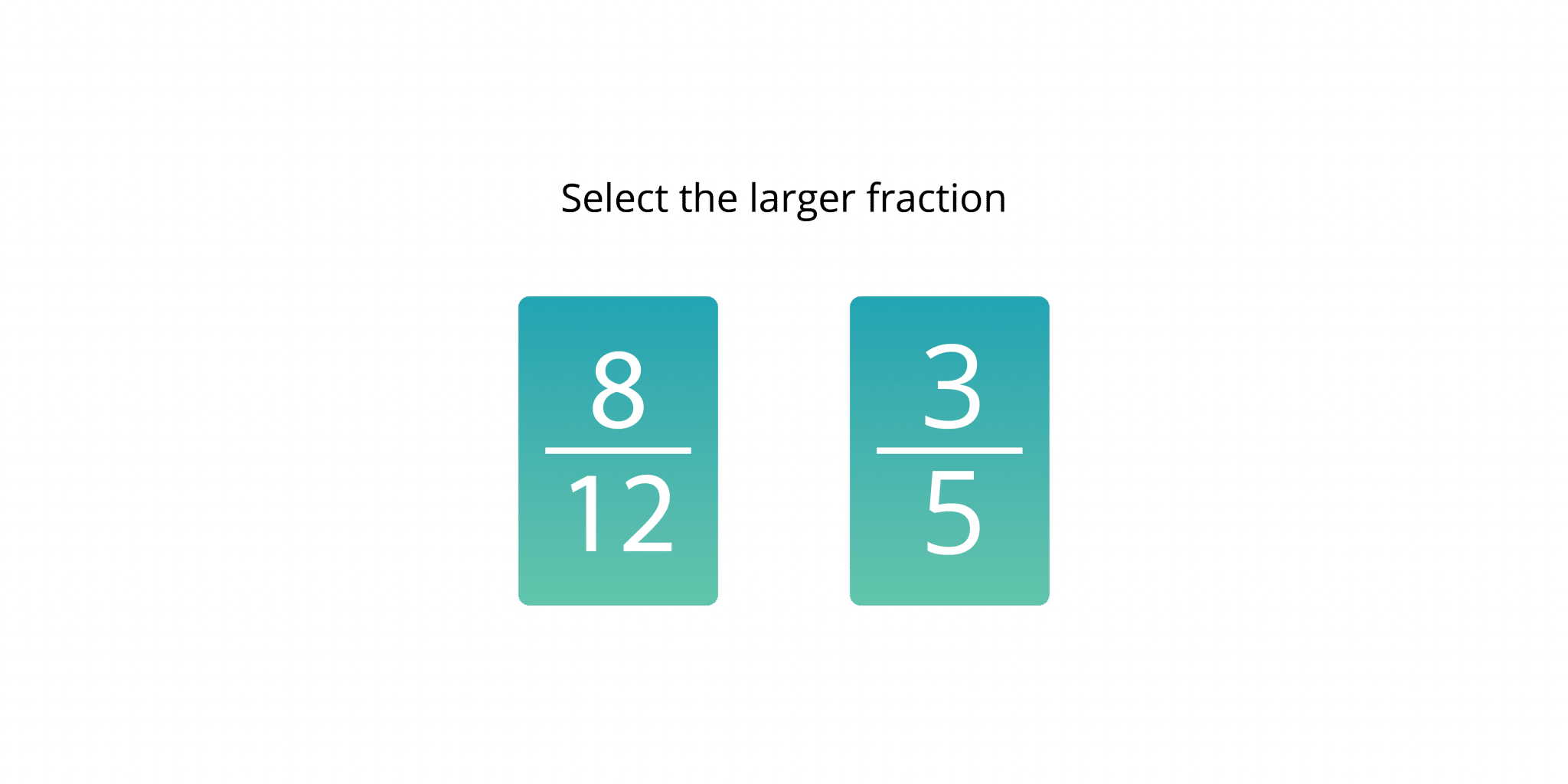
Fractions is the second subtest of the Magnitudes portion of the test. It displays 2 whole-number fractions. The user is required to choose the one that is bigger in magnitude. The fractions appear for 5000 ms. The user must enter their response within this time frame.
Appearance
The user will see two whole number fractions on their screen encased in brightly colored boxes. After they make their choice, another set of fractions will appear.
What does it Assess
Fractions measures the ANS acuity and response time of the user.
Game 2 – Sequences
What’s the Task
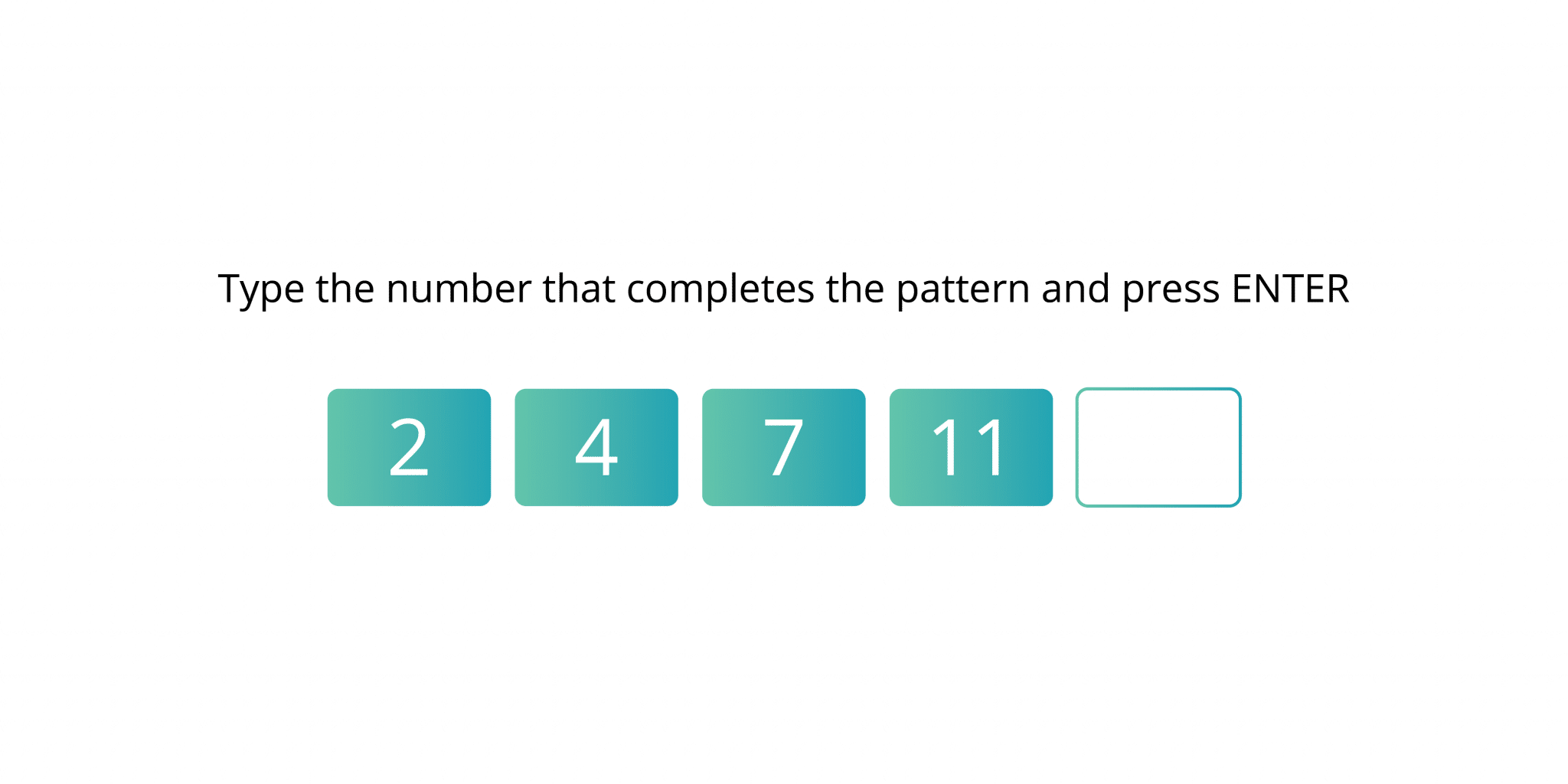
Based on Thurnstone’s Number Series Test, Sequences requires the user to complete the numerical pattern in front of him. It provides the user with a sequence of numbers with one number missing. Candidates have to enter the missing number and complete the pattern. There are 20 patterns to complete and you get 30 seconds for each one.
Appearance
A numerical pattern is on the screen and a number is missing from the pattern. The numbers will stay on the screen for 30 seconds giving the user a window to input their guess. Then, the next sequence will appear.
What does it Assess
Sequences measures the candidate’s numerical reasoning and ability to recognize patterns.
Game 3 – Shapes
What’s the Task
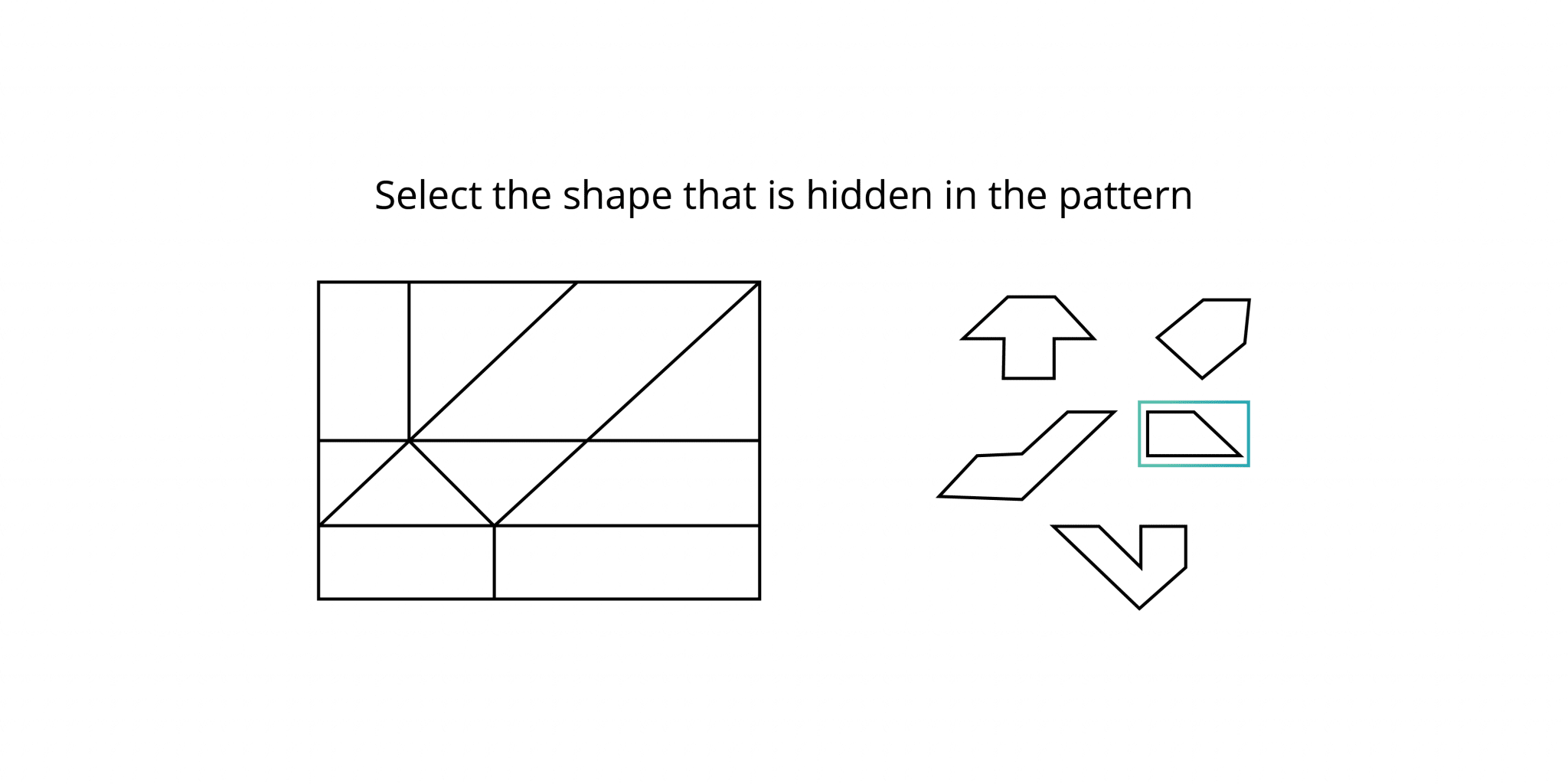
Modeled on the Gottschaldt Figures test, Shapes shows the user multiple simple shapes on the screen alongside a complex, big shape. The aim is to identify which one of the small shapes is embedded in the bigger, complex pattern. The user will have to solve 14 trials in total and will have 45 seconds to solve each one.
Appearance
In this game, you will see several smaller shapes on the right of the screen and a complex, bigger pattern on the left of the screen.
What does it Assess
This game analyzes the candidate’s spatial reasoning ability.
Game 4 – Letters
What’s the Task
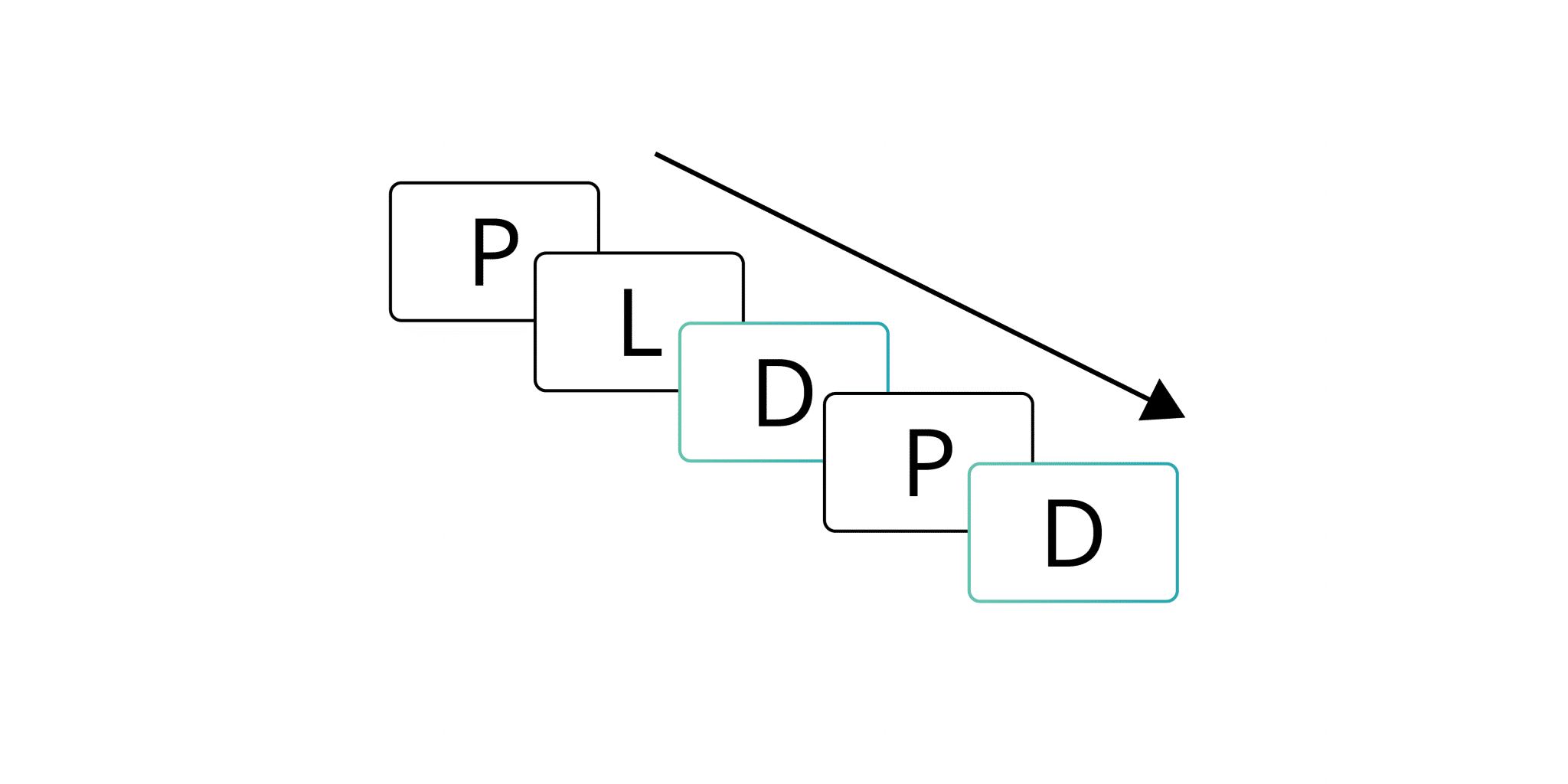
Letters is adapted from Kirchner n-back test. The user sees a sequence of letters displayed individually on the screen. The aim is to respond when you see the same letter that appeared on the screen two letters before. If the letter you see does not correspond with the one that appeared two letters previously, you must not respond. There are 10 targets for the candidate to identify within a 40-letter stream
Appearance
A big display showcases a letter for 1 second after which the next letter appears on the screen.
What does it Assess
Letters measures the candidate’s memory and response times.
Pymetrics Digital Interview
Format
Some employers include a digital (asynchronous) interview in their hiring process. You’ll receive prompts and record your responses on your own time.
Typical experience:
- One-way recording: you answer without a live interviewer.
- Employer-defined prompts: questions vary by role and company.
- Timed steps: you may have limits for prep and/or recording time.
- In-platform submission: responses are uploaded for the hiring team to review.
How it’s reviewed
Your responses are typically reviewed by the employer’s recruiting/hiring team. Some platforms may provide tools like notes, sharing, or transcripts to support review. There isn’t usually a single “test score,” and review rules can vary by employer.
How to prepare
- Use the job description to identify the skills to highlight.
- Prepare a few STAR examples (Situation, Task, Action, Result).
- Practice on camera, then refine clarity, structure, and pacing.
- Record in a quiet place with good lighting and a stable connection.
- Ask someone you trust to review a practice recording.
Our iPREP course also includes interview guidance and sample answers to help you prepare.
Did you know?
Pymetrics typically includes 12 short, online, game-based tasks that measure work-relevant cognitive and behavioral patterns; you may see games such as Balloons, Towers, Money Exchange, Keypresses, Digits, Cards, Arrows, Lengths, Easy or Hard, Stop, and Facial Expressions, but the exact set can vary by employer and assessment, and results are summarized into a profile across a range of cognitive, social, and behavioral traits based on how you play.
Preparation Strategies
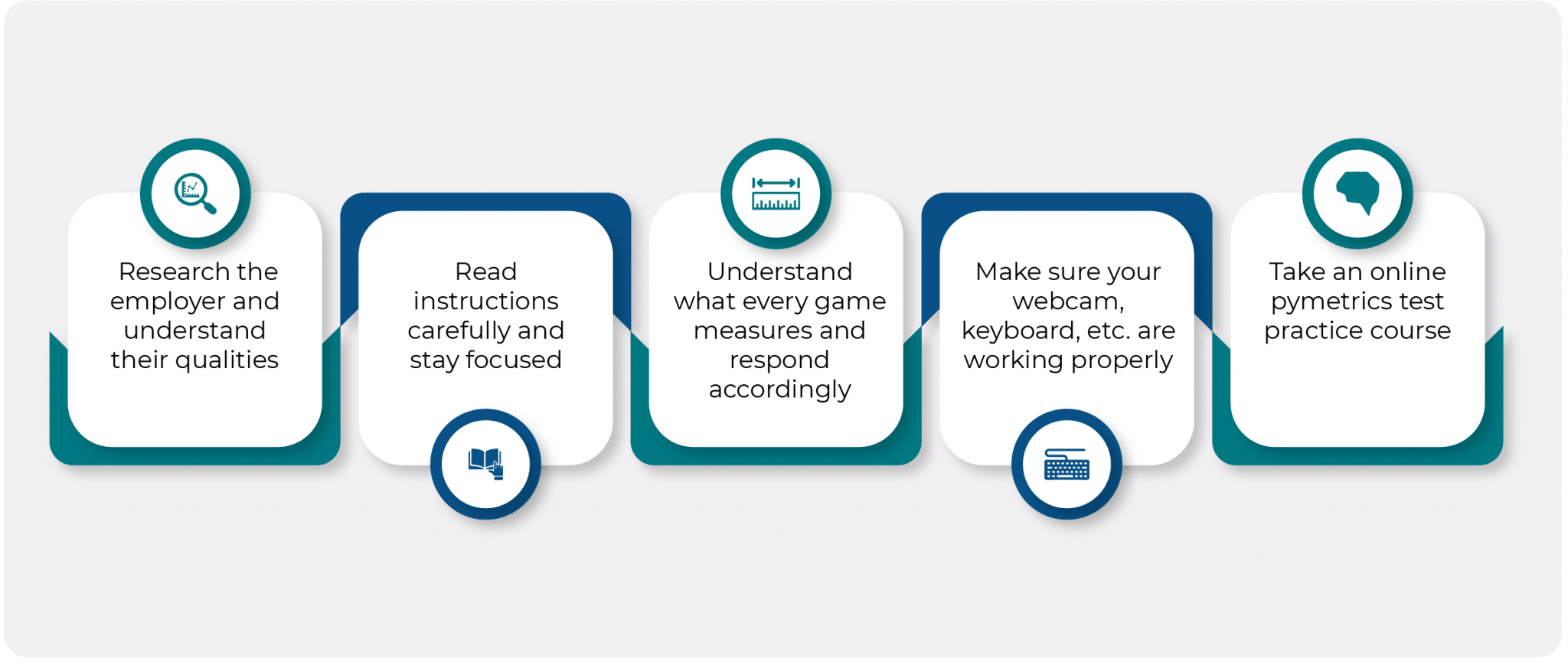
Research the employer
Review the company’s website and public channels to understand its values, culture, and the role’s key requirements. Use what you learn to highlight the traits and behaviors that fit the position.
Read instructions and stay focused
Treat the games like an assessment, not entertainment. Read the instructions before each game, stay attentive, and avoid rushing—small misunderstandings can affect your performance.
Don’t “game” the games
Each task measures different behavioral and cognitive patterns. The best strategy is to play naturally, follow instructions, and aim for consistent, thoughtful decisions rather than trying to force a specific outcome.
Set up your environment and equipment
Choose a quiet place with minimal distractions. Before you start, confirm your device, keyboard/mouse, camera (if needed), audio, and internet connection are working smoothly so you can respond without technical interruptions.
Practice with realistic simulations
Practicing game-style tasks can help you feel more comfortable with the format and pacing. If you use prep materials, focus on understanding instructions, improving concentration, and reducing mistakes under time pressure.
Test Features
Test Fast Facts (tl;dr)
- 12 core game-based tasks
- Optional: 4 numerical-logic games
- Usually 25–35 minutes total
- Measures cognitive and behavioral traits
- Digital interview may follow
- Retake allowed every 330 days
Game-Based Assessment
Pymetrics is a game-based assessment used by some employers to measure work-relevant cognitive and behavioral patterns through short online tasks. Your gameplay is analyzed to create a profile that can help hiring teams compare candidates in a consistent way.
What it measures
Pymetrics is designed to capture patterns related to traits employers often care about, such as attention, learning, decision-making, and risk tolerance. It is not a traditional “right/wrong” exam, and it doesn’t produce a single test score like many aptitude tests.
Results and visibility
How results are shared depends on the employer. In some hiring processes you may see a personal report, while in others the results are only shared with the hiring team or provided later.
How employers use it
Employers may use Pymetrics results to:
- Screen or shortlist candidates before later steps
- Compare candidates against role requirements
- Identify strengths that could fit different roles within the organization (in some cases)
Retake policy
You can typically take the Pymetrics assessment once every 330 days. Because the retake window is long, it’s worth treating the assessment seriously and minimizing avoidable mistakes.
Preparation tips
- Practice with realistic game-style simulations to get comfortable with the format and pacing.
- Read each game’s instructions carefully before you start.
- Play naturally and stay consistent instead of trying to “game” the system.
- Choose a quiet space and check your device and internet connection.
Technical Facts
Below are practical “behind-the-scenes” facts about the Pymetrics game-based assessment.
What it measures
Pymetrics is designed to capture patterns related to work-relevant cognitive, social, and behavioral traits. The platform may summarize your gameplay into trait-style outputs such as:
- Attention and focus
- Learning and adaptability
- Decision-making style
- Effort and persistence
- Risk tolerance
- Fairness and social preferences
- Emotional perception
Note that the exact trait labels and how they are reported can vary by employer and assessment setup.
Data signals and analysis
During gameplay, the system records many small performance signals (for example, timing, consistency, and choices). These signals are combined to create a profile that employers can use as one input in the hiring process.
Fairness and consistency
Game-based tasks can help standardize the experience by giving candidates the same type of structured activities. However, no tool can guarantee bias-free outcomes. Employers typically use results alongside other information when making decisions.
Results sharing
Access to results depends on the employer. In some processes candidates may see a personal report, while in others results are shared only with the hiring team (or shared later).
Flexibility and setup
The assessment is completed online and can typically be taken from any quiet location with a stable internet connection. For best performance, minimize distractions and ensure your device works smoothly before starting.
Results Scale and Interpretations
When you get results
In many hiring processes, a results report is generated after you complete the games. Whether you see a personal report immediately, later, or not at all depends on the employer’s setup.
If you do receive a report, it typically summarizes your gameplay patterns into a profile of work-relevant traits and tendencies.
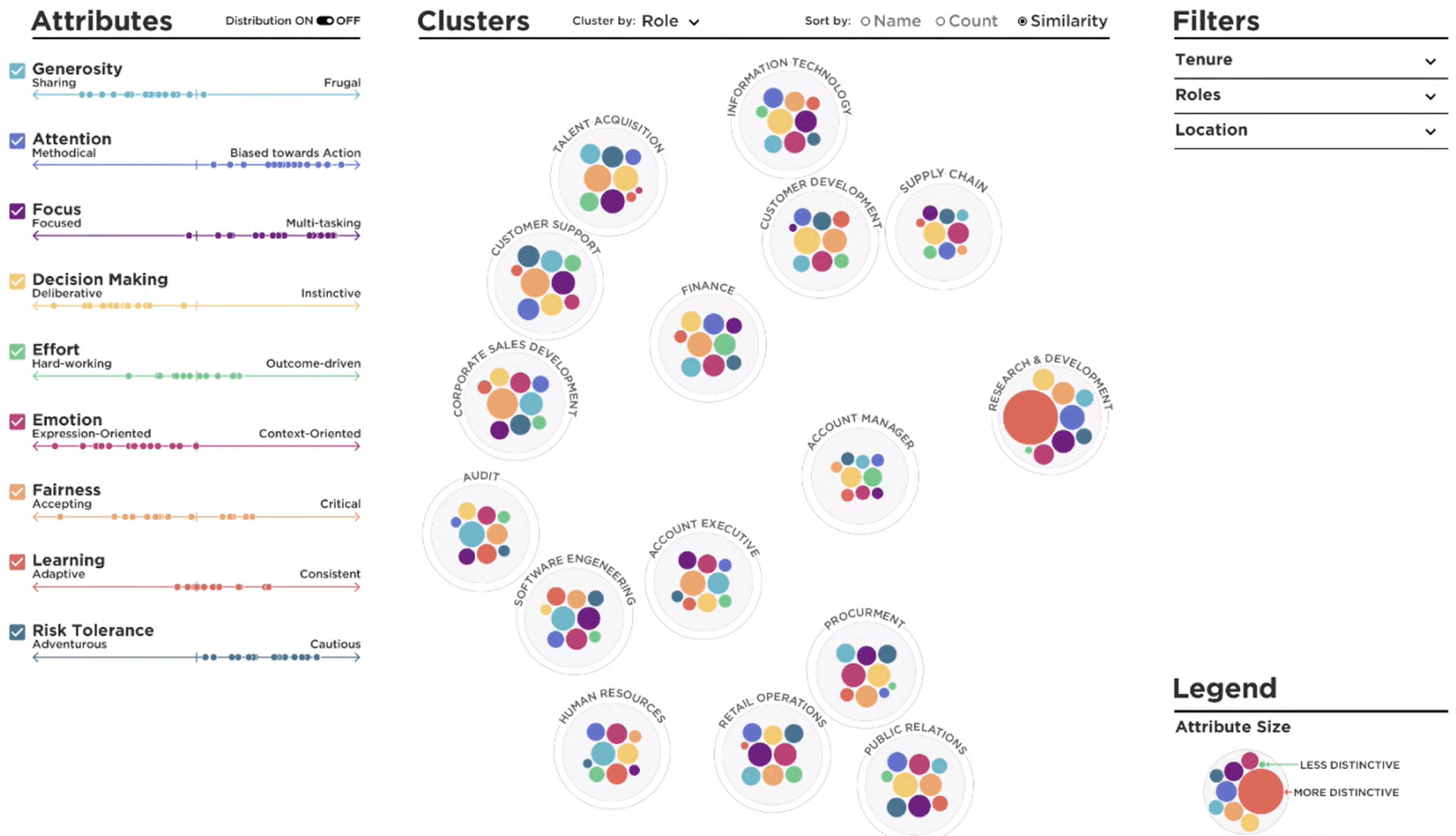
How results are presented
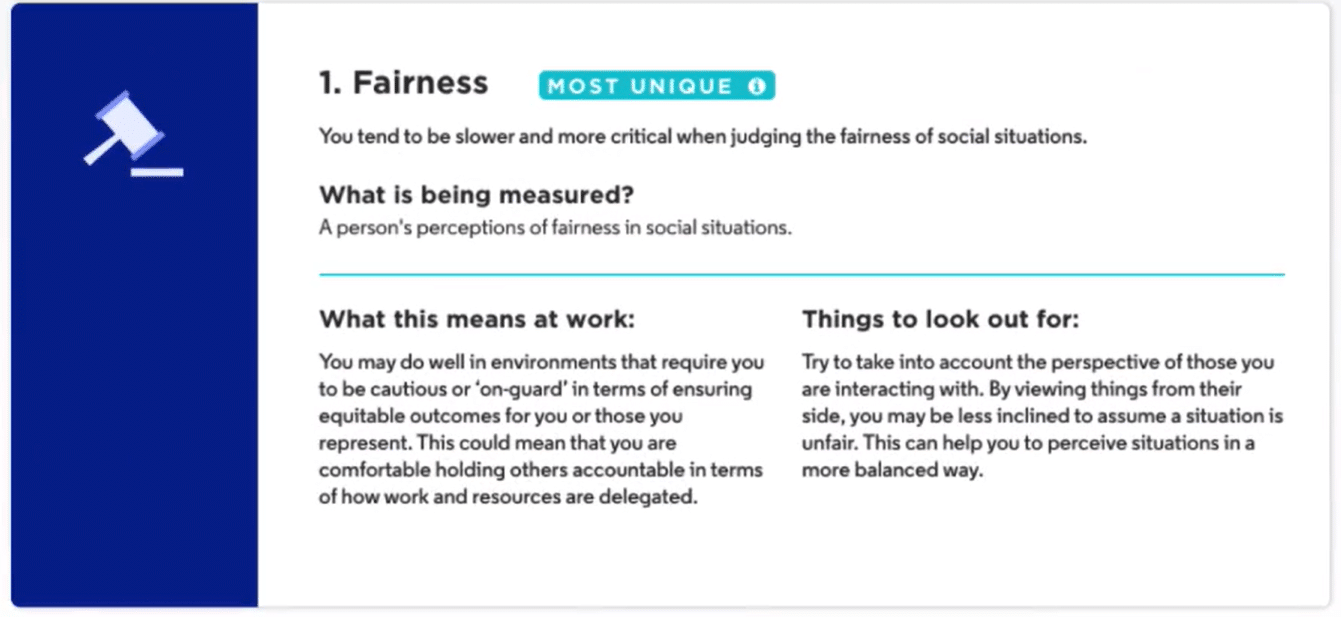
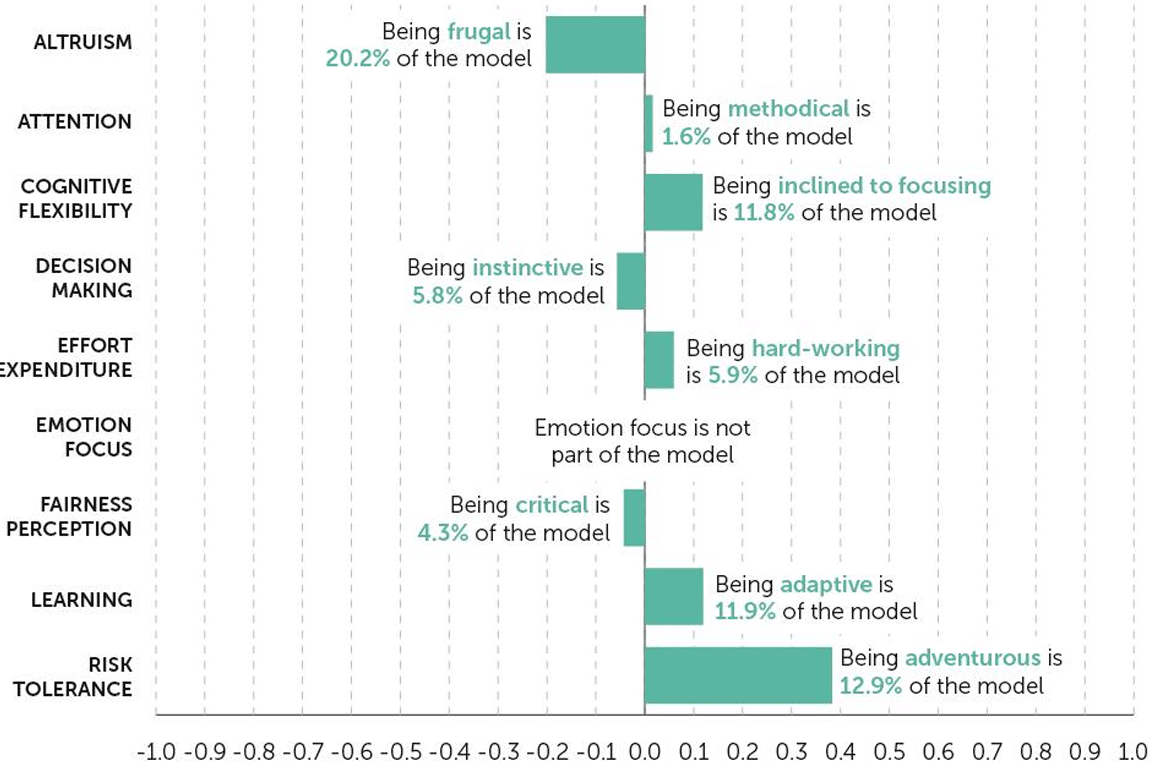
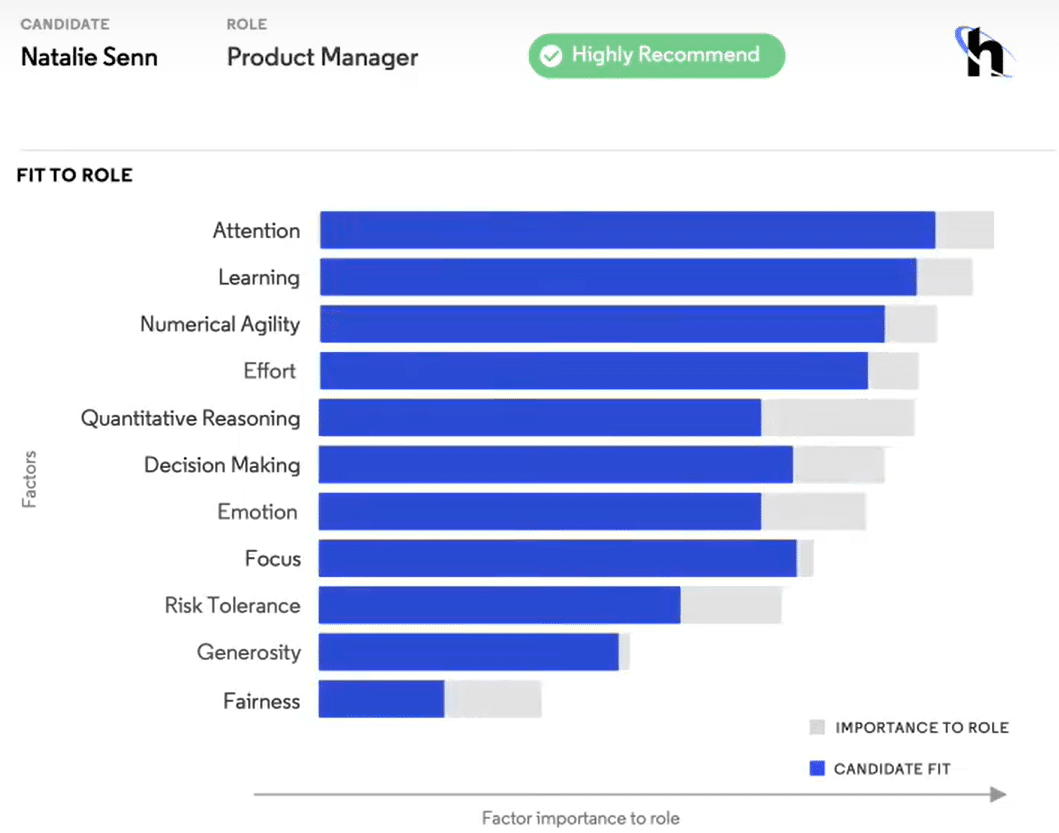
Results are often shown as a cluster or set of traits rather than a single test score. The report may explain how certain traits relate to a role and highlight potential strengths and areas to explore in interviews.
Some employers may also use the results to support structured interviewing and candidate comparisons. The level of detail, labels, and visuals can vary by employer.
Fit is based on behavioral patterns
Pymetrics uses patterns from the game tasks to describe behavioral and cognitive tendencies that may relate to role fit. Trait importance can differ across roles, so a profile that looks strong for one position may look different for another.
Results validity and retakes
You can typically take the Pymetrics assessment once every 330 days. If you are re-invited before that window, you may be asked to use your existing results rather than retake the games.
FAQs
A Pymetrics test is a game-based assessment made up of short online tasks. Most candidates complete a core set of 12 games. Total time is typically about 25–35 minutes, depending on the employer and invitation.
Employers commonly use a set of 12 mini-games. The exact game set can vary by employer, but examples often include Money Exchange, Keypresses, Balloons, Digits, Easy or Hard, Stop, Cards, Arrows, Lengths, Towers, and Facial Expressions.
There is no traditional “pass/fail.” The goal is to follow instructions carefully, stay focused, and play naturally. Results are usually summarized into a profile rather than a single score.
Yes. You can prepare by practicing similar game-style tasks to get comfortable with the pace and instructions. Prep resources can also help you understand common formats and reduce avoidable mistakes.
Most candidates take the 12 core games. Some employers may add extra modules. If additional games are included, your invitation typically makes that clear.
– Read each game’s instructions carefully
– Stay consistent and focused
– Avoid overthinking or trying to “game” the system
– Minimize distractions and technical issues
Yes. Preparation can help you feel calmer and avoid misunderstandings. Focus on comfort with instructions, attention, and steady decision-making under time pressure.
Total time is typically about 25–35 minutes, including instructions and setup, but it can vary by employer and invitation.
Because the games measure patterns in how you play rather than memorized knowledge, “cheating” is not a practical strategy. The best approach is to follow instructions and play naturally.
It’s better to think in terms of showing your natural, consistent approach rather than “acing.” Employers use the results as one input to understand fit, not as a single score to maximize.
Some employers add an additional module of 4 Numerical & Logical Reasoning games. These are separate from the core 12 games, and most candidates are not asked to complete them. If included, your invitation will indicate it.
The games are designed to measure work-relevant cognitive and behavioral tendencies (such as attention, learning style, decision-making, and risk tolerance). The specific trait labels and reporting can vary by employer.
You can typically take the assessment once every 330 days. If you’re invited again within that window, you may be asked to use your existing results rather than retake the games.
You usually can’t pause a game once it starts. However, each game is short, and you can often take breaks between games (depending on the employer setup).
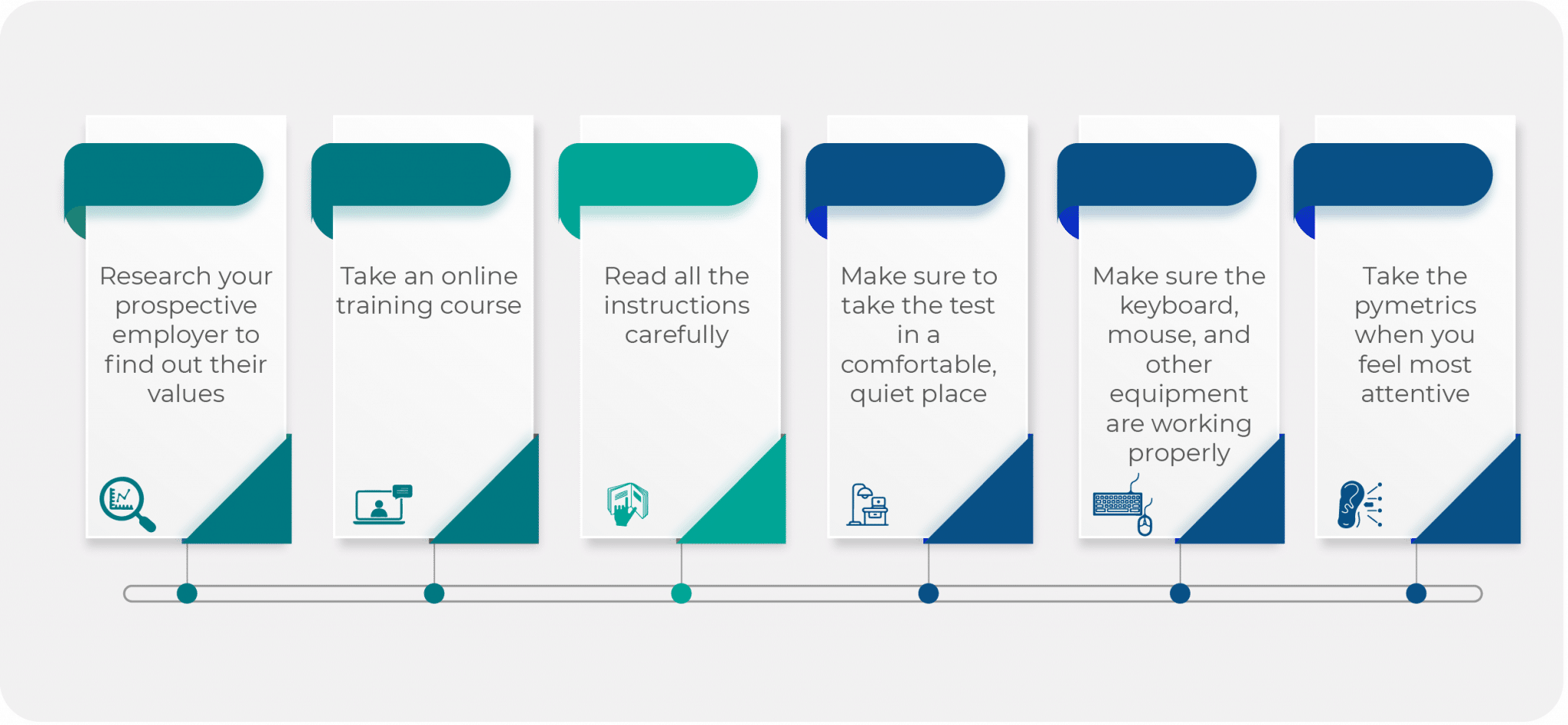
Test Tips
Before you start
- Choose a quiet, comfortable space
- Check your internet and device
- Make sure you feel alert
During the assessment
- Read every game’s instructions carefully
- Stay focused and avoid rushing
- Play naturally and stay consistent
Smart preparation
- Review the role and employer values
- Practice with realistic game-style tasks
- Use a training course if it helps
Administration
- Test location: Online; can be taken anywhere with a stable internet connection
- Test use: Used by employers at various hiring stages, often for screening/shortlisting
- Test format: Typically 12 short, game-based tasks (core assessment)
- Test materials: Computer or smartphone (depending on employer setup)
- Cost: None (covered by the employer)
- Retake policy: Once every 330 days
Test Provider
Pymetrics is a hiring assessment platform that uses short, game-based tasks to measure work-relevant cognitive and behavioral patterns. Pymetrics was acquired by Harver, and the solution is now part of Harver’s broader hiring platform.
The assessment is designed to help employers compare candidates in a structured way. How results are generated, shared, and used can vary by employer and hiring process.
Information Sources
Disclaimer – All information and preparation materials on iPREP are provided for tutoring and practice purposes only. “Pymetrics Core Soft Skills” and “Pymetrics Numerical & Logical Reasoning” are trademarks of Pymetrics, Inc. (a Harver company). iPREP is not affiliated with Pymetrics, Harver, or any other company mentioned in this article.
Free pymetrics Games practice test: Get to know what pymetrics games test assessments will be like by practicing with these sample games:
Pymetrics Balloons Game
The pymetrics Balloons game assesses your risk-taking tendencies and your ability to learn patterns in a short time. Try to earn as much money as possible by pumping the balloons and earning coins.
Pymetrics Money Exchange Game #1
Pymetrics Towers Game
The Towers game assesses the nature of your planning skills. What is the best way to reshuffle the discs and achieve the target formation? A speedy trial and error method?
Pymetrics Money Exchange Game #2
Pymetrics Easy or Hard Game
Pymetrics Digits Game
The “Digits Game” measures participants’ working memory through sequence recall. A recall of five or fewer numbers highlights areas for improvement. Recalling six to seven suggests average skills, while eight to nine indicates a high average ability.
Pymetrics Stop 1 Game
Pymetrics Cards Game
Pymetrics Arrows Game
Pymetrics Lengths Game
Pymetrics Faces Game
Pymetrics Keypresses Game
About the course
Includes 12 Game Simulations
8 Learning hours · 12 Games · 12 Game Guides · 12 Videos
You’ll start with a baseline simulation to see how you approach the Pymetrics game-based tasks. Next, you’ll learn the test format and apply preparation strategies before working through each core game with clear guidance on what it measures. You’ll finish with a full simulation to consolidate your approach and build familiarity with the hiring-style experience.

Skills you will learn
Attention, inhibition, and impulse control · Risk tolerance and reward tradeoffs · Working memory and recall accuracy · Learning adaptability across changing rules · Planning strategy under time pressure · Emotion recognition · Trust, fairness, and altruistic choices
Curriculum
Course Introduction
- Course orientation and platform walkthrough
Pymetrics Preview Challenge: Assess Your Starting Point
- Initial simulation and baseline familiarity
Pymetrics Games Test Format
- What to expect on test day
- How the games build your profile
Preparation Strategies and Test-Day Tips
- Game-by-game approach and pacing habits
- Reducing avoidable errors under pressure
Pymetrics Games Practice: One by One
- Guided practice across all core games
Balloons Game
- Risk tolerance and reward tradeoffs
Keypresses Game
- Instruction-following, focus, and impulsivity
Stop-1 Game
- Attention control and response inhibition
Digits Game
- Working memory and recall accuracy
Cards Game
- Risk strategy, learning, and pattern detection
Easy or Hard Game
- Effort, motivation, and decision strategy
Arrows Game
- Learning adaptability and sustained attention
Lengths Game
- Attention to detail and learning shifts
Money Exchange #1 Game
- Trust decisions under uncertainty
Money Exchange #2 Game
- Altruism and fairness-driven choices
Towers Game
- Planning and problem-solving strategy
Faces Game
- Emotion recognition and social perception
Game-on: Pymetrics Final Simulation
- Full simulation to apply your approach
Course Conclusion
- Next steps for continued practice
Reviews

Gurkaran Singh P****
June 26, 2025 at 9:46 AM
This course has helped me so much and would highly recommend! The tests are in depth and very useful to help ace your assessments
Byron A****
April 25, 2025 at 11:16 AM
I’ve only spent about an hour with the Pymetrics Games Prep from iPrep, but I can already feel myself getting better at the games. The practice and explanations are easy to follow, and I’m definitely feeling more confident.
Seg O****
March 2, 2025 at 7:34 PM
Its a solid practice program and should get you familiar with the pymetrics exam. Some practice is better than going cold turkey.
Ilina A**********
February 22, 2025 at 5:18 PM
Great practice tests with very helpful insights and strategies included. The video lectures combined with the description really provide the chance for an in-depth understanding of each task. Would recommend the course!
Michael B*****
January 4, 2025 at 9:22 PM
Honestly this is pretty useless without seeing the optimal solution for the specific problem. Also a strike against this, the explainer videos feature very easy puzzles compared to the majority of the actual problems.
iPrep
January 5, 2025 at 7:44 PM
Thanks for your feedback Michael. Our goal is to build the underlying skills needed to succeed on the Pymetrics games—not to train on specific game answers, which the real test doesn’t reveal either. The course focuses on strategies and practice to help improve performance across a range of difficulty levels.
Ruohong W**
October 24, 2024 at 7:13 PM
It's a very very helpful test!!I never know these strategies before using this pack to practice. I helped me a lot and make me more confidence in online assessment.
Grace N****
October 10, 2024 at 9:54 AM
I did not pass the test. However I'm grateful because I got the confidence to tackle the games in a calm manner which was important more than the results.
Craig m*****
October 8, 2024 at 9:09 AM
This app is absolutely, brilliant, it's accuracy at helping you prepare for your assessments through example tests from all 12 pymetrics games.
ZHICHENG W*
October 3, 2024 at 11:24 AM
the system is stable and the questions are practical, very helpful for preparation and time management practicing, but still the facial quesitons not well-understood