Reviewed by Tamir Rubin, Head of Product at iPREP • Updated July 2026
What is the Talogy Caliper assessment?
The Talogy Caliper™ is a workplace personality assessment used for hiring and development, often with an abstract reasoning component. Test-takers answer forced-choice and rating items, and may see number series or visual pattern questions. Configurations vary; many are untimed, with 98 questions and 60–75 minute completion times.Caliper Sample Question
What is the next number in the following series of numbers?
- 5
- 7
- 1
- 6
Caliper Assessment Question Types
Most/Least (Forced-Choice)
Assesses: work style
- Pick most-like and least-like statements
- Compare a set of statements
- No right answers; be consistent
- Answer as you at work
Rating (Scale)
Assesses: preferences
- Rate agreement on seven-point scale
- Use steady, honest self-reporting
- Avoid extremes unless truly accurate
- Watch for similar statements repeating
Number Series
Assesses: numerical patterns
- Find rule across number patterns
- Use differences, ratios, or cycles
- Question mix varies by employer setup
- Work carefully; double-check arithmetic steps
Visual Analogy
Assesses: spatial relationships
- Match relationship between two figures
- Track rotation, reflection, and shading
- Question mix varies by employer setup
- Look for multiple rules combined
Series Completion
Assesses: pattern recognition
- dentify progression across changing visuals
- Follow movement, size, and count
- Question mix varies by employer setup
- Choose next figure in sequence
Matrix Completion
Assesses: complex patterns
- Analyze rows and columns together
- Apply consistent rule to missing cell
- Question mix varies by employer setup
- Use all features, not one
Test Duration
Total time: varies by employer and configuration (often up to ~120 min)
Expect 98 questions; you may also see experimental/unscored items. Untimed: many finish in 60–75 minutes, but some take closer to 2 hours—confirm your invitation.
Test Breakdown & Sample Questions
The Caliper Assessment is a pre-employment test that helps employers understand how you think and how you’re likely to behave at work. It’s typically untimed and includes two main parts:
- Abstract Reasoning: pattern-based multiple-choice questions with correct/incorrect answers.
- Personality Assessment: work-style questions with no right or wrong answers, usually in two formats: Most/Least (Forced-Choice) and Rating (Scale).
The table below summarizes the main question types.
| Section | Question Type | What It Assesses |
|---|---|---|
| Personality Assessment | Most/Least (Forced-Choice), Rating (Scale) | Behavioral tendencies and work-style preferences |
| Abstract Reasoning | Pattern series, visual analogies, series completion, matrix-style questions | Pattern recognition, logical reasoning, problem solving |
Personality Section
As you navigate through the Caliper Assessment Test, you’ll encounter the Personality Section, a crucial part of the assessment that provides insights into your behavioral tendencies and personality traits. Unlike the Abstract Reasoning Section, which focuses on your cognitive abilities, the Personality Section delves into who you are as an individual—your attitudes, preferences, and typical behaviors. It’s not about right or wrong answers, but about understanding your unique personality and how it might fit within a professional context.
This section primarily consists of two types of questions—Most/Least Questions and Rating Questions—each designed to explore different facets of your personality. In the following guide, we’ll explore each type of question, what they assess, and the approach necessary to perform well on each type.
| Question Type | What It Assesses | Approach |
|---|---|---|
| Most/Least Questions | Various personality traits and behavioral tendencies | Introspection, honesty |
| Rating Questions | Attitudes, preferences, and typical behaviors | Honesty, consistency |
Most/Least Questions
These questions present you with a set of four statements, and you’re asked to identify which statement is most like you and which is least like you. These questions assess a range of personality traits, such as assertiveness, empathy, risk-taking, and patience, among others. They aim to understand how you might behave in different work situations. To perform well on these questions, it’s important to be introspective and honest. Remember, there are no right or wrong answers in this section—it’s about understanding your personality and how it might fit with a particular job role.
Your answer sheet will have two responses for each of these types of questions.
| Most | Least | |
|---|---|---|
| I sometimes have the feeling that I am taking too much responsibility upon me. | ||
| I have the ability to persuade people to do almost anything. | ||
| I cannot imagine myself lying or cheating. | ||
| I seem to enjoy interacting with people more than others do. |
Rating Questions
These questions present you with a statement, and you’re asked to rate how much you agree or disagree with the statement on a seven-point agreement scale. These questions also assess various personality traits and behavioral tendencies. They aim to gauge your attitudes, preferences, and typical behaviors. To excel in these questions, honesty and consistency are key. Try to avoid extreme responses unless the statement truly represents or opposes your personality.
In the Rating Question type of the Personality Section, you’ll be presented with a statement and asked to rate your level of agreement on a seven-point scale, as demonstrated in the following example:
| Statement | Strongly Disagree | Disagree | Mildly Disagree | Neutral | Mildly Agree | Agree | Strongly Agree |
|---|---|---|---|---|---|---|---|
| I enjoy working in a team-oriented environment. |
In this question, you would select the option that best represents your level of agreement with the statement. For example, if you strongly agree with the statement, you would select the “Strongly Agree” option.
As you prepare for this section, focus on understanding yourself better and being honest and consistent in your responses.
Abstract Reasoning Section
As you prepare for the Caliper Assessment Test, one of the key sections you’ll encounter is the Abstract Reasoning Section. This part of the test is designed to measure your cognitive abilities, specifically your capacity to identify patterns, solve problems, and think critically. Unlike other sections, the Abstract Reasoning Section doesn’t focus on what you know, but rather on how you think.
The section comprises four main types of questions—Number Series, Visual Analogy, Series Completion, and Matrix Completion. Each type of question is designed to assess a different aspect of your cognitive abilities. In this guide, we’ll delve into each type of question, explaining what they assess and the skills necessary to perform well on each type.
| Question Type | What It Assesses | Skills Necessary |
|---|---|---|
| Number Series | Numerical reasoning and pattern recognition | Analytical skills, attention to detail |
| Visual Analogy | Spatial reasoning and understanding of visual relationships | Spatial awareness, visual thinking |
| Series Completion | Pattern recognition and logical reasoning | Observational skills, logical thinking |
| Matrix Completion | Understanding of complex patterns and spatial reasoning | Multi-dimensional thinking, pattern analysis |
Number Series Questions
These questions present a series of numbers with an underlying pattern or rule. Your task is to identify this pattern and predict the next number in the series. They assess your numerical reasoning and ability to recognize patterns. To perform well on these questions, you need strong analytical skills and attention to detail.
Try a Number Series Sample Question
What is the next number in the following series of numbers?
3 5 9 17 33
- 45
- 57
- 65
- 71
The correct answer is 65.
Explanation:
Look at the differences between the numbers:
3 5 9 17 33
+2 +4 +8 +16
*2 *2 *2
The differences between each term are multiplied by 2 in every step. Therefore, the difference between the last displayed number of the series and the next number should be 16*2 = 32.
The next number of the series is, therefore, 33 + 32 = 65.
Another way to look at the differences is to realize that there is a consistent relationship between the series of differences and the original series. Each difference equals the number of the series minus one (“1”), or simply each number in the series of differences is the previous natural number in comparison to the original series.
It can be formally written as follows: an+1 = an + (an – 1)
For learning purposes, the next numbers of the series would be:
65 + 64 = 129
129 + 128 = 267
Visual Analogy Questions
These questions require you to identify relationships between different shapes or figures. You’ll be given a pair of shapes with a specific relationship, followed by another shape and a set of options. Your task is to select the shape that has the same relationship with the third shape. These questions assess your spatial reasoning and ability to understand visual relationships. To excel in these questions, you need good spatial awareness and the ability to think visually.
Try a Visual Analogy Sample Question
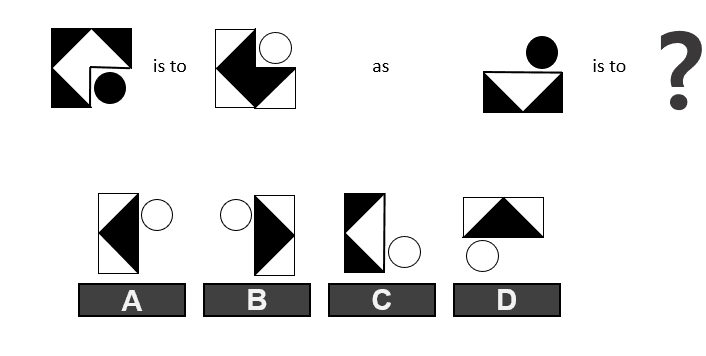
The correct answer is B.
Explanation:
Two steps create the transition between elements ONE and TWO:
Step 1 – the entire element rotates 90 degrees counterclockwise.
Step 2 – sections that were black become white and sections that were white become black.
In order to maintain the analogy, element THREE must go through the same process:
Step 1 – the entire element rotates 90 degrees counterclockwise. At this point, the element will look like this:

Note that you can already choose the correct answer based on this observation as only answer B is in the appropriate orientation.
Step 2 – black and white sections switch colors. Answer B maintains this observation, too.
Series Completion Questions
These questions present you with a series of shapes or figures following a certain pattern. Your task is to complete the series by selecting the shape or figure that comes next. They assess your pattern recognition and logical reasoning skills. To perform well on these questions, you need to be observant, able to identify patterns, and think logically.
Try a Figural Series Completion Sample Question
Which of the figures below the line will replace the question mark, following the sequence of figures shown?
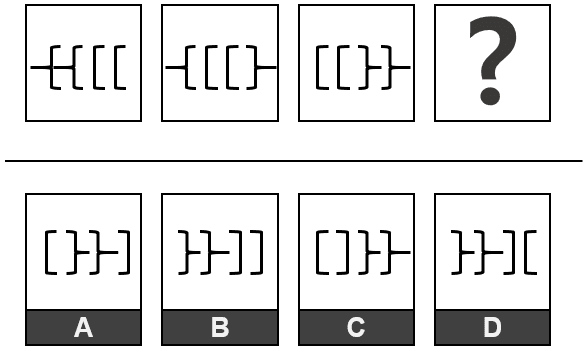
The correct answer is A.
Explanation: Each element contains four brackets aligned horizontally. From left to right, the leftmost bracket of an element becomes the rightmost bracket of the next element. In its new location, the bracket rotates 180 degrees and faces the other opposite direction. In the missing element, the simple bracket moves to the rightmost position and faces the same direction as the curly brackets, as presented in answer A.
Matrix Completion Questions
These questions present you with a matrix of shapes or figures with one missing element. Your task is to complete the matrix by selecting the shape or figure that fits the pattern. They assess your ability to understand complex patterns and your spatial reasoning skills. To excel in these questions, you need to be able to think in multiple dimensions and analyze complex patterns.
Try a Matrix Completion Sample Question
Which of the following should replace the question mark (?) to complete the pattern?
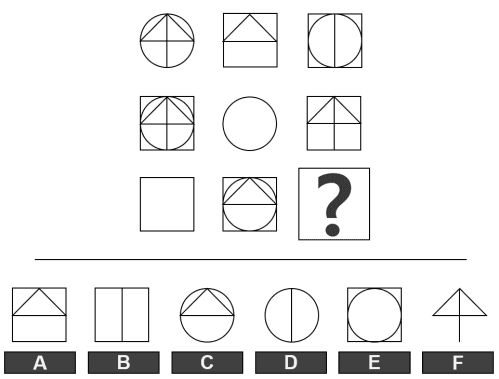
The correct answer is C.
Explanation: Take any two elements of one column or of one row and compare them. If they share a feature, then the third element of that column/row does not include that same feature. On the contrary, if there is a feature that appears in only one of them, it is included in the third element as well.
For example, the left column – the top and the middle elements are identical except for the square that surrounds the middle element. Therefore, none of the features comprise the bottom element but the surrounding square.
The missing element – elements 7 and 8 of the bottom row – share one feature, a square. The features inside the square of element 8 are unique to element 8, and element 7 has no unique features. The missing element, thus, is identical to the unique features of element 8.
Remember, the Abstract Reasoning Section is about your ability to think logically, recognize patterns, and solve problems. It’s about how you think, not what you know. So, as you prepare for this section, focus on honing your analytical skills, improving your spatial awareness, and strengthening your ability to think logically and critically.
Did you know?
The Talogy Caliper assessment typically includes two parts: Personality and Abstract Reasoning. Instead of a single “pass/fail” score, it produces a profile that highlights workplace strengths and potential development areas. It’s usually taken online and used by employers to support hiring and development decisions.
Caliper Preparation Strategies
- Understand the Test Structure: Familiarize yourself with the two main sections of the test—Abstract Reasoning and Personality. Understanding the types of questions you’ll encounter will help you know what to expect and reduce test anxiety.
- Practice Abstract Reasoning Questions: Enhance your cognitive abilities by practicing similar types of questions. This includes number series, visual analogies, series completion, and matrix completion questions. There are numerous resources available online that can help you practice these skills.
- Reflect on Your Personality Traits: The Personality Section is about understanding your unique behavioral tendencies. Reflect on your strengths, weaknesses, and typical behaviors. This self-awareness will help you answer the personality questions honestly and consistently.
- Take Practice Tests: Practice tests can help you familiarize yourself with the test format and timing. They can also help you identify areas where you need to improve. Remember, the goal is not to memorize answers, but to understand the reasoning behind them.
- Develop a Study Schedule: Consistency is key when preparing for the Caliper Assessment Test. Develop a study schedule that allows you to practice regularly. This will help you build confidence and improve your test-taking skills.
- Stay Healthy: Your physical health can impact your cognitive abilities. Ensure you’re getting enough sleep, eating a balanced diet, and exercising regularly. This will help you stay focused and perform at your best on test day.
Test Features
Overview of the Caliper Assessment Test
| Aspect | Description |
|---|---|
| Purpose | To measure a candidate’s potential as a successful employee |
| Format | Multiple-choice test |
| Sections | Abstract Reasoning and Personality |
| Duration | Typically about 2 hours |
| Administration | Primarily online |
The table above provides an overview of the Caliper Assessment Test, including its purpose, format, sections, typical duration, and administration method.
Purpose of the Test
The primary purpose of the Caliper Assessment Test is to measure a candidate’s potential as a successful employee. It evaluates a wide range of skills, including leadership potential, problem-solving abilities, time management skills, and interpersonal communication. The test is designed to predict job performance across a variety of roles and industries, making it a versatile and valuable tool for employers.
Comprehensive Assessment
The Caliper Assessment Test provides a comprehensive evaluation of a candidate’s cognitive abilities and personality traits. It comprises two main sections—Abstract Reasoning and Personality—each designed to assess different aspects of a candidate’s potential.
Untimed Test
Unlike many other assessments, the Caliper Assessment Test is untimed. This allows candidates to take the time they need to accurately represent their abilities. However, it typically takes about two hours to complete.
Online Administration
The Caliper Assessment Test is typically administered online, making it accessible to candidates from anywhere. This also allows for quick and efficient scoring and reporting of results.
Scientifically Validated
The Caliper Assessment Test is a valid and reliable tool, backed by over 50 years of scientific research. Its results have been proven to correlate with job performance, making it a reliable predictor of a candidate’s potential success in a role.
Used for Various HR Purposes
While primarily used for hiring decisions, the results of the Caliper Assessment Test can also be used for team building, leadership development, and employee coaching. This makes it a versatile tool for various human resources functions.
Common Names of the Caliper test
The Caliper Assessment Test is known by several common names, including:
- Caliper Profile
- Caliper Personality Profile
- Caliper Test
- Caliper Metrics
- Caliper Pre-Employment Assessment
- Caliper Talent Management Assessment
Technical Facts
Fast Facts (tl;dr)
- Format: Multiple-choice + rating items
- Main parts: Personality + abstract reasoning
- Timing: Untimed; usually 60–75 minutes
- Delivery: Usually online; sometimes paper
- Results: Profile, not pass/fail
- Use cases: Hiring and development
Test Format
The Caliper assessment combines an Abstract Reasoning component (pattern questions with correct/incorrect answers) and a Personality component (work-style questions with no right/wrong answers, often in Most/Least and Rating formats).
Test Duration
Caliper is untimed. Most people complete it in about 60–75 minutes, but the time can vary based on pace, role, and assessment configuration.
Test Administration
Most candidates take Caliper online. In some contexts, a paper version may also be used.
Scoring System
There is no traditional “test score.” Results are typically reported as a profile that summarizes work-related tendencies and potential fit for certain roles.
Test Validity
Caliper is a professionally developed workplace assessment used in selection and development. Specific validation details can vary by employer and job family.
Test Languages
Caliper is offered in multiple languages. The exact list depends on the employer’s setup and region.
Test Usage
Organizations use Caliper to support hiring decisions and, in some cases, employee development (such as coaching, team development, and leadership programs).
Competencies and competency areas
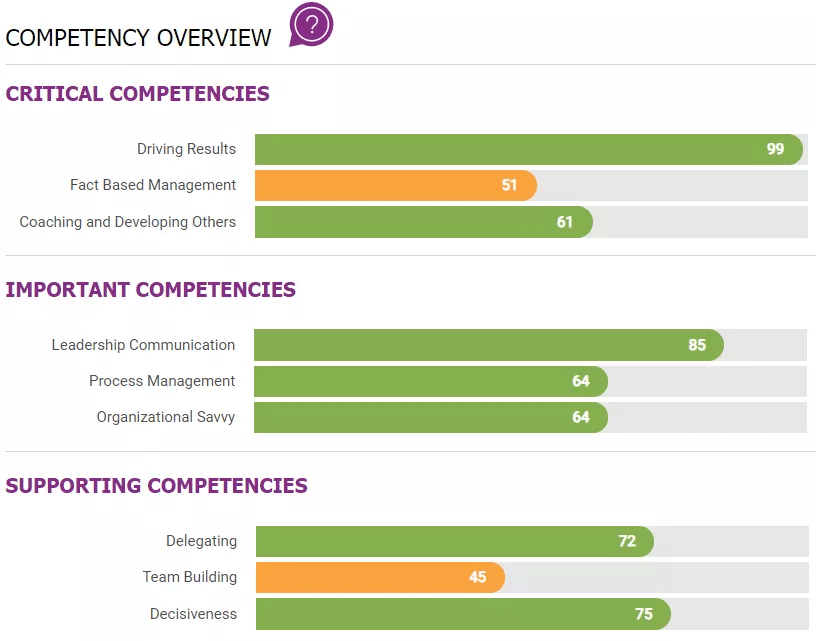
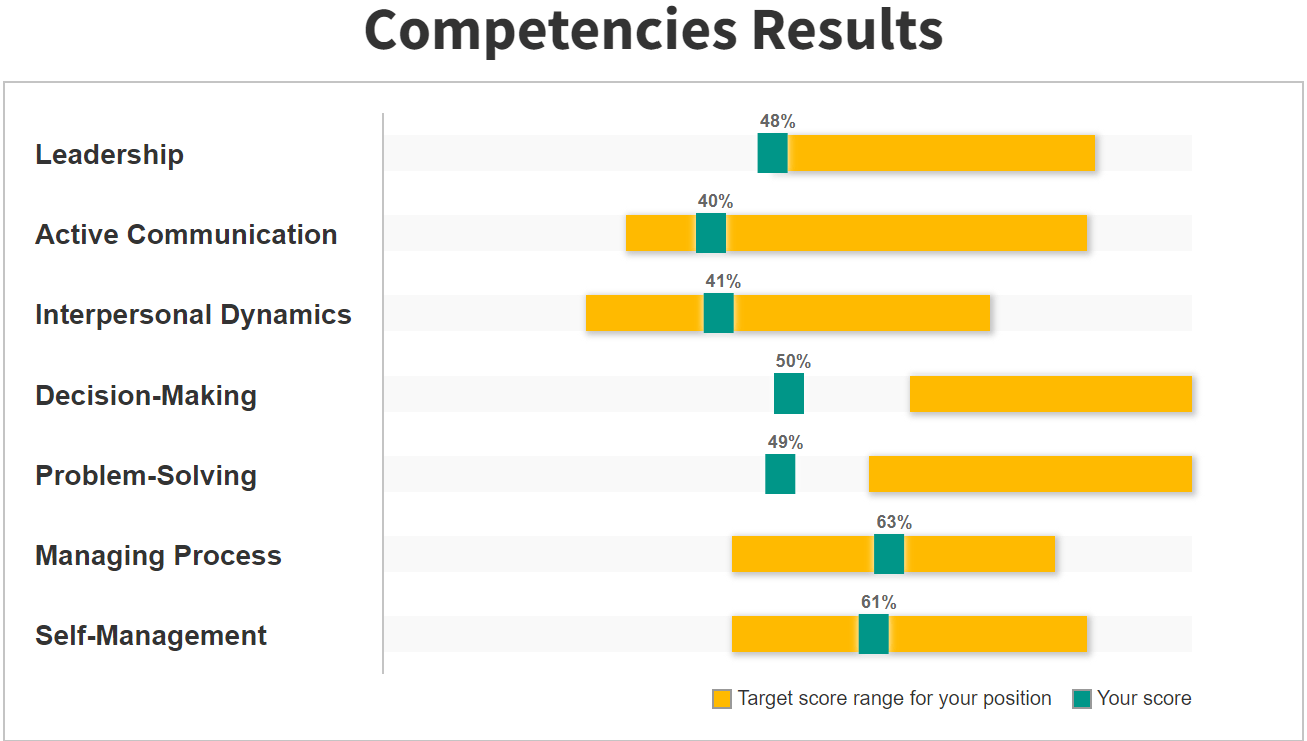
Caliper reports can include competency-based insights depending on the employer and the report package selected. Competency models and the number of competencies shown may vary by organization and role.
Results Scale and Interpretations
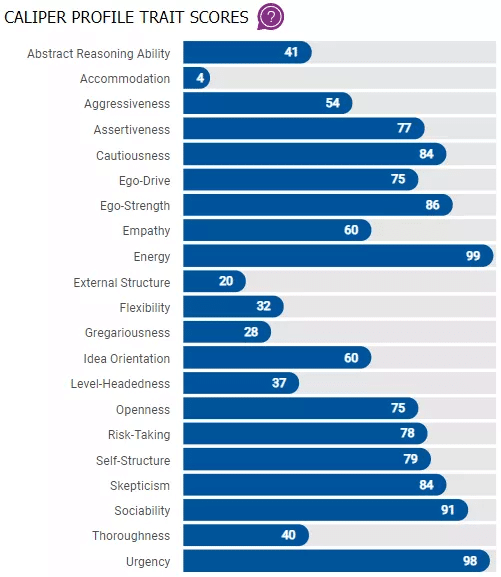
Caliper results aren’t presented as a single “test score” in the traditional sense. Instead, employers receive a report built from your personality trait results (and abstract reasoning) and—when used—compared against a job model to support hiring or development decisions.
| Component | What It Means |
|---|---|
| Trait percentiles | Each trait is scored as a percentile relative to others in the candidate’s country of employment |
| Abstract Reasoning | A cognitive component included alongside the personality traits |
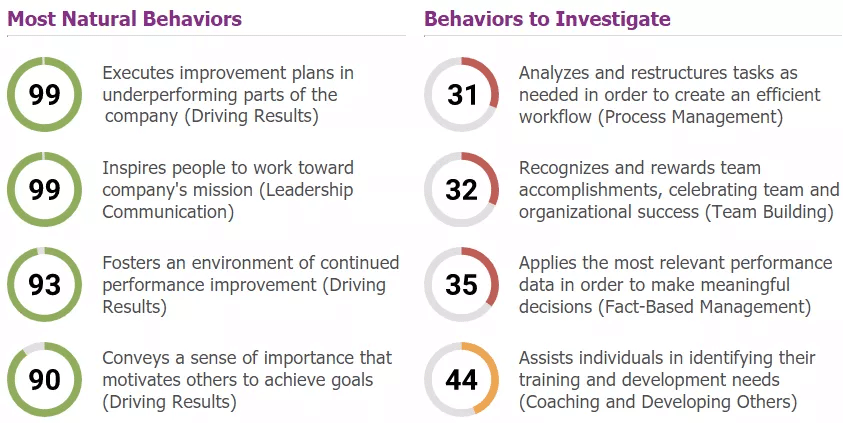
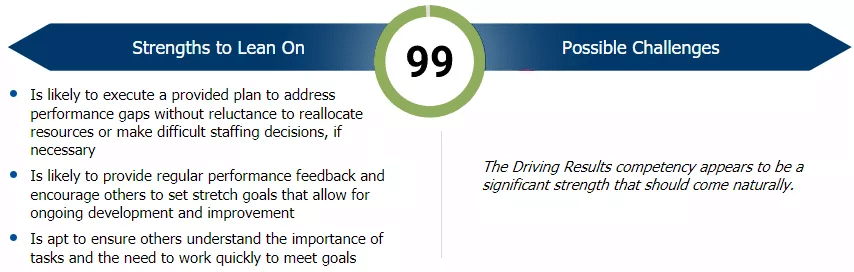
| Behavior / competency indicators | Traits can be combined into behavior and competency predictions (varies by report) |
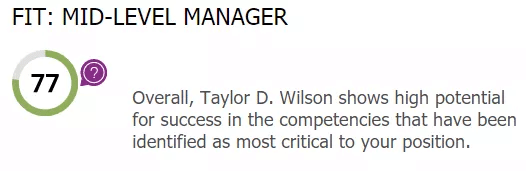
| Job-Fit Score | Overall fit to a job model on a 1–99 scale (when a job model is applied) |
What “percentiles” mean
Percentiles describe where a result sits relative to a reference group (for example, a percentile of 50 indicates a typical/average level for that trait in that norm group).
Job-Fit Score (when used)
When Caliper is matched to a specific job model, employers may receive a Job-Fit Score from 1 to 99, with interpretation bands (for example, 1–39, 40–59, etc.) used as guidelines.
Will candidates see the report?
Typically, candidates don’t receive the Caliper report directly; any feedback is handled by the employer that requested the assessment.
Caliper Assessment FAQs
The Caliper Assessment is a pre-employment assessment used by employers to understand how you think and how you’re likely to behave at work. It’s commonly used to support hiring decisions and, in some cases, employee development.
It measures two broad areas: abstract reasoning, which focuses on pattern-based problem solving with correct and incorrect answers, and work-style tendencies, which focus on behavioral preferences and traits with no right or wrong answers.
Most candidates see two main parts. The Personality Assessment typically includes Most/Least (Forced-Choice) items and Rating (Scale) items, while the Abstract Reasoning part uses multiple-choice pattern questions.
The assessment is untimed. Many candidates finish in about 60–75 minutes, but the total time can vary by person and by employer setup.
There isn’t a single traditional “test score.” Employers usually receive a profile that summarizes work-style tendencies and may include comparisons and role-related interpretations, depending on the report used.
Employers use the report to understand how a candidate’s work style and reasoning may align with the role’s needs. It is typically one input among several, alongside interviews and experience.
In most hiring processes, it is not treated as a pass-or-fail exam. The goal is to understand fit and work-style patterns relevant to the role.
It is a professionally developed workplace assessment used in hiring and development. The exact validation evidence and reporting approach can vary by employer and job family.
You can prepare by practicing abstract reasoning question types, getting comfortable with Most/Least and Rating formats, and answering the personality items honestly and consistently.
Not always. Some organizations also use Caliper results for development purposes such as coaching, leadership development, and team discussions.
Caliper Assessment Test Tips
Know what you’re walking into
Caliper typically has two parts: Personality (Most/Least + Rating) and Abstract Reasoning (patterns with one correct answer). Knowing the flow helps you stay calm and efficient.
Treat the Personality part like a consistency check
Answer as the “you at work,” not the “ideal candidate.” Caliper looks for stable patterns, especially around pressure, teamwork, and pace.
Handle Most/Least strategically
Most/Least items force trade-offs. Don’t chase what sounds impressive—choose what is most true and least true for you.
Keep Ratings steady
Rating items work best when you respond naturally and consistently. Avoid swinging to extremes unless that truly reflects you.
Use a quick rule routine for Abstract Reasoning
Scan for common rules: count, rotation, position, shading, and symmetry. Test one rule at a time instead of guessing.
Pace yourself (it’s untimed)
Untimed means you can think, not that you should get stuck. If a question stalls you, move on and return later.
Set yourself up to focus
Use a bigger screen if possible, silence notifications, and block uninterrupted time—especially if taking it online.
Administration
Test location: Caliper is usually taken online. You can typically complete it from anywhere with a reliable internet connection and a quiet space.
Test schedule: In hiring processes, the employer sets the timeline and sends you an invitation link. Some employers may require completion within a time window rather than at an exact hour.
Test format: Computer-based assessment with two main parts: Personality (Most/Least and Rating items) and Abstract Reasoning (multiple-choice pattern questions).
What you need: No special materials are required, but having scratch paper and a pen can help for the abstract reasoning questions.
Cost: If you’re taking Caliper for a job application, it’s typically paid for by the employer.
Retake policy: Retakes depend on the employer’s process and the role. If you’re unsure, ask the recruiter or HR contact who sent the invitation.
Test Provider
The Caliper assessment is a workplace assessment developed by Caliper, which is part of Talogy. Employers use it to better understand candidates’ work-style tendencies and potential fit for specific roles, and it’s also used in some organizations for employee development.
Caliper is used across industries and regions and is available in multiple languages (language options can vary by employer setup). Talogy also provides other assessment and talent solutions, including tools used for leadership and development programs.
Information Sources
Disclaimer – All information and preparation materials on iPREP are created for tutoring purposes. iPREP is not affiliated with Talogy, Caliper, or any other company mentioned.
Free Caliper Assessment Practice Test
Start with free Caliper Assessment practice questions that give you a clear feel for the personality, cognitive, and reasoning tasks used in the Talogy Caliper assessment. The free practice introduces common Caliper-style tasks such as workplace personality statements, most/least forced-choice items, rating-scale questions, number series, visual analogies, and pattern recognition.
Use the free practice to understand the question format, response style, and level of focus required before moving into full preparation. For complete practice, iPREP’s full Caliper course includes realistic assessment-style questions, detailed explanations, video lessons, and targeted practice for the main Caliper personality and cognitive question types.
Abstract Reasoning Question 1 of 8
What is the next number in the following series of numbers?
-1 2 1 3 4
- 5
- 7
- 1
- 6
The correct answer is 7.
Explanation:
Look at the differences between the numbers:
-1 2 1 3 4
+3 -1 +2 +1
While there is no simple pattern to the differences, you do get a hint: all the elements of the series of the differences, except the first one, appear in the same order as the numbers of the original series. You can assume that the next difference will be +3 as it is the number that follows 1 in the original series.
Therefore, the next number of the series is 4 + 3 = 7
The complete logic of the series is that every term in the series equals the sum of the previous two terms.
It can be formally written as follows: an+2 = an + an+1
For learning purposes, here is the series, had it continued for several more steps:
-1 2 1 3 4 7 11 18 29 47
+3 -1 +2 +1 +3 +4 +7 +11 +18
And for general knowledge: Did you know that any series of numbers in which each number (third in sequence and above) is the sum of the two preceding numbers is known as the Fibonacci sequence, named after Italian mathematician Leonardo of Pisa, known as Fibonacci?
Abstract Reasoning Question 2 of 8
What is the next number in the following series of numbers?
1 1 2 4 6 18 21
- 84
- 63
- 26
- 24
The correct answer is 84.
Explanation:
Look at the differences between the numbers. After writing them on your scratch paper, you will notice two alternating patterns:
1 1 2 4 6 18 21
*1 +1 *2 +2 *3 +3
The first pattern is multiplication; in every second step, the multiplier increases by 1. The second pattern is an addition; in every second step, the increment increases by 1 as well. According to this observation, the next number of the series follows the first pattern and is equal to the last number times four (*4).
The next number of the series is 21*4 = 84
For learning purposes, here is the series, had it continued for several more steps:
1 1 2 4 6 18 21 84 88 440 445
*1 +1 *2 +2 *3 +3 *4 +4 *5 +5
Things to consider:
- When you see that the number hasn’t changed in one of the steps of the series, you should consider two main options:
- The difference represents a step of “+0”, which is usually a part of a sub-series of increments (+0, +1, +2, +3, etc.) or a sub-series of diminishing increments (+2, +1, +0, -1, etc.)
- The difference represents a step of “*1”, which is usually a part of a sub-series of incremental multiplication (*1, *2, *3, etc.)
- Think of the difference between the numbers 2 and 4. It can be equivalently described as an addition of 2 or multiplication by 2. Similarly, the difference between 1 and 2 can be equivalently described as an addition of 1 or multiplication by 2.
Remember these examples and try to recall them if you encounter these steps in future problems.
Abstract Reasoning Question 3 of 8
Which of the figures below the line will replace the question mark, following the sequence of figures shown?
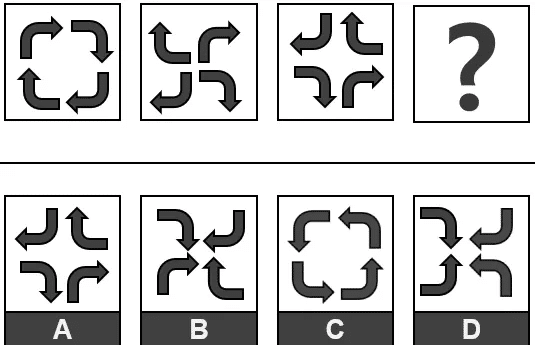
The correct answer is B.
Explanation: Each element in the sequence contains four inner shapes. Although it may seem as if these four shapes create a meaningful structure, they actually don’t. In each step in the sequence, each of the four elements rotates 90 degrees counterclockwise. In the missing element, each of the inner shapes would complete a 270-degree rotation in comparison to the first element.
An alternative explanation is that you can imagine each element as having four quarters, each holding a different shape. At each step within the sequence, each of the inner shapes moves to the neighboring quarter, going clockwise.
Tips:
- Remember to look for simple solutions.
- It is often easier to follow the logic of one or two of the inner shapes. In many cases, that would be enough to identify the correct answer from the distractors.
Abstract Reasoning Question 4 of 8
Which of the figures below the line will replace the question mark, following the sequence of figures shown?
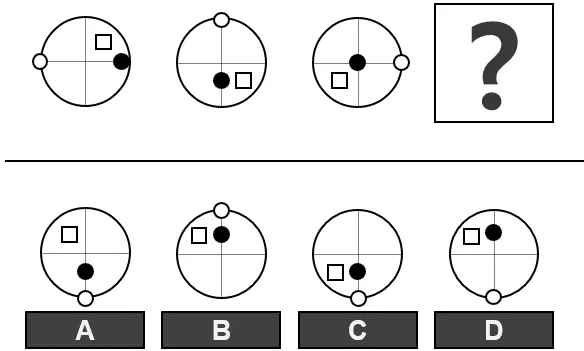
The correct answer is A.
Explanation:
Each element is comprised of a square divided by two lines and of three shapes—a black circle, a white circle, and a white square.
The logic of the series is based on two processes:
- In each step, the element is rotated 90 degrees clockwise. The rotation cannot be recognized if one only looks at the big circle and the lines because of its symmetry; however, you can follow the white circle and the white square and realize that they maintain their relative positions. Assuming the trend continues, and the element is rotated 90 degrees again, then answers A and D represent the expected positions of the white circle and the white square.
- In addition to the rotation, the black circle moves along the line it is initially positioned on. In each step, the black circle gets closer to the white circle, which is the case in answers A, B, and C.
Altogether, only answer A displays an accurate combination of both of the processes.
Tips & Tricks:
- Symmetry is an element that may be very confusing in abstract reasoning tests. In order to avoid this confusing factor, focus on a single distinct feature and try to assess the nature of the general logic through it.
Abstract Reasoning Question 5 of 8
Which of the following should replace the question mark (?) to complete the pattern?
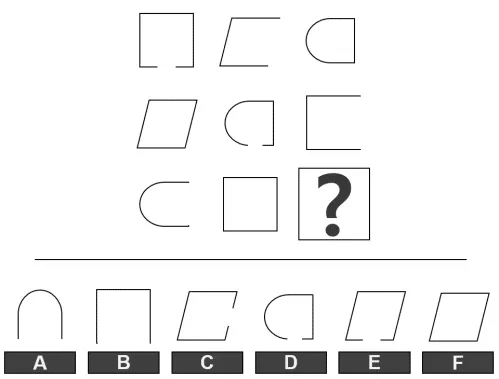
The correct answer is E
Explanation:
The matrix follows two logical rules:
The shape is determined by the 2-4-9 diagonal:
Elements 1,6,8 are squares; elements 3,5,7 have a rectangular right side and a semi-circle left side; elements 2,4 are parallelograms. Therefore, the correct answer should be a parallelogram too.
The outline is determined by the 1-5-9 diagonal:
Elements 3,4,8 have a complete outline; elements 2,6,7 are missing the right side of the outline; elements 1,5 have a gap in the bottom part of the outline. Therefore, the correct answer should have a gap too.
Option E satisfies both rules.
Tips & Tricks:
- Almost every time that you encounter a matrix with two sets of three elements that have a certain feature, and another two visible elements that have a different realization of the same feature – the correct answer will include a similar feature to that of the latter two elements. You can use this method in order to systematically eliminate options.
Abstract Reasoning Question 6 of 8
Which of the following should replace the question mark (?) to complete the pattern?
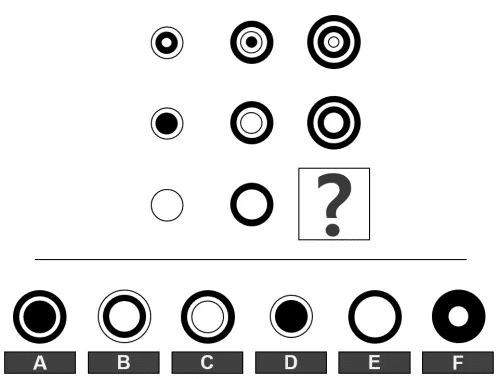
The correct answer is A
Explanation:
The solution is arrived at by understanding the logic of the matrix by columns.
Each of the elements of the top row includes several circles one on top of the other. Smaller circles are always on top of larger ones. With every step down, the top circle is removed.
For example, in the left column, the top element is comprised of three circles. In the middle element, the top little white circle is removed and it makes the black circle below it more visible. In the bottom element, the black circle is also removed and only the larger white circle remains.
In the right column, the top element includes five circles. The missing element is a product of removing the top two circles, which means that a black circle would remain on top, and beneath it, there would be a larger white circle and an even larger black circle – option A.
Tips & Tricks:
It is “tempting” to provide a logical explanation for the differences between the elements of the same row. While you can propose some explanation, it is less intuitive and is merely a more complex description of the differences by column. If you encounter cases in which you can provide a valid, yet complex logical explanation to one perspective of the matrix (i.e. logic by rows/columns/diagonals/etc.), try to take a step back and look at the matrix from a different perspective. It may make your solution much simpler.
Abstract Reasoning Question 7 of 8
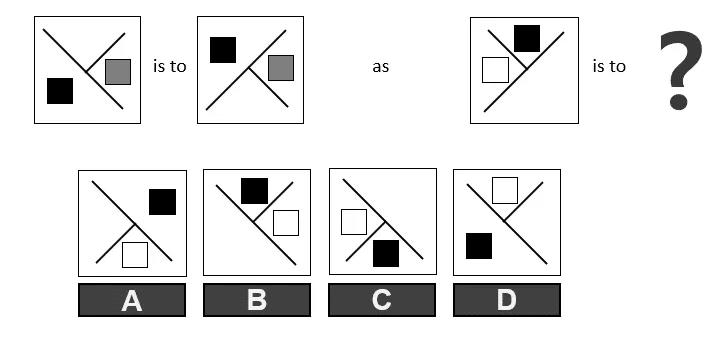
The correct answer is C.
Explanation:
Element TWO is a vertical flip of element ONE. If you vertically flip element THREE, you get answer C, which is element FOUR.
Tips & Tricks:
- Note that if you only examine the perpendicular lines in element ONE, it seems as if they need to be rotated 90 degrees clockwise in order to get to their position in element TWO. This rotation, however, does not explain the rest of the differences between elements ONE and TWO.
Oftentimes it is difficult to distinguish between rotations and flips, especially in regard to elements with some symmetrical features. Remember this fact in future cases where you perceive an analogy as a rotation or as a flip but you cannot completely explain the differences this way.
Abstract Reasoning Question 8 of 8
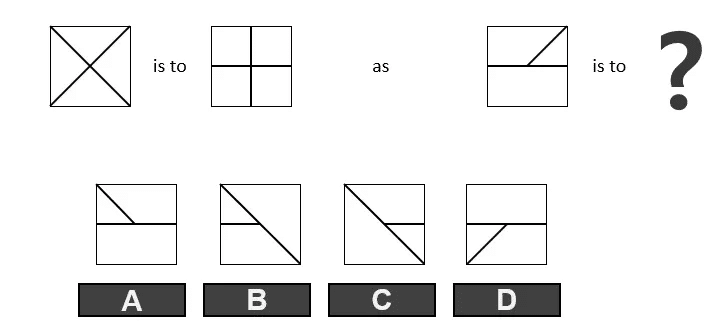
The correct answer is C.
Explanation:
Imagine that each square is a “clock” with a few hands and eight “hours.” This image highlights the “hours” of the clock and one of the hands, which will be discussed below –

Between elements ONE and TWO, each of the hands has moved one “hour” clockwise.
Answer C is analogous to element THREE in the same manner. The two hands which form a horizontal line in element THREE move one hour clockwise and form a diagonal line from the top-left corner to the bottom-right corner. The third diagonal hand moves and forms a horizontal line that points to the right.
Personality Rating Question 1 of 2
Statement:
I appreciate alternative and unordinary ways of thinking.
Response Options (Select One):
○ Strongly Agree
○ Agree
○ Mildly Agree
○ Neither Agree nor Disagree
○ Mildly Disagree
○ Disagree
○ Strongly Disagree
Personality Scale: Openness
What this statement assesses:
This question evaluates a candidate’s inclination toward creativity, curiosity, and receptiveness to new ideas.
Interpretation of Responses:
- High Agreement (Strongly Agree/Agree): Indicates that the individual is open-minded, values innovation, and readily entertains unconventional perspectives. Such applicants may excel in roles requiring creativity and adaptability.
- Low Agreement (Disagree/Strongly Disagree): Suggests a preference for traditional methods and familiarity over novelty. These candidates may be more comfortable in structured environments with well-established routines.
Personality Rating Question 2 of 2
Statement:
I get things done as quickly as possible.
Response Options (Select One):
○ Strongly Agree
○ Agree
○ Mildly Agree
○ Neither Agree nor Disagree
○ Mildly Disagree
○ Disagree
○ Strongly Disagree
Personality Scale: Urgency
What this statement assesses:
This question evaluates a candidate’s level of efficiency, speed of execution, and drive to complete tasks promptly.
Interpretation of Responses:
- High Agreement (Strongly Agree/Agree): Indicates a candidate who is motivated, time-conscious, and likely to excel in fast-paced environments or roles where meeting tight deadlines is critical.
- Low Agreement (Disagree/Strongly Disagree): Suggests a more relaxed pace, possibly valuing thoroughness over speed. Such applicants may be more suited to roles emphasizing careful attention to detail rather than rapid task completion.
Personality Ranking Question 1 of 2
Select the one statement that best describes you (Most) and the one that least describes you (Least)
| Most | Least | |
|---|---|---|
| I prefer to avoid conflict rather than confront it when under threat. | ( ) | ( ) |
| I believe that people generally don’t have deceptive intentions. | ( ) | ( ) |
| I may shift focus from one project to another as priorities change. | ( ) | ( ) |
| Taking time to complete tasks doesn’t bother me. | ( ) | ( ) |
What Each Statement Assesses:
- I prefer to avoid conflict rather than confront it when under threat:
Low indication of Aggressiveness – suggests a tendency to maintain harmony rather than assert dominance during conflicts. - I believe that people generally don’t have deceptive intentions:
Low indication of Skepticism – indicates trust in others and a positive view of human nature. - I may shift focus from one project to another as priorities change:
Low indication of Thoroughness – suggests flexibility and adaptability rather than strict adherence to a single plan. - Taking time to complete tasks doesn’t bother me:
Low indication of Urgency – implies comfort with a slower pace and less pressure to rush.
Example Scenarios
If you choose “I may shift focus from one project to another as priorities change” as Most, and “I prefer to avoid conflict rather than confront it when under threat” as Least:
This suggests you adapt quickly to changing priorities while still being willing to confront issues when needed. You may thrive in roles such as Project Coordinator in a fast-moving environment, Operations Manager, or Team Lead.
If you choose “I believe that people don’t have deceptive intentions” as Most and “Taking time to complete tasks doesn’t bother me” as Least:
This reflects a trusting, collaborative approach combined with a drive for timely results. Roles like Customer Success Manager, Account Executive, or HR Coordinator may be a good fit.
Personality Ranking Question 2 of 2
Select the one statement that best describes you (Most) and the one that least describes you (Least)
| Most | Least | |
|---|---|---|
| Before starting a task, I like to have clear instructions and details. | ( ) | ( ) |
| Criticism motivates me to start working with renewed focus. | ( ) | ( ) |
| I prefer the risk of entrepreneurship over a secure position in an established company. | ( ) | ( ) |
| A good manager considers the feelings of others when making decisions. | ( ) | ( ) |
What Each Statement Assesses:
- Before starting a task, I like to have clear instructions and details:
High indication of Thoroughness – the person values structure, clarity, and thorough planning before action. - Criticism motivates me to start working with renewed focus:
High indication of Ego-Strength – the individual responds positively to feedback, using it to improve performance. - I prefer the risk of entrepreneurship over a secure position in an established company:
High indication of Risk-Taking – the person is comfortable with uncertainty and willing to embrace new ventures. - A good manager considers the feelings of others when making decisions:
High indication of Empathy – the individual values understanding, compassion, and emotional intelligence in leadership.
Example Scenarios:
If you choose “A good manager considers the feelings of others…” as Most and “I prefer the risk of entrepreneurship…” as Least:
This suggests you value stability and empathetic leadership more than uncertainty and risk. You may thrive in supportive, team-focused roles such as Team Supervisor, HR Manager, or Customer Service Lead, where relationship-building and understanding others are key.
If you choose “Criticism motivates me…” as Most and “Before starting a task, I like to have clear instructions…” as Least:
This indicates you respond well to challenge and can act without detailed guidance. You may excel in dynamic environments where feedback fuels improvement, such as Sales Representative, Operations Team Lead, or Business Development Associate.
About the course
Includes 16 practice tests (1 full-length simulations)
10 Learning hours · 16 Tests · 324 test items · 110 Videos
This course prepares you for the Talogy Caliper™ experience by covering both major components: the Personality Assessment and the Abstract Reasoning section. You’ll practice the main personality formats (Most/Least (Forced-Choice) and Rating (Scale)) and build comfort answering consistently. You’ll also drill the core abstract reasoning question types, then complete full-length simulations to rehearse the overall flow.

Skills you will learn
- Behavioral tendencies and work-style preferences · Consistent self-reporting · Numerical reasoning and pattern recognition · Spatial reasoning and visual relationships · Logical reasoning and problem solving · Multi-dimensional pattern analysis
Curriculum
Course Introduction
- How the Caliper is structured
- How to use practice effectively
About Caliper Assessment
- What employers measure with Caliper
- Personality and abstract reasoning components
Personality/Behavioral Questions
- Most/Least (Forced-Choice) practice
- Rating (Scale) items and consistency
How to Pass Personality Tests
- Answer as you at work
- Avoid extremes unless truly accurate
- Stay consistent across similar statements
Figural Inductive Reasoning Questions (3)
- Visual analogy, series, and matrix practice
- Focus on rules, patterns, and logic
Visual Analogy Guide (3)
- Rotations, reflections, shading, and combinations
- Match relationships between paired figures
Matrix Completion Guide (4)
- Analyze rows and columns together
- Apply rule to missing cell
Figural Series Completion Guide (3)
- Identify progression across changing visuals
- Choose next figure in sequence
Number Series Questions (4)
- Differences, ratios, cycles, and mixed rules
- Multiple-choice, fill-in, and timed practice
Full-Length Caliper Test Simulations (2)
- Full test flow from start to finish
- Personality profile simulation and inquisitive mode
Course Conclusion
- Wrap-up and next steps for review
Reviews

Rhys G*******
May 9, 2026 at 8:20 AM
The iPREP preparation course for the Caliper Assessment is truly outstanding. It provides a very thorough, high-quality experience featuring both comprehensive written guides and engaging videos, allowing you to choose the learning method that best fits your preference, or utilize both for maximum impact. I would highly recommend iPrep for anyone aiming to succeed; it is incredibly well worth the value for the results it delivers
Matthew E****
February 11, 2026 at 7:48 AM
The IPrep course worked for me. I was very nervous going into this next step of the application process, but with 100% focus on the material I have progressed to the next step towards a great job. I recommend Focus, relax and be confident this prep course will get you there. Because it will.
Sven R***
October 20, 2025 at 10:07 PM
wow! what a class! I have to say it is worth more than $39.95 and for that price you are losing money not buying it!!
shirane h********
October 18, 2025 at 1:55 PM
I was very nervous about taking the exam, but thanks to this service I was able to get used to it beforehand.
Neal S*****
October 2, 2025 at 3:28 PM
I find this prep course very helpful. It has made me think more about myself and how I interact at work.
Valerie K*****
August 15, 2025 at 4:57 PM
This was not helpful to me for my recent Calipers test. I apparently 'failed' it even though I aced all of the pattern/puzzle questions...not sure how one can fail a personality test, but iPrep didn't give an overall numerical result for a practice test. Also I didn't see any of the pattern/puzzle questions on my exam and I went through every question on iPrep.
iPrep
August 16, 2025 at 5:52 PM
Hi Valerie. Sorry to hear the prep didn’t help as expected. The Caliper test can be frustrating since it’s mostly about personality fit—not correct answers—and employers assess results based on their own criteria. We appreciate the feedback and are always working to improve.
Guy R*********
June 26, 2025 at 9:12 PM
I am raving about my experience. iPrep provide an "Ace your test" booklet and extent access to the resources if you rave about your experience, which is helpful.
Jessyca H*****
May 12, 2025 at 3:19 PM
The real Caliper test looked and tested very differently; for example, the Visual Analogy and Numbers Series were a lot more difficult than in the iPREP, so to me, the iPREP wasn't much of a help.
iPrep
May 13, 2025 at 6:11 AM
Thanks for your feedback Jessyca. While our prep has met the expectations of most students, we’re sorry it didn’t match your experience. The Caliper can vary by employer, and we’d appreciate any details you’re willing to share to help us improve.