Reviewed by Tamir Rubin, Head of Product at iPREP • Updated February 2026
PI Cognitive Assessment Sample Question
Choose the word that is most nearly the opposite of “COMMEND”:
- comply
- certify
- criticize
- prevail
- dissuade
PI Cognitive Assessment
50 questions • 12 minutes
- Timed learning-speed and reasoning measure
- Numerical, verbal, abstract pattern questions
- Score = number of correct answers within the 12-minute time limit
- Typically no penalty for wrong
- Guess, keep pace, avoid stalling
PI Behavioral Assessment
adjective checklists • no time limit
- Free-choice adjective checklist format
- “Self-concept” (how others expect you to behave) selections
- “Self” selections for comparison
- No right or wrong profile
- Measures workplace behavioral drives
Test Duration
Total time: varies by employer and assessment setup
Cognitive is always 12 minutes; Behavioral has no time limit and is usually completed in a few minutes. Confirm which assessments you’ll take and any accommodation timing.
Test Breakdown & Sample Questions
The Predictive Index is commonly used with two separate assessments. Some employers use one of them, and others use both.
Predictive Index assessments at a glance
| Assessment | What it measures | What to expect | Time |
|---|---|---|---|
| PI Cognitive Assessment | Learning speed and problem-solving using numerical, verbal, and abstract (non-verbal pattern) reasoning | 50 multiple-choice questions | 12 minutes |
| PI Behavioral Assessment | Workplace behavioral preferences (not right/wrong) | Free-choice adjective checklist (two lists) | No time limit |
What you should know before you start
- The Cognitive Assessment is a fast, timed reasoning test. Most people find the time limit to be the main challenge.
- The Behavioral Assessment is a short, untimed questionnaire. There’s no “correct” profile—aim for honest, consistent answers.
- Not every employer uses both assessments, and how results are used can vary by role and company.
PI Cognitive Assessment: Question Types
The PI Cognitive Assessment is a fast, timed test that focuses on three core areas of reasoning:
- Numerical reasoning: Working with numbers, basic math, and number patterns.
- Verbal reasoning: Understanding written language and reasoning with words.
- Abstract reasoning: Identifying patterns and relationships in non-verbal information (often shapes or sequences).
Tip: In many practice resources, “non-verbal” and “logical” are used as broad labels, but on the PI Cognitive Assessment they typically show up as part of abstract reasoning (pattern-based logic).
The PI Cognitive Assessment is 50 questions in 12 minutes, so speed and accuracy both matter.
| Question type | What it assesses | Skills needed |
|---|---|---|
| Numerical reasoning | Comfort with numbers and quantitative patterns | Basic arithmetic, estimation, pattern recognition |
| Verbal reasoning | Understanding and reasoning with written language | Vocabulary-in-context, reading comprehension |
| Abstract reasoning | Non-verbal pattern-based logic | Rule-finding, visual pattern recognition |
Example Question: Numerical Reasoning
If a car travels at a constant speed of 60 miles per hour, how far will it travel in 2.5 hours?
A) 120 miles
B) 150 miles
C) 180 miles
D) 200 miles
Correct Answer: B) 150 miles
Explanation: To find the distance traveled, you multiply the speed by the time: 60 miles per hour×2.5 hours=150 miles60miles per hour×2.5hours=150miles
Why the Wrong Answers Are Wrong:
- A) 120 miles: This would be the distance if the car traveled for only 2 hours at 60 miles per hour.
- C) 180 miles: This would be the distance if the car traveled for 3 hours at 60 miles per hour.
- D) 200 miles: This answer doesn’t correspond to any logical calculation based on the given speed and time.
This question assesses your ability to apply basic arithmetic and understanding of distance, speed, and time relationships. Understanding why the wrong answers are incorrect helps reinforce the mathematical principles involved and can aid in recognizing and avoiding common mistakes.
PI Behavioral Assessment: PI Factors
The PI Behavioral Assessment is a short, untimed questionnaire completed using two adjective lists. You respond twice—once for how you think you’re expected to act at work, and once for how you naturally prefer to act. There are no right or wrong answers.
It summarizes your workplace style across these key factors:
- Dominance: Preference for taking charge, influencing outcomes, and making independent decisions.
- Extraversion: Preference for social interaction, persuasion, and frequent communication.
- Patience: Preference for steadiness, consistency, and a predictable pace.
- Formality: Preference for structure, rules, accuracy, and detail.
- Objectivity: Preference for logic and data in decision-making (often described as shaping how the other factors show up).
Tip: Because it’s a self-report questionnaire, the goal is not to “score high,” but to answer in a way that’s honest and consistent.
The PI Behavioral Assessment is untimed, so it’s better to focus on consistency than speed.
| PI factor | What it reflects | Often associated with |
|---|---|---|
| Dominance | Drive to influence and control | Assertiveness, independence, decision speed |
| Extraversion | Drive for social interaction | Communication, persuasion, teamwork orientation |
| Patience | Drive for stability and consistency | Steady pace, routine preference, persistence |
| Formality | Drive to follow rules and structure | Detail focus, planning, precision |
| Objectivity | Reliance on logic over emotion | Analytical decisions, fact-based judgment |
Example Question: PI BA
Select the adjectives that describe the way in which you’re expected to behave at work.
| assertive | decisive | independent |
| competitive | persuasive | outgoing |
| sociable | energetic | calm |
| patient | steady | accommodating |
| precise | organized | rule-minded |
| detail-focused | analytical | methodical |
The PI Behavioral Assessment isn’t a “right vs wrong” test. It measures behavioral tendencies. You see a prompt and a list of adjectives, and you select the ones that fit. Your results come from the overall pattern of what you pick—not any single word.
PI uses two prompts with the same adjective list: one about how you’re expected to behave at work (“Self-Concept”) and one about how you describe yourself (“Self”). The difference between those two sets can indicate how much you’re adapting to meet job expectations.
Behind the scenes, PI summarizes your pattern into four drives (factors): Dominance (A), Extraversion (B), Patience (C), and Formality (D). Broadly: A = assertiveness/control, B = social energy/influence, C = steadiness/pace, D = structure/precision. The meaning comes from the combination across all four.
When answering, keep the role you’re applying for in mind—especially on the “expected at work” prompt—so you’re thinking about the real demands and culture of that position (not an abstract “ideal employee”).
Did you know?
The Predictive Index assessments are designed to measure how you solve problems under time pressure (Cognitive) and what drives your workplace behavior (Behavioral). They aren’t about memorizing facts—employers use them to understand fit for a role and team. Taken online, the results can also help you recognize your strengths, work preferences, and how you tend to collaborate with others.
Preparation Strategies
1. Understand the Assessments
- Behavioral: Familiarize yourself with the five PI Factors. Reflect on your behavior in different situations.
- Cognitive: Understand the types of questions, including numerical, verbal, and abstract reasoning.
2. Practice Mindfulness for the Behavioral Assessment
- Be honest and authentic. This test is about understanding your natural tendencies, not what you think others want to see.
3. Sharpen Your Cognitive Skills
- Practice numerical, verbal, and logical reasoning questions.
- Focus on improving speed and accuracy.
4. Take Practice Tests for the Cognitive Assessment
- Simulate test conditions to build confidence.
- Analyze your mistakes and learn from them.
5. Develop a Study Schedule
- Plan your preparation over several weeks.
- Include regular breaks to avoid burnout.
6. Read Widely for the Verbal Reasoning Section
- Enhance your vocabulary and comprehension skills by reading diverse materials.
7. Engage in Critical Thinking Exercises
- Solve puzzles, play strategic games, and engage in activities that challenge your logical thinking.
8. Seek Feedback if Possible
- If you know someone who has taken the test, ask for insights and advice.
9. Mind Your Well-being
- Ensure proper sleep, nutrition, and relaxation. Your mental and physical well-being are crucial for optimal performance.
PI Test Features
Purpose
- Behavioral Assessment: Describes your workplace drives and preferences (no right/wrong answers).
- Cognitive Assessment: Measures how quickly you solve problems under time pressure using numerical, verbal, and abstract reasoning.
Together, they help employers understand fit for a role and team.
Format
- Behavioral Assessment: Online, untimed, completed using two adjective lists.
- Cognitive Assessment: Online, timed — 50 questions in 12 minutes.
How they’re used
- The same assessments can be used for different roles and at different points (hiring, team insights, coaching, development). What matters most is how the employer applies the results.
Taking the assessments online
- You’ll see clear on-screen instructions before you begin.
- You typically complete each assessment in one sitting. If you have technical or access needs, follow the employer’s instructions before starting.
Results and interpretation
- Results are usually shown in a visual summary and reviewed by the employer (sometimes with trained users of PI tools). As a test-taker, your best approach is speed-and-accuracy for the Cognitive Assessment and honest consistency for the Behavioral Assessment.
Fairness and accommodations
These assessments are designed for workplace use. If you need an accommodation, request it through the employer or test administrator as early as possible.
Common and Past Names of the PI Test:
The Predictive Index Behavioral & Cognitive Assessments are commonly referred to by various names. Here’s a list of some of the common names:
- Predictive Index (PI) Assessments
- PI Behavioral Assessment
- PI Cognitive Assessment
- Predictive Index Personality Test
- Predictive Index Cognitive Ability Test
- PI Learning Indicator (for the Cognitive Assessment)
- PI Job Assessment
Technical Facts
Fast Facts (tl;dr)
- Behavioral: untimed; usually a few minutes
- Cognitive: timed; 12 minutes
- Cognitive: multiple-choice; no wrong penalty
- Behavioral: free-choice adjective checklist
- Languages: multiple options (varies)
- Results: employer interpretation; score reported
Scoring and response formats
- Behavioral Assessment: you choose adjectives twice; a behavioral profile is generated.
- Cognitive Assessment: you answer multiple-choice reasoning questions; scoring is based on how many you get correct within the time limit.
Time considerations
- Behavioral Assessment: untimed; focus on consistent answers.
- Cognitive Assessment: 12 minutes total; keep a steady pace.
Development, quality, and use
The assessments are designed for workplace use and are commonly used across roles and industries. Employers may treat results as one input among others, and interpretation can vary by role and organization.
Security, privacy, and compliance
Assessments are delivered online and typically follow standard privacy and security practices used in employment testing. For data handling, accommodations, or retakes, follow the employer’s instructions or ask the test administrator before you begin.
Results Scale and Interpretations
PI Cognitive Assessment Scoring and Interpretation
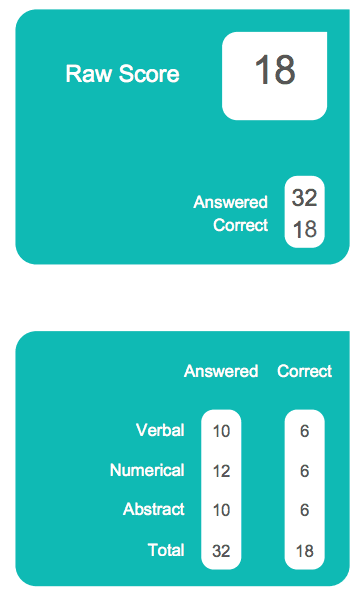
The PI Cognitive Assessment is scored based on how many questions you answer correctly within the time limit. Employers typically review the results as one input among others when evaluating fit for a role.
What your score is based on
- Number correct: Your performance is based on correct answers. There is typically no penalty for incorrect answers, so unanswered questions are usually the bigger risk than wrong ones.
- Converted score: The number-correct result is often converted into a reported score for easier comparison across test-takers.
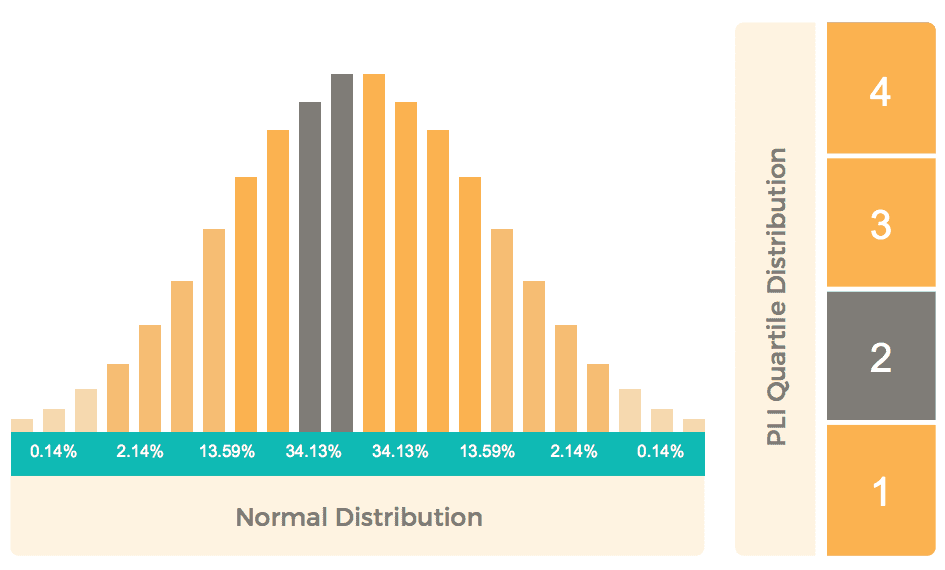
- Percentile (when provided): Some score reports include a percentile showing how a result compares to a reference group. The reference group can vary by employer.
- Score band (when provided): Some reports include a range (a “band”) around the score to reflect normal measurement variation.
How employers tend to interpret results
- Employers usually use the Cognitive score to estimate how quickly someone may learn new information and handle problem-solving demands.
- Interpretation can differ by role, company, and how the assessment is used in their process.
| Report item | What it means | What to keep in mind |
|---|---|---|
| Number correct | Total correct answers | Strong pacing helps most |
| Reported score | Converted score shown on report | You may not see all details |
| Percentile (if shown) | Comparison to a reference group | The comparison group varies |
| Score band (if shown) | A range around the score | Small differences may not matter |
PI Behavioral Assessment Scoring and Interpretation
The PI Behavioral Assessment is not scored as “right or wrong.” It produces a workplace-behavior profile based on how you describe yourself in two different ways.
Domains (two responses + combined view)
- Self: How you naturally see yourself at work.
- Self-Concept: How you believe you’re expected to behave at work.
- Synthesis: A combined view that reflects how your behavior may show up to others on the job.
| Domain | What it reflects |
|---|---|
| Self | Your natural workplace style |
| Self-Concept | Your perceived expectations |
| Synthesis | Likely observed behavior |
Factors (the main profile drivers)
The report summarizes your results across these factors:
- Dominance: Drive to influence outcomes.
- Extraversion: Drive for social interaction.
- Patience: Drive for steadiness and consistency.
- Formality: Drive for structure and rules.
- Objectivity: Preference for logic in decisions (often described as shaping how other factors appear).
Tip: Don’t treat factor results as “high = good.” Employers typically look for alignment with the role and team needs.
How results are used
- Employers may use the profile for hiring decisions, coaching, team insights, and development.
- Interpretation varies by role and organization, and the same pattern can be a strength in one job and a mismatch in another.
| Report element | What it means | What to remember |
|---|---|---|
| Domain views | Natural vs expected vs combined | Differences can be informative |
| Factor pattern | Your workplace drives profile | No single “best” profile |
| Fit discussion | Role/team alignment | Context matters most |
FAQs
They’re two separate assessments employers may use: the Behavioral Assessment (workplace behavior preferences) and the Cognitive Assessment (timed reasoning).
Behavioral is untimed (often a few minutes). Cognitive is timed at 12 minutes.
Behavioral looks at workplace drives (Dominance, Extraversion, Patience, Formality, Objectivity). Cognitive focuses on numerical, verbal, and abstract reasoning.
Behavioral produces a behavioral profile (not right/wrong). Cognitive is based on how many questions you answer correctly within the time limit (typically no penalty for wrong answers).
You can practice for the Cognitive Assessment with timed numerical, verbal, and abstract reasoning drills. For Behavioral, focus on answering honestly and consistently.
Employers use results to understand fit for a role and team, usually alongside interviews, experience, and other screening steps.
It varies by employer. Some share insights during the process, while others do not.
No single passing score. Employers interpret results based on role requirements.
Often yes, but availability can vary by employer setup.
Request accommodations through the employer or test administrator as early as possible, before you start the assessment.
Test Tips
Before you begin
- Check your setup: quiet space, stable internet, charged device
- Open everything early: link/login ready, browser updated
- Minimize distractions: notifications off, tabs closed
Behavioral Assessment tips
- Be authentic: answer as you typically act at work
- Don’t overthink: first instinct is usually best
- Stay consistent: don’t try to “match” a role
Cognitive Assessment tips
- Pace is everything: keep moving
- Skip and return: don’t get stuck
- Use elimination: remove wrong options
- Guess when needed: don’t leave blanks
If something feels off
- Clarify logistics first: timing, link, tech
- Follow employer/test administrator instructions
Administration
Test location: The assessments are delivered online. Depending on the employer, you may take them remotely or at a designated location.
Test schedule: The employer sets the schedule and will share your deadline or time window in advance.
Test format:
- Behavioral Assessment: free-choice adjective checklist (two lists), untimed
- Cognitive Assessment: multiple-choice reasoning, timed (12 minutes)
Materials: Usually no materials are needed. If scratch work or a calculator is allowed, the employer or test administrator will specify it.
Cost: Typically covered by the employer. Candidates usually don’t pay.
Retakes: Policies vary by employer and role. If you’re unsure, ask the test administrator before you begin.
Test Provider
The Predictive Index (PI) is the company behind the PI Behavioral Assessment and PI Cognitive Assessment. Employers use PI’s platform to support hiring and people decisions by learning how candidates tend to work (behavioral drives) and how quickly they solve problems under time pressure (cognitive ability).
As a test taker, the main thing to know is that PI is the publisher of the assessments—not the hiring decision-maker. Your results are sent to the employer, who interprets them in the context of the role and the rest of the selection process.
Information Sources
Disclaimer – All the information and prep materials on iPREP are genuine and were created for tutoring purposes. iPREP is not affiliated with the Predictive Index Company, which is the owner of the Predictive Index (PI) Cognitive Assessment.
Free Predictive Index practice assessment test: Get to know what the Predictive Index (PI) Cognitive & Behavioral Assessments will be like by practicing with these sample questions:
PI Cognitive Assessment Sample Questions
Question 1 of 7
Choose the word that is most nearly the opposite of “COMMEND”:
- comply
- certify
- criticize
- prevail
- dissuade
The correct answer is criticize.
“Commend” means to praise formally or officially. “Criticize” is exactly the opposite – it means to indicate the faults of someone or something in a disapproving way.
Question 2 of 7
The two figures above share a common feature. One of the figures below does NOT share this same feature. Which figure below does NOT share this common feature?
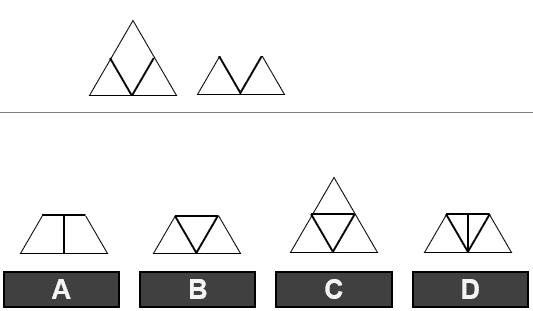
The correct answer is A.
One common feature of the shapes above the line is the two small equilateral triangles. This feature exists in all the options but option A.
Question 3 of 7
Assume the first two statements are true. Is the final statement: 1) True, 2) False, or 3) Uncertain based on the information provided?
Benevolent people donate money to charity and have pets.
Thomas donates money to charity and has no pets.
Thomas is not a benevolent person.
- True
- False
- Uncertain
The correct answer is True.
Statement A provides a rule: Benevolent people → donate money to charity AND have pets. This rule states that being benevolent entails two different properties that have to go together.
Statement B provides information: Thomas + does donate money + without pets.
Conclusion – Thomas is not a benevolent person. Thomas has only one of the necessary properties for being benevolent. Therefore, according to the first two statements, the conclusion is true.
Remember that previous knowledge or common sense are irrelevant for solving these types of questions.
Question 4 of 7
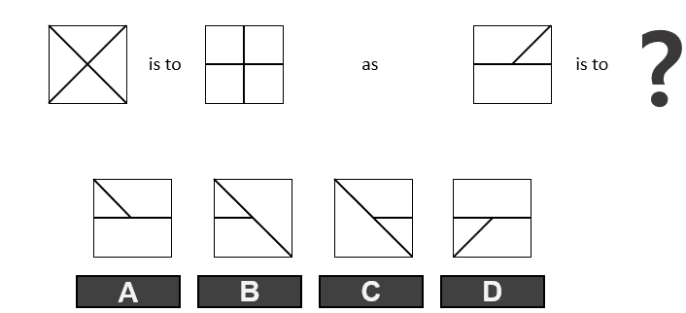
The correct answer is C.
Imagine that each square is a “clock” with a few hands and eight “hours.” Between the first two elements, each of the hands has moved one “hour” clockwise. Answer C is analogous to the third element in the same manner. The two hands which form a horizontal line move one hour clockwise and form a diagonal line from the top-left corner to the bottom-right corner. The third diagonal hand moves and forms a horizontal line that points to the right.
Question 5 of 7
What is the next number in the following series of numbers?
7 10 15 22 31
- 39
- 41
- 42
- 40
The correct answer is 42.
Explanation:
Look at the differences between the numbers:
7 10 15 22 31
+3 +5 +7 +9
+2 +2 +2
The difference between each term is greater by two in every step. Therefore, the difference between the last displayed number of the series and the next number should be 9 + 2 = 11
Therefore, the next number of the series is 31 + 11 = 42
Question 6 of 7
The chance of winning prizes at the local fair is 9/10. If 200 children visited the local fair, how many of them most probably did not win a prize?
- 18
- 10
- 12
- 20
- 40
The correct answer is 20.
9/10 is the probability of winning a prize. Therefore, the probability of not winning a prize is 1 – 9/10 = 1/10. You can use this figure in order to find the number of children who most probably did not win a prize:
200 * 1/10 = 200/10 = 20.
Question 7 of 7
Which of the figures below the line will replace the question mark, following the sequence of figures shown?
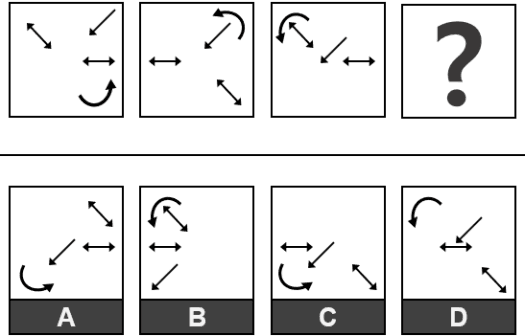
The correct answer is C.
Each element includes four arrows that move inside a frame. There is one logical rule that governs all the changes; yet, this rule makes each of the arrows behave differently. The general rule is that the arrows move according to their direction. Examining each arrow separately:
The regular arrow at the top-right corner moves forward toward the direction of the bottom-left corner.
Bi-directional arrows move back and forth. One alternates between the right side of the frame and the left side of it. The other alternates between the top-left corner and the bottom-right corner.
The curvy arrow moves in circles and in each step, you see it in a different corner of the frame.
PI Behavioral Assessment Sample Question
Sample Question
Which of these words describes you?
| Independent | Competitive | Self-starting |
| Resourceful | Inventive | Determined |
| Resolute | Autonomous | Venturesome |
| Innovative | Directive | Challenging |
| Forceful | Aggressive | Controlling |
| Self-reliant | Confrontational | Unyielding |
This list of adjectives, to varying degrees, generally supports the characterization of high dominance. High-dominance individuals are assertive, results-focused, and crave autonomy, often challenging traditional norms. They are proactive and can be resistant to external feedback.
Some words that moderately support dominance include: Independent, Competitive, Self-starting, Resourceful, Inventive, and Determined.
Some words that highly support dominance include: Resolute, Autonomous, Venturesome, Innovative, Directive, and Challenging.
Some words that extremely support dominance include: Forceful, Aggressive, Controlling, Self-reliant, Confrontational, and Unyielding.
Which words did you choose? Do they align with your occupational profile? Will the behaviors reflected by them be beneficial for your prospective job?
About the course
Includes 7 practice tests (5 full-length simulations)
10 Learning hours · 7 Practice tests · 220 Questions · 100 VIDEOS
Work through a structured PI prep path that builds speed and accuracy for the PI Cognitive Assessment, then shifts to clear guidance for the PI Behavioral Assessment. You’ll start with a quick warm-up, learn the main reasoning question types, and apply pacing tactics for the 12-minute format. Then you’ll complete PI-style simulations with focused review, followed by personality-test guidance and behavioral practice.

Skills you will learn
Numerical reasoning · Verbal reasoning · Abstract reasoning · Behavioral assessment
Curriculum
Course Introduction
- How the PI assessments work
- What to expect on test day
Warming Up – 15-Question Speed Test
- Quick pacing warm-up
- Build momentum under time pressure
Question Types Introduction
- Numerical reasoning fundamentals
- Verbal reasoning question approach
- Abstract pattern rule-finding
Time Management Tips
- Pacing for 12-minute pressure
- Skip, guess, and keep moving
- Avoid stalling on tough items
Full-Length PI Cognitive Assessment-Style Simulations
- PI-style simulations under real timing
- Timed and practice modes
- Explanations with step-by-step videos
Bonus: PI Behavioral Assessment – A Complete Guide
- Adjective checklist format explained
- Self vs self-concept responses
- Workplace drives and interpretation
How to Pass Personality Tests
- Honest, consistent response strategy
- Align answers with role expectations
Personality Assessment Test Simulations
- Full simulation with guided review
- Inquisitive mode for deeper insight
Course Conclusion
- Key takeaways and next steps
Reviews

Jose Maria d*********
February 7, 2026 at 3:46 AM
Really helped getting mentally ready for the PI test, scored 36 correct which was above my expectation Can recommend it
Patrick J**
August 24, 2025 at 8:40 AM
Very good course. Really super helpful and loads of tips and tricks to properly understand how to reach potential. Highly recommend it.
Jonathan C*******
August 12, 2025 at 1:24 AM
I have always had test anxiety, and these prep tests have become invaluable to me to get ready for the real thing. I love it!
Leonardo L******
June 28, 2025 at 8:01 PM
Great course! Enjoyed how complete and thorough it is. I don't have yet the results of my cognitive test but it would have been much harder without preparing first.
Alok S****
June 9, 2025 at 6:02 PM
Great product. Started using it over the weekend, and its certainly helped sharpen my skills. I am hoping to continue using it, in order to prepare for my upcoming exam. My potential employer is an entity that involves a fairly complex and sophisticated level of sales, and technical consultation, that coordinates with surgeons of orthopedics and podiatry. I can clearly see why they would want to initially evaluate potential candidates through this comprehensive exam.
Paul F******
May 20, 2025 at 9:21 PM
Really liking it so far. Gives clear and concise explanations. Not too much information that can muddy the waters. I would recommend.
Rebecca D******
January 21, 2025 at 10:52 AM
Forces one to think on a level that one is not accustomed to Very informative Felt my mind being stretched
Glen R*******
October 5, 2024 at 10:01 AM
iPREP is great value - good value for money price, comprehensive tutorials, easy to buy, easy to access, your dashboard let's you know exactly where you are and what's next, and the simulations are excellent. I'm delighted I chose iPREP over the four similar offerings I investigated. Well done iPREP
Trevor L**********
September 11, 2024 at 12:42 PM
Great course. Questions are exactly like the real test. I far improved my confidence, speed, and hopefully my score. These tests are extremely difficult and even a few hours of prep can make a huge difference.
jean f****
August 26, 2024 at 6:03 AM
great format and great way to improve but finished it in 4 hours and need many more to really improve