Reviewed by Tamir Rubin, Head of Product at iPREP • Updated February 2026
PHR Sample Question
As an HR professional, how should you approach the creation of a new company policy after several managers have handled a similar situation inconsistently?
- Gather feedback from key stakeholders (HR, management, affected departments), draft the policy, review for compliance and operational impact, then communicate/pilot and collect final feedback before rollout.
- Involve all employees in the organization in drafting the policy.
- Draft the policy independently and then present it to management for approval.
- Have the management team draft the policy.
Topics Covered (2024 ECO)
High-level content areas
- Business Management — metrics, culture, risk
- Workforce Planning and Talent Acquisition
- Learning and Development — training evaluation
- Total Rewards — compensation, benefits, incentives
- Employee Engagement — performance, retention, experience
- Employee and Labor Relations — compliance
- HR Information Management — HRIS data security
Test Duration
Total time: 120 minutes (2 hours) • 115 questions (90 scored + 25 unscored pretest)
You’ll also have 30 minutes for administration. Avg pace: ~65 seconds per question. Keep a steady rhythm, flag difficult items, and return if time remains.
Test Breakdown & Sample Questions
The PHR exam is a computer-based certification test that measures technical and operational HR knowledge, with a strong emphasis on applying HR concepts (including U.S. laws and regulations) across the core HR functional areas. You’ll have 2 hours of testing time, plus 30 minutes of administration time. The exam includes 115 total questions: 90 scored questions and 25 pretest (unscored) questions. Your score is based only on the scored questions; pretest questions are included to evaluate future exam content.
2024 PHR Exam Content Breakdown
| Section | Subtopics (high level) | Proportion of exam | Approx. number of scored questions (out of 90) |
|---|---|---|---|
| Business Management | Business operations, risk, strategy support, HR’s role in organizational effectiveness | 14% | ~13 |
| Workforce Planning and Talent Acquisition | Workforce planning, recruiting, selection, hiring, onboarding, and transitions | 14% | ~13 |
| Learning and Development | Training, performance support, development planning, and program evaluation | 10% | ~9 |
| Total Rewards | Compensation, benefits, pay practices, and rewards administration | 15% | ~14 |
| Employee Engagement | Culture, performance enablement, retention, inclusion, and employee experience | 17% | ~15 |
| Employee and Labor Relations | Workplace policies, investigations, discipline, conflict resolution, labor relations fundamentals | 20% | ~18 |
| HR Information Management | HRIS/data, records management, reporting, privacy, and process integrity | 10% | ~9 |
Let’s discuss the particular sections in detail:
Business Management Questions
The Business Management component of the PHR Exam (about 14% of the exam) evaluates your ability to support organizational goals by applying HR practices that improve operational effectiveness, reduce risk, and align HR work with business needs. Because this is a 2-hour exam, you can roughly plan for ~15–20 minutes of exam time on this section. There are two groups of focus areas:
Responsibilities
- Interpreting business needs and aligning HR activities to support organizational priorities
- Supporting organizational change efforts (communication, implementation support, adoption)
- Identifying HR-related risks and recommending steps to reduce exposure (legal, operational, reputational)
- Applying ethical decision-making and reinforcing standards of professional conduct
- Using data, trends, and business context to recommend practical HR solutions
- Collaborating with cross-functional stakeholders (management, finance, legal, operations)
Knowledge
- Basic business concepts and organizational structures
- Governance concepts and how policy frameworks support consistent decisions
- Change management principles and common change barriers
- Risk identification and basic controls (prevention, mitigation, documentation)
- HR metrics and analytics concepts (qualitative and quantitative)
- Decision-making in complex or ambiguous situations
- Common HR reporting capabilities and how to interpret summaries and dashboards
Workforce Planning and Talent Acquisition Questions
The Workforce Planning and Talent Acquisition component (about 14%) assesses your ability to plan for staffing needs and execute the hiring process in a compliant, effective way. Expect ~15–20 minutes worth of questions on this topic.
Responsibilities
- Identifying staffing needs and supporting workforce planning activities
- Developing and applying sourcing strategies (internal/external pipelines)
- Supporting job posting and recruiting workflows in a consistent, compliant manner
- Coordinating selection processes (screening, interviews, assessments)
- Supporting offers and pre-employment steps, including documentation and communication
- Assisting with onboarding/orientation and early-stage retention practices
- Supporting workforce transitions (internal moves, offboarding, reductions, and documentation)
Knowledge
- How U.S. employment laws and regulations affect recruiting, selection, and hiring practices
- Workforce planning concepts (headcount planning, forecasting, role prioritization)
- Labor market dynamics and talent availability
- Candidate evaluation tools (interviews, skills checks, structured selection methods)
- Background check and authorization concepts (as applicable to U.S. hiring)
- Applicant tracking approaches and recruitment workflow controls
- Offer practices (written vs. verbal, consistency, documentation)
- Onboarding steps and common compliance/record needs
- Offboarding practices and transition planning basics
Learning and Development Questions
The Learning and Development area (about 10%) measures your ability to support training and development programs that build employee capability and reinforce performance. Plan for ~10–15 minutes of exam time here.
Responsibilities
- Supporting training program planning and delivery (logistics, communication, participation)
- Helping evaluate training effectiveness (feedback, outcomes, performance indicators)
- Assisting managers and employees with development planning and growth opportunities
- Supporting performance enablement activities tied to learning (skill gaps, coaching support)
- Providing relevant information for succession and development discussions
Knowledge
- Training and development fundamentals and how adult learning principles apply
- Common delivery methods (in-person, virtual, blended, self-paced) and when they fit best
- Needs assessment concepts (skill gaps, performance issues, role requirements)
- Program evaluation basics (participation, learning checks, behavior change, results)
- Coaching and mentoring concepts and when each is appropriate
- Organizational development basics and how development supports change
- Motivation and engagement concepts as they relate to learning adoption
Total Rewards Questions
Accounting for about 15% of the test, the Total Rewards section evaluates your knowledge of compensation and benefits concepts and your ability to support pay and benefits administration in a compliant, organized way. You can expect ~15–20 minutes on this content.
Responsibilities
- Supporting compensation administration (pay actions, documentation, internal consistency)
- Assisting with benefits administration (enrollment support, communication, issue resolution)
- Supporting payroll-related coordination and helping resolve routine pay questions
- Participating in communication of rewards programs (cash and non-cash)
- Supporting compliance-oriented practices tied to pay and benefits programs
- Assisting with job/role documentation that supports pay decisions (as applicable)
Knowledge
- Compensation fundamentals (base pay, incentives, premiums, differentials)
- Benefits fundamentals (health/welfare, retirement, leave concepts)
- Job documentation and job analysis concepts that support consistent pay practices
- Market pricing and benchmarking concepts (comparisons, ranges, internal equity)
- Pay structures and common approaches to salary ranges
- Common payroll concepts and coordination points
- Non-cash rewards and recognition program basics
- U.S. legal/regulatory concepts commonly tied to compensation and benefits (as applicable)
Employee Engagement Questions
The Employee Engagement component (about 17%) focuses on building and sustaining a productive employee experience—culture, retention, performance enablement, inclusion, communication, and engagement practices. Expect roughly ~20 minutes of the exam here.
Responsibilities
- Supporting employee engagement initiatives (surveys, feedback loops, action planning support)
- Promoting practices that support retention and a positive employee experience
- Reinforcing inclusion, fairness, and respectful workplace expectations
- Supporting performance enablement efforts (goal clarity, feedback practices, manager support)
- Helping identify drivers of engagement issues (turnover signals, complaints, trends)
- Supporting internal communications related to culture, values, and employee programs
Knowledge
- Engagement and retention drivers (manager effectiveness, growth, recognition, fairness)
- Performance management fundamentals (feedback, goal setting, evaluation cycles)
- Inclusion and diversity concepts and workplace application
- Culture concepts and how behaviors reinforce or weaken culture
- Employee experience concepts (journey moments, friction points, service mindset)
- Basic measurement concepts (survey interpretation, themes, trends, follow-through)
Employee and Labor Relations Questions
This is a major portion of the exam (about 20%) and tests your ability to handle employee relations issues in a compliant, consistent way—policies, discipline, investigations, conflict resolution, and labor relations fundamentals. Plan for ~20–30 minutes of exam time here.
Responsibilities
- Applying and supporting workplace policies consistently and documenting actions
- Handling employee concerns and supporting conflict resolution steps
- Supporting investigations (intake, interviewing basics, documentation, confidentiality practices)
- Assisting with corrective action and discipline processes in line with policy and practice
- Supporting complaint handling and follow-up communications
- Helping manage attendance, conduct, and performance-related employee relations issues
- Supporting labor relations activities when applicable (basic concepts, contract awareness, escalation)
Knowledge
- U.S. labor/employee relations legal concepts commonly tested at the operational level
- Investigation fundamentals (fact-finding, neutrality, documentation, privacy boundaries)
- Corrective action models and progressive discipline concepts
- Grievance and dispute resolution basics
- Workplace safety/health concepts and reporting/response coordination (as applicable)
- Termination/offboarding practices and documentation considerations
- Collective bargaining and contract basics (high-level concepts, not legal advising)
HR Information Management Questions
The HR Information Management section (about 10%) evaluates your understanding of HR data, HRIS workflows, recordkeeping, reporting, privacy, and the integrity of HR processes. Expect ~10–15 minutes on this topic.
Responsibilities
- Maintaining accurate employee data and supporting data integrity practices
- Using HR systems to support HR processes (transactions, approvals, reporting requests)
- Supporting recordkeeping practices and retention processes (as applicable)
- Handling sensitive information appropriately and supporting privacy/security practices
- Assisting with routine reporting, audits, and documentation requests
- Supporting process standardization and controls (checklists, approvals, access limitations)
Knowledge
- HRIS basics (data fields, workflow concepts, roles/permissions)
- Reporting fundamentals (standard reports, dashboards, definitions, data quality checks)
- Record management concepts (documentation consistency, retention logic, controlled access)
- Data privacy and security fundamentals (confidentiality, least access, secure handling)
- Common process controls to reduce errors and ensure consistency
- Basics of compliance-related documentation expectations (operational level)
Did you know?
You’ll have 2 hours to complete 115 multiple-choice questions: 90 scored and 25 unscored pretest questions (you can’t tell which are which). The 2024 ECO organizes the exam into seven functional areas, and questions emphasize real-world HR application—not just definitions.
Preparation Strategies
There’s a big difference between hard work and smart work. No matter how motivated you are, you’ll get further with a clear plan. To prepare for the PHR (2024 ECO), use the strategies below:
1. Consider Your Budget
Start by mapping your costs. Between the application/exam fees and optional prep resources (books, practice tests, courses), expenses can add up quickly. Set a budget so you can compare options realistically. Also look for ways to reduce costs—some employers reimburse certification expenses, and some professional associations offer discounts or occasional scholarship opportunities. Even on a tight budget, you can still build an effective plan using free or low-cost materials and consistent practice.
2. Assess Your Skills and Knowledge
Before you study, do a quick self-audit against the 2024 Exam Content Outline. The exam is organized into seven functional areas, so identify where you’re strong and where you’re rusty. Use the outline to list your weak topics and prioritize them (for many candidates, this includes employee/labor relations scenarios, total rewards details, and HR data/records decisions). Once you’ve identified gaps, choose resources that target those gaps instead of studying everything evenly.
2024 ECO functional areas (use these for your self-assessment):
- Business Management
- Workforce Planning & Talent Acquisition
- Learning & Development
- Total Rewards
- Employee Engagement
- Employee & Labor Relations
- HR Information Management
3. Determine Your Study Methods
Choose study methods that match how you learn best and how much time you have. Many candidates do best with a mix of: short daily study blocks, active recall (flashcards/notes), and frequent scenario-based question practice. If you prefer structure, consider a prep program, a study group, or a guided weekly plan. If you prefer self-paced learning, set milestones (finish one domain per week, then review).
4. Seek Guidance from Colleagues and Connections
If you know HR professionals who passed the PHR recently, ask what mattered most for them. People who’ve taken the exam often share practical insights you won’t get from a generic study plan—like which topics were heavily scenario-based, what surprised them, and how they managed time. In some cases, you may even find a mentor who can review your approach or quiz you.
5. Develop a Study Schedule
Build a schedule backward from your intended exam date. Your timeline depends on your background and availability—some people study for a few weeks, others for months. The key is consistency. Aim to engage with the material daily or near-daily, and rotate domains so you’re not ignoring any area for too long. Use your self-assessment to decide where to spend extra time.
6. Take Practice Tests
Practice tests help you get comfortable with the format and reveal weak spots fast. Take one early to establish a baseline, then retake sets periodically to measure improvement. Focus on why you missed questions—misread the scenario, didn’t know the rule, or chose a “nice” answer instead of the most compliant/HR-appropriate next step. The PHR rewards applied judgment, not memorized definitions.
7. Take Prep Courses (Optional)
Prep courses can be useful if you want a complete structure: lessons, quizzes, review tools, and a built-in plan. They vary in price and style (self-paced vs instructor-led). A good course can save time by organizing the content and giving you consistent practice—but it’s still important to compare it against the 2024 ECO and make sure it covers all seven functional areas.
8. Retake if Needed (as needed)
If you don’t pass on the first try, treat it as data. Review your score report by domain, rebuild your plan around the weakest areas, and return with more targeted practice. Keep in mind that retakes involve waiting periods and fees, so it’s worth preparing seriously—but you don’t need to treat one attempt as “all or nothing.”
9. Schedule Your Test Early
Once you’re eligible, schedule early. It reduces last-minute stress and increases the chances you’ll get a date/time that fits your routine. Locking in the date can also help you commit to your study schedule and keep momentum.
Test Features
Variable Rates of Question Difficulty
The PHR exam includes 115 multiple-choice questions (90 scored + 25 unscored pretest) delivered in a computer-based format. Because HRCI uses multiple exam forms and includes unscored items being evaluated for future use, you may feel that some versions (or some question sets) are tougher than others.
The important point is that scores are scaled/equated so results remain comparable across forms, even when the perceived difficulty shifts. Still, the experience can be psychologically tricky: getting a streak of very challenging questions (or unexpectedly easy ones) can trigger doubt and throw off pacing.
The best way to handle difficulty swings is to prepare for application, not memorization. The PHR is designed to validate that you can apply HR fundamentals in realistic workplace situations—especially when multiple answers seem plausible and you must choose the “best next step.”
PHR vs. SHRM
| Category | PHR (Professional in Human Resources) | SHRM (SHRM-CP / SHRM-SCP) |
|---|---|---|
| Credentialing body | HR Certification Institute (HRCI) | Society for Human Resource Management (SHRM) |
| Primary focus | Applied, operational HR knowledge across functional areas | Competency-based HR decision-making (knowledge + situational judgment) |
| Eligibility (high level) | Experience-based eligibility tied to education level | SHRM-CP: no degree or specific HR experience required; SHRM-SCP: strategic HR experience required |
| Exam content structure | 7 functional areas (2024 ECO), covering operational HR responsibilities and knowledge | Knowledge items + situational judgment items based on SHRM’s competency framework |
| Exam length (testing time) | 2 hours (plus 30 minutes admin time) | 3 hours 40 minutes testing time (within a 4-hour appointment window) |
| Question count | 115 total (90 scored + 25 unscored pretest) | 134 total (includes unscored field-test items) |
| Recertification cycle | Every 3 years | Every 3 years |
| Recertification method | Earn required recertification credits (including ethics) or retake the exam | Earn required PDCs or retake the exam |
| Recognition | Widely recognized (including internationally) | Widely recognized, especially in the U.S., with growing global visibility |
Both certifications can be valuable. In practice, PHR tends to signal strong operational HR implementation across core functions, while SHRM emphasizes competency-based judgment and situational decision-making. The better choice depends on your role, employer expectations, and which framework better matches how you want to demonstrate your HR capability.
PHR Recertification
Your PHR certification is valid for three years. To maintain it, you typically have two options:
- Earn the required HR recertification credits during the 3-year cycle (including an ethics-related activity), or
- Retake and pass the PHR exam to renew your credential for another cycle.
Advantages of the PHR Certification
Earning the PHR can provide several practical benefits:
- Industry recognition: Signals verified HR capability and commitment to the profession.
- Career advancement: Can strengthen your profile for HR roles, promotions, and expanded responsibilities.
- Stronger applied knowledge: Prepping for the exam builds real operational skill across multiple HR domains.
- Competitive edge: Helps you stand out when employers prefer or require recognized HR credentials.
- Networking opportunities: Connects you to a broader professional HR community and ongoing learning.
- Increased earning potential: Certifications can support stronger positioning in salary discussions.
- Confidence and growth: Validates your judgment and helps you operate with more clarity in complex HR situations.
Technical Facts
Fast Facts (tl;dr)
- 115 questions total: 90 scored + 25 unscored (pretest)
- Multiple-choice format
- 2 hours testing time (+ 30 minutes admin time)
- Available in-person or online (remote proctoring)
- PHR is recognized globally
- Eligibility is experience-based (depends on your highest education level)
PHR Registration (high level)
You can register online from anywhere:
- Create an HRCI account (basic profile details).
- Choose the certification you’re applying for.
- Submit your education + HR work experience (PHR is not entry-level).
- Pay fees (HRCI shows the full fee schedule before checkout).
- Request accommodations if needed.
- Accept the policies to complete registration.
Eligibility Criteria (simplified)
To qualify, you need a high school diploma (or global equivalent) or higher plus professional HR experience. The required experience depends on your education level, and it must be recent (typically within the last several years) and professional HR work (not internships/student roles).
Common qualifying roles include HR generalist/specialist/coordinator/administrator (and similar). Managerial experience helps but isn’t required.
In-Person and Remote Testing
This is a computer-based exam offered at test centers and via remote proctoring.
In-person testing
- Arrive 15–30 minutes early with a government-issued photo ID.
- Personal items are stored outside the testing room.
- You’ll get a brief on-screen tutorial before the exam starts.
- Restroom breaks are allowed, but the timer keeps running.
Remote testing
- Log in ~30 minutes early.
- You’ll show your photo ID to the webcam and complete a room scan.
- The exam begins once the proctor confirms your setup.
Common and Past Names (quick note)
- PHR is the current credential name.
- Older variants like PHR-CA and PHR-GL existed in the past but were discontinued; most candidates today simply pursue the standard PHR.
Results Scale and Interpretations
Score Report
After you test, you’ll receive a score report showing your pass/fail status, a brief explanation of the scoring approach, and the passing standard. If you don’t pass, the report typically includes your scaled score so you can target improvement areas.
Passing Score
To pass the PHR, you must earn a scaled score of 500 or higher. The exam uses a scaling/equating process designed to keep scores comparable across different test forms, even when question difficulty varies.
Scoring Methodology
Your result is based on a scaled score (commonly described as 100–700), not a simple percent correct. The scaling process accounts for differences between exam forms, so candidates aren’t unfairly advantaged or disadvantaged by a slightly easier or harder version.
Pass/Fail Status and How to Use Your Report
- Pass: You meet the standard and earn the PHR credential.
- Fail: You’ll see your scaled score and can use the domain-level feedback to identify weaker areas.
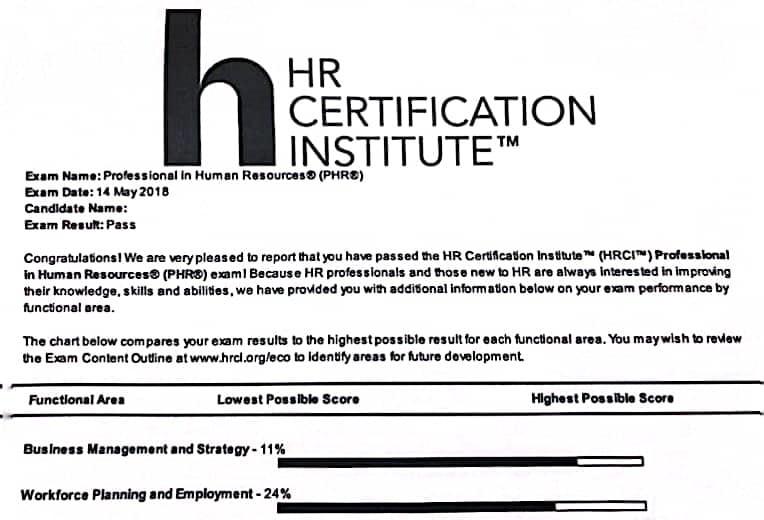
Even if you pass, the score report can still be useful: it typically shows how you performed by content area relative to the standard, helping you focus your continuing education and on-the-job development.
FAQs
The PHR certification test is an exam administered by the HR Certification Institute (HRCI) that measures how well HR professionals can apply HR knowledge in real workplace situations across the main HR functional areas.
It’s designed for HR professionals who perform operational HR responsibilities and want a recognized credential—common roles include HR generalists, HR specialists, HR managers, HR business partners, and HR consultants.
The 2024 Exam Content Outline is organized into seven areas: Business Management, Workforce Planning & Talent Acquisition, Learning & Development, Total Rewards, Employee Engagement, Employee & Labor Relations, and HR Information Management.
Combine a solid review of the 2024 ECO topics with lots of scenario-based practice questions. Use study guides, practice exams, and structured courses if you want a plan. The biggest score gains usually come from reviewing why an answer is best—not just memorizing terms.
It’s a computer-based, multiple-choice exam. Depending on availability, you may be able to test at a center or through remote proctoring.
You get 2 hours of testing time (plus 30 minutes of administration). The exam has 115 questions total: 90 scored and 25 unscored pretest questions.
PHR uses scaled scoring (commonly described as 100–700). A scaled score of 500 is the passing standard, and scaling helps keep results comparable across different exam forms.
It validates your HR capability, strengthens credibility, and can help with hiring, promotion, and broader HR responsibilities—especially where employers value formal certification.
Testing is typically available year-round, based on scheduling and location/remote availability. You choose a date/time from the available appointments.
Your PHR is valid for three years. To maintain it, you generally either earn required recertification credits during the cycle or retake the exam.
Test Tips
Preparing for the PHR is important—but test-day execution matters too. Use these tips to stay calm and score your best:
- Pack light. Most personal items must go into a locker (or be kept out of reach for remote testing).
- Plan your arrival. Check traffic (or your tech setup) and leave early so you’re not rushed.
- Bring valid ID. You’ll need a current government-issued photo ID (passport or driver’s license).
- Read for keywords. Many options look “almost right.” Read the question carefully, then read every answer choice before selecting the best one.
- Use the “mark” feature. Flag tough questions and return later—but don’t leave anything blank.
- Guess strategically. If you’re stuck, eliminate wrong choices first—cutting even two options boosts your odds.
- Watch the clock. Keep a steady pace so you don’t spend too long on any one question and risk running out of time.
Administration
- Test administrator: The PHR certification exam is administered by the HR Certification Institute (HRCI).
- Test scheduling: After your application is approved, you’ll receive an email allowing you to schedule your exam date. You must test within 120 days of approval. A 60-day extension may be requested if needed.
- Test format: Computer-based, multiple-choice exam. Both in-person and remote (online proctored) testing options are available.
- Test materials: No reference materials are allowed. During remote testing, you may not pause the exam to eat, smoke, or review notes.
- Cost: The exam includes a $100 application fee and a $395 exam fee, for a total of $495.
- Retake policy: If you do not pass, you may retake the exam after a 90-day waiting period. HRCI offers an optional Second Chance Insurance for an additional fee, which allows a retake without reapplying. Each retake uses a new set of questions and requires payment of the exam fee if insurance was not purchased.
Test Provider
The PHR (Professional in Human Resources) certification exam is provided by the HR Certification Institute (HRCI). HRCI develops the exam content, sets the eligibility and certification requirements, and administers the PHR as part of its broader lineup of HR credentials.
Information Sources
Disclaimer – All tutoring resources and study guides on iPREP are original and created solely for educational and test-preparation purposes. iPREP is not affiliated with the HR Certification Institute (HRCI) or any other organizations or trademark holders referenced on this page.
Free PHR practice test
Get a feel for the PHR exam format by practicing with these sample questions:
Business Management
Question 1 of 5
As an HR professional, how should you approach the creation of a new company policy after several managers have handled a similar situation inconsistently?
- Gather feedback from key stakeholders (HR, management, affected departments), draft the policy, review for compliance and operational impact, then communicate/pilot and collect final feedback before rollout.
- Involve all employees in the organization in drafting the policy.
- Draft the policy independently and then present it to management for approval.
- Have the management team draft the policy.
The correct answer is A.
Explanation (why A is correct):
A policy meant to standardize behavior should include stakeholder input, a compliance/risk check, and a controlled rollout. That improves consistency, reduces liability, and increases adoption.
Why the other answers are wrong:
- B: Involving all employees is usually impractical and slows decision-making; policy drafting typically requires targeted input from people who own the process and must enforce it.
- C: Drafting alone increases the risk of missing operational realities or legal/compliance concerns, and it often leads to low buy-in and inconsistent enforcement.
- D: Management can sponsor policy direction, but if HR isn’t leading coordination and compliance alignment, the policy may be inconsistent, incomplete, or harder to administer.
Question 2 of 5
Your organization is rolling out a new attendance policy across multiple sites. Employees are anxious and managers are already applying it differently. What is the best approach to guiding and directing this change?
- Clarify the reason for the change, align leaders and key stakeholders, communicate expectations, equip managers with tools and talking points, remove obstacles, reinforce early wins, and monitor adoption until the change becomes standard practice.
- Announce the change at a company-wide meeting and then implement it immediately.
- Keep the change process a secret until it’s time to implement it to avoid unnecessary stress.
- Have lower-level managers implement the change without explaining why it’s happening.
The correct answer is A.
Explanation (why A is correct):
When adoption is inconsistent, HR should align leadership, standardize messaging, enable managers, and monitor implementation. That reduces confusion and ensures the policy is applied fairly.
Why the other answers are wrong:
- B: A single announcement rarely produces consistent adoption; it doesn’t address training, resistance, or manager guidance—especially across multiple sites.
- C: Secrecy increases mistrust and rumors, which typically worsens resistance and harms engagement.
- D: Implementing without explaining the “why” invites pushback and inconsistent enforcement—exactly the problem you’re trying to solve.
Question 3 of 5
Senior leadership announces a shift toward faster growth, and departments are pushing for quicker hiring decisions. How can an HR leader best support the organization’s purpose, values, vision, and strategic goals?
- Focus exclusively on HR-related goals and metrics.
- Ignore the overall business goals and focus only on employee welfare.
- Align HR practices (hiring standards, onboarding, performance expectations, and compliance controls) with the organization’s goals while maintaining consistency and managing risk.
- Ensure all HR policies strictly adhere to governmental laws and regulations.
The correct answer is C.
Explanation (why C is correct):
HR supports strategy by aligning people practices to business direction while protecting the organization through consistent, compliant implementation.
Why the other answers are wrong:
- A: HR metrics matter, but “HR-only” focus can drift away from business needs; alignment is the goal, not isolation.
- B: Employee welfare is important, but ignoring business goals isn’t realistic and prevents HR from functioning as a business partner.
- D: Legal compliance is necessary but not sufficient; supporting strategy also involves execution choices (staffing, onboarding, performance systems, and capacity planning).
Question 4 of 5
As an organizational leader, how can you best evaluate whether your organization is operating efficiently during a period of rapid hiring?
- Conduct an annual performance review of all employees.
- Examine financial statements for profitability.
- Regularly review a combination of financial and non-financial metrics, such as productivity, overtime, turnover, time-to-fill, absence rates, and customer satisfaction.
- Evaluate the size of the organization compared to competitors.
The correct answer is C.
Explanation (why C is correct):
Efficiency shows up across multiple signals—cost, output, quality, workforce stability, and customer impact. A balanced metric set helps identify root causes and operational bottlenecks.
Why the other answers are wrong:
- A: Performance reviews are useful, but they’re not designed to measure organizational efficiency and they’re too infrequent for rapid-hiring conditions.
- B: Profitability can improve or decline for reasons unrelated to efficiency; financials alone don’t show process bottlenecks, quality issues, or workforce strain.
- D: Size comparisons are not a valid efficiency measure; a larger or smaller headcount doesn’t prove better operations or productivity.
Question 5 of 5
A department head asks HR to “just approve” a new incentive plan to push short-term output. Why is it important for an HR professional to understand the organization’s strategic goals and objectives before moving forward?
- So they can communicate these goals to the media.
- So they can ensure HR recommendations (including incentives, staffing, and performance expectations) support the organization’s direction and don’t create avoidable misalignment or risk.
- So they can argue with management about the direction of the company.
- So they can ensure the company is following all laws and regulations.
The correct answer is B.
Explanation (why B is correct):
Incentives can drive behavior. Strategic context helps HR ensure the plan supports the right outcomes and doesn’t create problems like inequity, turnover, quality drops, or compliance risk.
Why the other answers are wrong:
- A: Media communication isn’t the reason HR needs strategic understanding, and it’s typically not HR’s role in this context.
- C: The goal is alignment and risk management, not conflict; HR should partner with leaders, not “argue” as a default posture.
- D: Compliance matters, but strategic alignment is broader than legal compliance; a plan can be legal yet still harmful or misaligned with business goals.
Talent Planning and Acquisition
Question 1 of 5
What is an important initial step in the recruiting process?
- Posting job advertisements on multiple platforms
- Conducting job interviews
- Conducting a job analysis
- Checking references for potential candidates
The correct answer is C.
Explanation:
Conducting a job analysis is crucial as it provides detailed information about job duties, required skills, desired qualifications, and more. This information forms the foundation for effective job postings, interviewing, and candidate evaluation.
Question 2 of 5
Which of the following best represents a retention strategy for an organization?
- Job fairs
- Job descriptions
- Employee engagement programs
- Exit interviews
The correct answer is C.
Explanation:
Employee engagement programs are aimed at making employees feel valued, involved, and committed to their jobs. Such programs help improve job satisfaction and morale, thereby leading to better retention rates.
Question 3 of 5
How is succession planning best defined?
- The process of recruiting new talent
- The process of managing employee departures
- The process of identifying and developing potential future leaders or senior managers
- The process of identifying low-performing employees
The correct answer is C.
Explanation:
Succession planning involves identifying and developing potential future leaders or senior managers within the organization. This ensures the organization’s stability and preparedness for future leadership changes.
Question 4 of 5
What is the main purpose of orientation programs in an organization?
- Evaluating a new hire’s job performance
- Helping a new hire understand the organizational culture, values, and job role
- Identifying the new hire’s weaknesses
- Discussing the new hire’s compensation and benefits package
The correct answer is B.
Explanation:
Orientation programs are designed to help new hires understand the organization’s culture, values, and specific job roles. The programs also introduce them to their colleagues and provide them with important information they need to perform their roles effectively.
Question 5 of 5
When evaluating sourcing for recruitment, what factors should an HR professional consider?
- The number of candidates sourced from each platform
- The quality of candidates sourced from each platform
- The cost-effectiveness of each sourcing platform
- All of the above
The correct answer is D.
Explanation:
Answer: D. When evaluating sourcing, an HR professional should consider the number of candidates, the quality of candidates, and the cost-effectiveness of each platform. This helps in refining sourcing strategies and improving the overall effectiveness of recruitment efforts.
Workforce Planning & Talent Acquisition
Question 1 of 5
A manager asks HR to post a job opening immediately, but the role has been handled differently across teams. What is the most important initial step in the recruiting process?
- Posting job advertisements on multiple platforms.
- Conducting job interviews.
- Conducting a job analysis to clarify the core duties, requirements, and success criteria for the role.
- Checking references for potential candidates.
The correct answer is D.
Explanation (why C is correct):
A job analysis clarifies the role’s key duties, required skills, and success measures. That foundation drives a compliant, accurate job posting and consistent screening and interviewing.
Why the other answers are wrong:
- A: Posting before clarifying the role can attract the wrong candidates and create inconsistent selection decisions.
- B: Interviews should happen after you define what you’re hiring for and how you’ll evaluate candidates.
- D: Reference checks occur later in the process and depend on having clear, role-based criteria.
Question 2 of 5
Which of the following best represents a retention strategy for an organization?
- Job fairs.
- Job descriptions.
- Employee engagement programs.
- Exit interviews.
The correct answer is C.
Explanation (why C is correct):
Engagement programs strengthen commitment by improving connection, recognition, growth, and manager support—key drivers of retention.
Why the other answers are wrong:
- A: Job fairs are primarily a recruiting activity, not a retention strategy.
- B: Job descriptions support hiring and performance clarity, but they are not a direct retention strategy on their own.
- D: Exit interviews are reactive; they help diagnose turnover reasons but don’t prevent turnover by themselves.
Question 3 of 5
How is succession planning best defined?
- The process of recruiting new talent.
- The process of managing employee departures.
- The process of identifying and developing internal talent who could fill key roles in the future.
- The process of identifying low-performing employees.
The correct answer is C.
Explanation (why C is correct):
Succession planning ensures continuity by preparing qualified internal candidates for critical roles before vacancies occur.
Why the other answers are wrong:
- A: Recruiting new talent is external hiring; succession planning is focused on future internal readiness (though external hiring may supplement it).
- B: Departure management is offboarding/transition planning, not leadership pipeline development.
- D: Identifying low performance is part of performance management, not succession planning.
Question 4 of 5
What is the main purpose of orientation programs in an organization?
- Evaluating a new hire’s job performance.
- Helping a new hire understand the organization’s culture, expectations, and job role so they can become productive faster.
- Identifying the new hire’s weaknesses.
- Discussing the new hire’s compensation and benefits package.
The correct answer is B.
Explanation (why B is correct):
Orientation helps new hires understand how the organization works, what’s expected, and how to navigate resources—improving ramp-up and early retention.
Why the other answers are wrong:
- A: Performance evaluation happens after the employee has had time to work and demonstrate results.
- C: Orientation isn’t about “finding weaknesses”; it’s about support, clarity, and integration.
- D: Benefits may be reviewed during onboarding, but the primary purpose of orientation is broader integration and role clarity.
Question 5 of 5
When evaluating sourcing for recruitment, what factors should an HR professional consider?
- The number of candidates sourced from each platform.
- The quality of candidates sourced from each platform (for example, how many meet requirements or advance in the process).
- The cost-effectiveness of each sourcing platform (for example, cost per qualified candidate or cost per hire).
- All of the above.
The correct answer is D.
Explanation (why D is correct):
Effective sourcing evaluation looks at volume, quality, and cost. Together, these show which channels produce qualified hires efficiently.
Why the other answers are wrong:
- A: Volume alone can be misleading if candidates aren’t qualified.
- B: Quality matters, but ignoring cost can lead to inefficient spending.
- C: Cost matters, but low-cost sources aren’t useful if they don’t deliver qualified candidates.
Total Rewards
Question 1 of 5
Why is it important to align an organization’s salary and benefits plans with its mission, vision, and values?
- Because it ensures compliance with employment laws and regulations.
- Because it helps attract and retain employees whose expectations and motivations fit the organization, supporting engagement and long-term performance.
- Because it guarantees high profits.
- Because it is a requirement of the Internal Revenue Service (IRS).
The correct answer is B.
Explanation (why B is correct):
Total rewards should support what the organization is trying to achieve—whether that’s growth, stability, service quality, innovation, or retention. When pay and benefits match the organization’s values and talent goals, it becomes easier to attract, motivate, and keep the right people.
Why the other answers are wrong:
- A: Compliance matters, but alignment with mission/values is a strategic and cultural decision—not the main reason pay programs exist.
- C: Rewards can support performance, but no compensation plan guarantees profits.
- D: The IRS regulates certain benefit plan rules, but it does not require alignment with an organization’s mission/vision/values.
Question 2 of 5
Which of the following would be part of a “total rewards” strategy?
- Providing a competitive salary.
- Offering comprehensive benefits, including health insurance and retirement plans.
- Offering opportunities for professional development and career advancement.
- All of the above.
The correct answer is D.
Explanation (why D is correct):
Total rewards includes direct pay, benefits, and the broader value proposition—such as growth opportunities and recognition—because all of these influence attraction, motivation, and retention.
Why the other answers are wrong:
- A: Salary is only one component of total rewards.
- B: Benefits are essential, but total rewards goes beyond benefits alone.
- C: Development supports retention and engagement, but it’s one element—not the entire strategy.
Question 3 of 5
What is the primary purpose of regularly reviewing an organization’s salary and benefits plans?
- To ensure compliance with changing laws and regulations.
- To maintain competitiveness in the labor market.
- To ensure alignment with organizational goals and objectives.
- All of the above.
The correct answer is D.
Explanation (why D is correct):
Regular reviews help ensure pay/benefits remain compliant, competitive, and aligned with business priorities (for example, retention, growth, cost control, or critical-skill hiring).
Why the other answers are wrong:
- A: Compliance is important, but reviewing only for compliance ignores competitiveness and business alignment.
- B: Market competitiveness matters, but ignoring compliance or internal strategy can create risk and misalignment.
- C: Alignment matters, but if plans fall behind market rates or violate requirements, they can fail in practice.
Question 4 of 5
How should an organization approach the creation of salary and benefits plans for different categories of employees?
- Design plans to reflect the value of each role, the competitive market rate, and internal equity, while considering skills, experience, and organizational needs.
- Base salary and benefits solely on the employee’s tenure with the organization.
- Provide the same salary and benefits to all employees, regardless of role or level.
- Have senior leadership decide salary and benefits without input from HR or consideration of market data.
The correct answer is A.
Explanation (why A is correct):
A sound rewards structure balances market competitiveness, internal equity, and role value. It also helps defend pay decisions and improves fairness perceptions.
Why the other answers are wrong:
- B: Tenure may be one factor, but using it alone can create inequity and market misalignment.
- C: Equal pay for all roles ignores job value and market realities and can create serious recruitment and retention problems.
- D: Without HR input, data, and consistent structure, pay decisions are more likely to be inconsistent, unfair, or difficult to justify.
Question 5 of 5
Which of the following should be considered when deciding on salary and benefits plans?
- The financial health and budget realities of the organization.
- Market rates for similar roles in the same industry and region.
- Employee needs and preferences (for example, benefit priorities and life-stage needs).
- All of the above.
The correct answer is D.
Explanation (why D is correct):
A sustainable rewards plan balances affordability, market competitiveness, and employee value. Ignoring any one of these can lead to cost issues, hiring/retention problems, or low engagement.
Why the other answers are wrong:
- A: Budget alone can’t guide pay strategy; you also need market context and employee impact.
- B: Market rates matter, but ignoring affordability and employee priorities can make the plan unsustainable or unattractive.
- C: Preferences matter, but without budget and market data, the plan may be unrealistic or uncompetitive.
Employee and Labor Relations
Question 1 of 10
What is the main purpose of an employee handbook?
- To provide a comprehensive list of all employees in the organization.
- To describe the organization’s expectations, policies, procedures, benefits, and employee rights in a clear, accessible way.
- To outline the organization’s marketing strategies.
- To describe the organization’s product and service offerings.
The correct answer is B.
Explanation (why B is correct):
A handbook sets clear expectations and communicates key policies and employee rights, which supports consistency, fairness, and risk reduction.
Why the other answers are wrong:
- A: A roster is not the handbook’s purpose and would quickly become outdated.
- C: Marketing strategy is unrelated to workplace expectations and employee policies.
- D: Product/service descriptions belong in customer-facing materials, not employee relations documentation.
Question 2 of 10
Which of the following is an essential part of maintaining positive employee relations?
- Regular performance evaluations.
- A comprehensive onboarding program.
- Clear and open communication.
- All of the above.
The correct answer is D.
Explanation (why D is correct):
Positive employee relations rely on clarity, support, and ongoing communication—performance feedback and onboarding help employees succeed, and communication prevents misunderstandings.
Why the other answers are wrong:
- A: Helpful, but alone it won’t build trust or reduce issues if communication and support are weak.
- B: Important early on, but employee relations is ongoing, not just a new-hire issue.
- C: Critical, but without structure (onboarding, feedback processes) communication can be inconsistent.
Question 3 of 10
What is the primary role of human resources in labor relations?
- To negotiate labor contracts on behalf of the employer.
- To help ensure employees and managers understand rights, responsibilities, and processes under the labor agreement.
- To administer and enforce the terms of labor agreements consistently.
- All of the above.
The correct answer is D.
Explanation (why D is correct):
HR commonly supports labor relations by partnering on negotiations, communicating processes, and consistently administering contract terms.
Why the other answers are wrong:
- A: Negotiations can be a key HR function, but labor relations also includes day-to-day contract administration and guidance.
- B: Education is important, but HR must also enforce the agreement and manage the process consistently.
- C: Administration matters, but HR often also supports bargaining preparation/strategy and communication.
Question 4 of 10
Which law in the United States established the right of employees to form and join labor unions?
- The National Labor Relations Act.
- The Fair Labor Standards Act.
- The Occupational Safety and Health Act.
- The Civil Rights Act of 1964.
The correct answer is A.
Explanation (why A is correct):
The NLRA protects employees’ rights to organize, engage in collective bargaining, and participate in concerted activities.
Why the other answers are wrong:
- B: FLSA focuses on wages and hours (minimum wage, overtime), not union organizing rights.
- C: OSHA focuses on workplace safety and health, not labor organizing.
- D: The Civil Rights Act addresses discrimination, not union formation rights.
Question 5 of 10
What is the purpose of a grievance procedure in an organization?
- To punish employees who are not performing adequately.
- To provide a consistent process for resolving disputes or complaints fairly and efficiently.
- To deter employees from joining labor unions.
- To identify employees who are potential candidates for promotion.
The correct answer is B.
Explanation (why B is correct):
A grievance procedure provides structure and fairness for resolving disputes, which helps prevent escalation and supports consistent treatment.
Why the other answers are wrong:
- A: Performance discipline is handled through performance management, not grievance procedures.
- C: Deterring union activity is not the purpose and can create legal risk.
- D: Promotion decisions are unrelated to dispute-resolution processes.
Question 6 of 10
What role does the human resources department typically play in developing workplace policies and procedures?
- HR typically has no role in developing workplace policies and procedures.
- HR is usually responsible for developing, implementing, and communicating workplace policies and procedures.
- HR is usually responsible for developing policies and procedures, but not for implementing or communicating them.
- HR is usually responsible for communicating policies and procedures, but not for developing or implementing them.
The correct answer is B.
Explanation (why B is correct):
HR commonly leads policy development, ensures consistency and compliance alignment, and supports rollout through communication and manager guidance.
Why the other answers are wrong:
- A: HR typically plays a central role because policies impact employee relations, risk, and consistency.
- C: A policy that isn’t implemented/communicated effectively won’t be applied consistently and increases risk.
- D: Communication alone is not enough—HR also helps design policies and ensure workable procedures.
Question 7 of 10
What is one potential benefit of maintaining a positive relationship with labor unions?
- It can lead to higher wages for top management.
- It can reduce the risk of strikes and other forms of labor unrest.
- It can exempt the organization from compliance with labor laws.
- It can enable the organization to pay lower wages.
The correct answer is B.
Explanation (why B is correct):
A constructive union relationship supports stability, problem-solving, and smoother dispute resolution—reducing the likelihood of major disruptions.
Why the other answers are wrong:
- A: Union relationships do not exist to increase executive wages.
- C: Unionization does not remove legal obligations; labor laws still apply.
- D: Unions generally negotiate for wages/conditions; the purpose isn’t to enable lower wages.
Question 8 of 10
What is the purpose of a collective bargaining agreement?
- To define the terms and conditions of employment for a specific bargaining unit (wages, hours, benefits, working conditions, and dispute resolution).
- To provide a detailed job description for each role in the organization.
- To outline the organization’s strategic plans.
- To list all of the products and services offered by the organization.
The correct answer is A.
Explanation (why A is correct):
A CBA is the negotiated contract that sets employment terms for covered employees and establishes rules for handling issues.
Why the other answers are wrong:
- B: Job descriptions may support classification, but they are not the purpose of the CBA.
- C: Strategic plans are business documents, not negotiated labor contracts.
- D: Product/service listings are unrelated to labor agreements.
Question 9 of 10
How can an organization help balance employer and employee needs and rights?
- Ignore employee complaints and focus solely on the bottom line.
- Provide employees with comprehensive benefits, regardless of the cost to the organization.
- Foster a culture of respect, clear communication, and fair treatment supported by consistent policies and practices.
- Implement strict policies and procedures with no room for flexibility.
The correct answer is C.
Explanation (why C is correct):
Balancing needs means fairness, consistent practices, and open communication—so employees feel heard while the employer maintains clear expectations and operational control.
Why the other answers are wrong:
- A: Ignoring complaints increases conflict, turnover, and legal risk.
- B: Unlimited benefits aren’t sustainable; balance requires financial realism and consistency.
- D: Overly rigid policies can be unfair in practice and may worsen morale and conflict.
Question 10 of 10
When an employee presents a grievance, what is the most appropriate first step for an HR professional?
- Immediately implement disciplinary measures.
- Dismiss the grievance if it seems minor.
- Contact a labor union representative, regardless of the severity.
- Evaluate the grievance to understand what happened, what policy/contract terms apply, and what process should be followed.
The correct answer is D.
Explanation (why D is correct):
The first step is an impartial review: gather initial facts, identify applicable policy/contract rules, and determine the right process and urgency.
Why the other answers are wrong:
- A: Discipline without fact-finding is unfair and increases legal/employee relations risk.
- B: “Minor” issues can signal bigger problems; dismissing concerns damages trust and consistency.
- C: Union involvement depends on the context (represented vs. non-represented, contract terms, and the issue); it’s not an automatic first step in every case.