Reviewed by Tamir Rubin, Head of Product at iPREP • Updated February 2026
NHA CCMA Sample Question
What does the medical abbreviation “SOB” commonly indicate?
- Shortness of breath
- Swelling of the abdomen
- Severe abdominal pain
- Stiffness of the back
Topics Covered
High-level content domains
- Foundational knowledge and basic science
- Anatomy and physiology for clinical practice
- Clinical patient care procedures and safety
- Patient care coordination and education
- Administrative assisting, scheduling, and records
- Communication and customer service in healthcare
- Medical law, ethics, and confidentiality
Test Duration
Total time: 180 minutes (3 hours) • 180 questions
Includes 150 scored questions plus 30 unscored pretest. Keep moving—mark time-consuming items and return if time remains. Avg pace: ~60 seconds per question.
Test Breakdown & Sample Questions
The current NHA CCMA exam (CCMA 3.0) is organized into 7 domains. Domain weights below reflect the 150 scored questions (the exam also includes 30 unscored pretest questions).
| DOMAIN | # of Scored Items | Approx. % of Scored Exam |
|---|---|---|
| 1. Foundational Knowledge and Basic Science | 15 | 10.0% |
| 2. Anatomy and Physiology | 8 | 5.3% |
| 3. Clinical Patient Care | 84 | 56.0% |
| A. Patient Intake and Vitals | 14 | 9.3% |
| B. General Patient Care | 28 | 18.7% |
| C. Infection Control and Safety | 15 | 10.0% |
| D. Point of Care Testing and Laboratory Procedures | 9 | 6.0% |
| E. Phlebotomy | 12 | 8.0% |
| F. EKG and Cardiovascular Testing | 6 | 4.0% |
| 4. Patient Care Coordination and Education | 12 | 8.0% |
| 5. Administrative Assisting | 12 | 8.0% |
| 6. Communication and Customer Service | 12 | 8.0% |
| 7. Medical Law and Ethics | 7 | 4.7% |
| Total (Scored) | 150 | 100% |
Domain 1 – Foundational Knowledge and Basic Science
The Foundational Knowledge and Basic Science domain encompass 34 knowledge statements that cover a wide range of essential topics for clinical medical assistants. It provides a strong foundation in healthcare systems, medical terminology, basic pharmacology, and other fundamental aspects of the field. It equips aspiring healthcare professionals with the knowledge to navigate the complexities of the healthcare industry effectively.
The knowledge statements are the minimum requirement for clinical medical assistants to thrive and deliver high-quality care.
By mastering the information within this domain, individuals can establish a solid groundwork that sets them on a path to success in their healthcare careers.
Foundational Knowledge Sample Question
Which of the following medical abbreviations represents “four times a day”?
- TID
- QID
- BID
- PRN
Solution :
The correct answer is B. QID.
Explanation:
- TID stands for “three times a day.”
- BID stands for “twice a day.”
- PRN stands for “as needed” or “when necessary.”
- QID stands for “four times a day,” which indicates a medication or treatment should be administered four times within a 24-hour period
Domain 2 – Anatomy and Physiology
CCMA exam domain comprises 12 knowledge statements that cover a wide range of topics, including pathophysiology, disease processes, body structures, organ systems, and microbiology.
Understanding these fundamental aspects of the human body is crucial for certified clinical medical assistants (CCMAs) as it forms the foundation of their practice. Proficiency in anatomy and physiology plays a pivotal role in ensuring success on the CCMA exam.
The domain provides CCMAs with the knowledge to comprehend the intricacies of the human body, enabling them to accurately assess patient conditions, interpret diagnostic tests, and effectively communicate with healthcare professionals.
A strong grasp of anatomy and physiology is integral to the overall competence and professional growth of CCMAs in their pursuit of optimal patient care.
Anatomy and Physiology Sample Question
Which of the following structures is responsible for filtering waste products from the blood and producing urine?
- Liver
- Kidneys
- Pancreas
- Gallbladder
The correct answer is B. Kidneys.
Explanation:
- The liver is responsible for detoxification, bile production, and metabolism of nutrients.
- The pancreas is involved in producing digestive enzymes and regulating blood sugar levels.
- The gallbladder stores bile produced by the liver.
- The kidneys are responsible for filtering waste products from the blood, maintaining electrolyte balance, and producing urine.
Domain 3 – Clinical Patient Care
The Clinical Patient Care domain is divided into six subsections (each with its own set of knowledge and task statements). These subsections are:
- Patient Intake and Vitals: Collecting patient histories and measurements, taking and documenting vital signs, and preparing patients for care.
- General Patient Care: Supporting daily living needs, positioning and mobility, patient comfort, and basic clinical support under appropriate supervision.
- Infection Control and Safety: Preventing the spread of infection and maintaining a safe clinical environment (e.g., hand hygiene, PPE, cleaning/disinfection, exposure procedures, and safety practices).
- Point of Care Testing and Laboratory Procedures: Collecting, handling, and processing specimens; performing common point-of-care tests; using equipment correctly; and documenting results.
- Phlebotomy: Patient preparation and specimen collection procedures, including venipuncture basics and proper specimen handling.
- EKG and Cardiovascular Testing: Preparing patients for EKG/cardiovascular procedures, correct lead placement, and supporting common cardiovascular testing workflows.
This is the largest domain on the CCMA exam and reflects many of the day-to-day tasks clinical medical assistants perform. Mastering these skills helps ensure safe, accurate, and efficient patient care.
Clinical Patient Care Sample Question:
Which of the following vital signs measures the efficiency of lung function?
- Blood pressure
- Body temperature
- Respiratory rate
- Heart rate
The correct answer is C. Respiratory rate.
Explanation:
- Blood pressure measures the force of blood against the walls of the arteries.
- Body temperature indicates the balance between heat production and heat loss in the body.
- Respiratory rate measures the number of breaths taken per minute, reflecting the efficiency of lung function.
- Heart rate measures the number of times the heart beats per minute.
Domain 4 – Patient Care Coordination and Education
The Patient Care Coordination and Education domain focuses on the skills medical assistants use to help patients navigate care across visits and settings, support prevention and wellness, and reinforce provider instructions.
In the current CCMA exam outline, this domain includes 12 knowledge statements and 10 task statements. It covers topics such as reviewing records before visits, tracking preventive screenings and immunizations, coordinating referrals and community resources, supporting team-based care and transitions of care, and educating patients (including through telehealth/virtual processes and communicable disease prevention).
By building strength in this domain, medical assistants help improve continuity of care, patient understanding, and follow-through with care plans.
Patient Care Coordination and Education Sample Question
Which of the following is an example of an external resource that can be utilized for patient care coordination?
- Electronic health records (EHRs)
- Social worker
- Care plan
- Medication reconciliation
The correct answer is B. Social worker.
Explanation:
- Electronic health records (EHRs) are internal resources used for documenting patient information but do not directly involve external coordination.
- A care plan is a tool used to outline the patient’s goals, interventions, and expected outcomes but does not refer to external resources.
- Social workers are external resources who can assist with patient care coordination by providing support services, community resources, and advocating for patients’ social and emotional needs.
- Medication reconciliation is a process conducted internally to ensure accurate and up-to-date medication information but does not involve external resources.
Domain 5 – Administrative Assisting
The Administrative Assisting domain covers the administrative duties that support efficient patient flow and accurate documentation in a healthcare setting. This includes scheduling, maintaining and protecting medical records, handling routine documentation and forms, and supporting day-to-day office operations.
This domain includes 12 knowledge statements and 10 task statements in the current CCMA exam outline. Administrative and clinical responsibilities often overlap in real settings, so strong administrative skills help support smooth communication and coordination across the care team.
Administrative Assisting Sample Question:
Which of the following documents is used to record a patient’s medical history, including information about past illnesses, surgeries, and medications?
- Progress note
- Patient registration form
- Health insurance claim form
- Medical history form
The correct answer is D. Medical history form.
Explanation:
- A progress note is a document used to record the details of a patient’s visit or encounter with a healthcare provider.
- A patient registration form typically collects basic demographic information about the patient, such as name, address, and insurance details.
- A health insurance claim form is used to request reimbursement from an insurance company for services provided to a patient.
- A medical history form is specifically designed to gather comprehensive information about a patient’s past medical conditions, surgeries, allergies, medications, and other relevant health information.
Domain 6 – Communication and Customer Service
The Communication and Customer Service domain focuses on how clinical medical assistants communicate with patients, families, and the healthcare team to support safe care and a positive patient experience.
In the current CCMA exam outline, this domain includes 12 knowledge statements and 10 task statements. It emphasizes skills such as professional communication, active listening, verifying understanding, managing difficult interactions, maintaining appropriate boundaries, and supporting respectful, patient-centered service in diverse healthcare settings.
Mastering this domain helps clinical medical assistants build trust, reduce misunderstandings, and improve teamwork and patient satisfaction.
Communication and Customer Service Sample Question
In a healthcare setting, a patient complains about a long wait time and expresses frustration. As a medical assistant, what is the most appropriate response?
- Apologize to the patient and explain that wait times are unavoidable in a busy practice.
- Inform the patient that their appointment is not a priority and others have more urgent needs.
- Acknowledge the patient’s frustration, apologize for the inconvenience, and offer to provide updates on the wait time.
- Dismiss the patient’s complaint as unreasonable and reassure them that the wait will not be much longer.
The correct answer is C. Acknowledge the patient’s frustration, apologize for the inconvenience, and offer to provide updates on the wait time.
Explanation:
- Option A dismisses the patient’s concerns and does not offer a solution or address their frustration effectively.
- Option B is inappropriate and does not demonstrate empathy or understanding of the patient’s feelings.
- Option C acknowledges the patient’s frustration, demonstrates empathy by apologizing, and offers a solution by providing updates on the wait time.
- Option D dismisses the patient’s complaint and does not address their frustration, potentially worsening the situation.
Domain 7 – Medical Law and Ethics
The Medical Law and Ethics domain covers the legal and ethical responsibilities medical assistants must follow in healthcare settings. In the current CCMA exam outline, this domain includes 7 knowledge statements and 6 task statements.
Key topics include patient privacy and confidentiality, informed consent, advance directives, professional boundaries, and ethical decision-making. Strong performance in this domain supports safe, compliant care and helps protect patient rights.
Medical Law and Ethics Sample Question
A medical assistant accidentally discloses a patient’s confidential health information to an unauthorized individual. This incident is an example of a violation of:
- HIPAA regulations
- OSHA guidelines
- Stark Law provisions
- Good Samaritan laws
The correct answer is A. HIPAA regulations.
Explanation:
- HIPAA (Health Insurance Portability and Accountability Act) regulations protect the privacy and security of patients’ confidential health information.
- OSHA (Occupational Safety and Health Administration) guidelines pertain to workplace safety and health standards, not patient confidentiality.
- Stark Law provisions relate to physician self-referral and financial relationships, not patient confidentiality.
- Good Samaritan laws protect individuals who provide emergency assistance in good faith, and they do not directly apply to patient privacy and confidentiality.
Preparation Strategies
Prep for CCMA the way the job looks: patient scenarios, safety steps, accurate documentation, and confident communication.
1) Study the “big test areas” first
- Clinical Patient Care: Prioritize vitals/patient intake, infection control, point-of-care testing, phlebotomy basics, and EKG workflow.
- Law/Ethics + Communication: Build confidence with privacy/confidentiality, consent boundaries, and handling patient interactions professionally.
2) Practice steps, not just facts
- When you study a topic, learn the order of actions (what you do first, next, and why).
Examples: infection control sequence, specimen handling, preparing a patient for an EKG, documenting vitals.
3) Drill common “day-to-day” skills
- Vitals & patient intake: normal vs. abnormal values, patient positioning, and accurate charting.
- Infection control: PPE use, clean vs. sterile concepts, exposure response basics.
- Point-of-care testing/labs: specimen labeling, avoiding contamination, reporting results correctly.
- Phlebotomy & EKG: patient prep, equipment setup, and what to do if something doesn’t look right.
4) Use practice questions the right way
- After each set, review every missed question and write a one-line takeaway:
- “I missed this because…”
- “Next time I will look for…”
5) Train your pacing
- Use timed sets and aim for a steady pace—don’t spend too long on one item. If stuck, choose the best option, flag it, and move on.
Test Features
Purpose of the Certification
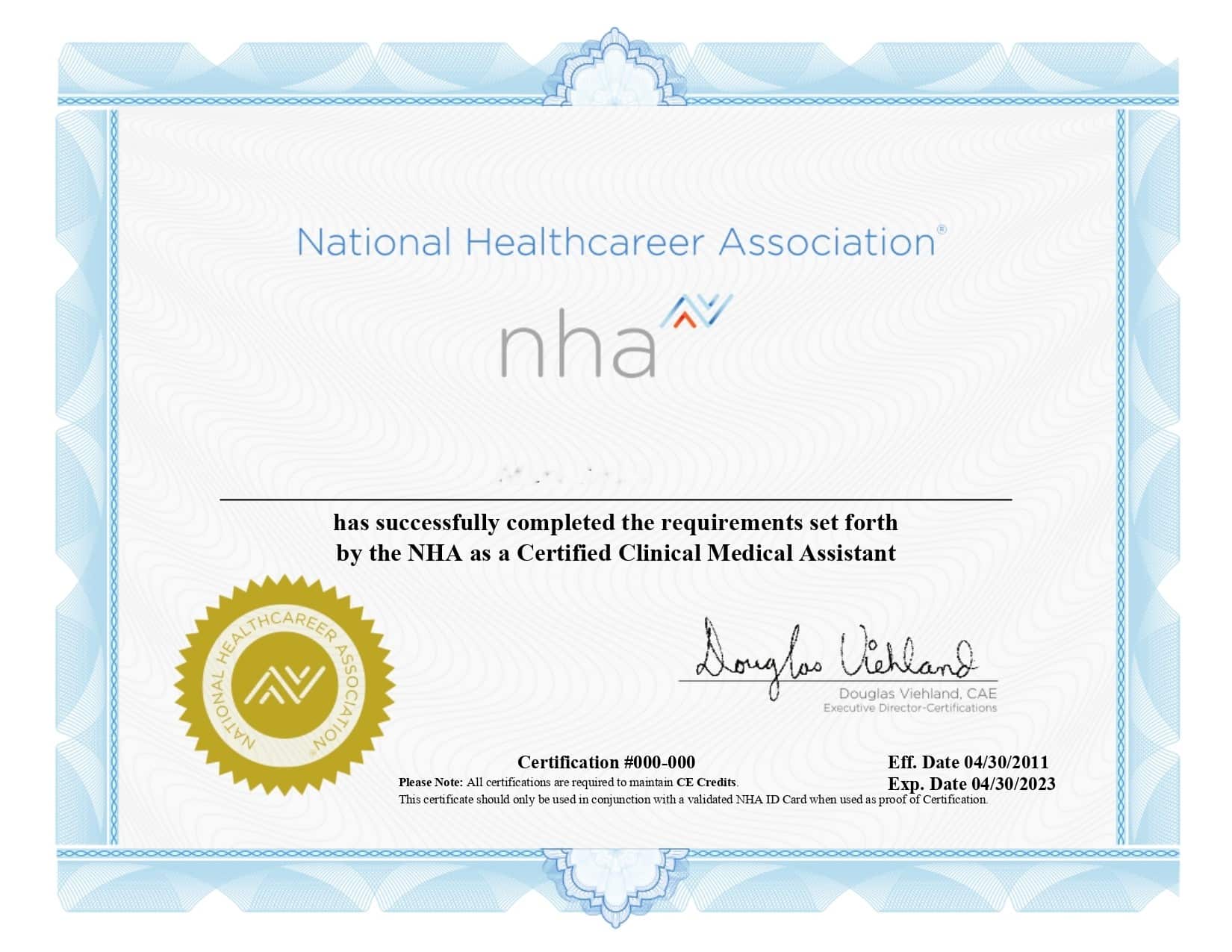
The NHA CCMA (Certified Clinical Medical Assistant) certification helps verify that a candidate has the knowledge and skills to support safe, effective patient care in real clinical settings. It signals competence in areas such as patient intake and vital signs, infection control and safety, point-of-care testing and basic lab procedures, phlebotomy and EKG support, documentation, patient communication, and medical law and ethics.
Many employers value CCMA certification because it provides a standardized way to assess readiness for the role.
Renewal and Ongoing Requirements
CCMA certification must be renewed every 2 years and typically requires completing continuing education (CE) hours to stay current and maintain active status.
| Aspect | Details |
|---|---|
| Certification renewal | Every 2 years |
| Continuing education | Required for renewal (requirements set by NHA) |
| Career value | Helps demonstrate verified skills to employers |
Source: iPREP
Retake Attempts
If you don’t pass on the first attempt, retakes are allowed, but waiting periods and attempt limits may apply. Always confirm the current retake policy and timelines in your candidate portal before scheduling.
Provisional Certification (Students)
Some students may be eligible for a provisional certificate before graduation. This can help demonstrate progress toward full certification while completing a medical assisting program. Eligibility rules depend on program and NHA requirements.
Technical Facts
CCMA Fast Facts
- 3 hours testing time
- 180 items total
- 150 scored questions
- 30 unscored pretest
- Computer-based exam
- Multiple-choice format
| Aspect | Details |
|---|---|
| Test Name | NHA Certified Clinical Medical Assistant (CCMA) |
| Purpose | Certifies core MA competencies |
| Recognition | National (U.S.) |
| Administered By | National Healthcareer Association (NHA) |
Eligibility Criteria
Eligibility is based on education plus a recent training or work-experience pathway:
- High school diploma or GED
- MA program completed (last 5 years), or
- 1 year supervised experience (last 3 years)
Students/provisional: Some students may be eligible to test before graduation and receive a provisional status that must be converted after graduation under NHA rules and timelines.
| Criteria | Requirements |
|---|---|
| Education | High school diploma/GED |
| Training | MA program within 5 years |
| Work experience | 1 year within 3 years |
CCMA vs. CMA
CCMA and CMA are both recognized medical assisting credentials but are issued by different organizations with different eligibility rules.
| Certification | CCMA | CMA |
|---|---|---|
| Exam Provider | NHA | AAMA |
| Typical Eligibility | Training or experience | Accredited program graduate |
| Exam Format | Multiple-choice | Multiple-choice |
| Renewal Cycle | Every 2 years | Every 5 years |
Language and Geography
CCMA testing is primarily in English and is used across the United States.
CCMA Test Tips
- Expect “first/next” workflow questions:
Many items test the correct sequence (intake → vitals → prep → document). Pick the option that matches safe, standard steps. - Default to safety and infection control:
If one choice improves patient safety, prevents contamination, or follows PPE/hand hygiene standards, it’s often the best answer. - Think scope of practice:
Choose actions a clinical medical assistant would perform or support (prepare, assist, collect, document, report). Avoid options that diagnose, prescribe, or independently treat. - Patient ID + documentation matter:
When options are close, the best answer often includes verifying the right patient/specimen and documenting correctly. - Use “single best answer” logic:
Multiple options may sound true—select the one that is most appropriate in that situation and aligns with standard protocols. - Don’t get stuck—flag and move on:
Make your best choice, flag it, and keep your pace steady for the full exam. - Watch for distractors:
Extreme words (always/never), unnecessary steps, or skipping verification/hand hygiene are common traps. - Recheck flagged items for keywords:
On review, look for “best,” “first,” “most appropriate,” and safety/legal cues (privacy, consent, reporting).
FAQs
The NHA CCMA is the Certified Clinical Medical Assistant credential offered by the National Healthcareer Association (NHA). It is a nationally recognized certification that validates core knowledge and skills used in clinical medical assisting.
Eligibility is based on education plus a recent training or work-experience pathway. Common pathways include having a high school diploma or GED (or qualifying student status through an approved route) and either completing a medical assistant program within the last 5 years or having 1 year of supervised medical assisting work experience within the last 3 years. Some students may be eligible to test before graduation and receive a provisional status that must be converted after graduation under NHA rules and timelines.
Exam fees and administrative costs can vary based on how you apply (for example, through a school/program vs. as an individual) and any bundled materials. Check your NHA account/portal for the most current pricing and payment steps.
The exam covers 7 domains. Domain weights reflect the 150 scored questions (the exam also includes 30 unscored pretest items): Foundational Knowledge and Basic Science (10%), Anatomy and Physiology (about 5%), Clinical Patient Care (56%), Patient Care Coordination and Education (8%), Administrative Assisting (8%), Communication and Customer Service (8%), and Medical Law and Ethics (about 5%).
Prepare by studying by domain, focusing on weak areas, and practicing exam-style questions. Combine learning sessions with timed practice sets to build pacing, then use full-length mock exams to build stamina.
Retakes are allowed, but waiting periods and attempt limits can apply. Confirm the current retake policy and timelines in your candidate portal before scheduling.
Yes. CCMA certification must be renewed periodically and typically requires completing continuing education (CE) hours/credits. Confirm the current renewal and CE requirements in your NHA account/portal.
Results Scale and Interpretations
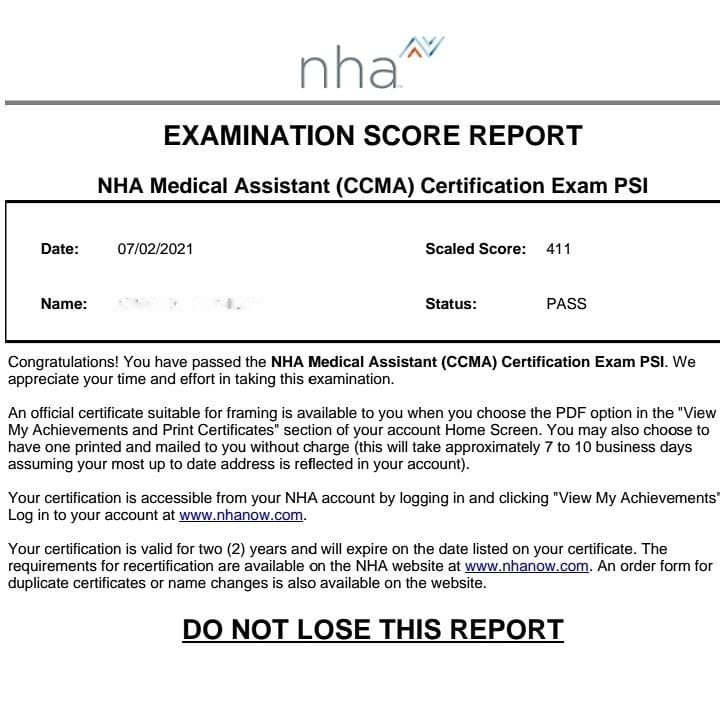
NHA CCMA exam results are reported as a scaled score, which helps ensure fairness across different versions of the exam by accounting for small differences in overall difficulty.
Your score is reported on a scale up to 500, along with a topic-area performance breakdown. Your official exam result is Pass or Fail. A scaled score of 390 is required to pass.
Note: “Provisional” typically refers to a candidate’s credential status/eligibility pathway (for example, certain student pathways), not a separate exam score category.
Administration
Test Administrator: The National Healthcareer Association (NHA) administers the CCMA certification exam.
Test Format: Computer-based multiple-choice.
Test Materials: No special materials are required beyond what the test provider supplies. Personal items and reference materials are not permitted.
Cost: Exam fees can vary depending on how you register (for example, through a school/program vs. as an individual). Check your NHA account/portal for current pricing.
Retake Policy: Retakes are allowed, but waiting periods and attempt limits can apply. Confirm the current retake policy in your candidate portal.
Test Provider
The National Healthcareer Association (NHA) provides the Certified Clinical Medical Assistant (CCMA) certification. It is a professional certification agency that offers a variety of certifications for healthcare professionals, including medical assistants, phlebotomists, pharmacy technicians, and more. The CCMA certification is for individuals seeking to become clinical medical assistants. It validates their knowledge and skills in patient care, clinical procedures, medical office management, and communication.
Information Sources
Disclaimer – All tutoring resources and preparation materials available on iPrep are authentic and designed for tutoring. iPrep is not affiliated with the National Healthcareer Association (NHA), the owner of the Certified Clinical Medical Assistant (CCMA) certification test, or any trademark or organization mentioned above.
Free NHA CCMA 3.0 practice test: Get familiar with the exam-style questions by practicing with these sample CCMA questions:
Question 1 of 11
What does the medical abbreviation “SOB” commonly indicate?
- Shortness of breath
- Swelling of the abdomen
- Severe abdominal pain
- Stiffness of the back
The correct answer is A. Shortness of breath.
Explanation:
- “SOB” is an abbreviation commonly used to represent “shortness of breath.”
- “Ascites” refers to the abnormal accumulation of fluid in the abdomen and is not represented by the abbreviation “SOB.”
- “Colic” typically refers to severe abdominal pain, but it is not represented by the abbreviation “SOB.”
- “Stiffness of the back” is unrelated to the abbreviation “SOB.”
Question 2 of 11
Which of the following is the correct order of the chambers of the heart through which blood flows after returning from systemic circulation?
- Right atrium, right ventricle, left atrium, left ventricle
- Left atrium, left ventricle, right atrium, right ventricle
- Right atrium, left atrium, right ventricle, left ventricle
- Left atrium, right atrium, left ventricle, right ventricle
The correct answer is A. Right atrium, right ventricle, left atrium, left ventricle.
Explanation:
- After returning from systemic circulation, deoxygenated blood enters the heart through the right atrium.
- From the right atrium, blood flows into the right ventricle, which pumps the blood to the lungs for oxygenation.
- Oxygenated blood returns to the heart through the left atrium.
- From the left atrium, blood flows into the left ventricle, which pumps the oxygenated blood to the rest of the body.
- Therefore, the correct answer is A) Right atrium, right ventricle, left atrium, left ventricle.
Question 3 of 11
Which of the following structures is the primary structure responsible for the production of red blood cells?
- Spleen
- Lymph nodes
- Bone marrow
- Thymus gland
The correct answer is C. Bone marrow.
Explanation:
- The spleen plays a role in filtering the blood, storing red blood cells, and producing some types of white blood cells, but it is not the primary site of red blood cell production.
- Lymph nodes are involved in filtering lymph and activating immune responses.
- The thymus gland plays a role in the development and maturation of T-lymphocytes (a type of white blood cell).
- Red blood cells are primarily produced in the bone marrow, specifically in the spongy bone marrow found in the center of bones.
Question 4 of 11
Which of the following methods is used to administer medication through the skin?
- Inhalation
- Intravenous
- Sublingual
- Topical
The correct answer is D. Topical.
Explanation:
- Inhalation involves breathing in medication through the respiratory system.
- Intravenous administration is the direct delivery of medication into a vein.
- Sublingual administration involves placing medication under the tongue for absorption.
- Topical administration involves applying medication directly to the skin.
Question 5 of 11
Which of the following is the correct sequence of steps for handwashing?
- Wet hands, apply soap, rinse thoroughly, dry with paper towel
- Dry hands, apply soap, rinse thoroughly, use hand sanitizer
- Wet hands, use hand sanitizer, apply soap, rinse thoroughly
- Wet hands, apply soap, rinse thoroughly, use hand sanitizer
The correct answer is A. Wet hands, apply soap, rinse thoroughly, dry with paper towel.
Explanation:
- Wetting the hands first helps to create a lather with soap.
- Applying soap helps to remove dirt, germs, and other contaminants.
- Rinsing thoroughly under running water removes soap and debris.
- Drying the hands with a paper towel helps to remove any remaining moisture.
Question 6 of 11
Which of the following positions is commonly used for examining the chest and lungs?
- Supine position
- Prone position
- Lithotomy position
- Fowler’s position
The correct answer is D. Fowler’s position.
Explanation:
- The supine position is lying flat on the back.
- The prone position is lying flat on the stomach.
- The lithotomy position is used for gynecological examinations.
- Fowler’s position is a seated or semi-seated position with the head and upper body elevated, commonly used for examining the chest and lungs.
Question 7 of 11
Which of the following is the correct technique for measuring blood pressure using a sphygmomanometer and stethoscope?
- Inflate the cuff until no sound is heard
- Place the diaphragm of the stethoscope over the brachial artery.
- Deflate the cuff at a rate of 10-20 mmHg per second
- Measure blood pressure immediately after the patient has exercised.
The correct answer is B. Place the diaphragm of the stethoscope over the brachial artery.
Explanation:
- When measuring blood pressure, the cuff should be inflated until the radial pulse is no longer felt, not until no sound is heard.
- When deflating the cuff, it should be done at a rate of 2-3 mmHg per second, not 10-20 mmHg per second.
- The diaphragm of the stethoscope should be placed over the brachial artery, not the radial artery.
- Blood pressure should be measured after the patient has been resting for a few minutes, not immediately after exercise.
Question 8 of 11
Which of the following is an example of a medical assistant’s responsibility related to medical billing and coding?
- Assisting with wound dressings
- Updating patient demographic information
- Verifying health insurance coverage
- Performing electrocardiograms (ECGs)
The correct answer is C.Verifying health insurance coverage.
Explanation:
- Assisting with wound dressings and performing electrocardiograms (ECGs) are clinical tasks typically performed by medical assistants.
- Updating patient demographic information is an administrative task that ensures accurate records but is not directly related to medical billing and coding.
- Verifying health insurance coverage involves confirming a patient’s eligibility, coverage limits, and any pre-authorization requirements to ensure accurate billing and coding practices.
Question 9 of 11
You receive a call from a patient who wants to reschedule their upcoming appointment due to a scheduling conflict. What is the most appropriate course of action as a medical assistant in an administrative role?
- Inform the patient that rescheduling is not possible and suggest they try to rearrange their schedule.
- Check the provider’s schedule and offer the patient alternative appointment times based on availability.
- Offer the patient the next available appointment without confirming availability with the healthcare provider.
- Ask the patient to call back later as you are unable to assist with scheduling changes.
The correct answer is B. Check the provider’s schedule and offer the patient alternative appointment times based on availability.
Explanation:
- Option A is not the most appropriate response as it does not accommodate the patient’s request and may not reflect good patient-centered care.
- Option B is not the best course of action as it is important to ensure appointment availability with the healthcare provider before offering an alternative.
- Option C is the most appropriate response. As a medical assistant, you should check the provider’s schedule to see available time slots and offer the patient alternative appointment options that align with the provider’s availability.
- Option D is not recommended as it does not address the patient’s request and may leave them feeling unsupported.
Question 10 of 11
During a phone call with a patient, you encounter a language barrier as they do not speak English fluently. What is the most appropriate course of action?
- Speak loudly and slowly to ensure the patient understands.
- Use complex medical terminology to expedite the conversation.
- Seek assistance from an interpreter or a language translation service.
- End the call and ask the patient to come in-person for further communication.
The correct answer is C. Seek assistance from an interpreter or a language translation service
Explanation:
- Speaking loudly and slowly may not effectively overcome the language barrier and can further confuse the patient. It’s important to use appropriate communication strategies.
- Using complex medical terminology can exacerbate the language barrier and hinder effective communication. It’s important to use clear and simple language.
- Seeking assistance from an interpreter or a language translation service ensures accurate communication and facilitates understanding between the patient and the medical assistant.
- Ending the call and asking the patient to come in-person may inconvenience the patient and delay necessary communication. Exploring alternative communication methods is preferred.
Question 11 of 11
Which of the following principles is associated with the concept of patient autonomy?
- Beneficence
- Nonmaleficence
- Veracity
- Informed consent
The correct answer is D. Informed consent.
Explanation:
- Beneficence refers to the duty to act in the best interest of the patient.
- Nonmaleficence refers to the duty to do no harm to the patient.
- Veracity refers to the duty to be truthful and honest with the patient.
- Patient autonomy is the right of the patient to make decisions about their own healthcare, and obtaining informed consent respects this principle
Boost your exam prep with these flashcards
About the course
Includes 17 practice tests (4 full-length simulations)
31 Learning hours · 17 Practice tests · 600 Questions · 180 Videos
Start with a quick readiness check to see where you stand across the CCMA 3.0 domains, then build your foundation with a structured study guide and subject refresh. From there, reinforce core anatomy and physiology systems and key clinical procedures (including phlebotomy and EKG/cardiovascular testing) before shifting into exam-readiness skills. Finish with mock tests to simulate real conditions, followed by targeted analysis to close gaps.

Skills you will learn
Foundational knowledge and basic science · Anatomy and physiology for clinical practice · Clinical patient care procedures and safety · Patient care coordination and education · Administrative assisting, scheduling, and records · Communication and customer service in healthcare · Medical law, ethics, and confidentiality
Curriculum
Course Introduction
- How the course is structured
- How to use explanations
Self-Assessment: Readiness For The Course And The Exam
- Baseline across CCMA domains
- Timed and practice modes
Study Guide & Subject Refresh
- Foundational knowledge and basic science
- Anatomy and physiology for clinical practice
- Clinical patient care procedures and safety
- Admin, customer service, law, ethics
Bonus: Anatomy and Physiology Guide
- Cardiovascular, respiratory, gastrointestinal systems
- Neurology, renal, hematological, immune systems
- Homeostasis and sensory system review
- Practice questions with explanations
Bonus: Phlebotomy and EKG/Cardiovascular Testing
- Venipuncture basics and specimen handling
- EKG lead placement and workflows
Getting Ready For the Exam
- Understand CCMA exam structure
- Study techniques and memorization for terminology
- Time management and test-day readiness
- Stress management and post-exam next steps
Mock Tests
- Full-length simulations and targeted practice
- Timed and practice modes
- Build pacing and decision-making
Post-Mock Test Analysis
- Review misses and strengthen weak areas
Course Conclusion
- Wrap-up and next steps
Appendix: Additional Resources
- Official CCMA guide and FAQs
- Recommended readings and professional associations
- Stress, health, and support resources
- Understanding and interpreting exam results
Reviews

Stacy D********
February 16, 2026 at 7:23 PM
No I didn’t pass, nothing I studied was on the test. Not sure what is going on but wasn’t familiar with the material
iPrep
February 17, 2026 at 1:37 AM
Hi Stacy, according to our records you’ve completed 11 out of 49 steps in the course. We recommend completing the full course before taking the exam again, as it’s designed to cover the topics tested on the NHA CCMA exam.
Amber D****
August 18, 2025 at 7:43 PM
This is a great tool for the CCMA exam. It is well laid out and very informational. I really like the precision it gives of answers you have missed. It helps to read why the answer was incorrect and gives context clues to help remember the correct answer to the question. Really pleased with this overall.
Amber D****
July 31, 2025 at 10:10 PM
This has been extremely beneficial for my CCMA test. The practice tests are very helpful and I love how I can see what I need to brush up on.
Patricia S*****
April 23, 2025 at 2:57 PM
Iprep has clear and detailed explanation for they test questions that covers every area to prepare you for the nha exam
Brandi T********
January 5, 2025 at 8:24 PM
Feeling more and more confident about passing my test as I get further into the study guide and practice tests!
Tyshara H****
December 18, 2024 at 11:46 PM
The study guides are really helpful and has helped me retain So much information. I feel much more prepared for the test after studying using this guide.
Tonya W*******
September 23, 2024 at 5:49 PM
I purchased this course 4 days before testing and I passed the first time. ! Great course that also helps you understand how to narrow down the best answer.
Jasmin D*****
September 8, 2024 at 11:16 PM
This course was the perfect refresher for the exam, and just what I needed to pass! I definitely recommend this practice material.
Amal M*******
August 26, 2024 at 3:41 PM
I liked this iPrep because I didn't know where to start studying, which helped me find a direction on where to start. It is very informative and easy to navigate!