Reviewed by Tamir Rubin, Head of Product at iPREP • Updated February 2026
NCE Exam Sample Question
Which of the following actions is most appropriate as an initial step when a counselor encounters an ethical dilemma that may involve legal requirements?
- Always prioritize the law over the code of ethics.
- Consult with a supervisor or colleague for guidance.
- Ignore the code of ethics as it is just a guideline.
- Choose whichever option is the easiest to follow.
Topics Covered
High-level content areas
- Professional Practice and Ethics principles
- Intake, Assessment, and Diagnosis decisions
- Areas of Clinical Focus case scenarios
- Treatment Planning goals, monitoring, termination
- Counseling Skills and Interventions selection
- Core Counseling Attributes professionalism, self-awareness
Test Duration
Total time: 4 hours 15 min • 200 questions (40 unscored)
Each section must be completed within its own time limit. You cannot return to a previous section once its time has expired, and calculator use is not permitted during the test.
Test Breakdown & Sample Questions
The NCE assesses entry-level counseling knowledge and skills across six work-behavior domains. The exam includes 160 scored questions (plus additional unscored pretest questions).
| Domain | Percent of scored items | Number of scored items |
|---|---|---|
| Professional Practice and Ethics | 12% | 19 |
| Intake, Assessment, and Diagnosis | 12% | 19 |
| Areas of Clinical Focus | 29% | 47 |
| Treatment Planning | 9% | 14 |
| Counseling Skills and Interventions | 30% | 48 |
| Core Counseling Attributes | 8% | 13 |
| Total | 100% | 160 |
Use this breakdown to prioritize your study time, focusing more on the higher-weighted domains.
1. Professional Practice and Ethics
This domain focuses on the standards and responsibilities that guide professional counseling practice. It accounts for 12% of the scored exam (about 19 scored questions).
Expect scenario-based questions on informed consent, confidentiality and its limits, documentation and records, professional boundaries, ethical decision-making, and professional communication, including appropriate use of technology and social media.
To prepare, practice applying ethical principles to realistic counseling situations and review the ethical and legal expectations that apply in your jurisdiction and work setting.
Sample Professional Practice and Ethics Question
A client tells you that she wants to friend you on social media. What is the most appropriate response?
- Accept the friend request to show the client that you are approachable and friendly.
- Decline the friend request and explain your professional boundaries to the client.
- Ignore the friend request and do not mention it in your next session with the client.
- Accept the friend request but avoid engaging with the client’s posts.
The correct answer is B. Decline the friend request and explain your professional boundaries to the client.
Explanation:
- Option A is incorrect. While it’s important to be approachable and friendly with your clients, accepting a client’s social media friend request can blur the professional boundaries between a counselor and a client and potentially compromise the therapeutic relationship.
- Option B is the correct answer. It maintains the professional boundary while also addressing the situation directly with the client. Transparency and direct communication about professional boundaries are crucial in the counseling profession.
- Option C is incorrect. Ignoring the situation does not address the issue. It’s essential to maintain open communication with your client, especially when it comes to issues that may impact the therapeutic relationship.
- Option D is incorrect. Even if you don’t engage with the client’s posts, accepting the friend request can blur professional boundaries and create potential ethical issues. It’s best to maintain professional boundaries by keeping your personal and professional lives separate.
2. Intake, Assessment, and Diagnosis
This domain focuses on the skills used to understand a client’s concerns and determine appropriate next steps. Expect questions on conducting an intake interview, selecting and using assessments appropriately, evaluating risk and level of functioning, and using diagnostic criteria in an ethical and culturally responsive way.
You may see scenarios involving mental status considerations, screening for substance use and other concerns, interpreting assessment results, and integrating information from multiple sources to support a working diagnosis and guide initial treatment planning.
Sample Intake, Assessment, and Diagnosis Question
During an intake interview, a client reports feeling sad most of the day nearly every day, a loss of interest in activities they once enjoyed, difficulty sleeping, decreased energy, and poor concentration for the past month. The client also reports that these symptoms are interfering with work and relationships. As a counselor, your preliminary diagnosis would be:
- Generalized Anxiety Disorder (GAD)
- Obsessive-Compulsive Disorder (OCD)
- Major Depressive Disorder (MDD)
- Post-Traumatic Stress Disorder (PTSD)
The correct answer is C. Major Depressive Disorder (MDD)
Explanation:
The client’s symptoms include depressed mood, loss of interest, sleep disturbance, low energy, and poor concentration, along with functional impairment. This pattern is most consistent with Major Depressive Disorder.
Why the other answers are wrong:
- A: GAD is characterized by excessive worry and related symptoms; the key feature of pervasive worry is not presented here.
- B: OCD requires obsessions and/or compulsions, which are not described.
- D: PTSD requires exposure to a traumatic event and a specific symptom cluster (e.g., intrusion, avoidance), which are not described.
3. Areas of Clinical Focus
This domain covers a wide range of common client concerns and clinical presentations. It is one of the largest sections of the exam, accounting for about 29% of the scored items.
Expect scenario-based questions involving concerns such as mood and anxiety symptoms, substance use, stress and adjustment, relationship and family issues, grief and loss, trauma-related concerns, and other challenges across the lifespan. The focus is on recognizing patterns in client presentations and choosing appropriate, evidence-informed counseling responses.
Sample Areas of Clinical Focus Question
A 16-year-old client discloses that they are experiencing constant bullying at school, which is causing them significant distress. As a counselor, what would be the most appropriate initial step in addressing this issue?
- Advise the client to ignore the bullies and focus on their studies.
- Contact the school immediately and demand action.
- Encourage the client to retaliate against the bullies.
- Validate the client’s experiences and feelings, and explore strategies for coping and seeking support.
The correct answer is D. Validate the client’s experiences and feelings, and explore strategies for coping and seeking support.
Explanation:
In this situation, the first step should be to validate the client’s experiences and feelings, which helps in building trust and understanding. Then, the counselor should collaboratively explore coping strategies and avenues for support with the client, which might include involving school personnel or parents in a way that respects the client’s autonomy and confidentiality.
Option A is incorrect because simply ignoring the problem does not address the emotional distress the client is facing or the potential for the problem to escalate. Option B, while potentially part of a broader response plan, is not the best initial step because it may not respect the client’s autonomy and could potentially make the situation worse if not done thoughtfully. Option C is incorrect because it encourages aggression and can potentially exacerbate the situation, rather than resolving it in a healthy and constructive manner.
4. Treatment Planning
This domain focuses on building a clear, practical plan for counseling and adjusting it over time. Expect scenario-based questions on setting goals and measurable objectives, choosing appropriate interventions, identifying barriers and supports, coordinating with other services when needed, and planning for progress monitoring, termination, and follow-up.
Sample Treatment Planning Question
You are working with a client who is dealing with severe social anxiety. The client has expressed a desire to be able to attend social events without experiencing panic attacks. As part of your treatment plan, you decide to incorporate exposure therapy. Which of the following best describes how you would approach this?
- Immediately have the client attend a large social gathering and instruct them to interact with as many people as possible.
- Gradually expose the client to social situations, starting with less threatening scenarios and working up to more challenging ones.
- Suggest the client to avoid social situations altogether until they feel ready to face them.
- Ask the client to repeatedly visualize attending social events without providing any further intervention.
The correct answer is B. Gradually expose the client to social situations, starting with less threatening scenarios and working up to more challenging ones.
Explanation:
The correct answer is B because it correctly applies the principles of exposure therapy, which involves gradual and repeated exposure to the source of fear or anxiety. This allows the client to learn to tolerate anxiety and realize that the feared outcomes are unlikely to occur.
Choice A is incorrect because it suggests flooding, which can be overwhelming and counterproductive for a client with severe social anxiety. Choice C is incorrect because avoiding social situations altogether would reinforce the client’s anxiety rather than helping them to overcome it. Choice D is incorrect because while visualization can be a helpful tool in therapy, it should not be the sole intervention, especially for a client with severe social anxiety.
5. Counseling Skills and Interventions
This domain focuses on what you do in session and how you choose interventions. Expect scenario-based questions on building the therapeutic relationship, applying core helping skills, selecting appropriate interventions, responding to crisis situations, and adapting your approach to the client’s needs and context.
You may see items on skills such as rapport-building, reflection and questioning, goal-focused interventions, group and family considerations, and the practical use of common counseling approaches in realistic client scenarios.
Sample Counseling Skills and Interventions Question
Maria, a new client, comes to you expressing feelings of overwhelming sadness, hopelessness, and loss of interest in activities she previously enjoyed. She mentions that these feelings have persisted for over two weeks. As a counselor, your best initial approach would be to:
- Immediately start Maria on cognitive-behavioral therapy.
- Assess Maria for potential suicidal ideation.
- Encourage Maria to engage in activities that she used to enjoy.
- Refer Maria to a psychiatrist for medication.
The correct answer is B. Assess Maria for potential suicidal ideation.
Explanation:
Given Maria’s symptoms of persistent sadness, hopelessness, and anhedonia (loss of interest in activities), these suggest a potential diagnosis of major depressive disorder. A crucial part of initial evaluation in such a situation involves assessing for safety and risk, including suicidal ideation, to ensure the immediate well-being of the client.
A. Starting Maria on cognitive-behavioral therapy immediately is not the best initial step. While this type of therapy can be very effective for depression, it is crucial to assess Maria’s safety (i.e., suicidal ideation) before proceeding with treatment planning.
C. While encouraging Maria to engage in activities she used to enjoy can be a part of behavioral activation (a component of cognitive-behavioral therapy), it is not the most appropriate initial step given the severity of Maria’s symptoms. Furthermore, without assessing for suicide risk, this could potentially overlook a serious safety issue.
D. Referring Maria to a psychiatrist for medication is not the best immediate step. While medication can be a part of the comprehensive treatment plan for major depressive disorder, the counselor’s first responsibility is to assess for immediate risks, including suicidal ideation. Furthermore, as counselors, it’s important to first understand the client’s symptoms, preferences, and needs before making a referral for medication.
6. Core Counseling Attributes
This domain focuses on the counselor qualities and foundational behaviors that support effective helping relationships. Expect questions on empathy, professionalism, self-awareness, managing personal reactions, and demonstrating respect for client diversity.
Items often ask you to choose the most appropriate counselor response in a scenario, showing active listening, nonjudgment, cultural sensitivity, and a supportive, ethical presence.
Sample Core Counseling Attributes Question
A client tells you they are struggling with feelings of isolation and loneliness since they moved to a new city for a job. They express a willingness to try new things to overcome their feelings of isolation and ask, “Do you have any suggestions for where to start?”
Which of the following is the most appropriate response to the client’s situation?
- “That’s a positive attitude to have. Joining a club or activity group in your city could be a good way to meet new people.”
- “I can understand why you feel that way. It must be challenging to adapt to a new city and not have familiar faces around.”
- “You should try to be more outgoing and social. That might help you make friends.”
- “Maybe you should consider moving back to where you came from if you’re not happy here.”
The correct answer is A.
Explanation:
In this example, the most appropriate response is A. The client has indicated a willingness to try new things to overcome their feelings of isolation, making it appropriate to suggest a practical solution like joining a club or activity group. In this context, choice B, while empathetic, does not take into account the client’s willingness to take action. Choice C assumes that the client is not outgoing or social, which may not be accurate or helpful. Choice D is not appropriate as it suggests that the client made a mistake by moving, rather than offering a supportive or constructive response.
Did you know?
The NCE is a 200-question multiple-choice exam. Typically, 160 questions are scored and determine your result, while the remaining questions are unscored (pretest). Policies like pass rates, retakes, and score validity can vary by program or state—confirm what applies to your registration.
NCE Exam Preparation Strategies
Know the exam:
200 multiple-choice questions; typically 160 scored and 40 unscored (pretest). Six domains.
Choose your resources:
One study guide plus one question bank. Stick with them.
Study consistently:
Short sessions several days a week, with a weekly review block.
Practice under time:
Timed sets, then one or two full-length practice exams. Review missed and guessed items.
Focus on application:
Especially ethics—practice “best first step” decisions in scenarios.
Plan test day:
Sleep well, arrive early, pace yourself, and move on from time-sinks.
If you retake:
Use your results to target weak domains. Rules can vary by program or state.
Test Features
The purpose of the NCE exam
The National Counselor Examination (NCE) is a standardized exam used as part of the credentialing process for many counselors. It is used by NBCC for national certification pathways and is also accepted by many state boards as one component of licensure requirements. The exam is designed to assess entry-level counseling knowledge and decision-making across core practice areas.
Test fast facts (tl;dr)
- Administered by NBCC
- 200 multiple-choice questions
- 160 scored questions (typical)
- 40 unscored pretest questions
- 225 minutes exam time
- Mid-exam scheduled break (typical)
- Total appointment time varies
- Eligibility varies by pathway
- Score based on scored items
Common names for the NCE
The official name is the National Counselor Examination (NCE). You may also see it referred to informally as the National Counselor Exam, the NCE Counseling Exam, or the NBCC exam.
How do I register for the NCE?
Registration steps can vary based on whether you are taking the exam through an NBCC pathway (such as an NCC application) or through a state board or graduate program. In general, registration involves submitting your application through the appropriate portal, receiving authorization to test, and then scheduling your appointment through the exam delivery provider. Always follow the instructions provided in your authorization to test.
Who is eligible?
Eligibility is determined by the pathway you are using (state licensure, graduate program, or NBCC). Requirements commonly include graduate-level education in counseling and meeting any additional documentation or supervision criteria required by your board or program. Confirm eligibility rules with your state board, program, or NBCC before you apply.
What’s the format?
Test format: Multiple-choice, computer-based. You have 225 minutes of exam time, and your total appointment time may be longer due to check-in, instructions, a tutorial, and the scheduled break. Breaks and review rules can vary by program and authorization, so follow the instructions provided on your exam day.
What’s on the exam?
The NCE tests counseling knowledge and practice across six work-behavior domains. These domains reflect the skills and decisions counselors use in real-world practice. The exam is also commonly aligned with broad counseling curriculum areas taught in graduate programs.
Results Scale and Interpretations
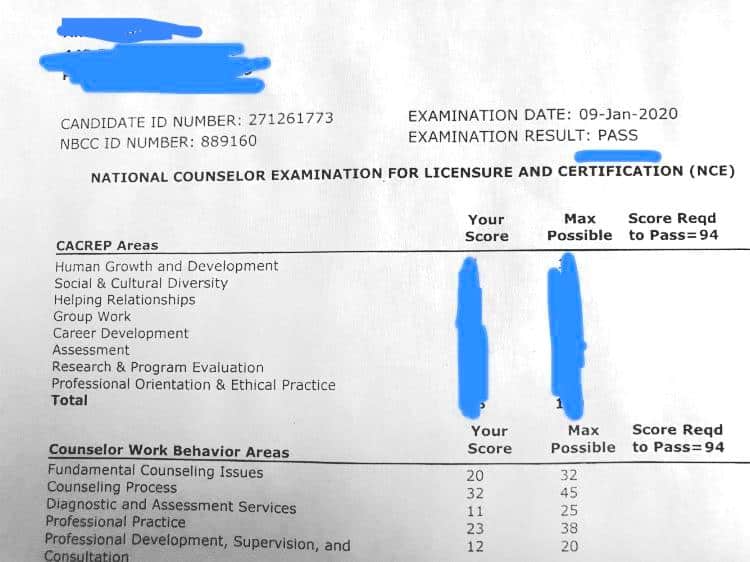
The NCE does not have one universal passing score. The minimum passing score is set for each exam form using a formal standard-setting process and may vary slightly by version to account for differences in overall difficulty.
How your score is calculated:
The exam includes 200 multiple-choice questions. Typically, 160 questions are scored and count toward your result. The remaining 40 questions are unscored field-test items used to evaluate questions for future exams.
Unscored items:
Unscored questions do not affect your score. They are not counted as right or wrong toward your result.
Score range:
Your score is based on the number of scored questions answered correctly, with a maximum possible score of 160.
What “pass” means:
Your result is based only on your performance on the exam. It is not affected by other test takers’ performance or by work history, education, or experience.
What you receive after testing:
After you finish, you receive an unofficial score report. For some testing options, you may access the report through your testing account.
How to use your score report:
Your report typically includes a breakdown across the six work-behavior domains:
- Professional Practice and Ethics
- Intake, Assessment, and Diagnosis
- Areas of Clinical Focus
- Treatment Planning
- Counseling Skills and Interventions
- Core Counseling Attributes
Use the domain breakdown to target weaker areas in your study plan instead of relying on a single practice-test percentage to predict a pass.
Important note:
Score reporting timelines and retake rules can vary by testing pathway and jurisdiction, so follow the instructions provided with your authorization and score report.
NCE Exam FAQs
The National Counselor Examination (NCE) is a 200-question multiple-choice exam designed to assess counseling knowledge and decision-making used in entry-level practice.
There is no single fixed passing score. The minimum passing score can vary by exam form and is not typically published in advance.
Typically, 160 questions are scored and count toward your result. The remaining questions are unscored (pretest) items used for exam development. Unscored items do not affect your score.
The exam content is organized into six work-behavior domains:
– Professional Practice and Ethics
– Intake, Assessment, and Diagnosis
– Areas of Clinical Focus
– Treatment Planning
– Counseling Skills and Interventions
– Core Counseling Attributes
You will answer 200 multiple-choice questions. The scored questions are distributed across the six domains.
You have 225 minutes of testing time. Your total appointment time may be longer due to check-in, instructions, a tutorial, and the scheduled break.
Study by domain, practice timed multiple-choice questions, and use full-length practice exams to build pacing and identify weak areas. Focus on applying concepts to scenarios, not just memorizing definitions.
Registration depends on your pathway. Many candidates register through NBCC as part of a credentialing route or through a state board or graduate program process. After approval, you schedule your appointment through the exam delivery provider using the instructions in your authorization to test.
Testing windows, locations, and delivery options can vary by pathway and authorization. The exam is typically delivered at testing centers, and online options may be available for some candidates when approved.
Retake rules, waiting periods, and attempt limits can vary by pathway and jurisdiction. Follow the retake instructions provided for your specific authorization and registration.
On-screen navigation and review rules can vary by test delivery option and authorization. Plan to answer every question before you finish, since there is typically no penalty for guessing.
You typically receive an unofficial score report after testing. Official reporting timelines can vary by pathway and jurisdiction, so follow the guidance provided with your score report and authorization.
NCE Exam Tips
Confirm your details:
Double-check your appointment time, testing location or online setup, and required ID.
Know the timing:
You have 225 minutes of exam time, and there is typically a scheduled break mid-exam. Follow the on-screen rules for breaks and review.
Arrive (or log in) early:
Give yourself buffer time for check-in, security steps, and the tutorial.
Bring a pacing plan:
Move steadily. If a question is taking too long, choose the best option you can and keep going.
Read for the “best” answer:
Many questions are scenario-based. Look for what you should do first, next, or most appropriately.
Answer every question:
There is typically no penalty for guessing, so avoid leaving items blank.
Use the break wisely:
Reset, hydrate, and regroup. Don’t use the break to spiral or rehash questions.
Stay calm and consistent:
If you hit a tough stretch, focus on process: read carefully, eliminate, choose, move on.
After the exam:
You typically receive an unofficial score report after testing. Official reporting timelines can vary by pathway and jurisdiction.
Administration
Here’s what to expect when scheduling and taking the National Counselor Examination (NCE).
Test location:
The NCE is delivered through Pearson VUE. Depending on your authorization, you may test at a Pearson VUE test center and, in some cases, an online-proctored option may be available.
Test schedule:
Testing windows and available dates depend on your pathway (state board, graduate program, or NBCC route) and your authorization to test. Always follow the dates and instructions provided in your authorization.
Test format:
Computer-based exam. There is no paper-based version.
Test materials:
Testing center policies vary. If you test in person, you will be provided with approved note-taking materials according to the test center rules.
Cost:
Fees depend on how you are registering (for example, through a certification application or another authorized pathway). Confirm the current fee during registration.
Retake policy:
Retake rules and waiting periods can vary by pathway and jurisdiction. If your pathway includes a required waiting period or limits on attempts within a time window, those details will be listed in your exam authorization and registration instructions.
Test Provider
The National Counselor Examination (NCE) is owned and overseen by the National Board for Certified Counselors (NBCC), which sets credentialing standards for the counseling profession and also offers other NBCC exams.
Pearson VUE delivers the NCE through its computer-based testing network, including test centers and exam appointment scheduling.
The Center for Credentialing & Education (CCE) is affiliated with NBCC and supports credentialing-related processes and services connected to NBCC programs and exams.
Information Sources
- National Board for Certified Counselors (NBCC)
- Pearson VUE
- Center for Credentialing & Education (CCE)
Disclaimer – All information and prep materials on iPREP are original and created for tutoring and study purposes. iPREP is not affiliated with the National Board for Certified Counselors (NBCC), the owner of the NCE, or with any other organizations mentioned on this page.
Welcome to the NCE Free Sample Questions section. Practicing with sample questions is a great way to get comfortable with the exam format and the types of scenarios you’ll see on test day.
Question 1 of 12
Which of the following actions is most appropriate as an initial step when a counselor encounters an ethical dilemma that may involve legal requirements?
- Always prioritize the law over the code of ethics.
- Consult with a supervisor or colleague for guidance.
- Ignore the code of ethics as it is just a guideline.
- Choose whichever option is the easiest to follow.
The correct answer is B.
A. While laws are important, automatically prioritizing them without considering the ethical implications is not the best practice. B. Consulting with a supervisor or colleague helps in making an informed decision considering both legal and ethical aspects. C. Ignoring the code of ethics is not appropriate as ethics are crucial in counseling practice. D. Choosing the easiest option does not take into account the responsibilities and obligations of a counselor.
Question 2 of 12
A counselor receives a gift from a client. What is the most appropriate action for the counselor to take?
- Accept the gift without any discussion.
- Politely decline the gift.
- Accept the gift but discuss the implications and context with the client.
- Report the client for attempting to give a gift.
The correct answer is C.
Explanation:
A. Accepting the gift without discussion does not consider potential ethical implications. B. Declining the gift could potentially harm the therapeutic relationship if the gift is of cultural significance. C. Discussing the implications and context allows for a consideration of the ethical aspects while acknowledging the client’s gesture. D. Reporting the client is unnecessary and could harm the therapeutic relationship, as gifts are not inherently unethical.
Question 3 of 12
A new client comes to you expressing difficulty in concentrating, fatigue, and feeling sad most of the time. Which assessment tool is most appropriate for initially evaluating whether the client might be experiencing depression?
- Minnesota Multiphasic Personality Inventory (MMPI).
- Beck Depression Inventory (BDI).
- Myers-Briggs Type Indicator (MBTI).
- Rorschach Inkblot Test.
The correct answer is B.
Explanation:
A. The MMPI is used for personality assessment and psychopathology, not specifically for depression. B. The BDI is specifically designed to assess the severity and symptoms of depression. C. The MBTI is a personality assessment tool and does not assess depression. D. The Rorschach Inkblot Test is a projective test mainly used to analyze personality structure and is not specific to depression.
Question 4 of 12
During an initial intake interview, a client reports experiencing severe anxiety attacks. What is the most appropriate next step for the counselor to take?
- Immediately refer the client to a psychiatrist for medication.
- Conduct a thorough assessment to understand the context and severity of the anxiety attacks.
- Suggest the client to try deep breathing and relaxation techniques without further assessment.
- Cancel future appointments as the counselor is not equipped to handle severe cases.
The correct answer is B.
A. Immediate referral for medication is premature without a thorough assessment. B. Conducting a thorough assessment helps in understanding the context and severity, and informs the subsequent course of action. C. Suggesting techniques without understanding the context might not address the underlying issues. D. Canceling future appointments without assessment is not client-centered and does not consider the client’s needs.
Question 5 of 12
A client with a history of trauma is experiencing flashbacks and nightmares. Which therapeutic approach is particularly effective in treating clients with Post-Traumatic Stress Disorder (PTSD)?
- Cognitive Processing Therapy (CPT).
- Reality Therapy.
- Person-Centered Therapy.
- Existential Therapy.
The correct answer is A.
A. CPT is specifically designed for treating PTSD and involves helping clients to reframe and process thoughts related to trauma. B. Reality Therapy focuses on fulfilling needs and making better choices, but is not specifically for PTSD. C. Person-Centered Therapy emphasizes the therapeutic relationship but does not specifically address trauma processing. D. Existential Therapy addresses issues of existence and meaning but does not focus on trauma processing.
Question 6 of 12
A couple comes to you seeking help for communication issues in their relationship. Which therapeutic approach is most effective for working with couples to improve communication and resolve conflicts?
- Play Therapy.
- Dialectical Behavior Therapy (DBT).
- Emotionally Focused Therapy (EFT).
- Psychodynamic Therapy.
The correct answer is C.
A. Play Therapy is primarily used for children to express themselves through play and is not specifically for couples. B. DBT is mainly used for individuals with emotional regulation issues and not specifically for couples. C. EFT is designed for couples and focuses on attachment and bonding, which are key to improving communication and resolving conflicts. D. Psychodynamic Therapy focuses on unconscious processes and is not specifically aimed at couples’ communication issues.
Question 7 of 12
A client is diagnosed with Generalized Anxiety Disorder (GAD). Which of the following is an important component to include in a CBT-based treatment plan for this client?
- Cognitive restructuring techniques.
- Analysis of past life events.
- Exposure to feared objects or situations.
- Improving social status and financial standing.
The correct answer is A.
A. Cognitive restructuring techniques are important for addressing negative thinking patterns, which are common in GAD. B. Analysis of past life events is more aligned with psychodynamic therapy and is not a primary component for treating GAD. C. Exposure therapy is mainly used for specific phobias and not for GAD. D. Improving social status and financial standing are not direct components of treatment for GAD.
Question 8 of 12
When creating a treatment plan for a client with depression, what should be an initial short-term goal?
- Complete elimination of depressive symptoms within two weeks.
- Help the client to secure a fulfilling job.
- Improvement in daily functioning and engagement in activities.
- Ensure the client forms at least three new close friendships.
The correct answer is C.
A. Complete elimination of depressive symptoms in two weeks is unrealistic as a short-term goal. B. Securing a fulfilling job is a long-term goal and not directly related to treating depression. C. Improving daily functioning and engagement in activities are attainable short-term goals and crucial for clients with depression. D. Forming new close friendships is not a primary treatment goal for depression and may be unrealistic as an initial short-term goal.
Question 9 of 12
A counselor is working with a client who frequently interrupts and talks over the counselor. Which of the following interventions would be most appropriate for addressing this behavior in session?
- Ignore the interruptions and continue speaking.
- Raise voice to talk over the client.
- End the session early because of the interruptions.
- Set boundaries and communicate the importance of mutual respect in conversation.
The correct answer is D.
A. Ignoring the interruptions does not address the issue and can lead to miscommunication. B. Raising voice to talk over the client can escalate the situation and harm the therapeutic relationship. C. Ending the session early without addressing the issue is not client-centered and may damage rapport. D. Setting boundaries and communicating the importance of mutual respect is a proactive approach that addresses the issue while maintaining rapport.
Question 10 of 12
A client is struggling with decision-making and often seeks the counselor’s advice on personal matters. What is the most appropriate intervention for promoting the client’s autonomy in decision-making?
- Provide direct advice on all decisions.
- Encourage the client to make decisions based on intuition.
- Have the client write a pros and cons list for each decision.
- Facilitate exploration of values, goals, and options to support informed decision-making.
The correct answer is D.
A. Providing direct advice does not promote autonomy and can create dependency on the counselor. B. Making decisions based on intuition alone may not consider all factors involved. C. While writing a pros and cons list can be helpful, it doesn’t necessarily address underlying values and goals. D. Facilitating exploration of values, goals, and options empowers the client to make informed decisions aligned with their personal values and objectives.
Question 11 of 12
Which of the following is considered a core attribute of an effective counselor?
- Ability to solve clients’ problems directly.
- Empathy and understanding toward clients’ experiences.
- Being highly directive and controlling in sessions.
- Expressing personal opinions on clients’ life choices.
The correct answer is B.
A. The counselor’s role is not to solve clients’ problems directly, but to facilitate clients’ personal growth and problem-solving skills. B. Empathy and understanding are essential attributes that help in building rapport and understanding the client’s perspective. C. Being highly directive and controlling is not conducive to client autonomy and self-exploration. D. Expressing personal opinions on clients’ life choices may impose the counselor’s values and is not client-centered.
Question 12 of 12
In counseling, what is the term used for the counselor’s ability to communicate understanding, acceptance, and respect, thereby enabling the client to express thoughts and emotions freely?
- Positive regard.
- Countertransference.
- Reflection.
- Unconditional positive regard.
The correct answer is D.
A. Positive regard is showing acceptance, but the term “unconditional” is important for indicating that this acceptance is not based on conditions. B. Countertransference refers to the counselor’s emotional reactions to the client, which can be based on the counselor’s own experiences. C. Reflection is a communication skill used by counselors to mirror the client’s thoughts or feelings. D. Unconditional positive regard refers to the counselor’s acceptance and valuing of the client without any conditions, enabling the client to express themselves freely.