Reviewed by Tamir Rubin, Head of Product at iPREP • Updated July 2026
What is Matrigma?
The Matrigma measures non-verbal abstract reasoning and learning potential using visual matrix puzzles, helping employers estimate how quickly candidates learn new rules and solve novel problems. Test-takers solve 3×3 matrix reasoning questions; timing varies by version, with Classic at 35 questions in 40 minutes and Adaptive at 12 minutes. (Test technical manual edition: 2017)Matrix Reasoning Questions
Assesses: abstract reasoning
- Solve 3×3 visual matrix puzzles
- Choose missing tile from options
- Detect patterns across rows, columns
- Apply rule changes across the grid
- Use elimination for faster decisions
Test Duration
Total time: varies by version (Classic vs Adaptive) (often up to ~40 min)
Classic: 35 questions in 40 minutes. Adaptive: 12 minutes total, with up to 60 seconds per item; the number of questions varies by person within the time limit.
Test Breakdown & Sample Questions
| Feature | Classic Matrigma Test | Adaptive Matrigma Test |
|---|---|---|
| Type of questions | Non-verbal 3×3 matrix puzzles using geometric shapes and symbols. Identify the rule that links the visible elements and choose the missing element from the answer options. | Same as Classic Matrigma. |
| Time limit | 40 minutes | 12 minutes total; up to 60 seconds per question |
| Number of questions | 35 | Varies by person within the time limit |
| Level of difficulty | Predetermined order; difficulty generally increases as you progress | Difficulty adapts to your answers (typically harder after correct answers, easier/similar after incorrect answers) |
Did you know?
The Matrigma Test challenges test-takers with abstract, non-verbal visual reasoning questions in two versions: Classic (35 questions in 40 minutes) and Adaptive (a timed test, typically 12 minutes, where the number of questions varies within the time limit). Scores are reported on a 0–10 scale. Because the test is non-verbal, it can be used across countries and languages.
Matrigma Preparation Strategies
1. Learn how to examine the matrix by row, by column, and by diagonals
The matrices of Matrigma are always 3-by-3 matrices. People tend to examine them as a structure that includes 3 rows and 3 columns. This is true; however, it is not the complete truth. Each matrix has two additional dimensions—the diagonals of the matrix. Often, these are the more challenging dimensions to analyze. You should look for practice materials that do not overlook this observation and provide practice questions that will make you examine each matrix through all of its dimensions.
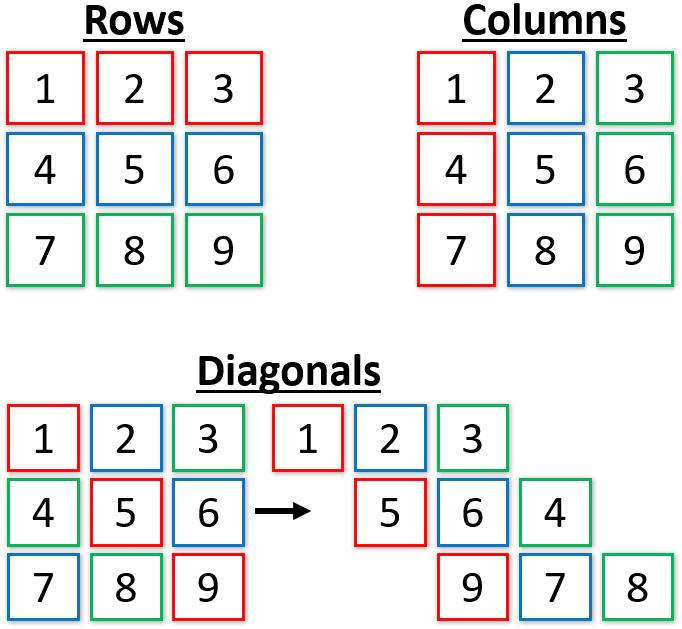
2. Learn about the most common features that change within the matrix
There are countless ways to describe changes in the matrix but you should set your mind to those changes that occur most often. A simple matrix is based on one or two pattern changes, but more complex matrices may combine 3-5 pattern changes and make it more difficult to recognize the overall pattern. The vast majority of the changes can be reduced to these pattern changes:
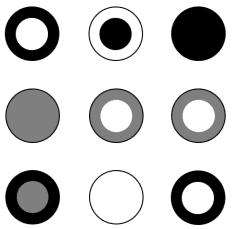
Color/fill changes
Objects and lines may change their color, pattern fill, or dash type. In this example, the outer part and the inner part of the circle change colors.
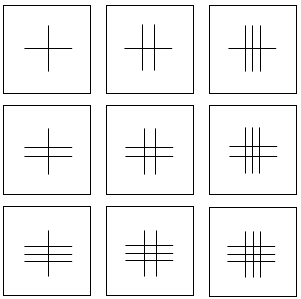
Quantity changes
The number of shapes or number of edges may change. In this matrix, horizontal lines are added by row and vertical lines are added by column.
Rotations and flips
The entire element or features of it may rotate or flip. In this matrix, the middle row is a 90° rotation of the top row; the bottom row is a horizontal flip of the middle row.

Structural changes
In this example, take any two elements, either by row or by column. Overlapping features disappear in the third element, and features that appear in only one of the elements appear in the third as well.

Spatial changes
In this category, certain features may move in space, get longer or shorter, or have various other manifestations. In this example, from the top-left element and either to the right or to the bottom, the two shapes “move” to opposite directions.

3. Get to know patterns of changes within the matrix
The aforementioned changes almost always happen in a certain pattern. These patterns determine the order in which the changes take place. Some examples of patterns are:
- Logic applies to columns only
- Logic applies to rows only
- Same changes by row and column
- Different changes by row and by column
You should find preparation materials that cover as many change patterns as possible so your thinking process will be flexible enough to recognize these patterns rather quickly. This will be very useful in reducing the time needed to solve each matrix, and will allow you to look for the correct answer within the options more effectively.
4. Acquire elimination techniques
In each Matrigma question, you will find six answers to choose from. Often, you will find that it is simpler to eliminate answers rather than to fully analyze the matrix in order to mentally come up with the correct answer. You should learn how to remove implausible answers as fast as possible so you will be left with fewer options to contemplate. This way, if you manage to eliminate all the answers but one, it has to be the correct answer, even if you haven’t completely deciphered the logic of the matrix. This is something that many of the detailed explanations on iPrep focus on.
5. Prepare twice with a break in the middle
It is very important to practice as much as possible for your test so you can take it with confidence. However, studying without a break can actually harm your test-taking success. You need the time in between to rest and get refreshed so you can process the information and give your brain a break. We recommend studying and then taking a long break, then studying again and taking a long break, and then taking the test.
However, you might also benefit from looking over some test questions right before the test to get conditioned and ready, like stretching before a race.
6. Try to simulate the real test conditions
It can be unnerving to sit down to take the real test when you have never practiced under those conditions. We recommend practicing a full-length test that matches the version named in your invitation, at least once, so you know what to expect. For Classic Matrigma, take a 40-minute, 35-question test; for Adaptive Matrigma, practice a 12-minute adaptive-style simulation with up to 60 seconds per item, with no interruptions and no distractions like your cellphone or other apps.
7. Get ready for the real test
Once you have taken a practice test or two under the real-life conditions you will encounter on test day, you can prepare yourself in other ways, too. Get a good night’s sleep and eat properly the day before and the morning of the test. Bring earplugs to reduce distractions. Use the bathroom before sitting down for the test and make sure you have a filled water bottle and a pillow for your back, if you think that will help you sit comfortably.
Test Features
Adaptive Matrigma Innovations
As technology advanced, Assessio introduced Adaptive Matrigma as a more modern delivery format alongside Classic Matrigma. Classic Matrigma follows a fixed structure of 35 questions in 40 minutes. While the question style is similar in both versions (matrix reasoning), the testing experience differs:
- Time limit: Adaptive Matrigma is timed (typically 12 minutes), and each item must be answered within 60 seconds.
- Adaptive difficulty: If you answer correctly, the next item is typically more difficult. If you answer incorrectly, the next item is typically easier or similar in difficulty.
- Number of questions: The number of items you see can vary by person, because the test adapts and you work through items until the time limit ends.
How can you know if you are about to take the Classic Matrigma or the Adaptive Matrigma? Your test invitation should state the full name of the test. Adaptive Matrigma is the more common version today; if you receive the 40-minute Classic Matrigma version, this should be clear in the instructions.
Supports Both Proctored & Unproctored Testing
Also known as Hogan Matrigma, the Matrigma Test has the flexibility to be administered with or without supervision. It is especially flexible because of its randomized question and response alternatives; two people will not get the same test.
Multi-Language Support
Plus, its non-verbal format makes it capable of being easily incorporated across different languages. Although it was first developed and published by Assessio in Sweden, it is now available in multiple countries and languages. Matrigma is largely used by a wide spectrum of industries around the world for recruiting employees.
A Strong Predictor of Cognitive Ability
Matrix problems are proved to be one of the most powerful tools for measuring cognitive abilities. The Matrigma Test is a reliable tool that accurately measures a person’s cognitive ability based on several years of research.
International, Nonverbal Ability Test

The Matrigma Test or Hogan Matrigma was published by the Swedish Assessio International in 2010. The test that features nonverbal format, matrix-type items, is available in over 30 countries around the world including Sweden, Norway, New Zealand, Canada, the U.S., Italy, and more. The test is identical no matter the geography.
Technical Facts
Fast Facts (tl;dr)
- Classic questions: 35 total
- Adaptive questions: Varies by person
- Classic time limit: 40 minutes
- Adaptive time limit: 12 minutes
- Question format: 3×3 matrix puzzles
- Content: Shapes and symbols
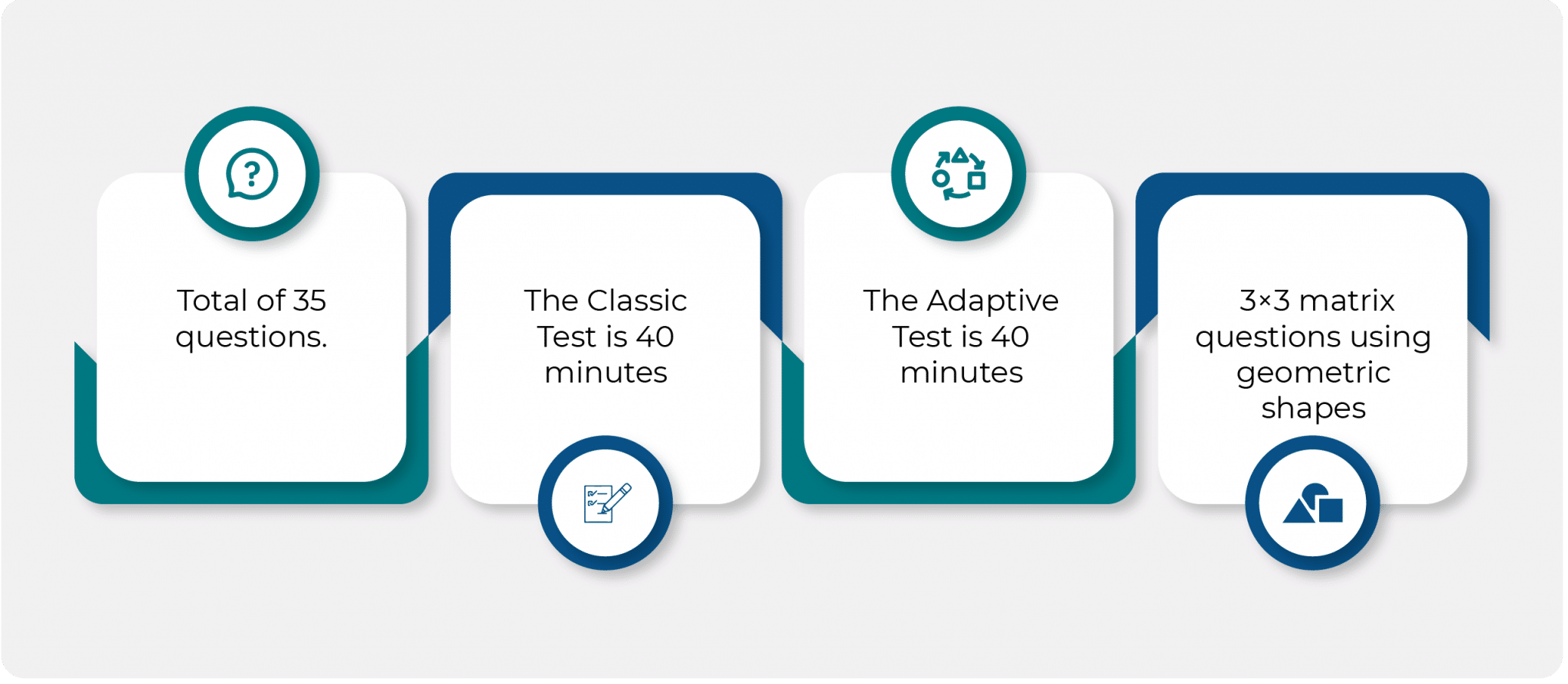
The Classic Matrigma Assessment comprises 35 items which you are supposed to complete within the duration of 40 minutes. Each question presents a 3×3 matrix of symbols and you need to select the missing symbol out of the six alternatives provided. Several studies have been conducted on the Hogan Matrigma, and it has been proven to be extremely reliable. In addition, the randomization of test questions allows supporting both proctored and unproctored testing. You can now find the Matrigma Assessment in more than 30 countries around the world and in more than 20 languages.
Results Scale and Interpretations
The Matrigma Test is a non-verbal test that measures your General Mental Ability or GMA in comparison to others. It measures your fundamental cognitive abilities like problem-solving skills, logical ability, and flair for spotting logical connections. The result of the Matrigma Assessment is always expressed by comparing it against the norm group or the total number of people who have taken the test.
The results are generated instantly upon completion. Your score report will place you in one of three levels of the Matrigma scale:
- Low
- Average
- High
The employer’s score report will be more detailed and will provide a numerical score and graphical representation of the score percentile. It will also include the range for passing scores, which may be different for different employers. The Adaptive Matrigma test score report takes into account the number of correct answers as well as the level of difficulty of the questions and also provides a relative percentile score.
As can be seen in the image below, the low, average and high intervals comprise 16%, 68%, and 16% respectively of the norm group that achieved a similar result. For instance, if you get a high score, your result is higher than or as high as 16% of the members of the norm group.
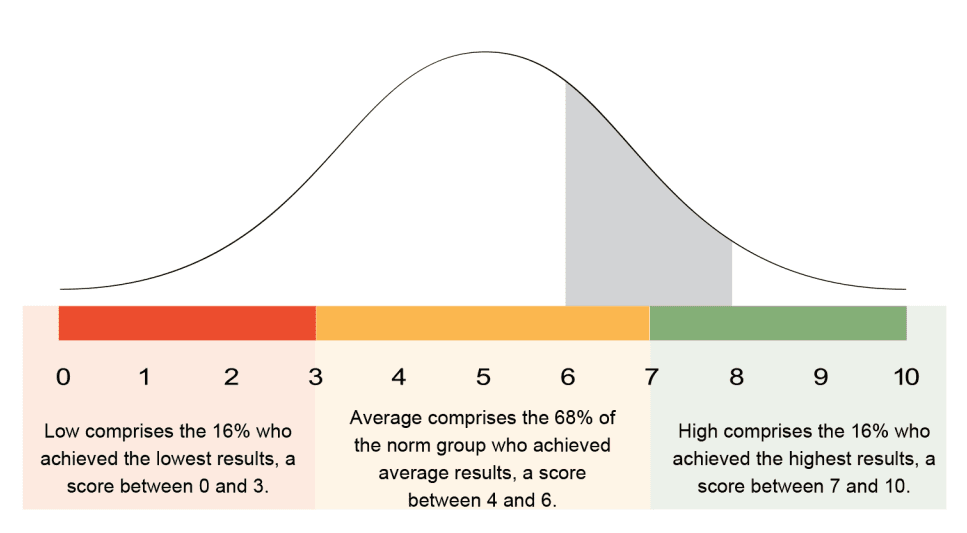
1. Low Score
A low score lies between 0 and 2. If one achieves a low score, it means that he or she may find it harder to solve problems requiring logical deductive ability and may need more time to become familiar with work duties, especially in complex jobs.
2. Average Score
An average score lies between 3 and 6 and indicates an individual’s average logical deductive ability. If your score is within the average zone, it indicates that you are likely to handle logical demands at work at a normal level.
3. High Score
A high score lies between 7 and 10. If you received a high score, then you are likely to solve problems requiring logical deductive ability more easily and become familiar with work tasks more quickly, especially in complex jobs.
Things to Keep In Mind
Your GMA score is one of the characteristics associated with work performance. In Classic Matrigma, your result is based on how many problems you solve within the given time; in Adaptive Matrigma, the score estimate also reflects the difficulty of the items you answer. Environmental disturbances, psychological condition, motivation, or preparedness may affect an individual’s true Matrigma assessment test report. If you are affected by one or more of these factors while taking the inductive reasoning test, you might score higher or lower than your “cognitive peer group.”
Therefore, if you are to take the test at home, make sure to create a space that is free from all disturbances. Sleeping and eating well will also help you take the test at your peak. But above all, practicing in advance is the best way of gaining an advantage.
Matrigma FAQs
The Matrigma Test is a test that measures your cognitive abilities in a non-verbal format. Companies will determine from the results whether you are a good enough candidate to move on to the next step in the hiring process.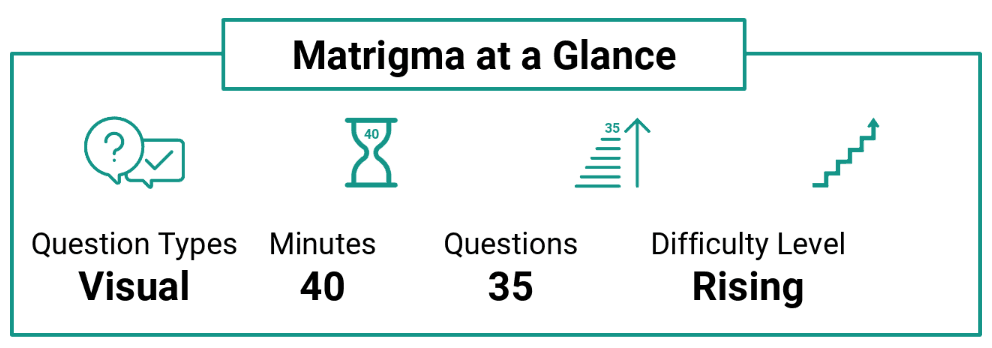
There are two types of Matrigma tests: Classic and Adaptive. The Classic test has 35 questions with a 40-minute time limit. The Adaptive test is timed (typically 12 minutes), and the number of questions you see varies by person within the time limit.
The Matrigma Test includes multiple-choice matrix (non-verbal) questions using geometric shapes and symbols.
– Classic Matrigma: 35 questions in 40 minutes. The questions generally become more difficult as you progress.
– Adaptive Matrigma: A timed test (typically 12 minutes). Each item has 60 seconds. The difficulty adapts based on your answers, and the number of questions you see varies by person within the time limit.
After you finish, you’ll receive a score that shows how your performance compares to others who have taken the test.
Classic Matrigma has a fixed structure: 35 questions in 40 minutes. The question order is predetermined, and the difficulty generally increases as you progress.
Adaptive Matrigma is a timed test (typically 12 minutes). You have up to 60 seconds per question, and you continue answering questions until the time limit ends.
In Adaptive Matrigma, the difficulty of the next question adapts to your previous answer:
– If you answer correctly, the next question is typically more difficult.
– If you answer incorrectly, the next question is typically easier or similar in difficulty.
During the test, you are not told whether your answers are correct or incorrect.
Matrigma Test Tips
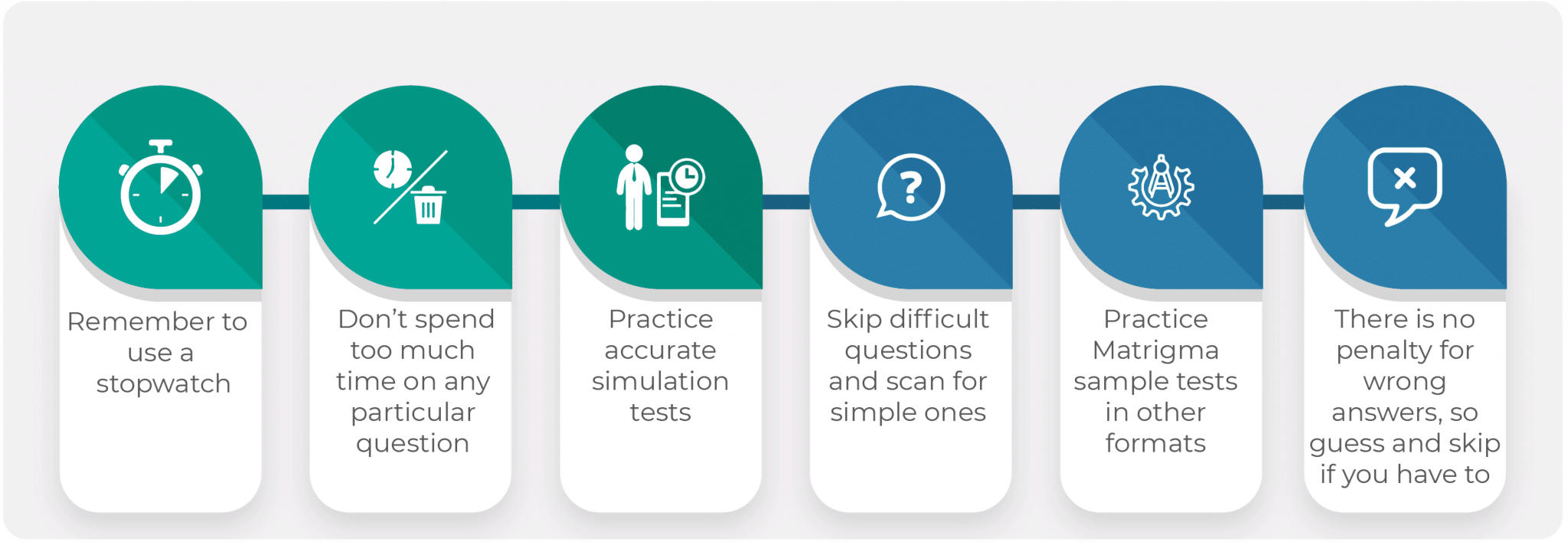
- Remember to use a stopwatch in order to make sure that you complete the test within the given time limit.
- Don’t spend too much time on any particular question. No question is worth that challenge. If you spend more than one minute and you have no clue regarding the underlying logic of the matrix, take an educated guess and move on to the next question.
- Practice accurate simulation tests. Before you take the Matrigma test, learn how the questions are framed and how long the assessment will take.
- Use version-specific pacing. In Classic Matrigma, prioritize easier items and return to harder ones if the interface allows it. In Adaptive Matrigma, answer each item as it appears within its 60-second limit; do not rely on scanning ahead for simpler questions.
- Practice Matrigma sample tests in other formats. If you struggle with the concept of abstract/inductive/figural reasoning questions, find free practice tests and get to know the basics, and then get back to Matrigma-style practice tests.
- There is no penalty for wrong answers, so guess and skip if you have to. If you find yourself stuck on a question which you are not able to solve within the allocated time, move on to the next one. If you spend too much time on one question, it will negatively affect your entire test performance.
Administration
Matrigma Assessment is administered online and, therefore, you can access and take it at any time. It is suitable for both individuals and large groups. The Matrigma test is a convenient inductive reasoning test available online in more than 20 languages.
- Test location: The first attempt is often non-proctored and taken online at home. Candidates who successfully pass this online Matrigma test may be required to retake the test in a proctored environment by the hiring company, typically in their office.
- Test schedule: Matrigma tests are usually scheduled in the early recruitment stages, after your CV demonstrates that you are potentially qualified for the job.
- Test format: Multiple choice on computer. Usually taken online.
- Test materials: Test taken on computer.
- Cost: None for you. Cost is usually covered by the employer.
- Retake policy: Determined by each employer.
Test Provider
Matrigma Test or Hogan Matrigma was published by Assessio International in 2010. Assessio is a consulting organization as well as a major psychometric test publisher located in Sweden.
They have been developing such tests since 1954. The test is administered either through Assesio’s Ascend platform, which integrates various testing or by Hogan Assessment Systems. The Matrigma test was developed by Assessio for the purpose of assisting in the selection of the best candidates for organizations.
It can be used as a stand-alone tool at the beginning of the recruitment process or as one of a set of tests in the Ascend platform. It is especially popular and reliable because of its randomized questions and responses as well as its non-verbal format which enables it to be incorporated in multiple languages, and less affected by language barriers.
Svenska Kunder
Hej. Det är sant – den här hemsidan är skriven på engelska och övningsmaterialet är också skrivet på engelska. Vi vill däremot försäkra dig om att du är på rätt plats.
Om du letar efter Matrigma-övningsprov, är det här den plats där du hittar den mest exakta simuleringen av det riktiga Matrigma-provet från Assessio. Övningsproven kommer även med en enkel och insiktsfull guide över hur du bör gå tillväga för att göra provet. Dessutom följs varje fråga av en detaljerad förklaring som avslöjar matrixens underliggande logik med ett enkelt och intuitivt språk.
Vi erbjuder även en pengarna-tillbaka-garanti, utan att ifrågasätta. Så ta den här chansen att förbereda dig för och göra bra ifrån dig på Matrigma-provet på första försöket.
Du är välkommen att prova några av de kostnadsfria Matrigma-övningsproven på den här sidan.
Information Sources
Disclaimer – All the information and prep materials on iPrep are genuine and were created for tutoring purposes. iPrep is not affiliated with Assessio International, which is the owner of Ascend and the Matrigma Test.
Free Matrigma Practice Test
Start with free Matrigma practice test questions that give you a clear feel for the non-verbal matrix reasoning tasks used in the real assessment. The free practice introduces common Matrigma-style skills such as visual pattern recognition, rule detection, spatial reasoning, shape changes, rotations, and logical elimination.
Use the free practice to understand the question format, pacing, and level of abstract reasoning required before moving into full preparation. For complete practice, iPREP’s full Matrigma course includes realistic practice tests, detailed explanations, video lessons, and targeted practice for both Classic and Adaptive Matrigma formats.
Question 1 of 5
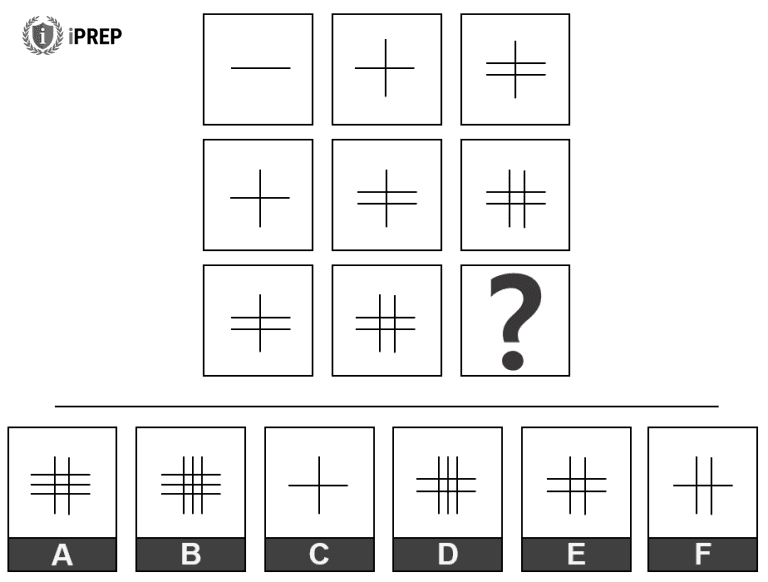
The correct answer is A.
Starting at the top left box, in each “step” (to the box on the right or down below) another line is added to the element. The addition alternates between vertical and horizontal lines. As the second box on the right includes two horizontal lines and two vertical lines and the last line to be added was a vertical line, a third horizontal line must be added to the missing element.
Question 2 of 5
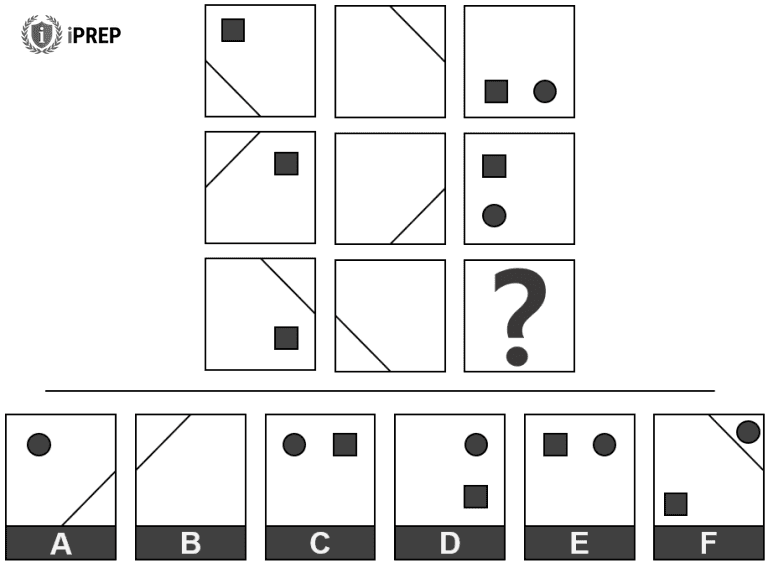
The correct answer is C.
This matrix follows a logic by columns. Each column consists of elements with a similar pattern. From top to bottom, each element rotates 90° clockwise.
Question 3 of 5
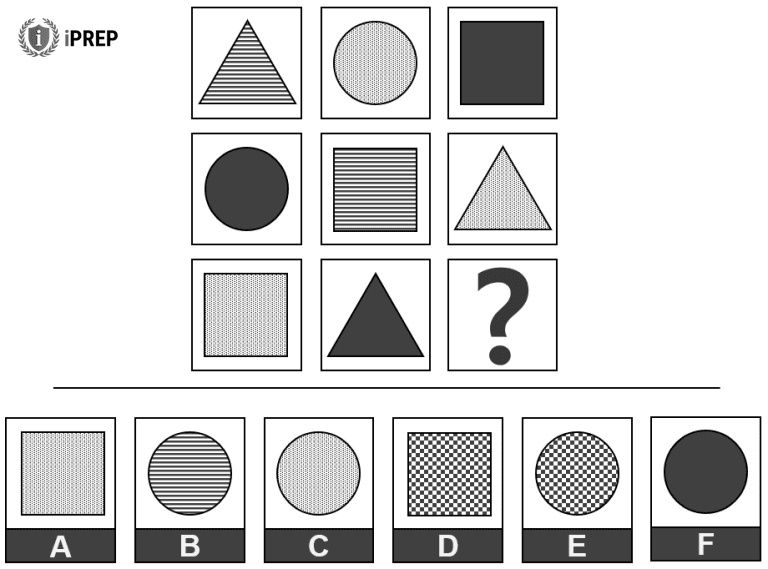
The correct answer is B.
The shapes of the matrix are either a triangle, a square, or a circle. Each shape is filled with some pattern, either solid dark grey, dotted or striped. Each column and each row of the matrix includes all three types of shapes and all three types of pattern fill. Therefore, the missing element must be a striped circle.
Question 4 of 5
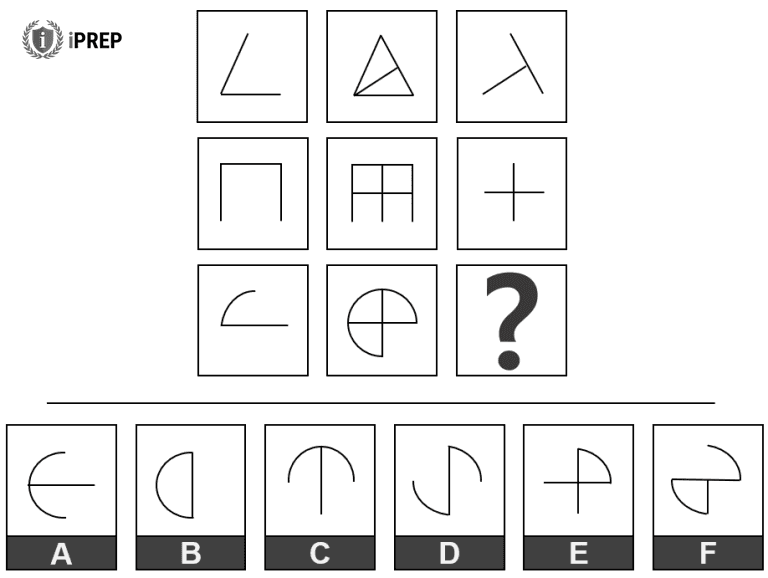
The correct answer is D.
The logic of this matrix is only governed by the logic of the rows. The middle element of each row is the combination of the right and left elements, placed one on top of the other.
Question 5 of 5
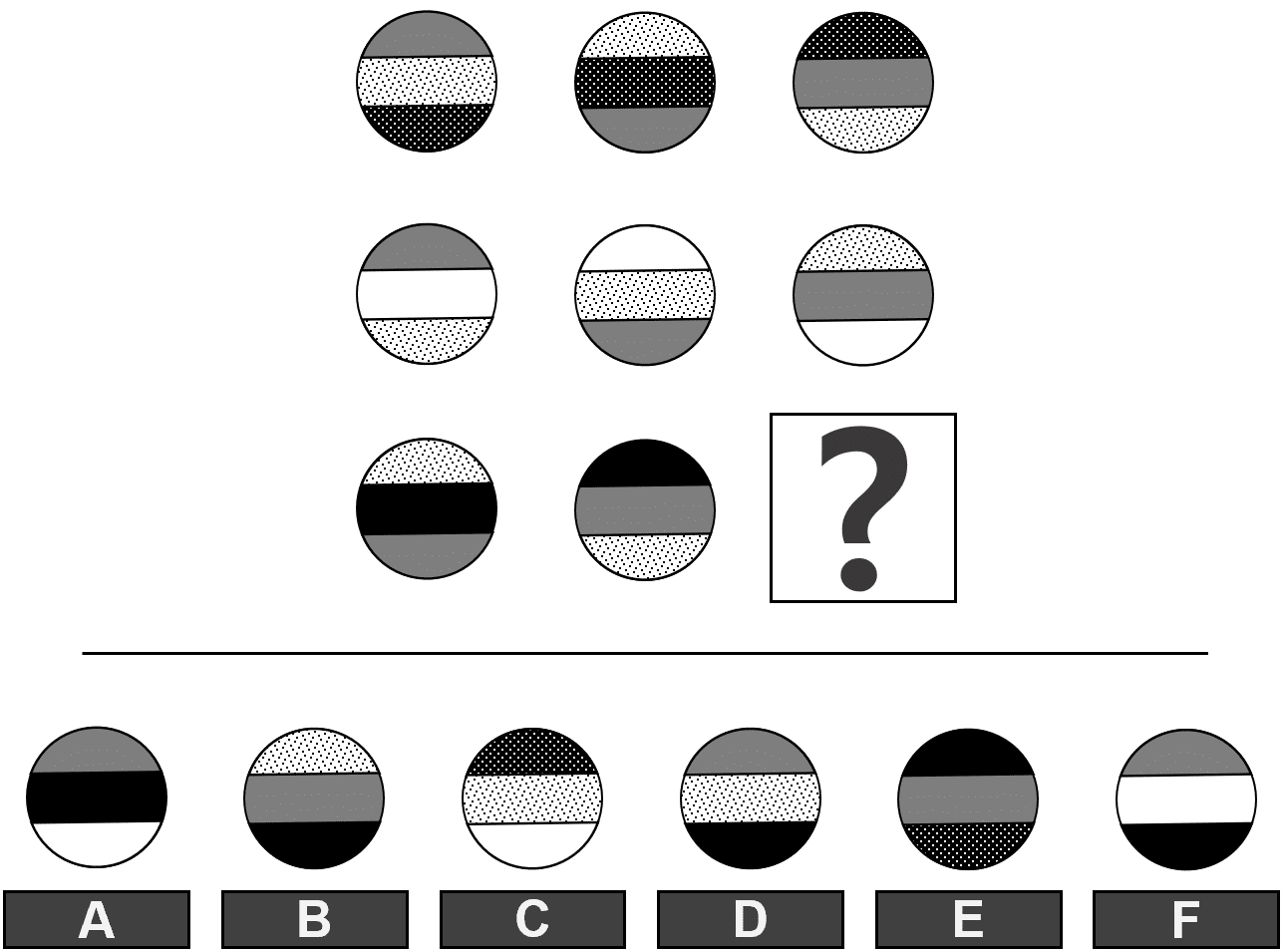
The correct answer is D.
This matrix can be solved by understanding the logic of the rows.
Each element is a circle divided into three sections. Each of these sections is filled with different colors and patterns, each pattern appearing once in every element.
In each row, from left to right:
- The pattern on the bottom becomes the pattern in the middle in the next element.
- The pattern in the middle becomes the pattern on the top in the next element.
- The pattern on the top becomes the pattern on the bottom in the next element.
It is easiest to see this pattern if you look diagonally from the bottom section of the left element to the top section of the right element
About the course
Includes 6 practice tests (4 full-length simulations)
10 Learning hours · 6 Practice tests · 165 Questions · 150 Videos
Start with warm-up practice to get comfortable with Matrigma’s non-verbal 3×3 matrix puzzles. Next, learn how to read patterns across rows, columns, and diagonals, then apply the most common rule types to solve efficiently. Finish with Matrigma-style simulations that reflect both Classic and Adaptive formats, followed by thorough answer explanations.

Skills you will learn
Abstract reasoning · Logical thinking · Inductive reasoning · Problem solving
Curriculum
Course Introduction
- Course orientation and platform walkthrough
Inductive & Abstract Reasoning Warm-Up
- Quick warm-up set and review
The Basic Structure of The Matrix
- Read rows, columns, and diagonals
- Track shape, color, quantity changes
Matrix Problems Warm-Up
- Warm-up matrix set with explanations
Deciphering the Logic → Solving the Matrix
- Identify rules, then apply consistently
- Use elimination to confirm missing tile
Time Management Essentials
- Pace for classic and adaptive formats
- Guess, skip, and return efficiently
Matrigma-Style Simulations – Test Yourself
- Matrigma-Style Simulation 1 — Adaptive, Classic, Practice
- Matrigma-Style Simulation 2 — Adaptive, Classic, Practice
- Matrigma-Style Simulation 3 — Adaptive, Classic, Practice
- Matrigma-Style Simulation 4 — Adaptive, Classic, Practice
Course Conclusion
- Consolidate approach and plan next practice
Reviews

Martin S********
July 17, 2026 at 5:29 AM
Helped me increase my confidence and the final test went above my expectations. Can recommend this platform in order to get you into the right mindset.
Daniel G****
June 14, 2026 at 3:20 PM
I used iPrep to prepare for the Matrigma test, and it made a significant difference to my results. The platform is very well structured, with clear explanations and plenty of practice questions that closely resemble the real test format. What I appreciated most was how pedagogical the training material was. Instead of simply providing answers, it helped me understand the underlying logic and patterns, which improved both my speed and accuracy over time. After working through the exercises, I felt much more confident and was able to achieve a noticeably higher score than when I first started practicing. I would definitely recommend iPrep to anyone preparing for Matrigma or other cognitive ability assessments.
Nina S********
May 30, 2026 at 1:50 PM
Easy way to get prepared. Thorough and clear explanations, you can watch, listen or read. If you’re in for a test it’s definagely worth to get some practise in.
Renata S*****
December 3, 2025 at 10:21 PM
There are many tests, you can train a lot, but the explanations are sometimes very complicated and unclear. Sometimes, despite the explanations, it is difficult to grasp the logic. Nevertheless, I think it is worth buying access because the price is really competitive—other websites are very expensive, around 30 EUR/week.
Susanne S*********
November 13, 2025 at 12:55 PM
Det är ett bra sätt att kunna öva på olika typer av tester som finns i rekryteringssammanhang. Tydliga förklaringar och bra övningar.
Yassine E******
October 4, 2025 at 6:17 AM
Good so far, the introductory course is clear and easy to follow. I like the explanations, and the practice questions make learning more effective
Karoline S********
June 20, 2025 at 12:07 PM
Fin måte å bli kjent med testen, gode forklaringer. Kunne hatt noen flere øvingsoppgaver. Hadde vært fint med noen nye oppgaver til adaptiv test etter å ha gjennomført den klassiske.
Soledas A******
May 29, 2025 at 8:48 PM
Great training for before a real test for a job, thank you! Great training and testing several times and a lot of repetition
Jeanette K**********
May 25, 2025 at 6:37 PM
I recommend it if you haven't done these kind of tests in a while. It helped me a lot to understand the logic behind these figures.
Ingeborg W****
May 5, 2025 at 6:35 PM
The best! excellent videos and explanations! Also, it includes much complex escenarios that I did not find in other online courses!