Reviewed by Tamir Rubin, Head of Product at iPREP • Updated February 2026
GAN Aptitude Sample Question
Paper Folding Test Instructions
This test is designed to assess your ability to understand and visualize three-dimensional objects. Each question presents a sequence of images.
On the left-hand side, you will see a series of images depicting the folding process of a square sheet of paper. The final image in this series will display the paper after one or two holes have been punched through it, following its folding. On the right-hand side, you will encounter images of five unfolded papers.
Your task is to identify which among these five images accurately represents the paper’s appearance with the holes once it is fully unfolded. Select the correct image and mark its corresponding letter.

Paper Folding
30 questions • 30 minutes
- Visualize folds, punches, and symmetry
- Track orientation after unfolding steps
- Compare answer options for holes
Numerical Computation
30 questions • 30 minutes
- Quick calculations with fractions and decimals
- Apply basic operations under time pressure
- Minimize errors using scratch work
Numerical Reasoning
20 questions • 22 minutes
- Identify patterns in number sequences
- Use differences, ratios, and alternation
- Choose the next term logically
Reading Comprehension
42 questions • 25 minutes
- Read passages, answer multiple-choice questions
- Locate main ideas and supporting details
- Infer meaning from context clues
Mechanical Reasoning
45 questions • 30 minutes
- Reason about forces, motion, and machines
- Interpret diagrams of mechanical systems
- Apply principles to practical situations
Problem Solving
25–30 questions • 35 minutes
- Applied logic using detailed scenarios
- Record, retrieve, and use information
- Use geometry concepts and measurements
- Appears only in some versions
Test Duration
Total time: varies by state (often up to ~172 min)
Expect several timed sections back-to-back. Total time can change when a Problem Solving section is included. Confirm your local program’s exact section list and timing before test day.
Test Breakdown & Sample Questions
The GAN Aptitude Battery encompasses a variety of test types, each meticulously designed to assess distinct cognitive abilities and skills. Below is a summary of these test types, including the number of questions, time allotted, and the competencies they aim to measure:
1. Paper Folding
- Questions/Time: 30 questions in 30 minutes.
- Assesses: Spatial visualization skills.
- Skills Needed: Ability to mentally manipulate 2D and 3D shapes, predict the appearance of paper after folding and unfolding, and spatial reasoning.
2. Numerical Computation (Basic Math – Arithmetic Computation)
- Questions/Time: 30 questions in 30 minutes.
- Assesses: Basic arithmetic proficiency.
- Skills Needed: Competence in whole numbers, fractions, and decimals operations; quick and accurate mathematical problem-solving.
3. Numerical Reasoning (Number Series)
- Questions/Time: 20 questions in 22 minutes.
- Assesses: Logical reasoning and pattern recognition.
- Skills Needed: Identifying patterns in number sequences, understanding arithmetic and geometric sequences, and complex numerical relationships.
4. Reading Comprehension
- Questions/Time: 42 questions in 25 minutes.
- Assesses: Comprehension and interpretation of written material.
- Skills Needed: Proficient reading, main idea identification, detail support, inference drawing, and understanding vocabulary in context.
5. Mechanical Reasoning
- Questions/Time: 45 questions in 30 minutes.
- Assesses: Knowledge of physical and mechanical principles.
- Skills Needed: Understanding basic laws of physics and mechanics, such as force and motion, and the operation of simple machines.
While the test typically focuses on five core areas, candidates should be prepared for a potential sixth section: Problem Solving, which appears in specific versions of the battery.
The Variable Section – Problem Solving
- Questions/Time: 25-30 questions in 35 minutes.
- Assesses: Ability to determine an outcome, record and retrieve information, measure, and use geometric concepts.
- Skills Needed: Analyzing detailed situations to decide on a response, eliminating extraneous information to focus on what is needed, creating number sentences for computation 4, and identifying when a correct answer is “Not Given” (NG).
Each section is crafted to not only gauge specific aptitudes but also to challenge the test-taker’s ability to apply their knowledge effectively under time constraints. Success in the GAN Aptitude Test requires a well-rounded preparation strategy that includes mastering the content, practicing with similar types of questions, developing effective test-taking techniques, and honing time management skills.
| Test Type | Questions/Time | Skills Assessed | Skills Needed |
|---|---|---|---|
| Paper Folding | 30 questions in 30 minutes | Spatial visualization | Mental manipulation of shapes, spatial reasoning |
| Numerical Computation (Basic Math) | 30 questions in 30 minutes | Basic arithmetic proficiency | Operations with whole numbers, fractions, decimals; quick problem-solving |
| Numerical Reasoning (Number Series) | 20 questions in 22 minutes | Logical reasoning, pattern recognition | Identifying patterns in sequences, understanding arithmetic and geometric sequences |
| Reading Comprehension | 42 questions in 25 minutes | Comprehension and interpretation of written material | Reading proficiency, identifying main ideas and details, drawing inferences |
| Mechanical Reasoning | 45 questions in 30 minutes | Knowledge of physical and mechanical principles | Understanding of physics and mechanics, operation of simple machines |
| Problem Solving (appears only in some variations) | 25-30 questions in 35 minutes | Applied Logic & Math | Operations with whole numbers, fractions, and decimals; quick problem-solving |
This table serves as a quick reference to understand the diverse range of skills and abilities the GAN Aptitude Test evaluates. It underscores the importance of a well-rounded preparation strategy that encompasses mastering specific content areas, enhancing test-taking techniques, and developing efficient time management skills to excel across all test sections.
Paper Folding Test
The Paper Folding test is a unique component of the GAN Aptitude Test designed to assess your spatial visualization skills, specifically your ability to understand how folding and unfolding a piece of paper affects its appearance, particularly where holes punched in the paper will appear once it’s unfolded. This section consists of 30 questions, and you are given 30 minutes to complete it, translating to an average of one minute per question.
Overview
- Test Format: You will encounter a series of diagrams showing a piece of paper being folded one or more times and then having holes punched through it. Your task is to select the option that correctly depicts the paper once it is unfolded.
- Skills Measured: Spatial awareness, the ability to visualize and manipulate objects in space, and attention to detail.
- Question Structure: Each question presents a sequence of images showing the paper folding process and possible outcomes after unfolding, from which you must choose the correct one.
Preparation Strategies
- Understand the Directions: Grasp the test’s instructions thoroughly. You must predict the paper’s appearance when unfolded, taking into account the position and number of holes punched.
- Visualize in Three Dimensions: Practice visualizing the folding and unfolding process in your mind. Pay close attention to where the paper is folded and imagine where the holes will appear on the unfolded paper.
- Practice with Physical Paper: Occasionally, physically folding paper and punching holes as per the example problems can provide a tangible understanding of how the process works, enhancing your spatial visualization skills.
- Develop a Systematic Approach: Start by carefully examining the initial fold; trace the subsequent folds and the hole punch. Predict the outcome before looking at the answer choices to avoid confusion.
- Time Management: With only one minute per question, it’s crucial to work swiftly but accurately. If you find yourself stuck on a question, make an educated guess and move on to ensure you answer all questions within the time limit.
- Attention to Detail: Small differences can determine the correct answer. Pay attention to the number of layers of paper and the orientation of the folds.
Test-Taking Tips
- Look at each question carefully, tracing the sequence of folds and punches.
- Imagine the paper in three dimensions to understand where the punches go through.
- Predict the outcome before reviewing the answer choices to have a clear idea of what to look for.
- Read all responses and compare them with your imagined outcome.
- If uncertain, narrow down your choices and reconsider your visualization of the folding process.
- Practice makes perfect. Utilize sample problems to hone your skills and speed.
Practice Problems
Engaging with practice problems is key to mastering the Paper Folding test. These problems will help you familiarize yourself with the test format and develop your spatial reasoning skills. Always review your answers to understand any mistakes fully.
Paper Folding Sample Question
Analyze the folding sequence and punched holes shown in the images on the left, then select the unfolded paper on the right that correctly represents the holes’ placement.

The correct answer is D.
Watch the video below for the solution explanation:
Numerical Computation Test
The Numerical Computation section of the GAN Aptitude Test evaluates your ability to perform basic arithmetic operations accurately and efficiently. This test comprises 30 questions that you must complete within 30 minutes, challenging your skills in arithmetic computation with a focus on speed and precision.
Overview
- Test Format: This segment assesses your proficiency in arithmetic, including operations with whole numbers, fractions, and decimals.
- Skills Measured: Competency in basic arithmetic operations (addition, subtraction, multiplication, and division), handling fractions and decimals, and applying these skills to solve practical problems.
- Question Structure: Questions are usually presented in direct calculation format.
Preparation Strategies
- Master Basic Arithmetic: Ensure you are comfortable with addition, subtraction, multiplication, and division of whole numbers, fractions, and decimals.
- Understand Fractions and Decimals: Familiarize yourself with converting between improper fractions and mixed numbers, reducing fractions to their lowest terms, and performing arithmetic operations with fractions and decimals.
- Practice Arithmetic without a Calculator: Since the test may not allow calculator use, practice performing calculations manually to improve speed and accuracy.
- Work on Speed and Accuracy: Time management is crucial. Practice under timed conditions to enhance your ability to solve problems quickly and accurately.
- Solve Practice Problems: Engage with a variety of practice problems, especially those that mimic the structure and format of the GAN Aptitude Test. This will help you become familiar with the types of questions you’ll encounter.
Test-Taking Tips
- Read Each Question Carefully: Ensure you understand what is being asked before attempting to solve it.
- Write Down Steps: Use scratch paper to organize your calculations and reduce the chance of simple errors.
- Estimate Before Calculating: For some questions, estimating the answer before performing the calculation can save time and help check your work.
- Check Your Work: If time permits, review your answers, especially for questions that seemed challenging or where your estimated answer differed significantly from your calculated answer.
Practice Problems
Your preparation should include practice problems covering:
- Arithmetic operations with whole numbers, fractions, and decimals.
- Converting between improper fractions and mixed numbers.
- Reducing fractions to their lowest terms.
Numerical Computation Sample Question
Solve:
$$$ \dfrac{5}{6}\div\dfrac{3}{2} = ?$$$
- $$$ \dfrac{5}{9} $$$
- $$$ \dfrac{5}{18} $$$
- $$$ 5 $$$
- $$$ 1\dfrac{1}{3} $$$
$$$ \dfrac{5}{6}\div\dfrac{3}{2} $$$ Instead of division, multiply by the inverse of $$$ \frac{3}{2}$$$
$$$ \dfrac{5}{6}\times\dfrac{2}{3} $$$ Multiply the numerators and the denominators
$$$ \dfrac{5\times2}{6\times3} $$$
$$$ \dfrac{10}{18} $$$ Reduce by 2
$$$ \dfrac{5}{9} $$$
Numerical Reasoning (Number Series) Test
The Numerical Reasoning section, focusing on number series, challenges your ability to identify patterns and sequences in a series of numbers. This test comprises 20 questions to be solved in 22 minutes, emphasizing your pattern recognition skills and your ability to apply logical reasoning to find the next number in a series.
Overview
- Test Format: You will be presented with sequences of numbers that follow a specific logical rule. Your task is to discern this rule and determine the next number in the sequence.
- Skills Measured: Logical reasoning, pattern recognition, and basic mathematical operations.
- Question Structure: Each question consists of a sequence of numbers, and you must choose the correct continuation from multiple-choice options.
Preparation Strategies
- Familiarize with Different Types of Patterns: Practice identifying various pattern types, such as arithmetic sequences (where a constant is added or subtracted), geometric sequences (where a constant is multiplied or divided), and more complex patterns (involving alternating sequences, squares, cubes, etc.).
- Practice Regularly: Consistently solve practice problems to become quicker at identifying patterns. Use a variety of sources for practice questions to ensure exposure to all possible pattern types.
- Work Backwards: For some sequences, it might be easier to start from the end and work your way back to understand the pattern.
- Use the Process of Elimination: If you cannot directly identify the next number, eliminate the most obviously incorrect answers to improve your chances of choosing the right one.
- Time Management: With just over a minute per question, it’s crucial to work efficiently. If you’re stuck on a question, move on and return to it if time allows.
Test-Taking Tips
- Read Carefully: Make sure you understand the sequence before attempting to solve it. Look for the simplest pattern first.
- Estimate Before Calculating: Sometimes, approximating the next number can help you narrow down the choices without detailed calculations.
- Look for Common Differences or Ratios: Many sequences are based on simple arithmetic or geometric rules. Identifying a consistent difference or ratio can often reveal the pattern.
- Consider Multiple Operations: Some series may involve more than one mathematical operation, so be open to combining approaches.
- Check Your Work: If time permits, revisit questions to confirm your answers, especially if your initial choice was made by elimination rather than direct calculation.
Practice Problems
Engaging with a wide range of practice problems is critical. Start with simple patterns and progressively tackle more complex sequences. Review your incorrect answers to understand where your reasoning went wrong. This reflection will improve your pattern recognition skills and enhance your performance on the test day.
Numerical Reasoning Sample Question
What is the next number in the following series of numbers?
203616 101808 50904 25452 12726
- 6374
- 6363
- 6371
- 6362
The correct answer is 6363.
Explanation: At a first glance, this problem seems to include tedious subtraction or division. Nonetheless, the problems in cognitive ability tests almost always have the potential to be solved quickly.
In this problem, two observations should lead you to the correct answer:
Observation 1 – The value of each number has half of the value of the previous number. While it might take you time to corroborate this observation, you can take into consideration that these are cognitive ability tests, so they cannot present a series of numbers that can only be deciphered by using a calculator.
Observation 2 – Only a single answer is a plausible correct answer. The last number in the series is 12726. Any number which ends with a 6 and is divided by 2 yields either a number that ends with 3 (e.g. 26/2 = 13) or 8 (e.g. 16/2 = 8). There are no other options. Of the four options, only 6363 is in line with this observation. Therefore, it can be immediately marked as the correct answer even if you decide not to perform the complete calculation.
Reading Comprehension Test
The Reading Comprehension section of the GAN Aptitude Test assesses your ability to understand and interpret written material. This test consists of 42 questions that you must complete in 25 minutes, challenging both your reading speed and comprehension skills.
Overview
- Test Format: The section includes various passages, each followed by multiple-choice questions. These questions test your ability to grasp the main idea, draw conclusions, and understand vocabulary in context.
- Skills Measured: Understanding of written English, including identifying main ideas, details, inferences, and vocabulary in context.
- Question Structure: Questions are directly related to the passages provided, requiring you to refer back to the text to find answers.
Preparation Strategies
- Practice Active Reading: Engage with the text by summarizing paragraphs, predicting outcomes, and questioning the material as you read.
- Enhance Your Vocabulary: A broader vocabulary aids in faster comprehension. Encountering unfamiliar words during practice, look them up.
- Timing Practice: Given the strict time limit, practice reading passages and answering questions more quickly over time.
- Understand Question Types: Familiarize yourself with different types of comprehension questions, such as main idea, detail, inference, and vocabulary in context.
- Practice Skimming: Learn to skim passages for the main idea and specific details, saving time for more complex questions.
Test-Taking Tips
- Read Instructions Carefully: Ensure you understand what each question asks before answering.
- Answer Based on the Passage Only: Your responses should be based only on information provided in the passage, not on outside knowledge.
- Use Process of Elimination: Eliminate clearly incorrect answers to increase your chances of selecting the correct response.
- Refer Back to the Passage: Don’t rely on memory alone; look back at the passage as needed to confirm your answers.
- Manage Your Time Wisely: Keep an eye on the time, ensuring you have enough to address all questions. It’s better to answer all questions, even if some are guesses, than to leave questions unanswered.
Practice Problems
To prepare effectively, engage with practice problems that mimic the test format. After answering, review explanations for both correct and incorrect choices to understand your mistakes and learn from them.
Reading Comprehension Sample Question
You all know of the Natural Bridge in Virginia. You perhaps have heard how the first President of the United States, in the athletic vigor of his youth, climbed and carved his name high on its cliff. If a score of such bridges, however, were thrown together side by side, they would not be so large as the Natural Bridge of Pine Creek, Arizona. It is to the world’s natural bridges what the Grand Canyon of Colorado is to the world’s chasms—the greatest, grandest, and most bewildering. The actual length of the Arizona bridge is over 500 feet, five times the span of the Virginia bridge, and the breadth is over 600 feet, more than 12 times as wide as the one in Virginia. There are also countless minor bridges in the Southwest. One is a curious natural bridge near Fort Defiance, New Mexico. This is small but unusual, for it was carved not by rock particles carried in water but by sand-laden winds.
The largest natural bridge in the world is located in the state of:
- Virginia
- Colorado
- Arizona
- New Mexico
The correct answer is C.
The information can be drawn from this section in the passage:
“You perhaps have heard how the first President of the United States, in the athletic vigor of his youth, climbed and carved his name high on its cliff. If a score of such bridges, however, were thrown together side by side, they would not be so large as the Natural Bridge of Pine Creek, Arizona.“
Mechanical Reasoning Test
The Mechanical Reasoning section of the GAN Aptitude Test evaluates your understanding of basic physical and mechanical principles in practical situations. This test comprises 45 questions that need to be completed in 30 minutes, emphasizing your ability to perceive and understand the relationship of physical forces and mechanical elements.
Overview
- Test Format: You will be presented with pictures depicting simple mechanisms or physical scenarios. Each problem asks a specific question about the situation in the picture, requiring you to apply your understanding of mechanical principles to choose the correct answer.
- Skills Measured: Knowledge of basic physical principles (such as gravity, force, and motion), understanding of simple machines (like levers, pulleys, gears), and the ability to apply these principles to solve problems.
- Question Structure: Questions are designed around everyday mechanisms or scenarios that don’t require specialized knowledge, focusing instead on common sense and basic mechanical understanding.
Preparation Strategies
- Review Basic Physics Concepts: Brush up on fundamental physics principles, especially those related to mechanics, such as force, work, energy, and the operation of simple machines.
- Understand Simple Machines: Familiarize yourself with the basics of simple machines—levers, inclined planes, screws, wheels and axles, pulleys, and gears—and how they work.
- Practice Visualizing Mechanical Situations: Work on translating the scenarios depicted in images into mechanical concepts and principles. Being able to visualize how components interact is crucial.
- Solve Practice Problems: Look for practice materials that focus on mechanical reasoning. Working through these problems will help you become familiar with the types of questions you’ll encounter.
- Apply Logical Reasoning: Many questions can be answered using common sense and basic reasoning. If a mechanical principle seems complex, try to break it down into simpler, more understandable parts.
Test-Taking Tips
- Carefully Examine Each Picture: Before attempting to answer, study the provided images closely to ensure you understand what is being shown.
- Read Questions Thoroughly: Make sure you understand what each question is asking. Sometimes, the crucial detail is in the question itself.
- Use Process of Elimination: If you’re unsure about an answer, eliminate the most obviously wrong choices first. This strategy can increase your chances of selecting the correct answer.
- Manage Your Time Effectively: With less than a minute per question, it’s important not to spend too much time on any single problem. If you’re stuck, move on and come back to it if time allows.
- Trust Your Instincts: Often, your first choice is the right one. Don’t second-guess yourself unless you find clear evidence to change your answer upon review.
Practice Problems
Engage with a variety of mechanical reasoning problems to build your confidence and improve your problem-solving speed. After solving each problem, take the time to understand why the correct answer is right and why the other choices are wrong.
Mechanical Reasoning Sample Question
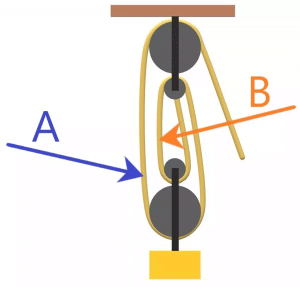
Which part of the string has a higher strain on it?
(If neither, mark C.)
- A
- B
- C
The correct answer is C.
The string attached to a pulley is considered to be massless and “non-stretchable.” Therefore, it has an equal distribution of tension forces acting on it. This is due to Newton’s Third Law of equal and opposite reaction, acting on every point of the string. Also, consider the force balance on a small section of the string. As each small section of the string is in equilibrium, the tension (T) acting on it on both sides will be the same as shown in the figure.

If you extend this argument over the whole length of the string, you can conclude that the tension will remain the same on every part of the string, which means that neither part of the string has a higher strain rate than the other.
Problem Solving Test
The Problem Solving section is a variable component of the GAN Aptitude Battery that focuses on analytical logic and the ability to process complex information to reach a decision. This test typically appears only in specific versions of the exam. If included, it usually consists of 25-30 questions to be completed in 35 minutes.
Overview
- Test Format: You will be presented with detailed situations, word problems, or logical scenarios. Your task is to determine an outcome, record/retrieve information, measure, or use geometric concepts. A critical feature of this test is the “Not Given” (NG) option, which you must select if the correct answer is not listed among the choices.
- Skills Measured: Analytical reasoning, troubleshooting, ability to follow complex instructions, decision-making based on strict criteria, and the ability to filter out extraneous information.
- Question Structure: Questions often involve “if-then” scenarios, data interpretation, or practical math problems wrapped in a narrative where you must identify what is relevant and what is not.
Preparation Strategies
- Identify Extraneous Information: The test often includes details you don’t need (e.g., the distance to a flagpole when you only need to calculate rope length). Practice crossing out information that is irrelevant to the specific question asked.
- Write Number Sentences: Translate the words into math. If the problem asks for the “unnecessary blocks walked,” write out the equation (e.g., $$$3 \times 2 = 6$$$) before solving.
- Practice with Logic Puzzles: Engage with puzzles that require deductive reasoning, such as logic grids or seating arrangement problems.
- Draw Pictures: For questions involving distance, direction, or layout (e.g., retracing steps or roping off an area), sketching the problem is highly recommended to visualize the knowns and unknowns.
- Analyze Conditional Statements: Practice working with “If/Then/Else” logic. Ensure you can follow a rule set through to its logical conclusion without skipping steps.
Test-Taking Tips
- Watch for “Not Given”: Calculate your answer first. If it doesn’t match options A, B, C, or D exactly, do not force it. Select “Not Given” (NG).
- Read the Rules Twice: In logic problems, a single word like “not,” “always,” or “except” can change the entire outcome. Read the constraints carefully.
- Isolate the Variable: If a problem seems overwhelming, focus on one variable at a time (e.g., just the color, or just the time) to eliminate incorrect answers.
- Don’t Overthink Common Sense: Follow the provided rules strictly, even if they seem arbitrary. The test measures your ability to follow instructions, not your opinion on the instructions.
- Trace Carefully: When working with flowcharts or sequences, use your finger or pencil to physically trace the path to avoid visual errors.
Practice Problems
To prepare effectively, engage with practice problems that require you to filter out irrelevant data and strictly follow logical rules. Practice identifying when an answer is not present in the choices.
Problem Solving Sample Question
In a packing house, there is a probability of 1 in 4 that fruit will be thrown away and won’t be packed. How many of the 240 apples that arrived at the packing house will not be packed?
- 36
- 40
- 60
- 72
The correct answer is 60.
Explanation: A probability of 1 in 4 means 1 out of 4 attempts. Other equivalent ways to describe such probabilities are “a chance of ¼” or “ a chance of 0.25”. In that case, the number of apples that would be thrown away equals:
240 apples * ¼ = 240/4 = 60 apples.
Tips for a quick solution:
Probability and odds are two basic statistical terms used to describe the likelihood that an event will occur. Although people often use them interchangeably, they are not mathematically equivalent.
Probability is the likelihood of an event to happen out of the total number of events (OCCURANCE/TOTAL).
- For example, a probability of ¼ of drawing a red marble out of a bag means that out of every 4 draws, 1 will probably be red.
- If the bag contains a total of 20 marbles, then it contains 5 red marbles out of 20 as 5/20 = ¼.
- Equivalent terms for probability are the probability of 1 in 4, 1 out of 4, ¼, or a 25% chance.
Odds (or ratio or odds-ratio) is the likelihood of an event to happen in comparison to the likeliness of the event not to happen (OCCURANCE : not-OCCURANCE).
- For example, if the odds of drawing a red marble out of the bag are 1:4, then there will be 4 events of not drawing a red marble, a total of 5 events.
- Since there is a total of 5 events, odds of 1:4 are actually equivalent to a probability of 1/5, or a 20% chance.
- So, if the bag contains a total of 20 marbles, then it contains 4 red marbles out of 20 as 1/5, or a 20% chance of 20 equals 4.
Did you know?
The GAN test covers diverse areas like spatial reasoning and reading comprehension, and scores range from 0-100, combining your test results with your background information. Successful test-takers often demonstrate strong math skills and time management. The computer-based exam is administered by testing centers, and results are used by employers to assess your potential for success in various roles.
Preparation Strategies
Preparing for the GAN Aptitude Test requires a methodical approach to ensure comprehensive coverage of the diverse question types and sections presented in the exam. Below is a targeted guide designed to enhance your preparation strategy:
- Understand the Test Format and Question Types: Begin by familiarizing yourself with the test’s structure, including the types of questions across different sections, to grasp what skills each part assesses, the total number of questions, and the time constraints.
- Develop a Study Schedule: Create a detailed study plan early in your preparation journey, allocating time to each test section. Prioritize areas where you need the most improvement, ensuring a balanced approach to cover all topics.
- Engage with a Computerized Prep Course: Opt for a computerized prep course designed for the GAN Aptitude Test. These digital platforms offer interactive practice materials and simulations that closely mimic the test environment, providing a more relevant and engaging study experience compared to traditional paper-based resources.
- Practice Regularly: Consistency is crucial. Regularly work through practice problems and simulate test scenarios to build familiarity with the question types and improve your problem-solving speed.
- Identify and Strengthen Weak Areas: Self-assess to identify weaker subjects or question types and focus your study efforts on these areas. This targeted practice can significantly boost your overall performance.
- Simulate Test Conditions: Take full-length practice exams under timed conditions to acclimate to the test’s pace and pressure. This practice will help enhance your time management and endurance.
- Maintain Your Well-being: A healthy mind and body are vital for optimal performance. Ensure you get enough rest, eat well, and manage stress effectively in the lead-up to the test day.
By following these seven strategies, you can approach your preparation for the GAN Aptitude Test with confidence and structure. The key lies in understanding the exam’s demands, consistent practice, targeted improvement efforts, and maintaining a positive and healthy mindset throughout your preparation period.
Test Features
Embarking on the GAN Aptitude Test journey opens a path to uncovering and showcasing your unique cognitive abilities and specialized skills. This multifaceted evaluation tool is ingeniously crafted to offer a panoramic view of your potential, preparing you for the demands of both academic and professional landscapes. Let’s delve into what makes the GAN Aptitude Test a pivotal step in your career or educational journey.
Purpose
At its core, the GAN Aptitude Test is designed not merely as an assessment but as a bridge to your future successes. It aims to sift through a wide range of cognitive abilities and specialized skills, providing a robust framework for understanding where your strengths lie and how they can be best applied in real-world scenarios. Whether you’re stepping into the academic world, eyeing a career shift, or seeking to benchmark your skills, this test is your ally, offering clarity and direction.
Main Features
Diverse Question Types
The test is a rich tapestry of multiple-choice questions carefully selected to challenge and accurately measure your intellectual prowess and practical application skills. This diversity is not just to test your limits but to provide a comprehensive overview of your abilities across various spectrums.
Broad Skill Assessment
From spatial visualization and arithmetic proficiency to reading comprehension and mechanical reasoning, the GAN Aptitude Test leaves no stone unturned. This broad-based skill assessment is your opportunity to shine in areas where you excel, highlighting your versatility and readiness for complex challenges.
Timed Sections
Each timed section of the test mirrors the real-world’s pressing demands, where making swift, yet accurate, decisions is often the key to success. This feature sharpens your time management skills, preparing you for environments where efficiency is as crucial as efficacy.
Adaptability
The test’s design ensures it is relevant for a wide audience — students, job seekers, and professionals alike. Its adaptability makes it a valuable tool for anyone looking to gain insights into their aptitude in specific areas, providing a versatile platform for personal and professional growth.
Objective and Standardized Evaluation
In the world of subjective judgments, the GAN Aptitude Test stands out by offering an objective and standardized measure of your capabilities. This uniformity is essential, providing a reliable benchmark for comparing abilities and facilitating fair educational and occupational decision-making.
Focus on Practical Application
What truly sets the GAN Aptitude Test apart is its emphasis on the practical application of skills. It’s not just about what you know, but how you can apply that knowledge in real-life scenarios. This focus ensures that the test evaluates your readiness to tackle practical challenges, bridging the gap between theoretical knowledge and its real-world applications.
Technical Facts
Diving into the GAN Aptitude Test reveals a meticulously designed assessment that challenges and measures your cognitive abilities and problem-solving skills across various domains. Here, we unpack the essential technical facts that every aspirant needs to understand to navigate this test successfully.
Test Structure and Timing
The GAN Aptitude Test is a comprehensive battery comprising several sections, each focused on a different skill set. Notably, the test includes:
- Paper Folding: 30 questions, 30 minutes
- Numerical Computation (Basic Math): 30 questions, 30 minutes
- Numerical Reasoning (Number Series): 20 questions, 22 minutes
- Reading Comprehension: 42 questions, 25 minutes
- Mechanical Reasoning: 45 questions, 30 minutes
This structure demands not only a mastery of the content across diverse subject areas but also exceptional time management skills to ensure completion within the stringent time limits.
Instructions and Protocol
As you embark on this testing journey, be mindful that adherence to instructions is paramount. You will be directed not to turn the page until instructed by the examiner—a rule that underscores the importance of following protocols to maintain the test’s integrity and fairness.
Answering Questions
The test is designed to assess your ability to understand, interpret, and respond to questions accurately. It requires a keen attention to detail and a strategic approach to answering questions. You’re not just proving your knowledge; you’re demonstrating your ability to apply this knowledge under pressure and within tight time constraints.
Armed with these insights, your preparation for the GAN Aptitude Test should focus not only on sharpening your skills in each test area but also on developing strategies for effective time management and strict adherence to test protocols. Understanding these technical facts sets the stage for a targeted and informed approach to your test preparation. Embrace this challenge with the knowledge and confidence that you are well-equipped to excel.
Results Scale and Interpretations
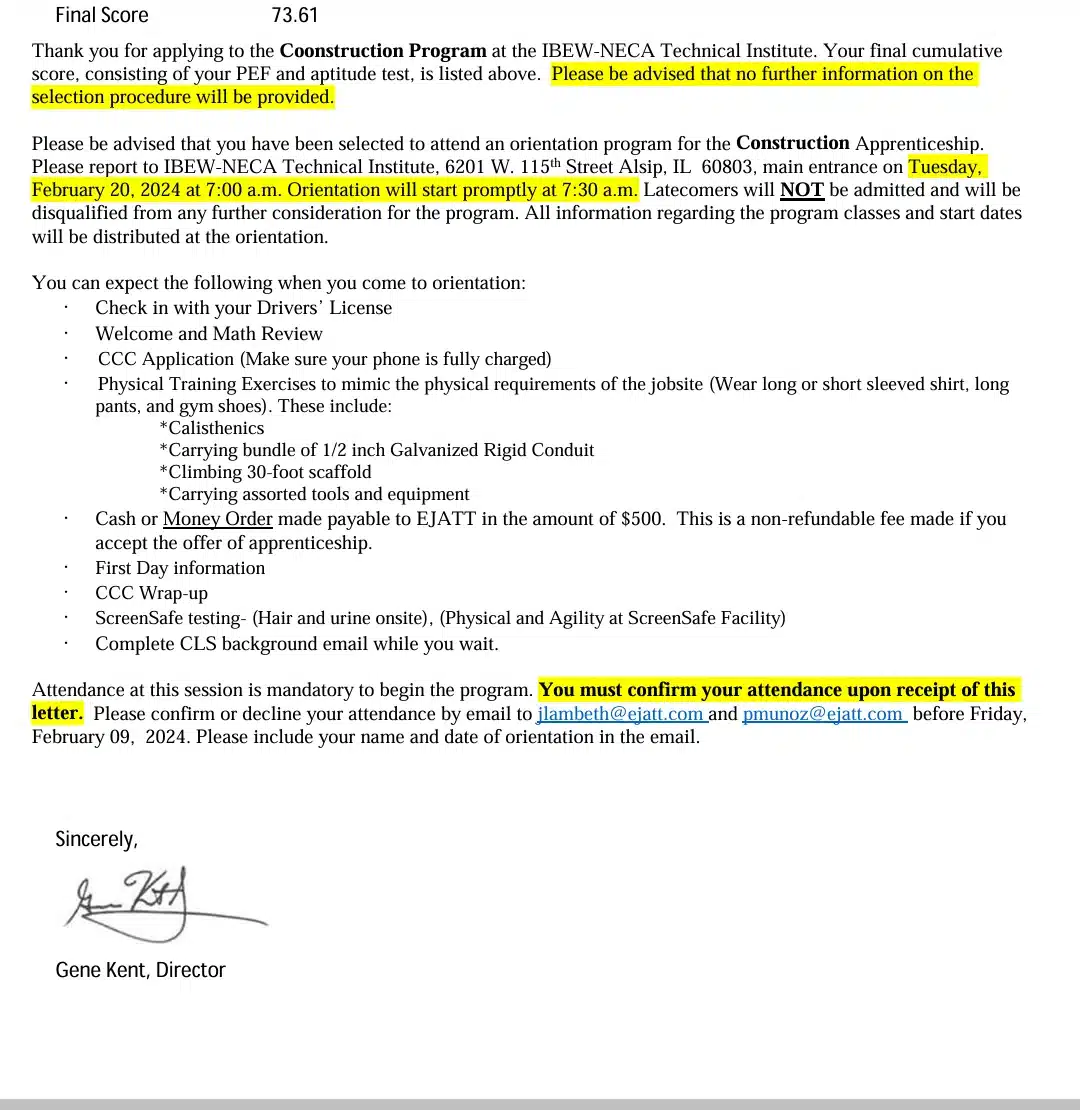
When you receive your results from the GAN Aptitude Test, you will be presented with a final cumulative score. This score will be a numerical value, like 73.61, out of a possible 100 points. It’s important to note that this score is comprehensive, reflecting not just your performance on the aptitude test but also incorporating other evaluated factors, known as your PEF (Personal Eligibility Form), into the final tally.
This scoring system, on a scale of 0 to 100, is designed to provide a clear, quantifiable measure of your aptitude in comparison to the testing population. Higher scores indicate stronger performance and, typically, a better reflection of your readiness for the challenges that the test aims to measure you against.
Scoring the GAN Test: Understanding Your Results
The GAN Aptitude Test uses a combined scoring system, incorporating your performance on the individual sections with your Personal Eligibility Form (PEF) information. This table explains how the scoring works and how to interpret your final score.
| Score Range | Interpretation |
|---|---|
| 90-100 | Excellent performance, indicating strong potential for success in various roles. |
| 80-89 | Very good performance, demonstrating above-average capabilities. |
| 70-79 | Good performance, suggesting suitable potential for many roles. |
| 60-69 | Average performance, indicating potential with further development. |
| 50-59 | Below average performance, may require additional preparation for specific roles. |
| Below 50 | Low performance, may benefit from additional assessment and support. |
Note: This is a general interpretation, and specific score requirements may vary depending on the role and employer.
GAN FAQs
The test is designed to measure a range of cognitive abilities and specialized skills across various domains, providing insights into an individual’s potential for success in academic and professional settings.
The test assesses skills such as spatial visualization, basic arithmetic, numerical reasoning, reading comprehension, and mechanical reasoning.
The test consists of multiple-choice questions across different timed sections.
Each section of the test is scored based on the number of correct answers, which are then compiled into a cumulative score.
Preparation should include familiarizing yourself with the test format, practicing with similar question types, and developing effective test-taking strategies.
GAN Test Tips
As you stand on the threshold of taking the GAN Aptitude Test, it is crucial to arm yourself with practical strategies that will steer you through the test with poise and confidence. Here are seven pivotal tips to adhere to on test day:
- Follow Directions Closely: When the test is distributed, pay careful attention to the administrator’s instructions. This is crucial as failing to follow directions can lead to easily avoidable mistakes.
- Carefully Read All Test Directions: Before diving into the questions, thoroughly read the test directions. Understanding exactly what is required is key to answering questions correctly.
- Examine All Examples Provided: Look at any examples given on the test as they often provide insight into how to approach the questions or the format answers should take.
- Manage Your Time Wisely: Be mindful of the time allocated for each section and budget it accordingly. Don’t linger too long on any one question.
- Tackle Easy Questions First: Begin with the questions that you find easiest. This strategy helps secure quick wins and builds confidence as you progress through the test.
- Aim to Answer Every Question: Even if you are unsure, it’s better to attempt an answer than to leave a question blank. Use the process of elimination to increase your chances of selecting the correct answer.
- Review If Time Allows: If you complete a section early, use the remaining time to review your answers, especially ones you were unsure about. Make sure that the answer you’ve marked corresponds to what you intended.
Administration
- Test Location: The test is held at the local office, the same one to which you applied.
- Test Schedule: Tests are held every couple of weeks/months. Available test dates will be sent to you if you meet the minimum requirements for the apprenticeship.
- Test Format: Multiple choice on computer.
- Test Materials: Tests are taken on a computer. Calculators are not allowed, and smart devices will be stored for the duration of the test. Writing instruments are provided but bring your own, just in case.
- Cost: The non-refundable application fee varies between locals but mostly varies between $20-$50.
- Retake Policy: you may take the test battery again after a period of six (6) months has elapsed from your most recent test date. If you try to take the test beforehand, you will have to wait six additional months. To take the test again, you are required to pay the processing fee once more.
Test Provider
GAN Human Resources is a company that has established itself as a pioneer in the field of human resources services, especially in the domain of data-driven selection procedures. Founded in 1998 and headquartered in Chicago, IL, the company has consistently focused on developing tools that aid organizations in making equitable hiring decisions. With a compact yet dedicated team of 11-50 employees, GAN Human Resources has built a reputation for creating processes that not only increase opportunities for all applicants but also ensure the success of selected candidates in their training programs.
Information Sources
Disclaimer – All the information and prep materials on iPREP are genuine and were created for tutoring purposes. iPREP is not affiliated with GAN Human Resources, which is the owner of the GAN Aptitude Test, or with any of the companies or organizations mentioned above.
Free GAN Aptitude practice test: Get to know what the GAN Aptitude Battery Tests will be like by practicing with these sample questions:
Paper Folding Sample Question 1
Paper Folding Test Instructions
This test is designed to assess your ability to understand and visualize three-dimensional objects. Each question presents a sequence of images.
On the left-hand side, you will see a series of images depicting the folding process of a square sheet of paper. The final image in this series will display the paper after one or two holes have been punched through it, following its folding. On the right-hand side, you will encounter images of five unfolded papers.
Your task is to identify which among these five images accurately represents the paper’s appearance with the holes once it is fully unfolded. Select the correct image and mark its corresponding letter.
Please review the example problem provided below to familiarize yourself with this test.
The correct answer is A.
Watch the video below for the solution explanation:
Paper Folding Sample Question 2
Now try a slightly more challenging example:

The correct answer is A.
Watch the video below for the solution explanation:
Numerical Computation Sample Question 1
Solve:
$$$ \dfrac{1}{2}-\dfrac{2}{9} = ?$$$
- $$$ \dfrac{7}{18} $$$
- $$$ \dfrac{2}{9} $$$
- $$$ \dfrac{1}{3} $$$
- $$$ \dfrac{5}{18} $$$
$$$ \dfrac{1}{2}-\dfrac{2}{9} $$$ The LCM is 18
$$$ \dfrac{1\times9}{2\times9}-\dfrac{2\times2}{9\times2} $$$
$$$ \dfrac{9}{18}-\dfrac{4}{18} $$$ Subtract the numerators
$$$ \dfrac{9-4}{18} $$$
$$$ \dfrac{5}{18} $$$
Numerical Computation Sample Question 2
Convert the decimal to fraction form:
13.375 =
- $$$ 13\dfrac{3}{8} $$$
- $$$ 13\dfrac{7}{8} $$$
- $$$ 13\dfrac{5}{8} $$$
- $$$ 13\dfrac{8}{13} $$$
The correct answer is A ($$$ 13\dfrac{3}{8} $$$).
| 13.375 | (Separate whole number from the decimal) |
| = 13 + 0.375 | (Multiply and divide the fraction by 1000). |
| = 13 + 0.375 x 1000/1000 | (Rearrange terms in the fraction) |
| = 13 + (0.375 × 1000)/1000 | (Multiply the terms in the numerator) |
| = 13 + 375/1000 | (Simplify the fraction by dividing the numerator and denominator by ‘125’). |
| = 13 + (375÷125)/(1000÷125) | |
| = 13 + 3/8 | |
| = 13 3/8 |
Numerical Reasoning Sample Question 1
What is the next number in the following series of numbers?
-1 2 1 3 4
- 5
- 7
- 1
- 6
The correct answer is 7.
Explanation:
Look at the differences between the numbers:
-1 2 1 3 4
+3 -1 +2 +1
While there is no simple pattern to the differences, you do get a hint: all the elements of the series of the differences, except the first one, appear in the same order as the numbers of the original series. You can assume that the next difference will be +3 as it is the number that follows 1 in the original series.
Therefore, the next number of the series is 4 + 3 = 7
The complete logic of the series is that every term in the series equals the sum of the previous two terms.
It can be formally written as follows: an+2 = an + an+1
For learning purposes, here is the series, had it continued for several more steps:
-1 2 1 3 4 7 11 18 29 47
+3 -1 +2 +1 +3 +4 +7 +11 +18
And for general knowledge: Did you know that any series of numbers in which each number (third in sequence and above) is the sum of the two preceding numbers is known as the Fibonacci sequence, named after Italian mathematician Leonardo of Pisa, known as Fibonacci?
Numerical Reasoning Sample Question 2
What is the next number in the following series of numbers?
3 5 9 17 33
- 45
- 57
- 65
- 71
The correct answer is 65.
Explanation:
Look at the differences between the numbers:
3 5 9 17 33
+2 +4 +8 +16
*2 *2 *2
The differences between each term are multiplied by 2 in every step. Therefore, the difference between the last displayed number of the series and the next number should be 16*2 = 32.
Another way to look at the differences is to realize that there is a consistent relationship between the series of difference and the original series. Each difference equals the number of the series minus one (“1”), or simply each number in the series of differences is the previous natural number in comparison to the original series.
It can be formally written as follows: an+1 = an + (an – 1)
For learning purposes, the next numbers of the series would be:
65 + 64 = 129
129 + 128 = 267
The next number of the series is, therefore, 33 + 32 = 65.
Mechanical Reasoning Sample Question 1
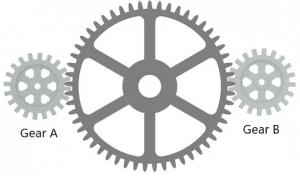
If the middle gear is rotating clockwise, which gear, A or B, will rotate in the same direction?
- Neither A nor B
The correct answer is C – Neither A nor B.
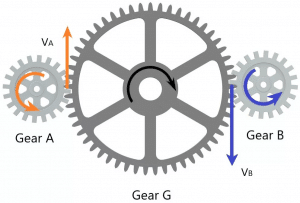
It can be observed from the image that gears A and B are linked directly to the middle gear. However, when two gears are directly linked, their tangential velocities are always the same, although the directions of their rotation are always opposite to each other.
In our case, the velocity vector between the middle gear and gear A will point upwards and the direction of rotation of the middle gear and gear A will be clockwise and counterclockwise respectively. Similarly, the velocity vector between the middle gear G and gear B will point downwards and the rotation of gear B will be counterclockwise. Hence both gears A and B will rotate in the opposite direction of the middle gear.
Mechanical Reasoning Sample Question 2
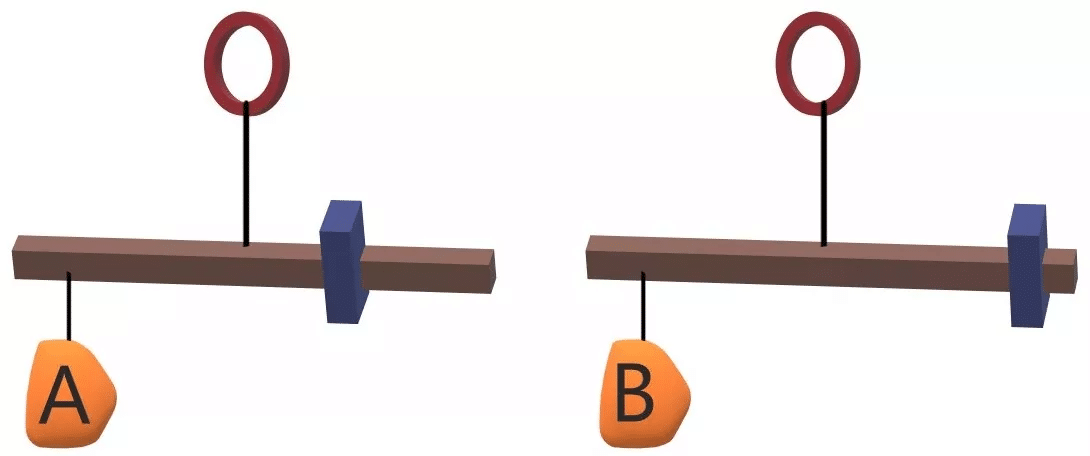
Two fixation points provide an accurate force to prevent the weights from breaking the poles. Which weight is heavier?
(If equal, mark C.)
- A.
- B.
- C.
The correct answer is B.
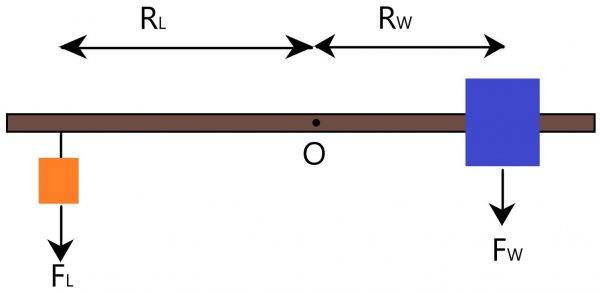
The given problem can be modeled as a beam balance with point O as the pivot. Summation of moments on O is zero since no rotation occurs. We denote the weights of load and counterweight as FL and FW and their moment arms as RL and RW respectively. Now, ΣM=0,
FW × RW – FL × RL = 0 or FL = RW/RL × FW
Since FW and RL are the same in both cases, and RW for B is greater than RW for A, hence load B must be heavier.
Reading Comprehension Sample Question
Passage:
In electrical installations, the concept of circuit protection is critical to ensure safety and prevent potential hazards. Circuit breakers and fuses are commonly used devices designed to interrupt the flow of current in electrical circuits when excessive currents, which could cause damage to equipment or start fires, are detected. Circuit breakers can be reset and reused after tripping, whereas fuses need to be replaced once they blow. Understanding the principles of electrical load, short circuits, and ground faults is essential for electricians to properly install and maintain these protective devices. The correct sizing of circuit breakers and fuses is crucial, as it must match the circuit’s maximum current capacity without being too high, which might not protect the circuit effectively, or too low, which could lead to unnecessary tripping or blowing.
Question:
What is the primary reason for the installation of circuit breakers and fuses in electrical circuits?
A. To increase the electrical load capacity of a circuit.
B. To interrupt the flow of current to prevent potential hazards.
C. To reduce the cost of electrical installations.
D. To permanently increase the current flow in electrical circuits.
Solution:
The correct answer is B. To interrupt the flow of current to prevent potential hazards.
Explanation:
The passage explains that circuit breakers and fuses are installed in electrical circuits primarily to interrupt the flow of current when excessive currents are detected. These excessive currents could cause damage to equipment or start fires, posing a significant safety hazard. The purpose of these devices is to provide circuit protection by preventing these hazards, rather than increasing the load capacity (A), reducing costs (C), or increasing current flow (D), which are not mentioned as their functions in the passage. Therefore, the correct answer is B, as it aligns to ensure safety and prevent potential hazards associated with excessive currents.
About the course
Includes 26 practice tests (2 full-length simulations)
40 Learning hours · 36 Practice tests · 864 Questions · 914 Videos
This course builds your readiness for the GAN Aptitude Test Battery by moving from orientation and targeted skill drills into full-length simulations. You’ll practice the core pillars—Numerical Computation, Numerical Reasoning, Reading Comprehension, Paper Folding, and Mechanical Reasoning—plus Problem Solving coverage for versions that include it. Each practice set is designed to help you recognize common patterns, apply the right method quickly, and stay accurate under time pressure.

Skills you will learn
Numerical Computation · Numerical Reasoning · Reading Comprehension · Paper Folding · Mechanical Reasoning · Problem Solving
Curriculum
Course Introduction
- Understand course flow and study setup
GAN Aptitude Test Breakdown
- Know sections, timing, and expectations
- Recognize each question type’s demands
Arithmetic Computation
- Basic Math – Arithmetic Operations: core fundamentals
- Basic Math – Multiple-Choice Solving Tips: strategy summary
- Basic Math – The Order of Operations: rules
- Basic Math – Fractions and Decimals: conversions practice
- Basic Math – Percents: quick percent calculations
Number Series/Sequences
- Identify rules using differences and ratios
- Fill-in-the-blank sequence problem practice
Reading Comprehension Tutorial
- Read passages and answer multiple-choice questions
- Find main ideas and key details
Paper Folding
- Guided folding walkthroughs and symmetry practice
- Timed and practice-mode folding question sets
Mechanical Comprehension
- Simple Machines and Mechanical Advantage: levers pulleys gears
- Common Forces that Appear in Mechanical Tests
- Understanding Fluid Mechanics: hydraulics basics
- Additional Mechanical Knowledge for Aptitude Tests: review
Problem Solving
- Problem Solving Practice Drills: “Not Given” logic
- Translate scenarios into clear math steps
Preparation Strategies and Test-Taking Tips
- Time management and elimination strategies
- Consistent approach across all sections
Full-Length GAN Test Simulations
- GAN Test Simulation 1: full battery modes
- GAN Test Simulation 2: full battery modes
- Review results and target weak areas
Course Conclusion
- Final wrap-up and next steps
Reviews

Nabieu K*****
March 29, 2026 at 2:02 PM
Really good course and super helpful. It explained everything in a way that was easy to understand, and the practice questions actually felt like what I’d see on the test. It definitely helped me feel more confident and prepared. Would recommend for sure.
Jordan M*****
March 23, 2026 at 10:03 PM
Very helpful. Definitely is a good refresher course. Very easy to use and gets you ready for anything the test could throw your way.
Cesar C**********
March 19, 2026 at 6:34 PM
It covers all the sections, provides what I need, and I feel confident in my testing abilities because of this resource!
Leonardo R***
March 14, 2026 at 8:34 AM
The prep has been great. It goes over your foundations, and teaches you tips and tricks that you may have not known, as well as building on this firm foundation of knowledge, so you not only feel prepared, but ARE prepared.
Kim D******
March 8, 2026 at 5:44 PM
Much better than GAN's own study guide. There's a video explanation for every test question. I needed to review the mechanical reasoning section and this was the best resource I've found so far.
Louis C*****
February 27, 2026 at 4:35 PM
Amazing great for a refresher and confidence booster. I like that the site has everything setup with reading and videos.
Romanche O****
February 26, 2026 at 12:17 AM
Good at explaining, so if you put the time in you’re sure to reap the benefits. I highly recommend this to anyone interested in joining the union.
Norma B*****
February 25, 2026 at 1:15 PM
Very helpful!! One of the best practice tests I ran across for apprenticeship. It gives a very detailed explanation of problems you will come across.
Antonio V*******
February 23, 2026 at 4:52 PM
Very useful in addition to the HR Aptitude study guide. Explanations are helpful for the most part. The only thing I would change would be the explanations for some of the numerical computations. Some of those are lengthier than other methods of figuring it out, and on a timed test.. that matter a lot. Regardless, I would recommend this before taking the test to go in with confidence.
Erick G********
February 15, 2026 at 10:03 PM
Really loving it so far, learned a lot more than expected, and some shortcuts. The videos on the test questions are the best!