Reviewed by Tamir Rubin, Head of Product at iPREP • Updated August 2026
What is the Foreign Service Officer Test (FSOT)?
The Foreign Service Officer Test (FSOT) is a U.S. Foreign Service selection assessment measuring job knowledge, English usage and comprehension, and logical reasoning. It covers government, history, society, geography, economics, math/statistics, grammar, reading, and argument analysis. Total time varies by administration; there is no essay or passing score. (Test revised: Oct. 2025)FSOT Sample Question
The EEOC is not responsible for protecting applicants from employment discrimination, based on their
- national origin
- religion
- mental health condition
- marital status
FSOT Sections
Job Knowledge
Section assesses: knowledge
- U.S. government, history, and society basics
- World history and geography fundamentals
- Economics concepts and policy awareness
- Math and statistics data interpretation
English Usage and Comprehension
Section assesses: language
- Grammar and sentence-level correctness checks
- Edit wording for clarity and tone
- Read passages; infer stated meaning
- Identify main idea and details
- Choose best revision or usage
Logical Reasoning
Section assesses: reasoning
- Analyze arguments and supporting evidence
- Draw justified conclusions from statements
- Identify assumptions and logical flaws
- Evaluate strength of competing inferences
- Recognize patterns in reasoning chains
Test Duration
Total time: varies by administration.
Plan for a single, continuous timed session. Timing can differ by test window or delivery method, so verify details before test day and pace yourself steadily throughout.
Test Breakdown & Sample Questions
The Foreign Service Officer Test (FSOT) is a computer-based, multiple-choice exam. The current FSOT does not include an essay. Test time and question counts can vary by administration, but you should plan for about 2 hours of timed testing (plus check-in and on-screen instructions).
Some administrations may include unscored questions used for research. If included, you’ll be notified by the test administrator.
| Section | What it focuses on | What to expect |
|---|---|---|
| Job Knowledge | Job Knowledge U.S. government, U.S. history and society, world history and geography, economics, and math/statistics | Multiple-choice; timed section |
| English Usage and Comprehension | Grammar and usage, clarity, and reading comprehension | Multiple-choice; time and question count vary |
| Logical Reasoning | Analyzing arguments, drawing conclusions from stated information, and identifying assumptions | Multiple-choice; time and question count vary |
Job Knowledge Test
The Job Knowledge section measures practical knowledge across topics that are relevant to Foreign Service work and are important across Foreign Service career tracks.
Time limit and number of questions can vary by administration. Expect a timed, multiple-choice section as part of the overall FSOT session.
Topics covered on the current FSOT Job Knowledge section include:
- U.S. Government
- U.S. History, Society, Customs, and Culture
- World History and Geography
- Economics
- Math and Statistics
What each topic area may include
U.S. Government: Core features of the U.S. federal system, the Constitution, the roles of Congress and the executive branch, and how U.S. foreign policy is shaped.
U.S. History, Society, Customs, and Culture: Major historical events and institutions, civic culture, social issues and trends, and how domestic factors can influence foreign policy.
World History and Geography: Major global events and developments, regional dynamics, and how international issues may affect U.S. interests.
Economics: Fundamental economic concepts, how markets function, and basic features of the U.S. economy and economic policy.
Math and Statistics: Basic math and data interpretation (for example: percentages, ratios, averages, and reading charts/tables).
All questions are multiple-choice, with four answer options.
Winning Tip
Answer the questions you know first. If you’re unsure, make your best choice and move on—you can use any remaining time to review flagged items if the test interface allows before the section ends.
Try a Job Knowledge Sample Question
Which Soviet Union leader did President George Bush meet at the Malta Summit of December 1989, in which the United States and the Soviet Union declared the Cold War over?
- Mikhail Gorbachev
- Leonid Brezhnev
- Vladimir Putin
- Boris Yeltsin
The correct answer is Mikhail Gorbachev.
The Malta Summit comprised a meeting between US President George H. W. Bush and Soviet General Secretary Mikhail Gorbachev, taking place on December 2–3, 1989, just a few weeks after the fall of the Berlin Wall. During the summit, Bush and Gorbachev would declare an end to the Cold War although whether it was truly such is a matter of debate.
English Usage and Comprehension
The English Usage and Comprehension section evaluates your ability to read and understand written material and apply standard English usage.
Time limit and number of questions can vary by administration. Expect a timed, multiple-choice section as part of the overall FSOT session.
Question formats may include:
- Identifying the best-written sentence (grammar, usage, clarity)
- Selecting the best revision or correction to a sentence
- Reading comprehension questions based on short passages
All questions are multiple-choice, with four answer options.
Winning Tip
Get comfortable with the common question styles (grammar/usage and reading comprehension). The more familiar the formats are, the less time you’ll spend interpreting the prompt—and the more time you’ll have to choose the best answer.
Try an English Usage Sample Question
Select the one underlined word or phrase that needs to be changed to make the sentence correct, or indicate that none of the underlined parts are in error.
Some people believe that public health should be improved by increasing the amount of sports facilities, while others believe that it has little effect and other measures should be taken to solve this problem.
- NO ERROR
- should be improved
- amount of sports facilities
- has little effect
Correct answer: amount of sports facilities
Explanation: Number is used with countable nouns (things you can count individually), while amount is used with uncountable nouns (quantities). Because sports facilities are countable, the phrase should be “the number of sports facilities,” not “the amount of sports facilities.”
Logical Reasoning
The Logical Reasoning section evaluates how well you can analyze written arguments and draw sound conclusions from the information provided.
Time limit and number of questions can vary by administration. Expect a timed, multiple-choice section as part of the overall FSOT session.
Question formats may include:
- Identifying an argument’s main conclusion
- Recognizing assumptions and logical gaps
- Selecting the option that best strengthens or weakens a claim
- Drawing the most reasonable inference based on stated facts
- Spotting flawed reasoning or inconsistencies
All questions are multiple-choice, with four answer options.
Winning Tip
Base your answer only on what’s stated in the prompt. Avoid using outside knowledge or “what’s usually true”—focus on the evidence given and choose the option that best follows from it.
Try a Logical Reasoning Sample Question
A city reports that after installing “smart” traffic lights on several major roads, average commute times fell by 10%. A council member concludes that the new traffic lights caused the improvement and proposes installing them citywide to reduce commute times even further.
Which of the following, if true, most seriously weakens the council member’s argument?
- During the same period, several large employers in the city expanded flexible and remote-work options, reducing the number of commuters on the roads.
- Many residents say they prefer the new traffic lights because they seem to reduce waiting time at intersections.
- The smart traffic lights cost more to install and maintain than the city’s previous system.
- Some roads without smart traffic lights already have commute times that are shorter than the city average.
The correct answer is A.
Explanation: If fewer people were commuting because of increased remote work, commute times could have dropped even without the smart traffic lights. That alternative explanation directly weakens the claim that the lights caused the improvement.
Why the other answers are wrong:
- B: Preferences don’t show causation; liking the lights doesn’t explain the 10% drop.
- C: Cost affects feasibility, not whether the lights caused shorter commutes.
- D: Comparing other roads’ commute times doesn’t address why times fell after installation.
Did you know?
The current Foreign Service Officer Test (FSOT) is a timed, multiple-choice exam with three sections: Job Knowledge, English Usage and Comprehension, and Logical Reasoning—and it does not include an essay; performance is evaluated across the test, and there is no single “passing score” used for all candidates.
FSOT Preparation Strategies
The FSOT is broad and time-pressured, so the best prep focuses on current test content and speed with accuracy. Prioritize resources that reflect the three-section FSOT (Job Knowledge, English Usage and Comprehension, and Logical Reasoning), and build a routine that mixes learning, practice, and review.
Build a “FSOT habit” (20–30 minutes daily)
Read a mix of U.S. and international coverage and summarize what you read in 2–3 sentences. Rotate topics like government, economics, global affairs, and science/technology to support Job Knowledge.
Use official-style practice to set your baseline
Complete a full-length practice session under timed conditions to learn pacing and identify gaps. Review every missed question and write down the rule, fact, or reasoning step you needed.
Double-check your materials match today’s FSOT
Before you study, confirm the content covers English Usage and Comprehension (including reading comprehension) and Logical Reasoning (not situational judgment) and does not rely on essay scoring.
Train multiple-choice speed without rushing
Practice eliminating wrong answers quickly, spotting “trap” wording, and choosing the best-supported option. Move steadily, flag tough questions, and return if time allows.
Add accountability with a study partner
Meet weekly to quiz Job Knowledge topics, review reading passages, and talk through reasoning questions out loud. Explaining your logic is one of the fastest ways to improve Logical Reasoning.
Test Features
Test Fast Facts (tl;dr)
- Three multiple-choice sections
- No essay on current FSOT
- Job Knowledge: broad topics
- English usage plus comprehension
- Logical Reasoning replaces SJT
- Timed exam; length may vary
- Some questions may be unscored
Retake Policy
Retake rules can change and may depend on current State Department policy. Check your FSOT registration portal for the most up-to-date retake waiting period and eligibility requirements.
Fees
Exam fees and missed-appointment charges can change. Confirm current pricing, cancellation deadlines, and any no-show fees in your registration account before scheduling.
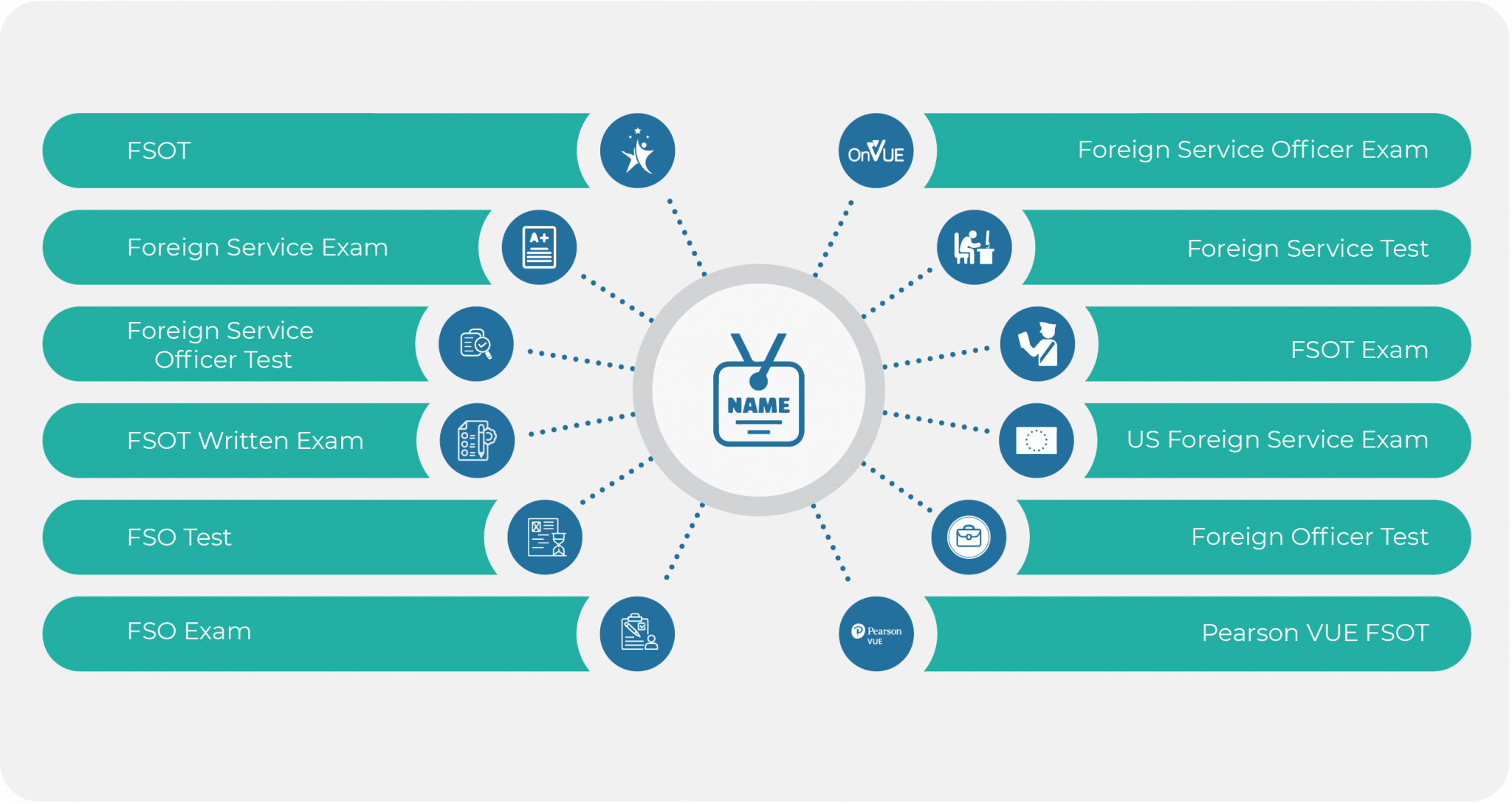
Common Names of the Test
While the official name of the test is the Foreign Service Officer Test, the test has many unofficial names, including:
- Foreign Service Officer Test
- FSOT Written Exam
- Foreign Service Officer Exam
- US Foreign Service Exam
- Pearson VUE FSOT
All these names refer to the same test.
Technical Facts
The Foreign Service Officer Test (FSOT) is part of the screening process for Foreign Service Officer candidates. To apply, you must:
- Be a U.S. citizen when you submit your registration
- Be at least 20 and no older than 59 when you submit your registration
- Be at least 21 and not yet 60 when appointed
- Be willing to accept assignments based on the needs of the Foreign Service
FSO Selection Process
The selection process generally follows these steps:
Step 1: Choose a Career Track
Select one of the five Foreign Service Officer career tracks: Consular, Economic, Management, Political, or Public Diplomacy.
Step 2: Register for the FSOT
Create a Pearson VUE account, complete the application and eligibility information, and schedule an appointment during an open testing window.
Step 3: Take the FSOT
Complete the timed, computer-based, multiple-choice exam at a Pearson VUE testing center or through online proctoring. The FSOT does not have a fixed passing score; candidates are selected to advance based on their scores and the needs of the Foreign Service.
Step 4: Foreign Service Officer Assessment
Candidates selected to advance complete written and oral assessments designed to evaluate areas such as general knowledge, analytical ability, communication, and negotiation skills. The written examination replaces the former Qualifications Evaluation Panel.
Step 5: Medical and Security Clearances
Candidates who pass the assessment must meet the medical qualification requirements and receive the required security clearance.
Step 6: Suitability Review
A Suitability Review Panel examines the candidate’s overall record, excluding medical records, to determine suitability for employment in the Foreign Service.
Step 7: The Register
Candidates who successfully complete all requirements are placed on a rank-ordered hiring register for their selected career track. Appointments are offered based on register ranking and the hiring needs of the Foreign Service, so placement on the Register does not guarantee employment.
Results Scale and Interpretations
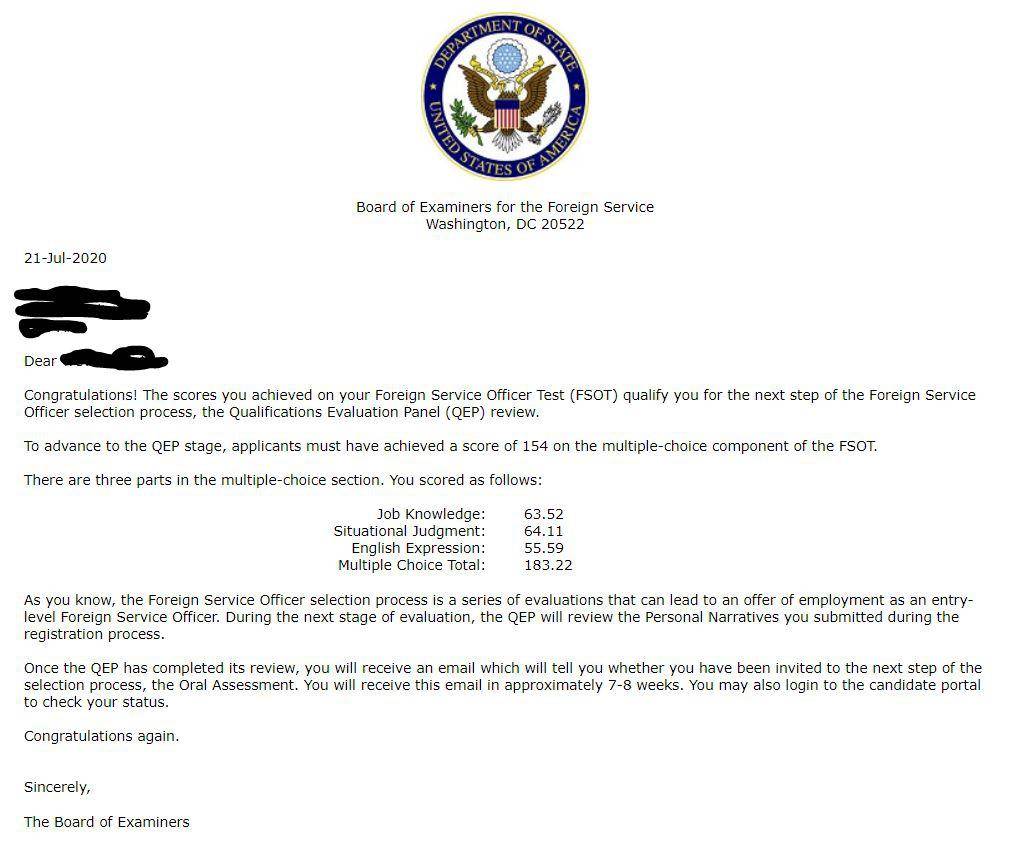
FSOT results are typically released after the testing window closes, and timing can vary by administration. Your score report generally includes scaled results (and may include comparative feedback) for the overall exam.
The FSOT is not a simple pass/fail test with a universal cutoff score. Advancement is competitive and depends on how you perform relative to other candidates and current hiring needs, so aim to maximize your overall score rather than targeting a specific number.
Notes
- Score reporting details can change by administration, so use your registration portal as the final source for timelines and requirements.
- Your application is tied to a specific testing window, and deadlines matter—missing required steps can end your candidacy for that cycle.
- Unless test instructions explicitly state otherwise, don’t leave questions blank. Make your best choice, keep moving, and review flagged items if time allows.
FSOT FAQs
The current FSOT is a timed, multiple-choice exam with three sections: Job Knowledge, English Usage and Comprehension, and Logical Reasoning.
Use a mix of broad reading (U.S. and world news), targeted review of core topics, and timed practice questions that match the current FSOT format.
The FSOT is not a simple pass/fail exam with a universal cutoff score. Advancement is competitive and depends on your results compared with other candidates and current hiring needs.
The number of questions can vary by administration. Plan for a timed, multi-section multiple-choice exam.
Retake rules can change. Check your FSOT registration portal for the current waiting period and eligibility.
After the FSOT, the Department of State selects candidates to advance to the Foreign Service Officer Assessment (FSOA) based on the highest FSOT scores and the needs of the Foreign Service.
You must be a U.S. citizen, be at least 20 and no older than 59 when you register, be at least 21 and not yet 60 when appointed, and be willing to accept assignments based on the needs of the Foreign Service.
FSOT Test Tips
Test day is all about pacing, focus, and avoiding preventable mistakes. Use these quick tips to stay in control from start to finish.
Pace within each section
You typically can’t move between sections once you start, but you can often flag or skip items within a section and return if time allows. Start with questions you can answer confidently, then circle back to tougher ones.
Make smart guesses
If you’re unsure, eliminate clearly wrong options first and then choose the best remaining answer. Unless the test instructions explicitly say there’s a penalty for wrong answers, don’t leave points on the table by skipping questions.
Read the prompt like it’s trying to trick you
Slow down for a few seconds to catch keywords (best, most likely, except, supported by). Many missed questions come from misreading—not lack of knowledge.
Watch the clock, not the stress
If you’re stuck, don’t wrestle with one question too long. Make your best call, flag it, and move on. A steady pace usually beats perfection on a few items.
Stay calm and take care of basics
Sleep well, eat something that won’t spike/crash your energy, and arrive early. A clear head helps as much as content knowledge on a timed exam.
Administration
- Test location: Pearson VUE testing centers (online proctoring may be available for some windows).
- Test schedule: Offered in scheduled testing windows throughout the year. Registration opens in advance and closes at the published deadline or when seats fill—check your Pearson VUE/FSOT account for current dates.
- Test format: Computer-based, multiple-choice.
- Test materials: No outside materials unless explicitly permitted by the test rules. Follow the test center/proctor instructions for personal items.
- Cost: Exam fees and any cancellation/no-show fees can change. Confirm current charges and deadlines in your registration account before scheduling.
- Retake policy: Testing limits and waiting periods can change. Verify your eligibility and next available window in your registration portal.
Test Provider
The FSOT is administered by Pearson VUE on behalf of the U.S. Department of State.
The exam is designed to evaluate skills and knowledge that are relevant to Foreign Service work, and to support a fair, standardized comparison of candidates during the early stages of the selection process.
Information Sources
Disclaimer – All the information and prep materials on iPrep are genuine and were created for tutoring purposes. iPrep is not affiliated with the Foreign Service, Department of State, Pearson VUE testing centers, or any other company mentioned.
Free FSOT Practice Test
Start with free FSOT practice test questions that give you a clear feel for the knowledge, language, and reasoning skills tested on the Foreign Service Officer Test. The free practice introduces common FSOT-style topics such as job knowledge, U.S. government, history, geography, economics, English usage, reading comprehension, and logical reasoning.
Use the free practice to understand the question format, pacing, and level of broad knowledge expected before moving into full preparation. For complete practice, iPREP’s full FSOT course includes realistic exam-style questions, detailed explanations, video lessons, and targeted practice for the main Foreign Service Officer Test sections.
Question 1 of 10 (Job Knowledge)
The EEOC is not responsible for protecting applicants from employment discrimination, based on their
- national origin
- religion
- mental health condition
- marital status
The correct answer is marital status.
Under the laws enforced by Equal Employment Opportunity Commission (EEOC), it is illegal to discriminate against someone (applicant or employee) because of that person’s race, color, religion, sex (including gender identity, sexual orientation, and pregnancy), national origin, age (40 or older), disability (physical or mental condition) or genetic information.
Only about half of the US states protect by state law against discrimination based on marital status. Federal employees are also protected from marital status discrimination by the Civil Service Reform Act of 1978 (CSRA).
Question 2 of 10 (Job Knowledge)
Which of the following is not one of the five permanently inhabited U.S. territories?
- A. American Samoa
- B. Guam
- C. Northern Mariana Islands
- D. Marshall Islands
Correct Answer: D
Explanation:
The five permanently inhabited U.S. territories are American Samoa, Guam, the Northern Mariana Islands, Puerto Rico, and the U.S. Virgin Islands. Four of them—Guam, the Northern Mariana Islands, Puerto Rico, and the U.S. Virgin Islands—are organized, unincorporated territories. American Samoa is unincorporated but technically unorganized. The Marshall Islands is not a U.S. territory; it is a sovereign country in free association with the United States.
Question 3 of 10 (English Usage)
Choose the word that best completes the sentence.
Spray sunscreen has become popular ______ it is quick and easy to apply.
- and
- but
- because
- therefore
The correct answer is C.
“Because” is the best answer because it introduces the reason spray sunscreen has become popular. “And” adds information but does not show cause. “But” signals contrast, which does not fit the sentence. “Therefore” signals a result, but the logic would be reversed: spray sunscreen is popular because it is quick and easy to apply, not the other way around.
Question 4 of 10 (English Usage)
Select one underlined word or phrase that needs to be changed to make the sentence correct, or indicate that none of the underlined parts are in error.
Online forums are a place where we can get answers to our questions and calm our doubts where we can connect with other like individuals and grow virtual friendships.
- NO ERROR
- a place where
- doubts where we
- grow virtual
The correct answer is C.
This is a run-on sentence where one idea runs into the other. To correct this you can either add a conjunction such as “and” or add punctuation such as a period or semicolon.
Question 5 of 10 (English Usage)
Select the one word or phrase that needs to be used in place of the underlined text to make the sentence correct, or indicate that the underlined text is not in error.
At Fire Island, a popular tourist spot east of the city, the remains of what might have been the shipping vessel were uncovered.
- NO ERROR
- has been
- had been
- having been
The correct answer is A.
Explanation: The word “might” is an auxiliary verb. Therefore, because of the addition of “might,” the only possible answer is “have been.”
Question 6 of 10 (English Usage)
Put the following sentences into the correct order to create a logical and flowing paragraph.
Sentence 1. With an ever-increasing population, clean water is becoming even more essential in developing African countries and it is estimated that investments of over $800 billion will be needed in the next few years.
Sentence 2. Drink 2025 is an initiative which aims to unite 7 drought-affected African nations in order to conserve water supplies and provide citizens with an uninterrupted supply of drinkable water.
Sentence 3. The initiative will bring together water conservation experts from around the globe, government agencies, charities, multilateral organizations, and private companies in order to raise the needed capital.
Sentence 4. The investment will ensure Africa remains healthy and disease free for many years to come.
- 1, 2, 3, 4
- 1, 3, 4, 2
- 2, 4, 1, 3
- 4, 3, 1, 2
The correct answer is A.
Explanation:
The logical flow of the paragraph is as follows.
Introduce the problem > Introduce the solution > Talk about the aims of the solution > Conclusion
Note the vocabulary connections in each sentence too.
“Developing African countries” in the 1st paragraph pairs with “7 drought-affected African nations” in the 2nd.
“Drink 2025” in the 2nd pairs with “the initiative” in the 3rd.
“Needed capital” in the 3rd pairs with “investment” in the 4th.
When tackling this type of question, you must take these vocabulary connections into account.
Question 7 of 10 (English Usage)
The following sentences compose a paragraph. Read the paragraph carefully and then answer the questions that follow it.
Sentence 1. Women entrepreneurs are a growing market force, serving as a critical source of innovation and job creation and fueling economic growth.
Sentence 2. Women-owned businesses do not have equal access to the capital needed to stabilize or expand.
Sentence 3. Women entrepreneurs also lack access to markets, market information, digital services, networks, mentorship, and other resources that enable them to overcome the obstacles of starting and growing firms, as well as connecting with buyers.
Sentence 4. As with finance, some of these barriers are systemic, and others are more individualized.
Sentence 5. Systemic barriers require institutional reforms.
Which is the best alternative to the underlined portion of sentence 5?
- decree
- beseech
- crave
- necessitate
The correct answer is D.
Explanation:
The meaning of necessitate is to make something necessary as a result or consequence. This would be the best alternative for “require” in this context to mean that institutional reforms are necessary as a result of systematic barriers.
Option A – The word “decree” is too commanding for this context.
Options B and C – These words are too figurative for this context.
Question 8 of 10 (English Usage)
The following sentences compose a paragraph. Read the paragraph carefully and then answer the questions that follow it.
Sentence 1. Women entrepreneurs are a growing market force, serving as a critical source of innovation and job creation and fueling economic growth.
Sentence 2. Women-owned businesses do not have equal access to the capital needed to stabilize or expand.
Sentence 3. Women entrepreneurs also lack access to markets, market information, digital services, networks, mentorship, and other resources that enable them to overcome the obstacles of starting and growing firms, as well as connecting with buyers.
Sentence 4. As with finance, some of these barriers are systemic, and others are more individualized.
Sentence 5. Systemic barriers require institutional reforms.
Which sentence correctly details the financial challenges that female entrepreneurs face?
- Sentence 1
- Sentence 2
- Sentence 3
- Sentence 4
The correct answer is B.
Explanation:
This is the only sentence that addresses the financial obstacles that women face to set up or expand their businesses. The word “capital” refers to money used for producing more wealth or for starting a new business. Therefore, this is the correct option.
Option A – This sentence highlights the importance of women entrepreneurs and not their financial challenges.
Option C – This sentence explains the nonfinancial challenges that women entrepreneurs face.
Option D – Sentence 4 depicts the nature of the barriers.
Question 9 of 10 (Logical Reasoning)
Stimulus: If a file is confidential, then it is stored in Cabinet X. If a file is stored in Cabinet X, then it is logged. If a file is logged, then it can be retrieved within 10 minutes. This file cannot be retrieved within 10 minutes.
Question: Which statement must be true?
- The file is stored in Cabinet X.
- The file is logged.
- The file is confidential.
- The file is not confidential.
The correct answer is D.
The chain is: confidential → stored → logged → retrievable within 10 minutes. We are told the file is not retrievable within 10 minutes (not Q). Therefore it is not logged (modus tollens). If it is not logged, it is not stored. If it is not stored, it is not confidential. Thus, the file is not confidential.
A, B, and C each contradict what follows from the chain.
Question 10 of 10 (Logical Reasoning)
Argument: If an employee travels internationally, the employee files a travel report. Nora filed a travel report. Therefore, Nora traveled internationally.
Question: The argument depends on which assumption?
- Nora prefers international travel to domestic travel.
- Only employees who travel internationally file travel reports.
- Nora filed the report on time.
- International travel reports require manager approval.
The correct answer is B.
The premise provides international travel → filed report, but the conclusion reverses it: filed report → international travel. That reversal requires the assumption that filing a travel report happens only after international travel. Negation test: if employees sometimes file travel reports without traveling internationally, then Nora’s filing does not support the conclusion that she traveled internationally.
Sample FSOT Flashcards
Boost your exam prep with these key concept flashcards.
About the course
Includes 25 practice tests (2 full-length simulations)
1,215 Questions & Explanations · 320 Flashcards · FSOT Study Guide: Read or Listen! · Exclusive: 282 Explainer Videos
Build FSOT readiness through a structured review of Job Knowledge, English Usage and Comprehension, Logical Reasoning, and full-length simulations. The course moves from core question-type familiarity into targeted drills, timed practice, and realistic multi-section exam practice.

Skills you will learn
U.S. government · U.S. history · World history · Geography · Economics · Math · Statistics · Reading comprehension · Grammar · Vocabulary · Spelling · Inference · Assumption recognition · Logical flaws
Curriculum
Course Introduction
- Course structure and study orientation
Question Types Introduction
- FSOT question formats and expectations
Job Knowledge
- U.S. Government, History, and Society — focused practice
- World History and Geography — focused practice
- Economics — focused practice
- Math and Statistics — practice problems
- Timed Job Knowledge practice
English Usage and Comprehension
- Reading Comprehension Tutorial — strategy review
- English Proficiency (Grammar & More) — expression practice
- Vocabulary — targeted practice tests
- Spelling — targeted practice tests
- Reading and writing simulation practice
Logical Reasoning
- Bucket 1: Making Inferences — summary drill
- Bucket 2: Identifying Assumptions — summary drill
- Bucket 3: Justifying Conclusions — summary drill
- Bucket 4: Finding Logical Flaws — summary drill
- Timed Logical Reasoning practice
Full-Length Test Simulations
- FSOT Test Simulation 1 — complete section practice
- FSOT Test Simulation 2 — complete section practice
Course Conclusion
- Final review and completion wrap-up
Reviews

Charles B******
April 5, 2026 at 4:53 PM
Good flash cards. They cover a lot of relevant information. The study prep goes over several topics that are necessary for the FSOT.
Dax R****
October 5, 2025 at 11:20 AM
The FSO iPrep is a user friendly and practical study guide for the FSO exam. The sample questions, full test simulations and detailed video explanations for each an response are extremely useful. Looking forward to passing the exam.
Jose D***
January 30, 2025 at 5:02 PM
A great and easy-to-use platform that provides invaluable feedback after each practice session, helping users improve and refine their skills efficiently.
Baraa A******
September 27, 2024 at 10:43 AM
Great product, very easy to learn, has all the needed sources, it really helped me study for the test, and I feel I am ready now.
Laura L*****
September 19, 2024 at 7:51 PM
I haven't taken the exam yet, but the iPrep course has been fantastic. The content is well-structured, engaging, and easy to follow. The course materials are comprehensive and help to break down complex concepts into manageable pieces. The practice questions are especially helpful, allowing me to feel more confident and prepared for the exam. I highly recommend iPrep to anyone looking for an effective way to study and prepare!
Ally L**
September 16, 2024 at 3:05 PM
It is super helpful and I am glad I chose Iprep. I love the flashcard style and it helps me to remember the content and test myself.
Jean D***
July 24, 2024 at 5:00 AM
Great work here!! Best explanation using context clue. Very informative. Good for getting a good idea of what to expect in the test!!
Henry M*
June 8, 2024 at 7:10 AM
the test is very good and the answers are great with detail explanation. It really gives me a lot of confidence in taking this test.
Kathy H******
June 7, 2024 at 2:49 AM
I tried the two-day trial and enjoyed the course. The questions are similar to the fsot practice test that the state department gives, so you know you are getting quality testing questions. While the huge amount of testing questions is incredibly useful, I found the flashcards to be the most helpful especially when I felt too tired. Overall, really good overview and quality practice questions.
Osha B*******
May 31, 2024 at 2:02 PM
I learned so much in the first lesson I had to go back and rewrite my study outline. This course gets you excited to take the test and show what you have learned!