Reviewed by Tamir Rubin, Head of Product at iPREP • Updated February 2026
FINRA SIE Sample Question
A 38-year-old retail client is considering placing an order for a Nasdaq-listed technology stock. The client’s order is for 5,000 shares, and they want assurance that the order will be executed immediately and at the best available price. The firm’s registered representative explains that market makers in the stock are actively quoting bid and ask prices.
Which type of order is MOST appropriate to meet the client’s stated needs?
- Limit order
- Market order
- Stop order
- Fill-or-kill order
Topics Covered
High-level content areas
- Capital markets participants and structure
- Economic factors affecting securities prices
- Investment products features, returns, risks
- Trading, order handling, settlement basics
- Customer accounts, documentation, suitability concepts
- Prohibited practices, ethics, industry standards
- Regulators, securities laws, compliance concepts
Test Duration
Total time: 1 hour 45 min • 80 questions (5 unscored)
Avg pace: ~80 seconds per question. Work steadily and flag time-consuming items for review. Aim to complete a first pass early, then use remaining time to check marked answers.
Test Breakdown & Sample Questions
To do well on the SIE, you should be comfortable with the basics of common securities and investment products. Some questions ask you to identify a product or concept by its features, risks, or typical use.
The SIE is a multiple-choice exam with four answer choices per question. The scored portion includes 75 questions, and the exam may also include additional unscored questions.
| Section | Percentage of Exam | Number of Scored Questions |
|---|---|---|
| (1) Knowledge of Capital Markets | 16% | 12 |
| (2) Understanding Products and Their Risks | 44% | 33 |
| (3) Understanding Trading, Customer Accounts and Prohibited Activities | 31% | 23 |
| (4) Overview of Regulatory Framework | 9% | 7 |
Because Sections 2 and 3 make up the largest share of scored questions, most candidates spend extra time there. That said, you should still study all sections—skipping a smaller domain can cost you easy points.
To help you prepare, here’s a quick overview of what each section typically covers:
Knowledge of Capital Markets (16% of scored questions)
This section checks whether you understand how the capital markets work and how market conditions can affect securities prices. You’ll be tested on topics such as:
- Market participants and offerings (issuers, investors, underwriting, public vs. private offerings)
- Economic and market factors that influence prices (interest rates, inflation, business cycles, monetary/fiscal policy)
- Basic market structure and trading venues (primary vs. secondary markets, exchanges, OTC markets)
- Key measures and terminology used to describe markets and securities (yields, spreads, index performance)
Many questions are “best description” style: you’ll be given a term, security, or market scenario and asked to choose the option that most accurately explains what it means or how it behaves.
Knowledge of Capital Markets Sample Question
Which of the following best describes the role of a market maker in the capital markets?
- Market makers provide liquidity by continuously quoting bid and ask prices and buying and selling from their own inventory.
- Market makers earn a profit only by investing long-term in stocks and bonds.
- Market makers primarily provide personalized advisory services to individual investors.
- Market makers regulate the activities of stock exchanges.
The correct answer is A:
Explanation (why A is correct): A market maker helps keep trading orderly by standing ready to buy and sell a security. Market makers quote bid and ask prices, trade from their own inventory when needed, and support liquidity so investors can transact more easily. They typically earn profits from the bid-ask spread.
Why the other answers are wrong:
B: Market makers may hold inventory, but their role is to facilitate liquidity and trading, not to profit only from long-term investing.
C: Advisory services are provided by investment advisers or registered representatives, not market makers.
D: Exchanges and regulators oversee exchange activity; market makers do not regulate stock exchanges.
Understanding Products and Their Risks (44% of scored questions)
This section is the largest part of the SIE. It focuses on how common securities and investment products work—and the risks and rewards associated with each.
You’ll be tested on both product features and risk concepts, including:
- Equity products (common/preferred stock) and the main risks to shareholders
- Debt products (corporate/municipal/government bonds) and how prices react to interest-rate changes
- Packaged products (mutual funds, ETFs, closed-end funds, UITs) including fees and what investors actually own
- Options basics (calls/puts, basic positions, and what drives premium changes)
- Variable products and annuities at a high level (general features and key risks)
- Return and risk measures (yield, total return, diversification, correlation)
Risk questions often ask you to identify the primary or most significant risk in a scenario. Common risks you should recognize include market risk, credit/default risk, interest-rate risk, inflation risk, and liquidity risk.
Understanding Products and Their Risks Sample Question
Which of the following investment products is typically associated with the highest level of liquidity?
- Certificates of deposit (CDs)
- Treasury bills (T-bills)
- Corporate bonds
- Real estate investment trusts (REITs)
Solution:
The correct answer is B: Treasury bills (T-bills).
Explanation: Treasury bills, also known as T-bills, are short-term debt securities issued by the U.S. government. They are typically considered to have the highest level of liquidity among the options provided. T-bills are highly liquid because they are actively traded in the secondary market and can be easily bought or sold before their maturity date. Certificates of deposit (CDs) (option A), corporate bonds (option C), and real estate investment trusts (REITs) (option D) are relatively less liquid compared to T-bills.
Understanding Trading, Customer Accounts and Prohibited Activities (31% of scored questions)
This section focuses on how trades work, what’s required to open and maintain customer accounts, and how to recognize prohibited or unethical conduct.
Key topics typically include:
- Trading basics: order types (market/limit/stop), time-in-force, bid/ask, execution, and trade confirmations
- Settlement and customer protections: standard settlement concepts, custody of customer assets, and handling customer funds and securities
- Customer accounts: individual and joint accounts, retirement accounts, custodial accounts, trusts/estates, and business accounts (plus the documentation and authorizations needed)
- Customer information & recommendations: collecting essential account information, understanding customer objectives and risk tolerance, and applying suitability concepts at a high level
- Prohibited activities: insider trading, market manipulation, churning/excessive trading, misrepresentations/omissions, unauthorized trading, and improper use of customer cash or securities
- Ethics and standards of conduct: recognizing red flags and responding appropriately when something doesn’t look right
Expect scenario-based questions where you choose the best next step (for example, what to do with a specific order, what documentation is required for an account, or which activity is prohibited).
Understanding Trading, Customer Accounts, and Prohibited Activities Sample Question
Which of the following activities is prohibited under the Securities Exchange Act of 1934?
- Insider trading
- Short selling
- Front-running
- Arbitrage
Solution:
The correct answer is C: Front-running.
Explanation: Front-running refers to the practice of a broker-dealer executing orders on a security for its own account while taking advantage of advanced knowledge of pending orders from customers. It is considered a fraudulent activity and is prohibited under the Securities Exchange Act of 1934. Insider trading (option A) involves trading on non-public, material information and is also prohibited. Short selling (option B) and arbitrage (option D) are legitimate trading strategies that are not prohibited by the Securities Exchange Act of 1934.
Overview of Regulatory Framework (9% of scored questions)
This section covers the big-picture rules that shape how the securities industry operates and how investors are protected. You’ll be expected to understand what major regulators do and the purpose of key securities laws.
Topics typically include:
- Regulators and rule makers: the SEC, FINRA, state securities regulators, and (at a high level) other bodies that oversee specific products/markets
- What regulation is designed to do: promote fair markets, require disclosure, prevent fraud and manipulation, and protect customer assets
- Core federal securities laws (high level):
- Securities Act of 1933 (new issues and disclosure to investors)
- Securities Exchange Act of 1934 (secondary trading, exchanges, broker-dealers, and ongoing reporting)
- Basic compliance concepts: registration, supervision, communications standards, and recordkeeping (conceptual understanding—not deep rule memorization)
Expect questions that ask you to match a rule, regulator, or law to its primary purpose, or to choose the most appropriate action in a simple compliance scenario.
Regulatory Framework Sample Question
Which of the following regulations requires broker-dealers to establish and enforce written anti-money laundering (AML) programs?
- Bank Secrecy Act (BSA)
- Investment Company Act of 1940
- Securities Act of 1933
- Sarbanes-Oxley Act of 2002
Solution:
The correct answer is A: Bank Secrecy Act (BSA).
Explanation: The Bank Secrecy Act (BSA) is a federal law that requires financial institutions, including broker-dealers, to establish and maintain effective anti-money laundering (AML) programs. AML programs aim to detect and prevent money laundering and other illicit activities by implementing policies, procedures, and internal controls. The Investment Company Act of 1940 (option B) regulates investment companies such as mutual funds. The Securities Act of 1933 (option C) primarily focuses on the registration and disclosure requirements for securities offerings. The Sarbanes-Oxley Act of 2002 (option D) introduced reforms to improve corporate governance, financial reporting, and auditing standards.
Did you know?
The SIE includes 75 scored multiple-choice questions (plus additional unscored questions) across four sections: Knowledge of Capital Markets, Understanding Products and Their Risks, Understanding Trading, Customer Accounts and Prohibited Activities, and Overview of Regulatory Framework—so it’s smart to focus most on the highest-weighted sections while still covering everything.
FINRA SIE Preparation Strategies
Preparing for the FINRA Securities Industry Essentials (SIE) exam works best with a simple plan: follow the outline, practice regularly, and fix weak spots.
Review the SIE content outline
Use the four exam sections as your roadmap so you cover the topics that actually appear on the test.
Build a realistic study schedule
Study in short sessions, add weekly quizzes, and start timed practice early to build pacing and confidence.
After each practice set, review missed (and guessed) questions, restudy that topic, and repeat similar questions until your accuracy improves.
If you’re stuck (options basics, bond pricing/yield, account documentation, prohibited activities), use targeted videos, a tutor, or a study group.
Keep “math” in perspective
The SIE is more concept-based than calculation-heavy. Know basic yield ideas (like current yield) and focus on the inverse relationship between bond prices and yields.
Final review
In the last few days, do mixed timed sets, then review your error log and key notes.
| Resource / Method | Description |
|---|---|
| Study guides | Coverage of all SIE topics |
| Online courses | Video lessons + practice by topic |
| Practice exams | Timed mocks for stamina and pacing |
| Flashcards | Fast review of terms and rules |
| Official resources | Outline and exam-day policies |
Test Features
Purpose of the FINRA SIE Exam
The SIE is designed to confirm a baseline understanding of core securities-industry concepts, rules, and ethical standards. It supports investor protection by promoting informed, compliant behavior, and it’s often the first step toward further registration exams (such as Series 6 or Series 7) required for specific roles.
Benefits of the Exam
Passing the SIE can strengthen your resume and improve entry-level job prospects in finance. It also builds foundational knowledge you’ll use in day-to-day work and can help you move toward additional licenses and career paths such as sales, trading support, advisory support, operations, or compliance.
Prerequisite for Further Licensing Exams
The SIE is a standalone exam you can take independently, but to perform many securities activities, you’ll typically need to pass the appropriate top-off exam (for example, Series 6 or Series 7) tied to your role.
Career Advancement
Earning the SIE shows employers you’ve mastered industry basics and are ready to pursue additional registrations. Those added licenses can expand what you’re allowed to do—and open up more specialized positions over time.
Technical Facts
FINRA SIE Fast Facts
- 80 total questions: 75 scored + 5 unscored
- Multiple choice (four answer choices)
- Taken at a Prometric test center or online
- Time limit: 1 hour 45 minutes
- Passing score: 70
- No firm sponsorship required to take the SIE (standalone exam)
- Open to anyone who meets eligibility requirements (citizenship is not required)
Exam Registration
Register through your FINRA account, then schedule through the test delivery vendor.
| Step | Description |
|---|---|
| 1. Eligibility | No FINRA member-firm affiliation required |
| 2. FINRA account | Create/sign in to your FINRA account |
| 3. Enroll | Enroll for the SIE exam |
| 4. Schedule | Choose online or a Prometric test center appointment |
| 5. Confirm | Receive confirmation with your exam details |
Eligibility Criteria
To take the SIE, you must meet basic identity/registration requirements set during enrollment (for example, providing accurate personal information that matches future registration records if you later associate with a firm).
Exam Program Notes
The SIE is the “core knowledge” exam. For most representative roles, you’ll also need the relevant top-off exam (such as Series 6 or Series 7) after the SIE, depending on your job function.
Common names of the exam
- SIE
- SIE exam / SIE test
- FINRA SIE
- Securities Industry Essentials (spelled out)
- Essentials exam / FINRA Essentials
- Securities Essentials
FAQs
The Securities Industry Essentials (SIE) Exam is FINRA’s entry-level exam that measures your understanding of core securities-industry concepts, basic rules, and ethical standards.
The SIE is commonly required for people pursuing roles that involve FINRA registration. Many candidates take it to qualify for, or prepare for, a role at a FINRA member firm.
There are no firm sponsorship prerequisites to take the SIE. You must register through FINRA’s enrollment process to schedule an exam.
The exam is computer-based multiple choice with four answer choices. It includes 75 scored questions plus additional unscored questions, covering four content areas: capital markets, products and risks, trading and customer accounts, and the regulatory framework.
The passing score is 70.
Yes. The SIE can be taken online or at a Prometric test center, depending on availability and your scheduling choice.
Your passing SIE result is valid for four years.
Yes. Candidates use the official content outline plus commercial prep resources such as courses, practice exams, and flashcards.
Yes. If you don’t pass, you can retake the SIE after the applicable waiting period set during enrollment/scheduling.
No. The SIE is typically the first step. To be registered for a specific role, you usually must pass the relevant top-off exam (for example, Series 6 or Series 7), and requirements depend on what you will do on the job.
SIE Exam Test Tips
Before you arrive
- Sleep: Aim for a full night so you’re sharp for 1h 45m.
- Fuel up: Eat something balanced and drink water (skip anything too heavy).
- Bring your ID: Have the required, valid identification ready.
During the exam
- Start steady: Take 30 seconds to settle in, then begin.
- Read like a lawyer: Watch for best, most likely, except, first, and not.
- Use elimination: Cross out wrong answers to narrow to the best choice.
- Keep moving: Don’t get stuck—mark it, move on, and come back.
- Answer everything: There’s no penalty for wrong answers, so never leave a blank.
Stay out of trouble
- Follow testing rules: Leave prohibited items/materials out of the testing area.
Final minutes
- Review smart: Revisit marked questions and double-check for missed keywords.
Results Scale and Interpretations
Score needed to pass the SIE
The SIE has a passing score of 70. Scores are reported on a common (equated) scale, which helps account for small differences in difficulty across different versions of the exam. Unscored questions do not affect your score, and there is no penalty for guessing, so it’s best to answer every question.
Waiting period if you fail the SIE
If you don’t pass, you must wait before retesting:
- After the 1st and 2nd failed attempts: 30 days
- After the 3rd failed attempt: 180 days
- After each additional failed attempt: 180 days
Validity of the exam result
A passing SIE result is valid for four years. If you later become registered with a FINRA member firm and then your registration ends, your SIE remains valid for four years from the registration termination date.
After you pass: what’s next?
Passing the SIE is an important milestone, but it does not by itself register you with FINRA. To become registered for a specific role, you typically must pass the relevant top-off exam (for example, Series 6 or Series 7) and meet your firm’s registration requirements.
| Item | What to expect |
|---|---|
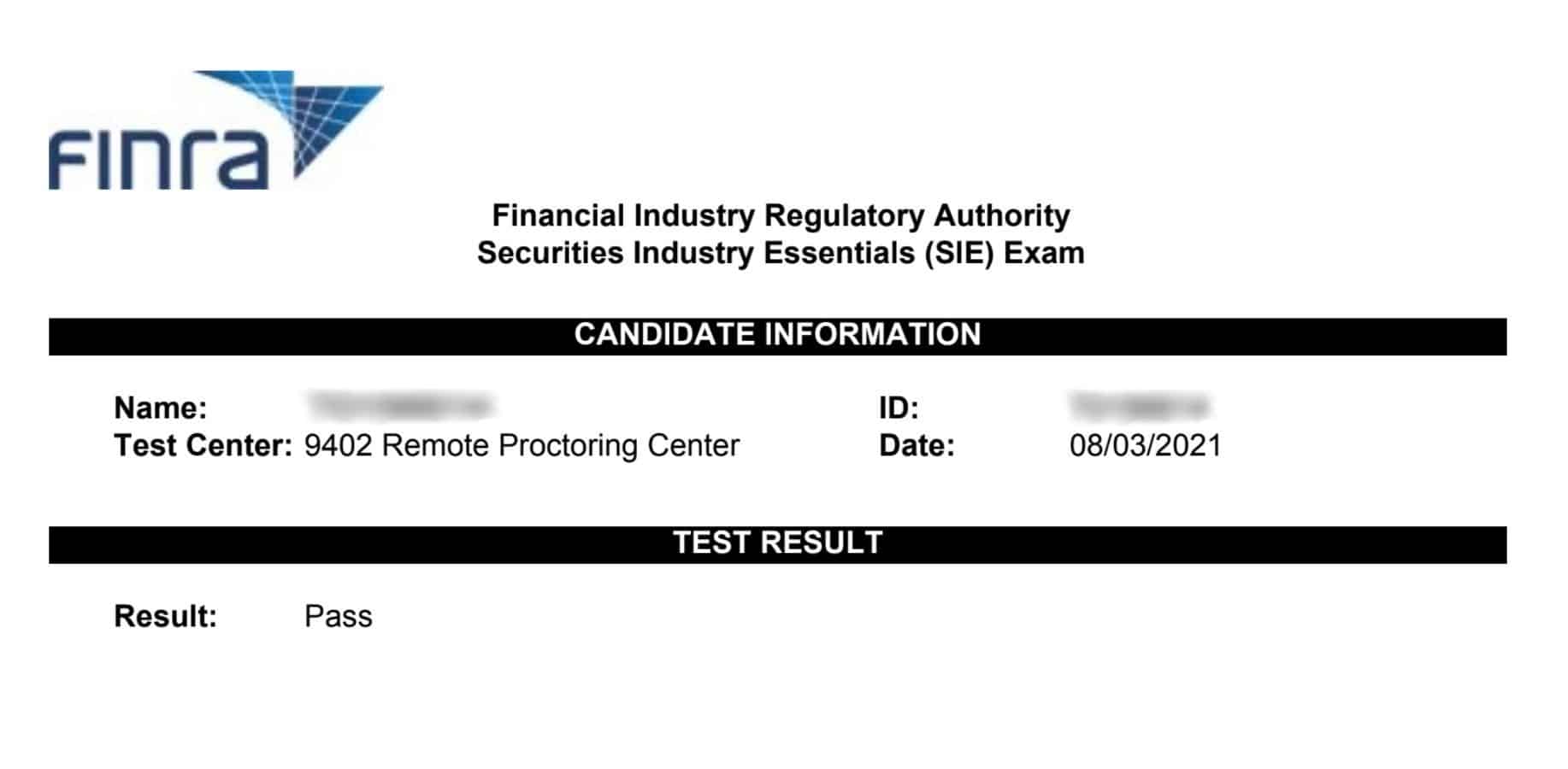
| Exam result timing | You’ll receive an unofficial pass/fail at the end of the exam, and your result will be posted to your FINRA account after processing |
| SIE validity | 4 years (from pass date, or from registration termination date if you were registered) |
| Retake rule | 30 days after the 1st/2nd fail; 180 days after the 3rd and beyond |
Administration
Administration
- Test administrator: FINRA (delivered through Prometric).
- Scheduling window: After you enroll, you receive a 120-day window to take the exam.
- Where you can test: At a Prometric test center or online (remote-proctored), depending on availability and eligibility.
- Format: Computer-based, multiple-choice.
- Reschedule/cancel policy: To avoid fees, reschedule or cancel at least 10 business days before your appointment. Changes closer to the appointment can trigger fees (and late cancellations/no-shows may cost the full exam fee).
- Test materials & rules: You can’t bring reference materials into the testing session. Testing rules are strictly enforced, and violations can result in score cancellation and other penalties.
- Cost: $100.
- Retake policy: If you fail, you must wait 30 days after the 1st and 2nd attempts; after a 3rd failure, the waiting period is 180 days (and remains 180 days for additional attempts).
Test Provider
FINRA provides the Securities Industry Essentials (SIE) Exam. As a self-regulatory organization, FINRA oversees member brokerage firms and registered representatives and administers qualification exams as part of its role in supporting investor protection and fair markets.
Information Sources
Disclaimer – All tutoring resources and preparation materials on iPREP are original and created for training purposes. iPREP is not affiliated with the Financial Industry Regulatory Authority (FINRA), the SIE exam, or any trademark, organization, or entity mentioned on this page.
Free FINRA SIE Exam practice test: Get to know what the FINRA SIE Exam will be like by practicing with these sample questions:
FINRA SIE Sample Questions
Question 1 of 10
A 38-year-old retail client is considering placing an order for a Nasdaq-listed technology stock. The client’s order is for 5,000 shares, and they want assurance that the order will be executed immediately and at the best available price. The firm’s registered representative explains that market makers in the stock are actively quoting bid and ask prices.
Which type of order is MOST appropriate to meet the client’s stated needs?
- Limit order
- Market order
- Stop order
- Fill-or-kill order
The correct answer is B.
Explanation:
A market order ensures immediate execution at the best available price, matching the client’s need for speed and certainty of execution. A limit order (A) sets a price restriction but may not execute immediately. A stop order (C) becomes a market order only once the stop price is triggered, so it doesn’t guarantee immediate execution. A fill-or-kill order (D) requires the entire order to be executed immediately or canceled, which is less appropriate here since the client’s focus is best execution and certainty rather than all-or-nothing fulfillment.
Question 2 of 10
A client asks her registered representative how stocks of large, established U.S. corporations like Microsoft are typically traded. The representative explains that these securities are bought and sold through an electronic system that matches buyers and sellers without a physical trading floor.
In which type of market does this trading MOST commonly occur?
- Primary market
- Third market
- Secondary market
- Fourth market
The correct answer is C.
Explanation:
The secondary market is where previously issued securities trade between investors, most often through exchanges or electronic platforms. The primary market (A) is for new issues. The third market (B) involves exchange-listed securities trading over-the-counter. The fourth market (D) refers to direct trading between institutions without broker-dealer involvement.
Question 3 of 10
During a period of rising unemployment, the U.S. government passes legislation to increase infrastructure spending and reduce individual income taxes to stimulate consumer demand.
This is an example of which type of policy?
- Fiscal policy
- Monetary policy
- Regulatory policy
- Trade policy
Solution :
The correct answer is A.
Explanation:
Fiscal policy involves government spending and taxation decisions to influence the economy. Monetary policy (B) is managed by the Federal Reserve, using tools like interest rates and open market operations. Regulatory policy (C) relates to oversight of industries. Trade policy (D) involves tariffs, trade agreements, and import/export rules.
Question 4 of 10
The United States reports a significant increase in imports of consumer electronics from Asia, while exports of U.S. manufactured goods remain flat. At the same time, fewer foreign tourists are traveling to the U.S. and spending dollars domestically.
What is the most likely impact on the U.S. balance of payments?
- Surplus in the capital account
- Improvement in the trade balance
- Neutral effect, as imports and exports offset
- Deficit in the current account
Solution :
The correct answer is D.
Explanation:
The current account reflects trade in goods and services. Rising imports and reduced foreign spending in the U.S. both increase outflows of dollars, worsening the current account and creating a deficit. A surplus in the capital account (A) refers to foreign investment inflows. An improvement in the trade balance (B) would require exports exceeding imports, which is not the case. Neutral effect (C) is incorrect since the scenario clearly shows greater outflows.
Question 5 of 10
Which of the following BEST describes a shelf registration under SEC Rule 415?
- It allows an issuer to register securities and sell them over time, as market conditions warrant.
- It requires securities to be registered and sold immediately upon effectiveness.
- It permits securities to be offered only to institutional investors under Regulation D.
- It exempts issuers from filing a prospectus for follow-on offerings.
Solution :
The correct answer is A.
Explanation: A shelf registration allows issuers to register securities in advance and sell them in portions over a period of up to three years, providing flexibility to time offerings. Option B is incorrect because securities do not need to be sold immediately. Option C confuses private placements with shelf registrations. Option D is incorrect because a prospectus must still be provided for each takedown from the shelf.
Question 6 of 10
In the event a corporation is liquidated, which of the following correctly describes the order of claims on company assets?
- Common stockholders are paid before bondholders
- Preferred stockholders are paid after common stockholders
- Bondholders share equally with common stockholders
- Bondholders are paid before stockholders, with common stockholders last in priority
The correct answer is D.
Explanation: In liquidation, creditors and bondholders are paid first, followed by preferred shareholders, and finally common shareholders. Option A is incorrect because common stockholders are last. Option B reverses the order of stockholder priority. Option C is incorrect because bondholders do not share equally with common stockholders—they have senior claims. Option D correctly reflects the order of liquidation and ownership rights.
Question 7 of 10
A 13-week (91-day) U.S. Treasury bill with a $100,000 face value is purchased at $98,800. Using the bank discount yield (BDY) convention on a 360-day year, what is the quoted yield?
- 4.65%
- 4.70%
- 4.75%
- 4.85%
Solution :
The correct answer is C: 4.75%.
Explanation:
BDY = (Discount ÷ Face) × (360 ÷ Days)
= ($1,200 ÷ $100,000) × (360 ÷ 91)
= 0.012 × 3.9560
≈ 0.0475 = 4.75%.
Other choices reflect common errors: using price instead of face, a 365-day year, or rounding too early.
Question 8 of 10
A closed-end fund reports an NAV of $10.00 per share but trades in the market at $9.40. At what discount to NAV is the fund trading?
- 5.5%
- 6.0%
- 6.4%
- 7.0%
The correct answer is B: 6.0%.
Explanation:
Discount to NAV = (NAV − Market Price) ÷ NAV
= ($10.00 − $9.40) ÷ $10.00
= $0.60 ÷ $10.00
= 6.0%.
Closed-end funds trade at market prices that may be at a premium/discount to NAV; open-end fund public offering price is computed from NAV and sales charge, not market supply/demand.
Question 9 of 10
Which of the following statements correctly distinguishes limited partnerships from general partnerships?
- Limited partners have limited liability and do not participate in management, while general partners manage the business and have unlimited liability.
- Limited partners manage day-to-day operations, while general partners provide passive capital.
- Both limited and general partners share equal management authority but different liability exposure.
- Limited partnerships are exempt from SEC registration, while general partnerships are not.
The correct answer is A.
Explanation:
In limited partnerships, general partners manage the business and assume unlimited liability, while limited partners contribute capital, have limited liability, and cannot participate in management. Option B reverses roles. Option C incorrectly claims equal management authority. Option D is wrong because securities of limited partnerships must generally be registered unless an exemption applies.
Question 10 of 10
Which statement BEST describes record-retention requirements for customer account records versus order tickets?
- Customer account records are generally retained longer than order tickets.
- Order tickets are retained longer than customer account records.
- Neither customer account records nor order tickets have retention requirements.
- Both customer account records and order tickets are retained for the same minimum period.
The correct answer is A.
Explanation:
Customer account records are typically subject to longer retention requirements than order tickets, because they document account setup, customer information, and ongoing account history, while order tickets document individual transactions.
Why the other answers are wrong:
B: This reverses the general retention approach; transaction records are not typically kept longer than core account records.
C: Broker-dealers have record-retention requirements for both account documentation and order/trade records.
D: Retention periods vary by record type; they are not generally the same for account records and order tickets.