Reviewed by Tamir Rubin, Head of Product at iPREP • Updated January 2026
EIAT Sample Question
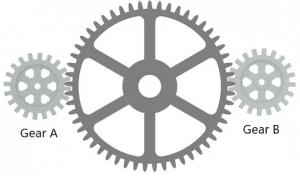
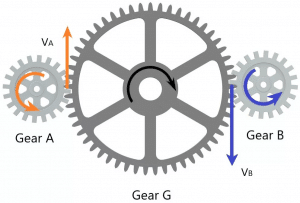
If the middle gear is rotating clockwise, which gear, A or B, will rotate in the same direction?
- A
- B
- Neither A nor B
Mathematics
30 questions • 15-20 minutes
- Applied arithmetic
- Fractions
- Decimals
- Ratios
- Basic algebra
Reading Comprehension
35 questions • 15-20 minutes
- Passage-based items
- Main idea
- Details
- Inference
- Vocabulary
Mechanical Aptitude
35 questions • 15-20 minutes
- Simple machines
- Forces
- Motion
- Gears
- Pulleys
- Levers
Test Duration
Total time: varies by local notice (often up to ~60 min)
Local recruitment/testing notices set the exact time limit and instructions. Test-takers often report about 45–60 minutes total. Confirm your scheduled limit in advance and pace evenly across sections.
Test Breakdown & Sample Questions
Most aptitude tests include multiple sections designed to measure different skills. Results help determine training needs and overall fit for the role.
The Elevator Industry Aptitude Test (EIAT) is made up of three sections:
| Section | What it measures |
|---|---|
| Mathematics | Performing practical calculations and solving math problems using arithmetic and basic algebra |
| Reading Comprehension | Understanding written passages and answering questions based on what you read |
| Mechanical Aptitude | Applying basic mechanical and physical principles to common systems and tools |
In the sections below, you’ll find an overview of each section, common question types, practical approaches for answering efficiently, and sample questions.
#1 Mathematics
This section measures practical math skills you’ll use to solve job-style problems quickly and accurately. Expect questions that involve arithmetic and basic algebra.
What you’ll see
- Whole-number arithmetic and order of operations
- Fractions, decimals, and percents (including converting between them)
- Ratios and simple word problems
- Basic algebra (solving for an unknown, simple formulas)
How to prepare
- Get comfortable working without a calculator by using clean, step-by-step setups.
- Practice estimating and checking reasonableness so you can spot wrong options fast.
Winning Tip: If the answer choices are far apart, use rounding to estimate first. Eliminate unlikely options, then do the exact calculation only if you need it.
Sample Questions
Mathematics Sample Question 1
Which of the following has the lowest value?
- 1/4 + 0.2
- 0.32 + 0.19
- 2/5 + 0.1
- 1/2 – 0.01
- 1/3 + 1/6
The correct answer is 1/4 + 0.2
Explanation: In questions that involve expressions comprised of both decimals and fractions, it is usually easier to convert all expressions to decimals and only then to compare them. An exception is the last expression, which is more easily simplified by finding a common denominator.
- 1/4 + 0.2 = 0.25 + 0.2 = 0.45 → the lowest value
- 32 + 0.19 = 0.51
- 2/5 + 0.1 = 0.4 + 0.1 = 0.5
- 1/2 – 0.01 = 0.5 – 0.01 = 0.49
- 1/3 + 1/6 = 2/6 + 1/6 = 3/6 = 1/2 = 0.5
Mathematics Sample Question 2
What is the value of the following expression?
32 – 16 / 4 + ((5 x 3)2 – 10) / 5 = ?
The value of the expression is
The value is 71.
| 32 – 16 / 4 + ((5 x 3)2 – 10) / 5 | Two parentheses. Start with the inner parentheses. |
| 32 – 16 / 4 + (152 – 10) / 5 32 – 16 / 4 + (225 – 10) / 5 | Solve second parentheses. Inner order is also PEMDAS, so start with the exponent. Then, continue with subtraction |
| 32 – 16 / 4 + 215 / 5 | Moving to multiplication and division. Since these are separated by +/- signs, there’s no significance to solving left to right |
| 32 – 4 + 43 28 + 43 = 71 | Completing with addition and subtraction, left to right. |
| This is the same result as the first one by chance. |
#2 Reading Comprehension
This section measures how well you understand written information and draw conclusions from it. Passages can cover everyday topics and may not relate to the elevator trade.
What you’ll see
- Short passages followed by questions about:
- Main idea and key details
- Meaning of a phrase or sentence in context
- Logical conclusions based on what is stated
- Purpose or tone of the passage
How to approach it
- Read the question first so you know what to look for.
- Base every answer on the passage (not on outside knowledge).
- If two answers seem close, go back and find the specific line that supports your choice.
Winning Tip: Don’t rely on your first impression. Re-read the sentence that contains the key information and confirm it matches your answer exactly.
Sample Questions
Reading Comprehension Sample Question 1
Choose the word or the words that, when inserted in the sentence to replace the blank or the blanks, best fits the meaning of the sentence.
With a location that was blocked to traffic by ongoing construction work, the owners of the store had dire expectations regarding his revenue; however, with the implementation of electronic commerce, the location proved not to be as ___________ as originally thought.
- auspicious
- contingent
- opportune
- disadvantageous
- unmanageable
The correct answer is “disadvantageous”.
After analyzing the sentence, you should convert it a very “reduced” version; here is an example:
“The owners were afraid it was going to be bad, but it was not as ___ as originally thought.”
Here you should know that you want a term that means “bad,” but none of the words may be the words that initially pop to mind.
The correct answer, “disadvantageous,” is a long word you can initially disregard. However, inspecting the word will reveal that it contains both a prefix and a suffix:
“Dis” means “Not (something).” “–eous” turns the noun into an adjective.
The remaining core is “advantage” which means “good.”
With the prefix and suffix, the meaning of the word becomes “not-good (something)” or simply “bad.”
The meaning of the other words:
Auspicious and opportune mean lucky or advantageous or simply “good.”
Unmanageable (wild) and contingent (conditional/possible) do not create a meaningful enough sentence.
Reading Comprehension Sample Question 2
What is the meaning of the underlined word?
I was absolutely famished! The aroma of food I was smelling as I walked down the street didn’t help my state.
- quite furious
- extremely hungry
- exhausted
- extremely happy
The correct answer is B.
The correct meaning of the word can be derived based on an informational context clue.
“I was absolutely famished! The aroma of food I was smelling as I walked down the street didn’t help my state.”
While the speaker was walking down the street, the smell of food did not help their situation, because they were so hungry.
#3 Mechanical Aptitude
This section measures your understanding of basic mechanical concepts and your ability to apply them to practical situations. The questions focus on everyday mechanical principles and do not require elevator-specific knowledge.
What you’ll see
- Simple machines (levers, pulleys, inclines, wedges, screws)
- Forces and motion (gravity, friction, tension, balance)
- Basic systems and components (gears, fluids/pressure, basic tool use and function)
- “What happens if…” scenarios based on diagrams or short descriptions
Winning Tip: Don’t overthink it. Use core ideas—force direction, mechanical advantage, and friction—to reason through the setup. If there’s a diagram, label the forces and identify what changes (load, distance, or direction).
Sample Questions
Mechanical Comprehension Sample 1
If bar A moves right at a speed of X, how does bar B move?

- Left, slower than X
- Right, slower than X
- Right, same speed
The correct answer is C – right, same speed.
When the bar A moves to the right with speed X, it also gives a tangential speed X to gear L since they are directly meshed. Gear L moves clockwise, which rotates the gear M counterclockwise. Since gear L and M are directly meshed, they have the same tangential speed X.
Now, gear M rotates gear N clockwise with the same tangential speed and similarly, gear N rotates gear O counterclockwise with tangential speed X. Gear O will move bar B along with it in the right direction with the same tangential speed X.

Mechanical Comprehension Sample 2
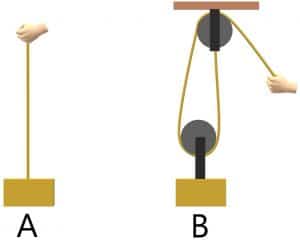
Compared to the regular lifting of the load (A), how much effort is required to lift the load with the pulley (B)?
- Same effort as regular lifting
- Half the original effort
- One-third of the original effort
The correct answer is B.
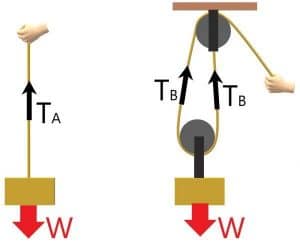
When the load is hung from the string, it generates tension (T) in the string and the effort required to lift the load equals that tension in the string. In regular lifting (case A), the tension in the string equals the weight (W) of the load, therefore, the required effort (F) is F = W.
By using a pulley (case B), the tension in the string is divided into the number of strings used to lift the load. In our case, the number is two, as shown in the figure. So, the tension in the string is equal to half the weight of the load W. this shows that the required effort is F = W/2, which is half that in case A.
Hence we can conclude that tension is halved by using the given pulley.
Did you know?
The NEIEP Elevator Industry Aptitude Test (EIAT) includes three sections—mathematics, reading comprehension, and mechanical aptitude—and is scored pass/fail, with 70% typically required to pass; candidates who pass may then be invited to a tool assessment and an interview, and ranking/selection is driven largely by interview results (process details can vary by local and applicant pool).
Preparation Strategies
Learn how to approach multiple-choice questions
It’s usually best to answer every question rather than leave blanks. If you’re unsure, eliminate options that don’t fit and make an educated guess. Don’t let one question take too long.
Keep stress under control
Stress leads to mistakes. Focus on one question at a time and keep a steady pace. Preparation is the best way to feel calmer on test day.
Use a structured prep plan
Study ahead so you know what to expect in mathematics, reading comprehension, and mechanical aptitude. A structured plan helps you stay consistent and avoid surprises.
Practice to find weak spots
Do timed practice to see where you lose points or time, then focus your study on those areas.
Get comfortable without a calculator
Expect manual math. Practice fractions, decimals, percents, and estimation to work faster and sanity-check answers.
Build a time strategy
Pace yourself from the start. If a problem is slowing you down, choose your best option and move on.

EIAT Test Features
Fast Facts (tl;dr)
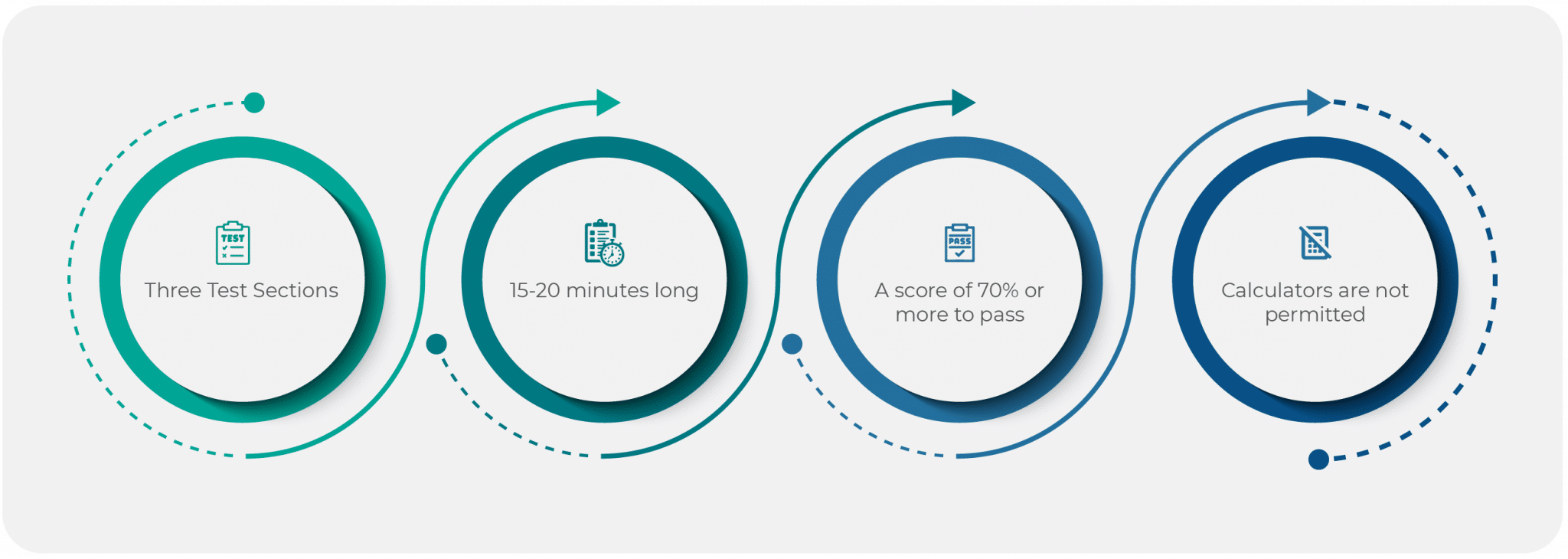
- Three sections: math, reading, mechanical
- 30/35/35 questions (approx.)
- Timed; section order may vary
- Multiple-choice questions
- Pass/fail; 70% typically passes
- Photo ID required
Step 1 of a multi-step application process
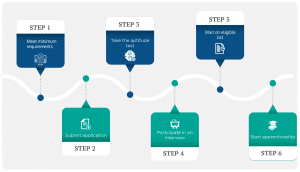
Interested individuals must apply during an open recruitment and complete the recruitment process, which typically includes an application, an aptitude test (EIAT), a tool assessment, and an interview. The EIAT is commonly used as an early screening step, and candidates who pass may move on to the next steps depending on the local selection process.
| Step | What happens |
|---|---|
| 1 | Apply during an open recruitment |
| 2 | Take the EIAT (aptitude test) |
| 3 | Tool assessment and interview (after passing EIAT) |
Answering every question
Test directions can vary, but many multiple-choice aptitude exams do not subtract points for wrong answers. If you’re unsure, eliminate unlikely choices and make your best selection rather than leaving the question blank.
Retakes
If you do not meet the minimum passing standard, you typically won’t advance in that recruitment period. Retake opportunities and timing can vary by local and recruitment cycle.
Common and past names of the test
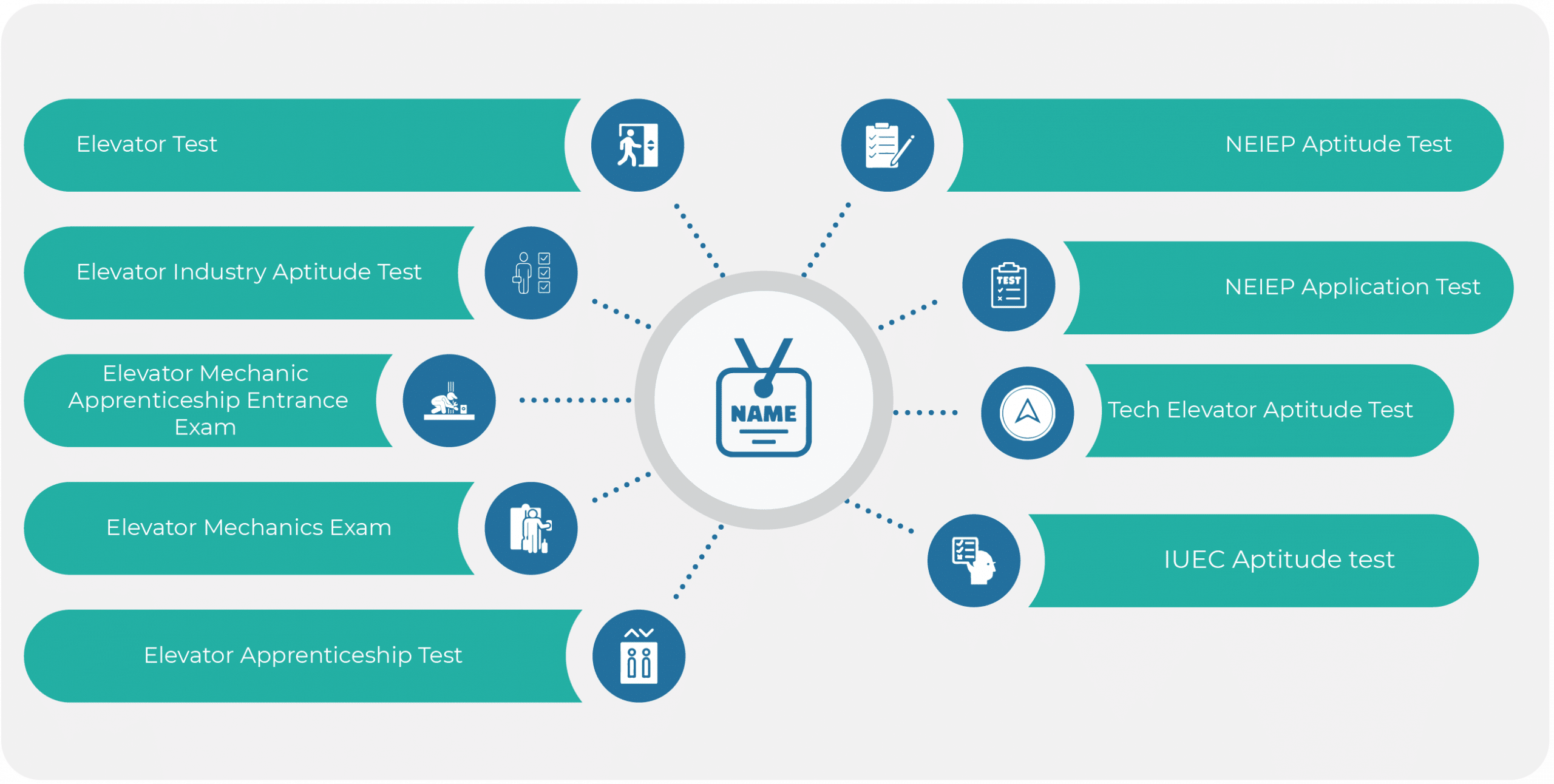
You may see the EIAT referenced by different names, including:
- Elevator Industry Aptitude Test (EIAT)
- NEIEP aptitude test
- Elevator apprenticeship aptitude test
- Elevator mechanic apprenticeship entrance exam
Tool assessment
After the EIAT, some candidates are invited to a tool assessment focused on identifying tools and applying basic tool knowledge (for example, tool names, common uses, and simple readings). Tool assessment results may be considered as part of the overall selection process along with the interview, depending on the local program.
Technical Facts
The process to become an Elevator Constructor Apprentice
Selection steps can vary by local, but the process typically includes:
- Meet basic eligibility requirements
- Apply during an open recruitment period
- Take the EIAT
- If you pass, complete a tool assessment and interview
- If selected, begin the apprenticeship
Meet the eligibility requirements
Eligibility can vary by local program, but applicants are commonly expected to meet requirements such as:
- Minimum age set by the program
- High school diploma or GED-equivalent
- Legal authorization to work in the United States
- Ability to provide required documentation (for example, education verification and veteran documentation if applicable)
Some programs may also require additional screening (for example, drug testing) as part of selection or onboarding.
Apply to an apprenticeship
Applications are submitted through the official apprenticeship recruitment portal when a local recruitment opens. You’ll typically create an applicant profile, complete the application, and upload required documents. If your application is accepted for testing, you’ll receive instructions for scheduling the EIAT.
Take the EIAT
The EIAT is used to assess readiness across mathematics, reading comprehension, and mechanical aptitude. A passing result is required to stay in the process.
Tool assessment and interview
Candidates who pass may be invited to a tool assessment and an interview. The format, length, and scoring approach can vary by local, and interview results are a key factor in how candidates are ranked.
Complete the apprenticeship
If selected, you’ll enter an apprenticeship that combines on-the-job training with classroom instruction. Program length and requirements vary by local and employer needs.
Pen-and-paper format
The EIAT is administered as a paper-based test.
High school-level content
Most questions focus on practical skills and concepts typically taught in high school, presented in an aptitude-test format.
Results Scale and Interpretations
What is a good score?
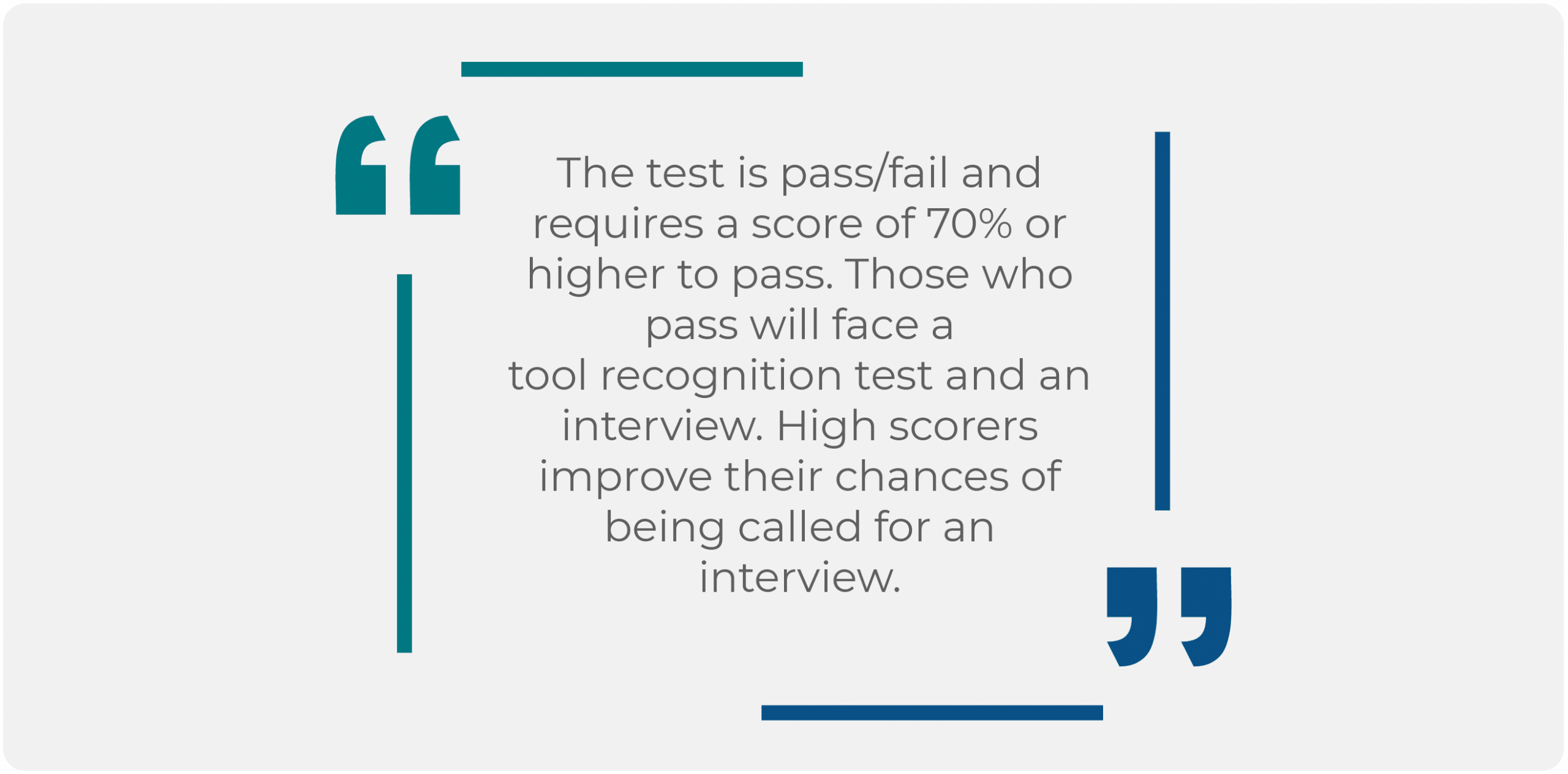
The EIAT is scored on a pass/fail basis. A score of 70% correct is typically the minimum passing grade. You will be notified whether you passed or failed, and only passing applicants move forward to the next stage.
How results are used
Passing the EIAT makes you eligible to be scheduled for an interview. Correct responses on the tool assessment count toward the final score on the interview, and interview results are a key factor in how candidates are ranked (exact ranking methods can vary by local and recruitment cycle).
“Tier” divisions
Some recruitment lists may group candidates by score bands or rankings, but fixed tier cutoffs are not universal and can vary. Focus on passing the EIAT and preparing to perform well on the tool assessment and interview.
What if I fail the exam?
Applicants who fail the EIAT are not interviewed and are removed from the applicant pool. You may re-apply during the next or a subsequent recruitment period.
EIAT FAQs
The Elevator Industry Aptitude Test (EIAT) is an aptitude assessment used in many elevator apprenticeship recruitment cycles. It evaluates skills commonly needed for training, including reading comprehension, mechanical aptitude, and mathematics. Passing the EIAT is typically required to continue in the selection process.
The EIAT is a timed, multiple-choice test with questions in three areas: mathematics, reading comprehension, and mechanical aptitude. Timing and section flow can vary by administration, and you’ll receive instructions on test day.
Follow the directions provided during your test administration. As a general strategy, if you’re unsure, eliminate options that don’t fit and choose your best answer rather than getting stuck on one question.
Eligibility requirements can vary by local and recruitment cycle. Common requirements include meeting the minimum age for the program, having a high school diploma or GED-equivalent, and being authorized to work in the United States.
Applications and required documents are typically submitted online through the official recruitment portal when a local recruitment opens.
After you submit your application and required documents, you’ll typically receive a follow-up message if you are approved to test. Scheduling timelines vary by local and applicant volume.
Testing is scheduled after your application is reviewed and accepted for the current recruitment cycle. Your test date and time are usually provided by email or through the applicant portal.
Calculator rules are set by the test administrator. Plan to complete math questions without relying on a calculator, and follow the instructions provided on test day.
The EIAT is commonly treated as pass/fail, and 70% is often referenced as the minimum passing standard. Passing is required to move forward, and next steps can vary by local and recruitment cycle.
EIAT Test Tips
Strengthen your math basics
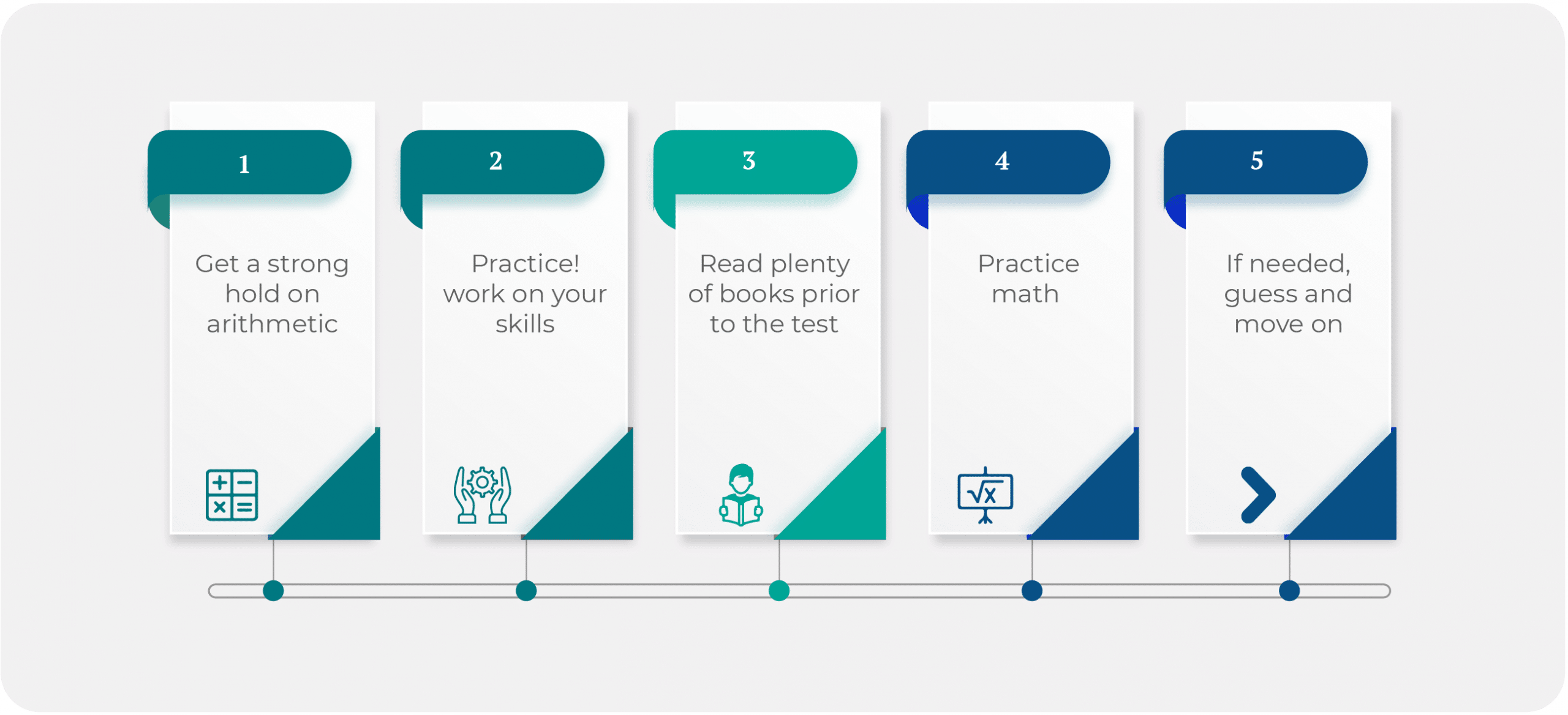
Build speed with arithmetic, fractions, decimals, percents, and simple algebra. Be ready to work efficiently with scratch work and estimation, and follow the test-day rules provided by the administrator.
Practice under time pressure
Use timed drills and short practice sets so you get used to working steadily and making quick decisions.
Read with purpose
Practice reading short passages and answering questions about main idea, details, and conclusions. On test day, focus on what the passage actually says.
Use smart guessing
If you’re stuck, eliminate choices that clearly don’t fit and pick your best answer. Don’t let one question consume time you’ll need for easier points later.
Administration
- Test administrator: The EIAT is administered through the local elevator apprenticeship program as part of the recruitment process.
- Test schedule: After you submit your application and required documents, you’ll receive instructions for your test date and time by email and/or through the applicant portal (timelines vary by local and applicant volume).
- Test format: Timed, paper-based, multiple-choice exam.
- Test materials: Writing materials are typically provided at the test site. Calculator rules are set by the test administrator—plan to complete math questions without relying on a calculator, and follow test-day instructions.
- Retake policy: If you do not pass, you typically cannot advance in that recruitment period. Retake opportunities depend on when the next local recruitment opens.
Test Provider
The EIAT is developed and maintained by the National Elevator Industry Educational Program (NEIEP) as part of the elevator industry’s apprenticeship recruitment and training pipeline. NEIEP supports apprenticeship education and assessment by defining training standards and creating tools that help programs evaluate candidates’ readiness for apprenticeship-level work.
Information Source
- NEIEP – National Elevator Industry Education Program
- IUEC – International Union of Elevator Constructors
Disclaimer – All information and preparation materials on iPREP are provided for tutoring and practice purposes. iPREP is not affiliated with NEIEP or IUEC, and iPREP is not the owner or administrator of the Elevator Industry Aptitude Test (EIAT).
Free Elevator practice test: Get familiar with what the Elevator Industry Aptitude Test (EIAT) can feel like by practicing with these sample questions:
Question 1 of 10
If the middle gear is rotating clockwise, which gear, A or B, will rotate in the same direction?
- Neither A nor B
The correct answer is C – Neither A nor B.
It can be observed from the image that gears A and B are linked directly to the middle gear. However, when two gears are directly linked, their tangential velocities are always the same, although the directions of their rotation are always opposite to each other.
In our case, the velocity vector between the middle gear and gear A will point upwards and the direction of rotation of the middle gear and gear A will be clockwise and counterclockwise respectively. Similarly, the velocity vector between the middle gear G and gear B will point downwards and the rotation of gear B will be counterclockwise. Hence both gears A and B will rotate in the opposite direction of the middle gear.
Question 2 of 10
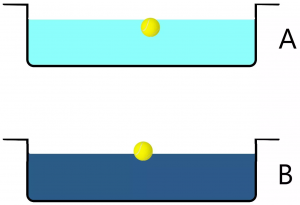
Similar balls are thrown into containers A and B. The ball sinks in container A and floats in container B. Which container is filled with denser liquid?
(If the information is insufficient, mark C.)
- A.
- B.
- C.
The correct answer is B.
When an object is immersed in liquid, a pressure difference is created between its opposite sides. This pressure difference causes a force that pushes the object upwards, known as buoyancy. It is defined as:
Buoyant Force B = density of liquid (ρ) × displaced volume of fluid (V) × gravitational acceleration(g)
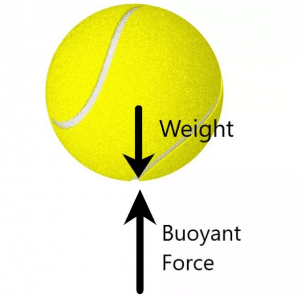
This shows that the denser the liquid, the greater the buoyant force, and the object will be more likely to float. In our case, the liquid in container B must be denser for the same ball to float higher. Forces acting on the ball are shown in the figure.
Question 3 of 10
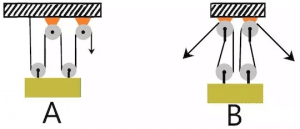
In which case is a stronger force required to lift the load?
(If equal, mark C.)
- A.
- B.
- C.
The correct answer is B.
In the given scenario, the weight is supported by two different mechanisms. In case A, the weight is being lifted with the help of four pulleys joined by a single string, while four parts of the string lift the load. The tension force in the string will be equally divided between the parts of the string. Hence the total effort required to lift the load “W’ will be “W/4.”
In case B, there are two strings, each connected to two pulleys and having two pieces each. The load, in this case, will be divided into two since two strings are being used. First, analyze the left string. The load to be lifted is W/2. The tension in each piece of the string will be half the load, i.e. W/4. The tension in the right string will also be the same. Since two people are pulling in case B, each will require an effort of W/4 and the total effort will be W/2. Hence Case B will require a stronger force in lifting the load.
Question 4 of 10
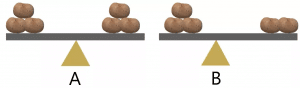
Which of the two illustrated scenarios is physically possible?
(If both or neither, mark C.)
- A.
- B.
- C.
The correct answer is C – both are possible.
The given scenario shows a class 1 lever balanced in two different cases. We assume load on the right side of the fulcrum and effort on the left. Now, in case A, load and effort are equal and so are the moment arms of both load and effort. This means that the moments of both the load and effort cancel out each other and as a result, the lever is balanced. Hence, case A is very likely to be possible.
In case B, the effort is greater than the load, but the moment arm of effort is smaller than the moment arm of the load. The resultant moment, in this case, will also be zero since the moment is the product of force and moment arm and one factor compensates for the other in this case. Therefore this case is also physically possible.
Therefore, both scenarios are physically possible.
Question 5 of 10
Solve:
$$$ \dfrac{1}{2}-\dfrac{2}{9} = ?$$$
- $$$ \dfrac{7}{18} $$$
- $$$ \dfrac{2}{9} $$$
- $$$ \dfrac{1}{3} $$$
- $$$ \dfrac{5}{18} $$$
$$$ \dfrac{1}{2}-\dfrac{2}{9} $$$ The LCM is 18
$$$ \dfrac{1\times9}{2\times9}-\dfrac{2\times2}{9\times2} $$$
$$$ \dfrac{9}{18}-\dfrac{4}{18} $$$ Subtract the numerators
$$$ \dfrac{9-4}{18} $$$
$$$ \dfrac{5}{18} $$$
Question 6 of 10
Write the solution in the box below:
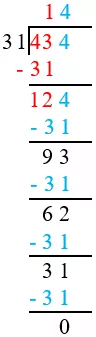
434 ÷ 31 = ?
Type your answer here:The correct answer is 14.
As 31 is clearly higher than 4, you may begin the long division by asking yourself how many times 31 goes into 43 (the first two digits). Then, you bring down the last digit 4. If you are not certain about the answer, it is recommended to subtract 31 from the remainder of the dividend and count how many times you had to repeat the action to reach a remainder of zero.
Question 7 of 10
Which of the following has the lowest value?
- 1/3 + 1/6
- 1/5 + 1/8
- 1/2 + 1/10
- 1/4 + 1/7
The correct answer is 1/5 + 1/8.
Explanation:
In this problem, you may try to calculate the exact value of each expression, but two observations may help you quickly figure out which expression has the lowest value.
- First observation – only 1/2 + 1/10 is an expression higher than 1/2 and it can be eliminated.
- Second observation – recall that in any comparison of fractions with equal numerators, the fraction with the higher denominator has the lower value. If you compare the expression 1/5 + 1/8 to the other two options, it has two fractions that respectively have lower values than the components of the other expressions (i.e. 1/5 is smaller than both 1/3 and 1/4 AND 1/8 is smaller than both 1/6 and 1/7); therefore, it must have the lowest value overall.
The complete calculation of the expressions:
- 1/3 + 1/6 = 2/6 + 1/6 = 3/6 = 1/2 = 0.5
- 1/5 + 1/8 = 0.2 + 0.125 = 0.325
- 1/2 + 1/10 = 0.5 + 0.1 = 0.6
- 1/4 + 1/7 = 0.25 + 0.143~ = 0.393~
Question 8 of 10
Which of the following has the highest value?
- 4.119
- 0.7489
- 3.981
- 3.69899
- 3.096
The correct answer is 4.119
Explanation: The first thing you should do when you encounter questions of this type is to check the value of the integer part. The number with the highest integer value always points to the number with the highest value overall. If some answers have the same value for the integer part, then the highest value is determined by the value of the leftmost decimal digit, the one closest to the decimal point. If the leftmost decimal digit is also identical, the highest value is determined by the next decimal digit, etc.
In this case, answer A has the highest integer part value – 4, thus it is the correct answer.
Question 9 of 10
Choose the word or the words that, when inserted in the sentence to replace the blank or the blanks, best fits the meaning of the sentence.
Most parents thought it was an __________ decision to make the field trip part of the yearly routine, as they valued the trip as exciting and empowering for the children.
- ill-advised
- adequate
- economical
- obscure
- remarkable
The correct answer is adequate, which means satisfactory or acceptable.
Explanation: since according to the second part of the sentence the parents demonstrated positive appreciation of the trip’s contribution to their children, we expect a positive adjective to describe the decision to make the field trip part of the yearly routine. Only two words answer to this notion. ‘Remarkable’ might have been the best choice, as it has a very positive tone, comparable to the positive appreciation of the trip as “empowering” and “exciting”. Nonetheless, the word ‘remarkable’ cannot be placed after the determiner “an”, thus ‘adequate’ is the next best choice to complete the sentence and the correct answer.
The meaning of the rest of the words and why they are not the correct answer:
- ill-advised – unwise or imprudent – this word is contrary to the positive appreciation of the parents
- economical – giving good value or service in relation to the amount of money, time, or effort spent – even if it may be true, ‘economical’ is not the word reflected from the words that described the trip’s contribution.
- Obscure – not clearly expressed or easily understood – this is not the right choice as the sentence portrays a very clear reason for the decision.
Question 10 of 10
What is the meaning of the underlined word?
He had reached the apex or height, of his career.
- best time
- top
- worst time
- most interesting time
The correct answer is B.
The correct meaning of the word can be derived based on a direct definition context clue.
“He had reached the apex or height, of his career.”
The words in bold repeat the meaning of the word apex to clarify its meaning.
Power Tools Flashcards
About the course
Includes 21 practice tests (2 full-length simulations)
32 Learning hours · 21 Practice tests · 551 Videos · 500 Flashcards
Work through focused lessons that build the core EIAT skills—Mathematics, Reading Comprehension, and Mechanical Aptitude—then apply them in targeted practice with written solutions and short video walkthroughs. Along the way, you’ll learn the question types and practical approaches for answering efficiently. Finish with EIAT-style simulations that mirror the test experience, then review full explanations to see what to strengthen next.
Skills you will learn
- Applied arithmetic · Fractions and decimals · Reading comprehension · Vocabulary · Mechanical aptitude · Tool assessment
Curriculum
Course Introduction
- How the EIAT course is organized
Question Types Introduction
- Typical EIAT-style question formats
- Multiple-choice approach and eliminating distractors
Arithmetic Computation (4)
- Whole-number arithmetic and order of operations
- Fractions, decimals, and conversions
- Estimation, checking, and pacing tips
Verbal Ability (3)
- Passage questions: main idea, details, inference
- Vocabulary in context and word knowledge
- Sentence completion strategies
Mechanical Comprehension (4)
- Simple machines and mechanical advantage
- Forces, motion, friction, and balance
- Hydraulics, fluid mechanics, and pressure
Tool Recognition (18)
- Common hand and power tools identification
- Measuring, layout, and tape measurement
- Safety equipment, measures, and proper technique
- Practice sets for tool assessment
Test-Taking Tips
- Time management and educated guessing
- Staying calm and avoiding common errors
Elevator Industry Aptitude Test-Style Simulations (12)
- Full EIAT-style practice across three sections
- Timed and practice modes with explanations
- Review results to guide improvement
Course Conclusion
- Wrap-up and next steps guidance
Bonus Section: Getting Ready for the Interview (10)
- Interview process and expectations
- STAR method and strong responses
- Preparation, conduct, and post-interview reflection
- Mock interviews and common pitfalls
Reviews

Joshua K*******
January 18, 2026 at 10:37 AM
Super helpful for passing the test. 3 questions in the aptitude test were the exact same as in this course.
Joshua K*******
January 18, 2026 at 10:37 AM
Super helpful for passing the test. 3 questions in the aptitude test were the exact same as in this course.
MATTHEW W*****
December 10, 2025 at 5:43 PM
So far this has been the most generalized comprehension style prep ive used and it works. The price is right and dont be hesitant its worth your time and money. Invest in yourself
MATTHEW W*****
December 10, 2025 at 5:43 PM
So far this has been the most generalized comprehension style prep ive used and it works. The price is right and dont be hesitant its worth your time and money. Invest in yourself
Dalton P***
November 7, 2025 at 3:01 PM
You will not regret this. I have not been in school for 10 years and was struggling to find a simple course to refresh my memory before I take my test. The course is set up nicely, explaining all the material before practicing it. Every question you answer will include a video with someone showing you step by step how to complete it. It will also explain why an answer is correct and why the other answers are not. Everything is presented clearly and it provides alternative ways to solve problems.
Dalton P***
November 7, 2025 at 3:01 PM
You will not regret this. I have not been in school for 10 years and was struggling to find a simple course to refresh my memory before I take my test. The course is set up nicely, explaining all the material before practicing it. Every question you answer will include a video with someone showing you step by step how to complete it. It will also explain why an answer is correct and why the other answers are not. Everything is presented clearly and it provides alternative ways to solve problems.
Aaron V***
October 28, 2025 at 12:25 AM
The iPrep course has given me a clear picture of what is to be expected not only in the testing but of the career that I want to pursue.
Aaron V***
October 28, 2025 at 12:25 AM
The iPrep course has given me a clear picture of what is to be expected not only in the testing but of the career that I want to pursue.
Ricky J****
October 10, 2025 at 7:43 PM
I did not pass the elevator aptitude test. I didn't get a good enough score to get an interview. I didn't study long enough or often enough. I do like that what was in this study pack I felt less in the dark and knew what to expect to see on the test. So for that I'm giving a 4 star rating. It was the most affordable option that had the most material to review.
Ricky J****
October 10, 2025 at 7:43 PM
I did not pass the elevator aptitude test. I didn't get a good enough score to get an interview. I didn't study long enough or often enough. I do like that what was in this study pack I felt less in the dark and knew what to expect to see on the test. So for that I'm giving a 4 star rating. It was the most affordable option that had the most material to review.