Reviewed by Tamir Rubin, Head of Product at iPREP • Updated February 2026
Word Analogies
Section Assesses: Verbal logic
- Identify relationships between word pairs
- Apply logic to complete analogies
- Distinguish subtle meaning differences quickly
- Avoid trap answers from similarity
Algebra & Math Word Problems
Section Assesses: Quant reasoning
- Translate scenarios into equations
- Select correct operations and formulas
- Solve multi-step arithmetic efficiently
- Work without calculator support
Number Sequences
Section Assesses: Pattern logic
- Detect rules across number series
- Use differences, ratios, or alternations
- Predict missing or next values
- Apply logic under tight pacing
Figural Analogies
Section Assesses: Visual reasoning
- Infer rules in symbol patterns
- Track rotations, shifts, and symmetry
- Match relationships across figure pairs
- Choose best completion from options
Test Duration
Total time: 90 minutes (1 hour 30 min) • 120 questions.
The 4 skill areas are commonly mixed throughout the test rather than presented as separate timed sections. Calculators aren’t permitted, so rely on mental math and estimation. There is typically no penalty for wrong answers, so make an educated guess and move on. Avg pace: ~45 seconds per question.
Test Breakdown & Sample Questions
The EDPT is commonly reported by test-takers as a 120-question, multiple-choice exam completed in 90 minutes. It is typically organized into four sections that assess key reasoning and problem-solving skills.
| Section | What it measures |
|---|---|
| Word Analogies | Verbal relationships and logic in language |
| Algebra & Math Word Problems | Applied arithmetic and algebraic reasoning |
| Number Sequences | Pattern recognition and numerical logic |
| Figural Analogies | Visual/symbolic reasoning and pattern matching |
Word Analogies
These questions are algebraic concepts expressed in words. The basic format of the Word Analogies section looks something like this: A is to B as C is to D.
Word analogies are linguistic problems or exercises that involve finding the relationship between two words and applying that same relationship to another pair of words. The goal is to identify the relationship between two words and use that relationship to complete a phrase or sentence.
For example, a common word analogy might be:
“Cat is to meow as the dog is to _____.”
The relationship between the words “cat” and “meow” is that a cat makes the sound “meow.” Applying that relationship to the second pair of words, we can complete the analogy by saying, “Dog is to bark.”
Word analogies are often used in educational settings to improve vocabulary, critical thinking skills, and logical reasoning abilities. They can also be used in intelligence tests to measure cognitive ability and problem-solving skills.
Winning Tip
Candidates taking the assessment should identify how the first two words are related and then find a word that has a similar relationship with the third word. This strategy involves looking for a word that shares the same type of relationship as the first pair of words. It’s also important to carefully consider the meaning of the words in the analogy and avoid jumping to conclusions based on surface-level similarities.
Sample Question
YACHT is to VEHICLE as WHALE is to…
- OCEAN
- WATERCRAFT
- MAMMAL
- ELEPHANT
- FISH
The correct answer is MAMMAL.
Explanation: The analogy underlying this question is A is a type of B. Specifically, in both the example and the correct answer, A is a maritime type of B.
The example – Yacht is a vehicle. Although “vehicle” may colloquially refer to land motor vehicles, the term also encompasses watercraft and aircraft.
The correct option – Whales belong to the family of mammals. Most mammals live on land, but there are some marine mammals that spend all of their lives at sea—the most familiar ones being whales and dolphins.
Algebra And Math Word Problems
As the name suggests, this section includes algebraic equations. It consists of math questions that require the candidate to translate a real-world situation or problem into an algebraic equation or expression and then solve for a specific unknown variable. They cover a variety of math categories including algebra, geometry, and calculus.
The main challenge of algebra and math word problems is figuring out what information is essential and how to translate that information into an equation or expression. It is crucial to read the question carefully, identify the unknown variable, and then use the information to write a solvable equation or expression.
Winning Tip
One winning tip for the Algebra and Math Word Problems section is to focus on understanding the problem before attempting to solve it. Many exam takers try to solve the problem immediately without comprehending what the problem asks them to do.
To fully understand the problem, you should read the question carefully, identify the given information, and figure out what you are asked to find. You should also look for any keywords or phrases that can give you a clue about the type of problem it is, such as “rate,” “distance,” or “perimeter.”
Sample Question
The new lottery scratch card series guarantees a 1/10 chance of winning some monetary prize and a 1/2 chance that the win will be a substantial sum. If I buy 20 lottery scratch cards from the new series, how many substantial wins should I expect?
- 10
- 2
- 1
- 4
- 0
The correct answer 1 substantial win.
Explanation:
You can either accumulate the chances in order to find the answer or to calculate the chance of winning a substantial sum in advance.
Step by step:
Tickets bought = 20
Chance of winning tickets = 20 * 1/10 = 20/10 = 2
Chance of a substantial win = 2 * 1/2 = 2/2 = 1
In advance:
Chance of a substantial win = 1/10 * 1/2 = 1/20
Of the tickets bought = 20 * 1/20 = 20/20 = 1
Tips for a quick solution:
- Problems that deal with proportions, combinations, and probabilities, usually appear towards the end of the test. If this is your mathematical strong suit, and time is about to run out, you can guess the answers and move closer to the end of the test.
- Remember that the probability of two terms happening together is always lower than the probability of each of them happening without the requirement of co-occurrence.
Number Sequences
Number sequences are a series of numbers that follow a specific pattern or rule. The goal is to identify the pattern or rule and use it to determine the missing numbers in the sequence.
Number sequences can take on many forms, such as arithmetic, geometric, or Fibonacci sequences. Arithmetic sequences have a constant difference between consecutive terms, while geometric lines have a constant ratio between successive terms. Fibonacci sequences are formed by adding the two previous terms to get the next term in the sequence.
To solve number sequence problems, you need to observe the pattern in the given sequence and use it to predict the next numbers in the sequence or to determine the missing numbers. The process requires a strong understanding of mathematical concepts such as addition, multiplication, and exponents and the ability to recognize patterns and apply logic.
Winning Tip
One winning tip for the Number Sequences section is to look for patterns in the sequence. Many number sequences follow a specific pattern or rule that can be identified by examining the differences or ratios between consecutive terms.
Another tip is to check if the sequence follows a sequence type such as arithmetic, geometric, or Fibonacci. Doing so can help you identify the pattern and find the next terms more easily.
Sample Question
What is the next number in the following series of numbers?
7 10 15 22 31
- 39
- 41
- 42
- 40
The correct answer is 42.
Explanation:
Look at the differences between the numbers:
7 10 15 22 31
+3 +5 +7 +9
+2 +2 +2
The difference between each term is greater by two in every step. Therefore, the difference between the last displayed number of the series and the next number should be 9 + 2 = 11
Therefore, the next number of the series is 31 + 11 = 42
Figural Analogies
Figural analogies involve comparing visual patterns or shapes to identify their relationship and then using that relationship to solve a problem. They are often included in cognitive aptitude tests, which assess a person’s ability to reason, problem-solve, and learn new information.
In figural analogies, a pair of related shapes or figures are presented, and the task is to identify the underlying relationship between them. The relationship could be based on shape, size, orientation, symmetry, shading, or other visual characteristics. Once the relationship is identified, the candidate must apply it to a second pair of figures to determine which option completes the analogy.
Winning Tip
The tip for figural analogies is to look for the relationship between the figures beyond their appearance. Focus on identifying patterns in size, orientation, symmetry, or other visual characteristics, and try to apply them consistently across the given pair and the answer options.
Sample Question
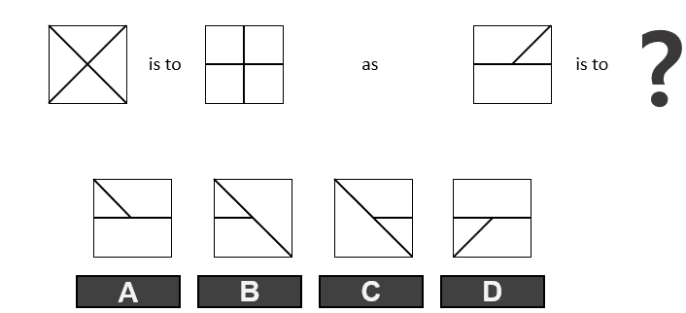
The correct answer is C.
Imagine that each square is a “clock” with a few hands and eight “hours.” Between the first two elements, each of the hands has moved one “hour” clockwise. Answer C is analogous to the third element in the same manner. The two hands which form a horizontal line move one hour clockwise and form a diagonal line from the top-left corner to the bottom-right corner. The third diagonal hand moves and forms a horizontal line that points to the right.
Did you know?
The EDPT is a multiple-choice test that commonly includes word analogies, algebra and math word problems, number sequences, and figural analogies, and test-takers widely report a format of 120 questions in 90 minutes, so pacing matters; it’s often described as challenging due to complex questions and a tight time limit, and qualifying outcomes vary by role and program.
EDPT Preparation Strategies
The EDPT is often viewed as challenging, but targeted practice can make a noticeable difference—especially with pacing. Many test-takers report a format of 120 questions in 90 minutes, so your goal is to build both accuracy and speed.
- Know what you’ll face: Get familiar with the main question types (word analogies, math word problems/algebra, number sequences, and figural analogies) so nothing feels new on test day.
- Practice like it’s test day: Use timed sets and full-length practice to mirror real pressure. Don’t just “do questions”—work under a clock.
- Find your weak spots fast: Track which question types slow you down or cause errors, then focus most of your study time there.
- Track scores and time: Record your accuracy and how long sets take. Your aim is fewer mistakes with steadier pacing over time.
- Refresh core skills: Review arithmetic and algebra fundamentals, and stay sharp on vocabulary/relationships for analogies.
- Build a pacing plan: Move quickly through easier questions first, flag time-consuming items, and return if time allows.
- Use smart shortcuts: Learn quick methods (estimation, mental math, fraction/decimal conversions, pattern spotting) to reduce time per question.
Test Features
Primarily used by the U.S. military
The EDPT is used by U.S. military programs to help evaluate candidates for certain technical and analytical career paths. Exactly which roles use the EDPT—and how scores are applied—can vary by branch, unit, and current staffing needs.
What it measures
The EDPT focuses on reasoning skills commonly needed in technical work, including verbal reasoning (word relationships), arithmetic/algebraic reasoning, pattern recognition (number sequences), and visual/symbolic reasoning (figural analogies).
No penalty for wrong answers
There is typically no penalty for incorrect answers, so it’s usually better to make an educated guess than to leave a question blank.
Possible to reschedule
If you can’t test on your assigned date, rescheduling may be possible depending on the testing site’s availability and your program’s rules. Contact your test administrator as soon as possible to confirm your options.
Technical Facts
EDPT Test Fast Facts
- Questions: 120 multiple-choice questions
- Time limit: 90 minutes
- Test delivery: Paper-and-pencil
- Structure: 4 skill areas; questions are commonly mixed rather than presented as separate timed sections
- Calculator: Not permitted
Language and location
The EDPT is administered in English and is most commonly taken through U.S. military testing programs.
What the EDPT is used for
The EDPT helps screen candidates for roles that require strong reasoning and problem-solving in technical environments. How scores are used—and which jobs require them—varies by program, so focus your prep on the core skill areas and timed practice.
Results Scale and Interpretations
EDPT scores
EDPT scoring and qualifying requirements can vary by program and role, and official cut scores are not always publicly posted. Use your recruiting/testing point of contact to confirm the current minimum score for the job you want.
In general, focus on maximizing correct answers within the time limit. If you’re unsure on a question, make your best guess rather than leaving it blank.
| What to know | Practical takeaway |
|---|---|
| Scores and minimum requirements may change by role/program | Confirm the current qualifying score with your recruiter or test administrator |
| Selection is competitive even when you meet a minimum | Aim to score comfortably above the stated requirement when possible |
| No negative marking is typically reported | Educated guessing is usually better than leaving items unanswered |
FAQs
The EDPT (Electronic Data Processing Test) is a multiple-choice aptitude test used in U.S. military testing programs to help evaluate candidates for certain technical roles. It focuses on reasoning and problem-solving skills rather than hands-on use of software tools.
Many test-takers consider the EDPT challenging because the questions can be complex and the pace is fast. Preparation and timed practice can significantly improve performance.
EDPT requirements depend on the branch, role, and current recruiting needs. Some technical specialties may require an EDPT score, but the exact list can change—confirm requirements with your recruiter or testing office.
Retesting is typically allowed after a waiting period. A common policy is a 6-month wait, though exceptions may be possible depending on your program and circumstances.
A “good” score depends on the specific job you’re targeting and the current qualifying threshold. In general, aim to score comfortably above the minimum required for your intended role.
The EDPT commonly includes questions in four areas: Word Analogies, Algebra & Math Word Problems, Number Sequences, and Figural Analogies.
A common retest rule is once every 6 months, though policies can vary by testing program—confirm your current retake window with your test administrator.
EDPT Assessments Test Tips
- Build reasoning skills: Practice logic, pattern recognition, and step-by-step problem solving—not just memorization.
- Stay calm and focused: Use slow breathing and keep moving if you get stuck.
- Read carefully: Double-check what the question is asking before you commit to an answer.
- Prioritize easy wins: Move quickly through questions you can solve fast, then return to harder ones if time allows.
- Use smart guessing: If there’s no penalty for wrong answers, eliminate what you can and answer every question.
- Practice under time pressure: Train with a timer so your pacing feels natural on test day.
- Sleep and prep logistics: Get good rest the night before and bring a valid ID to the testing site.
Administration
- Test administrator: The EDPT is typically administered through U.S. military testing programs at authorized testing locations (for example, MEPS or other military education/testing centers).
- Scheduling: EDPT scheduling is usually handled through your recruiter or your assigned testing office as part of your application/enlistment process.
- Test format: Multiple-choice, paper-and-pencil.
- Test materials: You’ll typically be provided basic materials such as a pencil and scratch paper (exact materials can vary by site).
- Cost: For most candidates, the EDPT is administered as part of a military process rather than as a public exam. Any fees or administrative requirements depend on your program and testing location.
- Retake policy: A common retest rule is a 6-month waiting period, though exceptions may be possible depending on the program.
Test Provider
The EDPT is a U.S. military aptitude test used within Department of Defense testing programs. It’s administered through authorized military testing channels, and availability or usage can vary by branch and role.
Information Sources
Disclaimer – All preparation materials and exam details provided by iPREP are for tutoring and practice purposes. iPREP is not affiliated with the United States Department of Defense (DoD) or any military branch, and does not claim ownership of the EDPT or any related trademarks.
Free EDPT practice test: Get to know what the Electronic Data Processing Test (EDPT) will be like by practicing with these sample questions:
Question 1 of 8
Complete the analogy
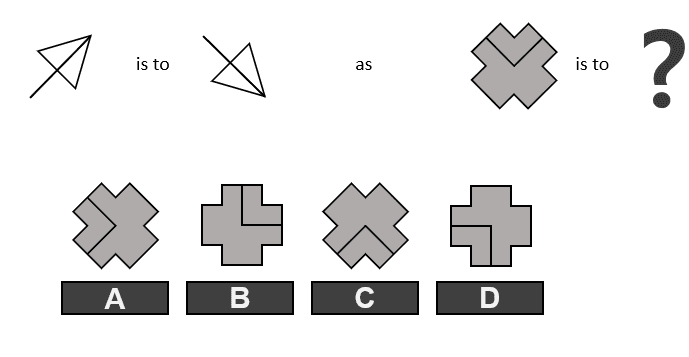
The correct answer is C.
Explanation: The second element is a vertical flip of the first one. Option C is a vertical flip of the third element; therefore, it is the correct answer.
Solving Tips:
- At times, one difference can be described in several different ways. Each description may yield a different expected missing element. Notice that the second element can also be described as a 90-degree rotation of the first. If you assume that this is the correct analogy, then you will not find a fitting answer among the options. In such cases, you would have to go back and rephrase the analogy.
- Rotation, flipping, and symmetry are all common elements used on cognitive ability tests. Keep them in mind when examining analogies between elements that have the same structure but different orientations.
Question 2 of 8
Complete the analogy
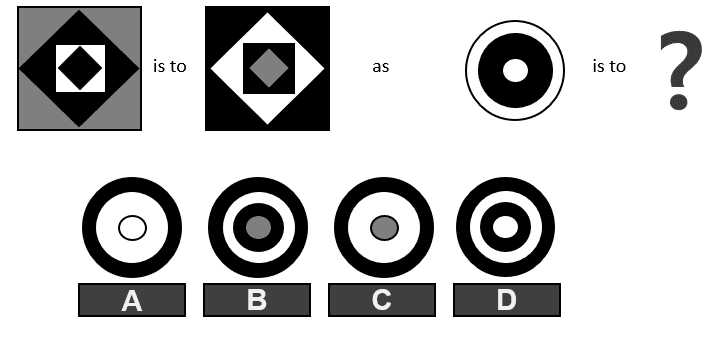
The correct answer is A.
Explanation:
Each element is comprised of shapes one on top of the other.
The logic of the analogy: following the order of the shapes, from inside out, the color of each shape of the first element becomes the color of the next shape in size in the second element; that is, except for the color of the outermost shape, which becomes the color of the innermost shape of the second element.
You may try reducing this analogy to a sequence of words. This way, you can see that the last word of the first element becomes the first word of the second element and the rest of the words maintain their order:
First element = black, white, black, gray;
Second element = gray, black, white, black.
According to that, the third element demonstrates this sequence: white, black, white.
Therefore, the missing element should demonstrate “white, white, black,” as in option A.
Question 3 of 8
What is the next number in the following series of numbers?
0.5 2 8 32
- 128
- 96
- 64
- 116
The correct answer is 128.
Explanation:
Look at the differences between the numbers:
0.5 2 8 32
*4 *4 *4
This means that every number in the series is equal to the previous number times 4.
It can be formally written as follows: an+1 = an * 4
The next number of the series is equal to 32*4 = 128
For learning purposes, the next numbers of the series would be:
128*4 = 512
512*4 = 2048
Tips for a quick solution:
- The multiple-choice format allows you to eliminate all the answers but the correct one. Once you realize that the difference between terms is *4, you can make an estimation of the value of the next number. As the last term is 32, the correct answer must be greater than 120 (30*4). Even 116 is too low, which means you can eliminate all options but 128.
- If you only consider the last digit, then 2 * 4 = 8. This means that the last digit of the correct answer must be 8. 128 is the only option that fits this observation.
Question 4 of 8
What is the next number in the following series of numbers?
203616 101808 50904 25452 12726
- 6374
- 6363
- 6371
- 6362
The correct answer is 6363.
Explanation: At a first glance, this problem seems to include tedious subtraction or division. Nonetheless, the problems in cognitive ability tests almost always have the potential to be solved quickly.
In this problem, two observations should lead you to the correct answer:
Observation 1 – The value of each number has half of the value of the previous number. While it might take you time to corroborate this observation, you can take into consideration that these are cognitive ability tests, so they cannot present a series of numbers that can only be deciphered by using a calculator.
Observation 2 – Only a single answer is a plausible correct answer. The last number in the series is 12726. Any number which ends with a 6 and is divided by 2 yields either a number that ends with 3 (e.g. 26/2 = 13) or 8 (e.g. 16/2 = 8). There are no other options. Of the four options, only 6363 is in line with this observation. Therefore, it can be immediately marked as the correct answer even if you decide not to perform the complete calculation.
Question 5 of 8
CAR is to GARAGE as PLANE is to…
- Depot
- Port
- Hangar
- Harbour
The correct answer is “Hangar”.
Explanation:
A car is kept in a garage the same way that a plane is kept in a hangar.
The main relationships found in analogies and are listed below:
- Purpose: This means that ‘A’ is used for ‘B’ the same way that ‘X’ is used for ‘Y’.
- Cause and Effect: This means that ‘A’ has an effect on ‘B’ the same way that ‘X’ has an effect on ‘Y’.
- Part to Whole (individual to group): This means that ‘A’ is a part of ‘B’ the same way that ‘X’ is a part of ‘Y’
- Part to part: ‘A’ and ‘B’ are both parts of something the way that ‘X’ and ‘Y’ are both parts of something
- Action to object: ‘A’ is done to ‘B’ the same way ‘X’ is done to ‘Y’.
- Object to action: ‘A’ does something to ‘B’ just as ‘X’ does something to ‘Y’.
- Word meaning: ‘A’ means about the same as ‘B’ and ‘X’ means about the same as ‘Y’
- Opposite word meaning: ‘A means about the opposite of ‘B’ and ‘X’ means about the opposite of ‘Y’
- Sequence: ‘A’ comes before (or after) B’’ just as ‘X’ comes before (or after) ‘Y’.
- Magnitude: ‘A’ is greater than (or less than) ‘B’ and ‘X’ is greater than (or less than) ‘Y’.
Question 6 of 8
CIRCLE is to SPHERE as SQUARE is to…
- Triangle
- Oval
- Circle
- Cube
The correct answer is “Cube”.
Explanation:
A sphere is the solid/3-dimensional form of a circle just as a cube is the solid/3-dimensional form of a square.
The main relationships found in analogies and are listed below:
- Purpose: This means that ‘A’ is used for ‘B’ the same way that ‘X’ is used for ‘Y’.
- Cause and Effect: This means that ‘A’ has an effect on ‘B’ the same way that ‘X’ has an effect on ‘Y’.
- Part to Whole (individual to group): This means that ‘A’ is a part of ‘B’ the same way that ‘X’ is a part of ‘Y’
- Part to part: ‘A’ and ‘B’ are both parts of something the way that ‘X’ and ‘Y’ are both parts of something
- Action to object: ‘A’ is done to ‘B’ the same way ‘X’ is done to ‘Y’.
- Object to action: ‘A’ does something to ‘B’ just as ‘X’ does something to ‘Y’.
- Word meaning: ‘A’ means about the same as ‘B’ and ‘X’ means about the same as ‘Y’
- Opposite word meaning: ‘A means about the opposite of ‘B’ and ‘X’ means about the opposite of ‘Y’
- Sequence: ‘A’ comes before (or after) B’’ just as ‘X’ comes before (or after) ‘Y’.
- Magnitude: ‘A’ is greater than (or less than) ‘B’ and ‘X’ is greater than (or less than) ‘Y’.
Question 7 of 8
Aunt Shirley’s agricultural plot yielded 23% more vegetables this season compared to last season. How much did it yield this season if last season Aunt Shirley harvested 8,000 pounds of vegetables last season?
- 9,840 pounds
- 10,320 pounds
- 8,960 pounds
- 11,280 pounds
- 10,870 pounds
The correct answer is 9,840 pounds.
Explanation: This problem requires you to know how to do direct percentage calculations. We’ll present three different methods to solve this problem + a time-saving method. We advise reading them all in order to find your best possible way to approach this type of calculation.
Shortcut Method – Use Estimation
23% is a bit less than one-quarter. One-quarter of 8000 pounds = 8000/4 = 2000 pounds
The correct answer must be slightly less than 8000 + 2000 = 10,000 pounds.
Only one answer is fitting – 9,840 pounds. The next answer which is less than 10,000 is far too small.
You can confidently mark the answer and move forward.
Traditional Methods:
Solution A – The Usual Way To for Working Out Percentages:
In percentage problems, the basic value is always 100% and the increment/deduction is calculated in relation to the basic value. You can always use this formula in order to understand what the increment/deduction’s value is:
(Basic value/100) X value of increment/deduction. In our case, the basic value is 8,000 pounds. The required increment is 23%; therefore the calculation is:
8000/100 X 23 = 80 X 23 = 1840.
Seasonal crops = basic value + 23% = 8000 + 1840 = 9840.
On this type of test, there are always shorter or simpler ways to reach the solution.
Solution B – Breaking the Increment/Deduction into Pieces:
It is also easier to work with “simple” percentages. Without using a calculator, it might be easier to calculate a 23% increase by summing up 10% + 10% + 1% + 1% + 1%.
10% of 8000 is simply calculated by moving the decimal point one place to the left and 1% by moving the decimal point two steps to the left:
100% = 8000 → 10% = 800 → 1% = 80
Seasonal crops = basic value + 23% = basic value + 10% + 10% + 1% + 1% + 1% = 8000 + 800*2 + 80*3 = 8000 + 1600 + 240 = 9840 pounds
Question 8 of 8
The sum of two consecutive numbers is greater by 5 than the next consecutive number.
What is the number that comes after these three consecutive numbers?
- 8
- 9
- 10
- 11
- 12
The correct answer is 9.
In the first step, you must create the simplest equation from the information provided:
- The sum of two consecutive numbers: X + (X+1)
- is greater by 5 than the next consecutive number: X + (X+1) = (X+1+1) + 5
X + (X+1) = (X+1+1) + 5
2X + 1 = X + 7 \ -X – 1
2X + 1 -X – 1 = X + 7 -X – 1
X = 6
Therefore, the number that comes after these three consecutive numbers is
(X+1+1+1) = 6 + 1 + 1 +1 = 9.
About the course
Includes 42 EDPT practice tests
20 Learning hours · 42 Practice tests · 620 Questions · 590 Videos
This course starts with the EDPT essentials—what the test measures, how it’s typically structured, and what to expect on test day. You’ll then build a practical pacing approach and sharpen no-calculator problem solving with targeted practice across the main EDPT question types. A focused math refresher supports faster, more accurate work on algebra and math word problems.

Skills you will learn
Verbal reasoning · Arithmetic/algebraic reasoning · Pattern recognition · Visual/symbolic reasoning
Curriculum
Course Introduction
- Course structure and how to practice
- Using explanations to fix mistakes
EDPT Test Information
- EDPT format, pacing, and constraints
- What each question type assesses
EDPT Test-Taking Tips & Preparation Strategies
- Build a pacing plan
- Smart guessing and time triage
- Mental math and estimation shortcuts
Word Analogies
- Identify word-pair relationships quickly
- Avoid trap answers from similarity
- Practice sets with clear explanations
Shape Analogies
- Spot visual rules and transformations
- Rotation, symmetry, and pattern matching
- Practice sets with clear explanations
Number Series/Sequences
- Find rules across number sequences
- Differences, ratios, and alternations
- Timed, practice, and enhanced modes
Math Refresher – From Basics to Algebra
- Refresh no-calculator math foundations
- Build confidence for algebraic reasoning
Basic Math – Arithmetic Operations
- Fast, accurate four-operation drills
Basic Math – Fractions and Decimals
- Fraction/decimal operations and conversions
Basic Math – Percents
- Percent calculations without a calculator
Basic Math – The Order of Operations
- Multi-step expression accuracy practice
Basic Math – Multiple-Choice Solving Tips
- Estimation and elimination for MCQ math
Basic Algebra – Exponents
- Exponent rules, powers, and simplification
Basic Algebra – Principles of Solving Equations
- Evaluate expressions and substitute variables
Basic Algebra – Solving Linear Equations
- Equations, proportions, and literal forms
Basic Algebra – Solving a System of Linear Equations
- Solve two-variable linear systems
Basic Algebra – Factoring Polynomials
- Factor and simplify polynomial expressions
Basic Algebra – Solving Quadratics
- Factoring-based quadratic solving review
Math Word Problems
- Translate scenarios into equations
- Multi-step arithmetic under time pressure
- Timed, practice, and enhanced modes
Course Conclusion
- Final review and readiness checklist
- Target weak areas for retakes
Reviews

Jacob C*******
January 18, 2026 at 12:58 AM
Love it! I feel more prepared with this course and it's given me a feel for the test structure. Only issue is there are a few bugs around lag when submitting, and the results screen confusing my score with the average.
Garland C**
October 29, 2025 at 3:42 PM
I have done many, many tests through test prep books and done well with those. This is by far the hardest and most convoluted test prep I have ever had. There is no way I would recommend thise course to anyone.
iPrep
October 30, 2025 at 6:49 AM
Hi Garland. We're sorry to hear this didn’t meet your expectations. Our EPT course has helped hundreds of students succeed, and it's designed to reflect the real test’s level and format as closely as possible. While it can feel challenging, that’s exactly how we prepare our learners for the real thing. We’re always here to support you—feel free to reach out if you'd like help navigating the course.
Christopher L***
October 20, 2025 at 4:24 PM
Many of the word analogies are insufficient, to the degree they seem to be made by non native English speakers. Some examples: Cottage : Building (A cottage is a type of building, implying hierarchy or size) Options: Giraffe : Lion Lion : Giraffe Mouse : Mammal Shrub : Tree The correct analogy here is Shrub : Tree since a shrub is a smaller type of plant, similar to how a cottage is a smaller building. Option 2 (Lion : Giraffe) is incorrect because it reverses the hierarchical relationship; if this were correct, it would need to be Giraffe : Lion, maintaining the size context. -- This example states two falsehoods. A shrub is not a type of tree. A building can be any size. The correct choice here should be mouse : mammal, as a mouse is a type of mammal. It is the only answer that fits "a is a type of b" relationship. There are many such examples. This part of your testing suite contains many flaws.
iPrep
October 21, 2025 at 8:30 AM
Hi Christopher. Thank you very much for your thoughtful and detailed feedback! We truly appreciate the time you took to explain your reasoning and provide examples. Your observations are extremely helpful, and we’ll carefully review and revise the Word Analogy section to ensure all examples are accurate and clear.
Ginna M*****
September 7, 2025 at 8:39 PM
Great review help. The practice tests give various ways to solve problems, and detailed explanations. I would recommend this to other students.
solomon b********
September 3, 2025 at 11:26 PM
It has been pretty good so far, the test seems to be very unique in its contents and the practice test is the same way
Alan H****
August 19, 2025 at 10:45 PM
this course was the same price as other competitors but this one has way more content. this is clearly the better buy
Jonathan V*******
July 12, 2025 at 6:50 PM
EDPT prep is great. There are not many resources out there but this is one of the better ones! Has everything you need to get a good score
William H*******
June 27, 2025 at 3:13 PM
Very good study materials for the EDPT. Covers nearly all the topics within and provides videos to help with your understanding.