Reviewed by Tamir Rubin, Head of Product at iPREP • Updated September 2026
What is the CPC exam?
The CPC® exam tests physician-service coding with CPT®, ICD-10-CM, and HCPCS Level II. It is open-book with approved code books only and includes 100 multiple-choice questions in 4 hours, including 10 medical-record cases. The pass mark is 70%. (HCPCS transition: Mar. 2026)CPC Exam Sample Question
A patient undergoes a laparoscopic cholecystectomy. Which of the following CPT codes should be used?
- A. 47562
- B. 47563
- C. 47600
- D. 47610
CPC Test Question Types
Multiple-choice questions
Assesses: Coding accuracy
- Apply codes to short scenarios
- Identify correct CPT, ICD-10-CM, HCPCS
- Use guidelines to select modifiers
- Interpret documentation for billable services
Case-study question sets
Assesses: Integrated coding
- Review longer clinical case narratives
- Combine diagnoses, procedures, and modifiers
- Apply guidelines across multiple services
- Check compliance and documentation details
Test Duration
Total time: 240 minutes (4 hours) • 100 questions
Plan steady pacing and time to consult code books. Avg pace: ~145 seconds per question. Mark tough items, move on, and return if time remains.
Test Breakdown & Sample Questions
The Certified Professional Coder (CPC) exam, administered by the AAPC, consists of 100 multiple-choice questions that assess proficiency across various medical coding domains. The distribution of questions by topic is detailed in the table below:
| Topic | Number of Questions |
|---|---|
| Surgical Procedures | |
| – Integumentary System (CPT® 10,000 Series) | 6 |
| – Musculoskeletal System (CPT® 20,000 Series) | 6 |
| – Respiratory, Cardiovascular, Hemic, Lymphatic Systems, Mediastinum, and Diaphragm (CPT® 30,000 Series) | 6 |
| – Digestive System (CPT® 40,000 Series) | 6 |
| – Urinary, Male and Female Reproductive Systems (including maternity and delivery), Endocrine System (CPT® 50,000 Series) | 6 |
| – Nervous System (CPT® 60,000 Series) | 6 |
| Evaluation and Management (E/M) Services | 6 |
| Anesthesia | 4 |
| Radiology | 6 |
| Laboratory and Pathology | 6 |
| Medicine | 6 |
| Medical Terminology | 4 |
| Anatomy | 4 |
| ICD-10-CM Code Application and Official Guidelines | 5 |
| HCPCS Level II (including modifiers) | 3 |
| Coding Guidelines (including modifier use) | 7 |
| Compliance and Regulatory Topics | 3 |
Additionally, the exam includes 10 case studies with multiple-choice questions that integrate various coding scenarios, covering topics such as surgical procedures, medicine, anesthesia, radiology, pathology and laboratory, E/M services, medical terminology, anatomy, compliance, and regulatory information.
Overall Skills for Success:
To perform well on all these question types, you’ll need a strong foundation in medical terminology, anatomy, and coding guidelines. Practice applying your knowledge to various coding scenarios using resources like practice exams will also be crucial. Remember, the CPC exam emphasizes understanding and applying coding principles, not just memorizing codes.
Did you know?
The CPC Exam, with its 100-question format, covers 17 coding sections, including anesthesia and radiology. Successful test takers often have practical experience and rigorous preparation. Administered online or in-person, the exam uses a strict scoring system where 70% is the passing mark. Employers highly value the results, using them to gauge a candidate’s coding proficiency and reliability. Can you handle the pressure and precision required?
Preparation Strategies
- Understand the Exam Format: Familiarize yourself with the exam structure, including the number of questions, the types of questions, and the subjects covered.
- Study the Official Manuals: Focus on the CPT, ICD-10-CM, and HCPCS Level II coding manuals. These are the primary sources for exam questions.
- Take Practice Exams: Use practice tests to identify areas where you need improvement and to get comfortable with the exam’s timing and format.
- Attend a Review Course: Consider enrolling in a CPC review course, which can provide structured guidance and expert insights.
- Join Study Groups: Collaborate with peers who are also preparing for the CPC Exam. Group study can offer support, different perspectives, and shared resources.
- Use Flashcards: Create flashcards for medical terminology, anatomy, and key coding concepts. This can help reinforce your memory through active recall.
- Focus on Weak Areas: Identify and concentrate on the areas where you are weakest. Use targeted study materials to improve these skills.
- Stay Updated: Keep abreast of any updates or changes in coding guidelines and practices. The healthcare field is constantly evolving, and so do the coding standards.
- Utilize Online Resources: Make use of online forums, webinars, and other resources.
- Practice Time Management: Develop a strategy to efficiently manage your time during the exam. Practice answering questions under timed conditions to improve your speed and accuracy.
Test Features
The CPC Exam is designed to assess the proficiency and knowledge of medical coders. Purpose: It ensures that candidates have a thorough understanding of medical coding standards and can accurately translate medical services into standardized codes.
Comprehensive Content: The exam covers a wide range of topics, including CPT, ICD-10-CM, and HCPCS Level II codes, and various medical specialties such as anesthesia, surgery, radiology, and pathology.
Real-World Application: Questions are designed to mimic real-life coding scenarios, requiring candidates to apply their knowledge to practical situations.
Flexible Format: The CPC Exam is available both online and in-person, accommodating different preferences and schedules of test-takers.
Common names for the CPC Exam
- CPC Certification Exam
- Certified Professional Coder Exam
- AAPC CPC Exam
- Medical Coding Certification Exam
Technical Facts
Test Fast Facts (tl;dr)
- 100 questions
- 4-hour duration
- Multiple-choice format
- Available online and in-person
- Requires 70% to pass
- Covers CPT, ICD-10-CM, HCPCS
- Scenario-based questions
- Medical specialties included
- Proctored environment
- Open book
Purpose: It aims to ensure that candidates have a deep understanding of coding principles and can accurately assign codes for medical diagnoses and procedures.
Comprehensive Coverage: The exam encompasses various coding systems, including CPT, ICD-10-CM, and HCPCS Level II, and spans multiple medical specialties such as surgery, radiology, and pathology.
Scenario-Based Questions: The exam includes questions that mimic real-life coding situations, requiring candidates to apply their knowledge in practical contexts.
Flexible Testing Options: The CPC Exam can be taken either online or in-person, providing flexibility to suit different candidates’ preferences and schedules.
Time Limited: As of September 19, 2022, the exam format has changed. It now consists of a single, continuous four-hour session with 100 questions to complete. You will need to remain seated for the full duration to finish the exam.
Breaks: Short breaks are allowed if needed, but the exam timer will not pause. After returning from a break, you must go through a security check and a full room scan before resuming the exam.
Results Scale and Interpretations
Earning your Certified Physician Coder (CPC) credential demonstrates your expertise in medical coding. But how do you interpret your score report? While details might be limited, let’s explore what we know about CPC exam scoring and how it can inform your path forward.
Decoding the Score Report
Unfortunately, the CPC exam score report is primarily a pass/fail notification. You’ll receive electronic results within 7-10 business days indicating whether you achieved the required passing score (typically 70%).
There is no detailed score report with components like:
- Raw Score: The total number of correct answers out of 100 questions.
- Percentile Ranking: How your score compares to other test-takers (e.g., scoring higher than 80% of examinees).
- Sub-Scores: Performance breakdowns by specific coding sections (e.g., surgery, radiology).
Limited Details, Focused Goal
While the lack of a detailed report might seem like a drawback, remember the primary goal is to achieve a passing score. This signifies you possess the fundamental medical coding knowledge and skills necessary for the profession.
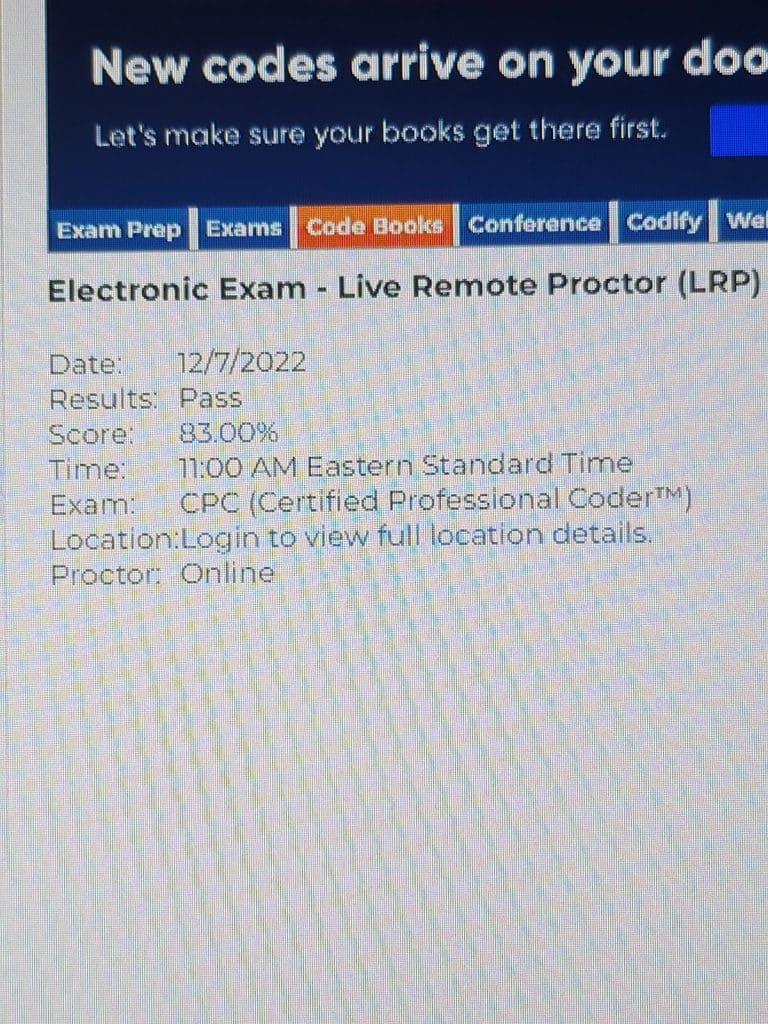
AAPC results are posted in MyAAPC exam details, and Areas of Study are available after results are released.
FAQs
The CPC Exam is a certification test for medical coders to validate their knowledge and skills in coding using CPT, ICD-10-CM, and HCPCS Level II codes.
The exam measures proficiency in medical terminology, anatomy, coding guidelines, and the practical application of coding principles to real-world scenarios.
The CPC Exam consists of 100 multiple-choice questions, covering various medical coding topics and requiring application of coding guidelines.
A minimum score of 70% is required to pass the CPC Exam.
The exam is 4 hours long, designed to test both knowledge and time management skills.
Yes, the CPC Exam is available both online and in-person, providing flexibility for test-takers.
Yes, the CPC Exam is an open-book test, allowing you to use the CPT, ICD-10-CM, and HCPCS Level II coding manuals during the exam.
Employers use CPC Exam results to assess a candidate’s coding proficiency and readiness for medical coding roles, often influencing hiring decisions and career advancement.
Exam results are typically available within 7–10 business days after completing the exam.
If you don’t pass, you can retake the exam. AAPC offers options for retakes to help you achieve certification.
No, AAPC does not provide detailed score reports, not even upon request or for a fee.
Test Tips
- Arrive Early: Ensure you arrive at the testing center at least 30 minutes early to avoid any last-minute stress or delays.
- Bring Necessary Materials: Don’t forget your coding manuals, photo ID, and any other required items. Being prepared will keep you focused.
- Read Questions Carefully: Take your time to read each question thoroughly before answering to avoid mistakes due to misinterpretation.
- Manage Your Time: Allocate your time wisely, spending no more than 2 minutes per question. If a question is too difficult, move on and return to it later.
- Use Process of Elimination: If you’re unsure of an answer, eliminate the clearly incorrect options first to improve your chances of selecting the right one.
- Stay Calm and Focused: Keep a clear mind, take deep breaths if you feel anxious, and maintain your concentration throughout the exam.
- Double-Check Your Answers: If time permits, review your answers, especially the ones you were uncertain about, to correct any mistakes.
Administration
- Test Location: The CPC Exam can be taken at various approved locations or online.
- Test Schedule: Exams are scheduled regularly; check AAPC’s website for specific dates and times.
- Test Format: The exam is computerized, with 100 multiple-choice questions.
- Test Materials: Bring only approved code books/reference materials; permitted note-taking tools depend on the exam delivery format.
- Cost: CPC exam vouchers are $425 for one attempt or $499 for two attempts; student pricing is $400 for one attempt or $475 for two attempts.
- Retake Policy: If you fail, you can retake the exam; specific retake policies and fees apply.
Test Provider
The American Academy of Professional Coders (AAPC) is the organization behind the CPC Exam. Established in 1988, AAPC provides training, certification, and resources for medical coders, billers, and other healthcare professionals. Their services aim to enhance the accuracy and efficiency of medical coding and billing, ensuring high standards in the healthcare industry.
AAPC has a global presence, offering certification exams, training programs, and professional development resources worldwide. Their top products include the Certified Professional Coder (CPC) certification, the Certified Outpatient Coder (COC) certification, and comprehensive training courses in medical coding, billing, auditing, and compliance.
Information Sources
- AAPC CPC Certification
- AAPC CPC Exam FAQs
- AAPC Taking the CPC Exam
- AAPC Official Blog
- AAPC Member Forums
Disclaimer –All the information and prep materials on iPREP are genuine and were created for tutoring purposes. iPREP is not affiliated with AAPC, which is the owner of the CPC Exam, or with any of the companies or organizations mentioned above.
Free CPC Exam Practice Test
Start with free CPC exam practice test questions that give you a clear feel for the medical coding knowledge tested on the Certified Professional Coder exam. The free practice introduces common CPC-style tasks such as CPT coding, ICD-10-CM diagnosis coding, HCPCS Level II codes, modifier use, anatomy, medical terminology, compliance, and coding case scenarios.
Use the free practice to understand the question format, pacing, and level of coding accuracy expected before moving into full preparation. For complete practice, iPREP’s full CPC course includes realistic exam-style questions, detailed explanations, video lessons, and targeted practice for the main AAPC CPC exam content areas.
Question 1 of 20 (Surgery)
A patient undergoes a laparoscopic cholecystectomy. Which of the following CPT codes should be used?
- 47562
- 47563
- 47600
- 47610
Correct Answer: 47562
Explanation:
- 47562: Correct code for laparoscopic cholecystectomy.
- 47563: Incorrect; this code is for laparoscopic cholecystectomy with cholangiography.
- 47600: Incorrect; this code is for open cholecystectomy.
- 47610: Incorrect; this code is for cholecystectomy with exploration of the common duct.
Question 2 of 20 (Evaluation and Management)
What is the appropriate CPT code for a new patient office visit with medical decision making of moderate complexity?
- 99202
- 99203
- 99204
- 99205
Correct Answer: 99204
Explanation:
- Why 99204 is correct: For office/outpatient E/M services, a new patient visit with moderate level of medical decision making is reported with 99204. Under the current office/outpatient E/M rules, code selection is based on medical decision making (MDM) or total time, not on counting old history/exam elements such as “comprehensive history” and “comprehensive exam.”
- Why 99202 is wrong: 99202 is also a new patient office/outpatient code, but it represents straightforward MDM, not moderate MDM. It is therefore too low for the scenario.
- Why 99203 is wrong: 99203 is the code for a new patient office/outpatient visit with low level MDM. That is still below the complexity stated in the question.
- Why 99205 is wrong: 99205 is a new patient office/outpatient visit with high level MDM. That would overcode the encounter because the question specifies only moderate complexity.
Question 3 of 20 (Anesthesia)
Which code represents anesthesia for a total knee arthroplasty?
- 01382
- 01402
- 01404
- 01400
Correct Answer: 01402
Explanation:
- 01382: Incorrect; this code is for anesthesia for knee arthroscopy.
- 01402: Correct; this code is for anesthesia for total knee arthroplasty.
- 01404: Incorrect; this code is for anesthesia for knee revision procedures.
- 01400: Incorrect; this code is for anesthesia for knee joint procedures.
Question 4 of 20 (Radiology)
What is the CPT code for a screening mammogram of both breasts?
- 77065
- 77066
- 77067
- 77063
Correct Answer: 77067
Explanation:
- Why 77067 is correct: 77067 is the code used for screening mammography, bilateral. Since the question asks for a screening mammogram of both breasts, this is the primary code that matches the service. CMS materials also reflect 77067 as the screening mammography code in current use.
- Why 77065 is wrong: 77065 is used for diagnostic mammography, unilateral. It is wrong on two separate points: the question asks for screening, not diagnostic, and it asks for both breasts, not unilateral imaging. CMS coding guidance distinguishes 77065/77066 as diagnostic mammography codes.
- Why 77066 is wrong: 77066 is used for diagnostic mammography, bilateral. It matches the “both breasts” part, but it is still wrong because the question asks for a screening mammogram, not a diagnostic mammogram.
- Why 77063 is wrong: 77063 is not the primary screening mammogram code. It is an add-on code for screening digital breast tomosynthesis, bilateral, and CMS states it is billed in addition to the primary screening mammography code, which is 77067. So 77063 by itself does not answer the question correctly.
Question 5 of 20 (Pathology and Laboratory)
Which code represents a complete blood count (CBC) with automated differential WBC count?
- 85025
- 85027
- 85004
- 85007
Correct Answer: 85025
Explanation:
- 85025: Correct; this code is for CBC with automated differential WBC count.
- 85027: Incorrect; this code is for CBC without differential.
- 85004: Incorrect; this code is for manual differential WBC count.
- 85007: Incorrect; this code is for blood smear, microscopic examination with manual differential WBC count.
Question 6 of 20 (Medicine)
For an adult patient receiving a single influenza vaccine by intramuscular route, which code reports the vaccine administration when age-based counseling administration codes do not apply?
- 90460
- 90471
- 90472
- 90473
Correct Answer: 90471
Explanation:
- Code 90471 reports immunization administration for the first or only vaccine by percutaneous, intradermal, subcutaneous, or intramuscular route. That makes it the correct administration code for a single adult influenza shot when the question asks only for the administration and not the vaccine product. It also avoids the common mistake of selecting a product code instead of the admin code.
- A is wrong because 90460 is the pediatric counseling administration code and does not fit a routine adult vaccine administration question.
- C is wrong because 90472 is used for each additional vaccine after the first, not for the first or only administration. Both are legitimate administration codes, but neither matches the service described.
- D is wrong because 90473 is used for oral or intranasal immunization administration rather than intramuscular administration. The key takeaway is to separate product codes from administration codes and then match the administration code to route and sequence.
Question 7 of 20 (Medical Terminology)
Which term describes inflammation of the liver?
- Hepatitis
- Nephritis
- Gastritis
- Dermatitis
Correct Answer: Hepatitis
Explanation:
- Hepatitis: Correct; it means inflammation of the liver.
- Nephritis: Incorrect; it means inflammation of the kidneys.
- Gastritis: Incorrect; it means inflammation of the stomach lining.
- Dermatitis: Incorrect; it means inflammation of the skin.
Question 8 of 20 (Anatomy)
Question: What is the anatomical term for the windpipe?
- Esophagus
- Trachea
- Bronchi
- Larynx
Correct Answer: Trachea
Explanation:
- Esophagus: Incorrect; it is the tube that carries food to the stomach.
- Trachea: Correct; it is the windpipe.
- Bronchi: Incorrect; these are the main passageways into the lungs.
- Larynx: Incorrect; it is the voice box.
Question 9 of 20 (ICD-10-CM)
What is the ICD-10-CM code for type 2 diabetes mellitus without complications?
- E10.9
- E11.9
- E13.9
- E14.9
Correct Answer: E11.9
Explanation:
- E10.9: Incorrect; this code is for type 1 diabetes mellitus without complications.
- E11.9: Correct; this code is for type 2 diabetes mellitus without complications.
- E13.9: Incorrect; this code is for other specified diabetes mellitus without complications.
- E14.9: Incorrect; this code is for unspecified diabetes mellitus without complications.
Question 10 of 20 (HCPCS Level II)
Which HCPCS Level II code range should a coder search first for a standard power wheelchair rather than a manual wheelchair or orthosis?
- E1130-E1150
- K0813-K0899
- E0135-E0148
- L0631-L0651
Correct Answer: K0813-K0899
Explanation:
- K0813-K0899 is the HCPCS Level II range for power-operated wheelchairs. That makes it the correct starting point when the item being coded is a standard power wheelchair. This is a better coding approach than guessing from a manual wheelchair answer set that does not match the device category.
- A is wrong because E1130-E1150 is used for standard manual wheelchairs, not power-operated chairs.
- C is wrong because E0135-E0148 covers walker-type equipment rather than wheelchairs. Both distractors stay in DME territory, but neither belongs to the power wheelchair family.
- D is wrong because L0631-L0651 describes orthotic devices, not wheelchairs. The key takeaway is to identify the equipment category first, then choose from the correct HCPCS family before narrowing to the exact item.
Question 11 of 20 (Coding Guidelines)
Which modifier indicates a bilateral procedure?
- -22
- -50
- -51
- -59
Correct Answer: -50
Explanation:
- -22: Incorrect; this modifier indicates increased procedural services.
- -50: Correct; this modifier indicates a bilateral procedure.
- -51: Incorrect; this modifier indicates multiple procedures.
- -59: Incorrect; this modifier indicates a distinct procedural service.
Question 12 of 20 (Surgery)
What is the CPT code for a standard open appendectomy?
- 44950
- 44955
- 44960
- 44970
Correct Answer: 44950
Explanation:
- 44950: Correct; this code is for an open appendectomy (removal of the appendix through an open incision).
- 44955: Incorrect; this code applies to an incidental appendectomy performed for reasons other than appendicitis, such as during another intra-abdominal surgery.
- 44960: Incorrect; this code is used for an appendectomy performed for a ruptured appendix with abscess or generalized peritonitis.
- 44970: Incorrect; this code is for a laparoscopic appendectomy.
Question 13 of 20 (Evaluation and Management)
Which current CPT family is used for a later hospital inpatient or observation visit after the initial service, replacing the old concept of a follow-up inpatient consultation?
- 99221-99223
- 99231-99233
- 99238-99239
- 99281-99285
Correct Answer: 99231-99233
Explanation:
- Codes 99231-99233 report subsequent hospital inpatient or observation care. They are the current CPT family for a later hospital visit after the initial hospital service has already occurred. This makes them the correct modern replacement for old follow-up inpatient consultation thinking.
- A is wrong because 99221-99223 is the initial hospital inpatient or observation care family, not a later visit.
- C is wrong because 99238-99239 is used for hospital discharge management rather than ongoing subsequent care. Both options are valid hospital E/M families, but they do not fit the service timing in the question.
- D is wrong because 99281-99285 applies to emergency department visits, not subsequent inpatient or observation care. The key takeaway is to code current hospital E/M services by whether the encounter is initial, subsequent, or discharge rather than using outdated inpatient consultation terminology.
Question 14 of 20 (Anesthesia)
Which code represents anesthesia for cesarean delivery only?
- 01961
- 01967
- 01968
- 01969
Correct Answer: 01961
Explanation:
- 01961: Correct; this code is for anesthesia for cesarean delivery only.
- 01967: Incorrect; this code is for neuraxial labor analgesia/anesthesia for planned vaginal delivery.
- 01968: Incorrect; this code is for anesthesia for cesarean delivery following neuraxial labor analgesia/anesthesia.
- 01969: Incorrect; this code is for anesthesia for cesarean hysterectomy following neuraxial labor analgesia/anesthesia.
Question 15 of 20 (Radiology)
Which code reports a DXA bone density study of one or more axial skeleton sites without vertebral fracture assessment?
- 77080
- 77081
- 77085
- 76977
Correct Answer: 77080
Explanation:
- Code 77080 reports dual-energy X-ray absorptiometry of one or more axial skeleton sites, such as the hips, pelvis, or spine, without vertebral fracture assessment. That makes it the best answer when the service is a standard axial DXA study only. It is stronger than the original because it tests axial-versus-peripheral and with-versus-without vertebral assessment distinctions.
- B is wrong because 77081 is for appendicular or peripheral DXA rather than axial skeleton sites.
- C is wrong because 77085 includes vertebral fracture assessment in addition to the axial DXA study. Both are plausible bone density codes, but each changes an important part of the service.
- D is wrong because 76977 is an ultrasound bone density study rather than DXA. The key takeaway is to distinguish modality, body region, and whether vertebral fracture assessment is included before choosing the bone density code.
Question 16 of 20 (Medicine)
What is the CPT code for a routine electrocardiogram (ECG) with at least 12 leads, with interpretation and report?
- 93000
- 93005
- 93010
- 93015
Correct Answer: 93000
Explanation:
- 93000: Correct; this code is for a routine ECG with interpretation and report.
- 93005: Incorrect; this code is for ECG tracing only, without interpretation and report.
- 93010: Incorrect; this code is for ECG interpretation and report only.
- 93015: Incorrect; this code is for cardiovascular stress test using ECG monitoring.
Question 17 of 20 (Medical Terminology)
Which medical term describes the surgical removal of the gallbladder?
- Cholecystectomy
- Cholecystitis
- Cholelithiasis
- Cholangiography
Correct Answer: Cholecystectomy
Explanation:
- Cholecystectomy: Correct; it means the surgical removal of the gallbladder.
- Cholecystitis: Incorrect; it means inflammation of the gallbladder.
- Cholelithiasis: Incorrect; it means the presence of gallstones.
- Cholangiography: Incorrect; it is an imaging test of the bile ducts.
Question 18 of 20 (Anatomy)
What is the anatomical term for the collarbone?
- Scapula
- Clavicle
- Sternum
- Humerus
Correct Answer: Clavicle
Explanation:
- Scapula: Incorrect; it is the shoulder blade.
- Clavicle: Correct; it is the collarbone.
- Sternum: Incorrect; it is the breastbone.
- Humerus: Incorrect; it is the upper arm bone.
Question 19 of 20 (ICD-10-CM)
What is the ICD-10-CM code for acute bronchitis due to Mycoplasma pneumoniae?
- J20.0
- J20.1
- J20.2
- J20.3
Correct Answer: J20.0
Explanation:
- J20.0: Correct; this code is for acute bronchitis due to Mycoplasma pneumoniae.
- J20.1: Incorrect; this code is for acute bronchitis due to Hemophilus influenzae.
- J20.2: Incorrect; this code is for acute bronchitis due to Streptococcus.
- J20.3: Incorrect; this code is for acute bronchitis due to coxsackievirus.
Question 20 of 20 (Case)
OPERATIVE REPORT
PREOPERATIVE DIAGNOSIS: Fractured right distal radius
POSTOPERATIVE DIAGNOSIS: Same
PROCEDURE: Closed reduction of right distal radial fracture with percutaneous pinning
DESCRIPTION OF PROCEDURE:
The patient was brought to the operating room and placed under monitored anesthesia care (MAC). The right arm was prepped and draped in the usual sterile fashion. Closed reduction of the distal radial fracture was performed under fluoroscopic guidance. Once acceptable alignment was achieved, percutaneous pins were inserted to stabilize the fracture. The pins were confirmed to be in appropriate position under fluoroscopy. A splint was applied, and the patient was taken to recovery in stable condition.
What CPT® and ICD-10-CM codes should be reported?
- 25606 – Percutaneous skeletal fixation of distal radial fracture; S52.501A – Unspecified fracture of the lower end of the right radius, initial encounter
- 25607 – Open treatment of distal radial fracture; S52.501A – Unspecified fracture of the lower end of the right radius, initial encounter
- 25608 – Open treatment of distal radial fracture with internal fixation; S52.511A – Displaced fracture of distal radius, initial encounter
- 25565 – Closed treatment of radial shaft fracture; S52.521A – Displaced fracture of shaft of right radius, initial encounter
The correct answer is A.
25606 represents percutaneous fixation of a distal radial fracture, and S52.501A describes an unspecified fracture of the lower end of the right radius.
B. (25607) refers to open treatment, which was not performed in this case.
C. (25608) involves open treatment with internal fixation, but the procedure was percutaneous.
D. (25565) applies to shaft fractures, not fractures of the distal radius.
Sample Survey of CPC Flashcards
Boost your Survey of the CPC Exam prep with these key concept flashcards.
About the course
Includes 10 practice tests (5 full-length simulations)
35 Learning hours · 10 Practice tests · 500 Questions · 540 Flashcards
This course walks you through CPC®-level physician-service coding from the ground up—starting with healthcare business basics, terminology/anatomy, and official coding rules. You’ll then build system-by-system coding fluency across ICD-10-CM and CPT®, including HCPCS Level II and modifier use. The course finishes with full mock exams to help you apply everything under realistic conditions.

Skills you will learn
CPT® coding · ICD-10-CM diagnosis coding · HCPCS Level II coding · Modifier selection · E/M coding · Compliance and medical necessity
Curriculum
Course Introduction
- How to navigate lessons, tests, and tools
Chapter 1: The Business of Medicine
- Medical coding roles and care settings
- Payers, RVUs/RBRVS, and medical necessity
- HIPAA, compliance, fraud/abuse, OIG work plan
Chapter 2: Medical Terminology and Anatomy Review
- Terminology foundations: prefixes, suffixes, roots
- Common abbreviations and medical acronyms
- Anatomy review across major body systems
Chapter 3: Introduction to ICD-10-CM Coding
- ICD-10-CM structure, conventions, guidelines
- Diagnosis lookup steps and symptom coding
- Sequencing rules and key chapter guidance
Chapter 4: Introduction to CPT®, HCPCS Level II, and Modifiers
- CPT® book structure and appendices
- HCPCS Level II overview and usage
- NCCI edits and modifier fundamentals
Chapter 5: Integumentary System
- Skin anatomy terms for accurate coding
- ICD-10-CM integumentary conditions coding
- CPT® procedures plus common modifiers/HCPCS
Chapter 6: Musculoskeletal System
- Bones, joints, muscles: anatomy and terminology
- ICD-10-CM musculoskeletal disorders coding
- CPT® procedures with HCPCS/modifiers
Chapter 7: Respiratory, Hemic, and Lymphatic Systems
- Respiratory and lymphatic anatomy essentials
- ICD-10-CM respiratory and hemic coding
- CPT® procedure selection for these systems
Chapter 8: Cardiovascular System
- Heart and vascular anatomy terminology
- ICD-10-CM cardiovascular conditions coding
- CPT® procedures with common modifiers/HCPCS
Chapter 9: Digestive System
- Digestive anatomy terms and documentation cues
- ICD-10-CM gastrointestinal conditions coding
- CPT® procedures plus modifiers/HCPCS patterns
Chapter 10: Urinary and Reproductive Systems
- Urinary and genital anatomy terminology
- ICD-10-CM urinary/reproductive disorders coding
- CPT® procedures with HCPCS/modifiers
Chapter 11: Nervous and Endocrine Systems
- Nervous and endocrine anatomy essentials
- ICD-10-CM coding for these conditions
- CPT® procedures: selection and documentation fit
Chapter 12: Radiology
- Radiology coding basics and terminology
- CPT® diagnostic imaging code selection
- Modifiers and HCPCS Level II tie-ins
Chapter 13: Pathology and Laboratory
- Lab/pathology coding concepts and rules
- CPT® codes for tests and panels
- Medicare guidance considerations
Chapter 14: Anesthesia
- Anesthesia types, time, and terminology
- Anesthesia coding guidelines and compliance
- CPT® anesthesia procedures with modifiers
Chapter 15: Evaluation and Management (E/M) Services
- E/M framework: history, exam, MDM
- E/M categories, time-based coding, modifiers
- Choose codes that match documentation
Chapter 16: Medicine Section
- CPT® Medicine section structure and scope
- Coding for: key medicine service areas
Chapter 17: Modifiers: In-Depth Analysis
- Why modifiers matter in reimbursement
- CPT® and HCPCS Level II modifiers
- Apply modifiers to real case examples
Chapter 18: Global Surgical Coding Essentials
- Global package rules and period basics
- Bundling, unbundling, separately reportable services
- Surgery scenarios: modifiers and decision points
Mock Exams Practice
- Full CPC simulations in multiple modes
- Review rationale for every answer choice
- Exam-taking tips for pacing and accuracy
Course Conclusion
- Wrap-up, recap, and next-step planning
Reviews

Malik O****
September 20, 2026 at 7:07 PM
Thorough and detailed. so many amenities in a pack. I appreciate the true effort and help. it has built my confidence too.
Jessica G*****
September 17, 2026 at 1:42 PM
I am loving IPREP! I signed up for a course through Health Tech Academy for $2000. Finished the course and went to take practice exams and didn’t understand a single thing. So glad my mom recommended IPREP as she has been doing this her whole life and just became a certified professional coder in 2019. She was like this practice test is exactly like the test you will have to take so use this as a study tool. I then saw there was an actual course for $49 and was like sign me up now! I feel like I’m actually learning what I need to know to not only pass the exam but also do well in the profession. $49 is a hell of a lot better than $2000. Thankfully I put it on my credit card so I’m getting refunded but stay as far away from Health Tech Academy! Use iPREP!
Ibironke O******
September 13, 2026 at 12:01 PM
Going through iPREP lesson has given me a better understanding of tackling medical coding. I now have the feeling of owing my credentials by building a momentum with iPREP guides to work with clarity, discipline and purpose. Lastly, I am more familiar with the geography of each medical coding book by highlighting and annotating the guidelines with much understanding.
Joann V******
September 11, 2026 at 1:55 PM
This has been by far an amazing study guide. it explains exactly why its correct or not correct and the chapters are on point tell you exactly what you need to know. I would recommend it to anyone
Ibironke O******
August 28, 2026 at 12:25 PM
Going through these lessons has made me not only to just prepare for my CPC certification exam but also building a momentum with the guides we worked on. iPREP has prepared me to work with clarity, discipline and purpose. I am more familiar with the medical coding guidelines and learned the geography of each book by highlighting and annotating the guidelines. However, some of the practice scenarios are missing key details such as exact lesion size, location site, and enough detail to support the graft code selection making it incomplete medical report documentation. I kindly suggest for example, that practice scenarios code selection should be supported by documented size, site, and procedure types as full detailed medical report to avoid questions that force the learners to guess unspecified details. In medical coding, guessing is not allowed and should be prevented. Lastly, iPREP has done a fantastic job of organizing this material in an easily understandable format. I will recommend for anyone looking forward to sitting for CPC certification to take a good advantage of this great opportunity.
ELENE C*************
July 13, 2026 at 9:20 PM
Already taken the course VIA aapc but this one i believe is helping me with reviewing the material. we shall see if I pass
taninder k***
July 7, 2026 at 6:39 AM
just started with the iprep and it feels easy to learn and is very helpful. looking forward to make a good impact on the cps exam journey.
Tiffani O**
February 18, 2026 at 7:00 PM
Great study guide, and a great refresher on things I needed for the test. I appreciate several tests to make sure I get enough practice.
Shari R*******
February 3, 2026 at 5:38 PM
I wish I would have found this course 1st instead of wasting my time with a different program. So far (40%+ complete) I am absolutely loving their curriculum. The depth of the information is great. They seem to be breaking the information down and building it up at a respectable pace. It's a lot of repetitive information, but each time it's adding additional information on top. Making the information given make sense.
Rachel M*******
December 9, 2025 at 12:52 AM
This program seems like a great fit for anyone who is interested in passing the CPC exam. It came highly recommended to me by a friend.