Reviewed by Tamir Rubin, Head of Product at iPREP • Updated February 2026
CDA Exam Sample Question
You have a student in your class, 8-year-old Michael, who is struggling with his reading skills. He becomes easily frustrated during reading time, and has started to act out in class as a result. How might you best address this behavior?
- Work with Michael to develop an individualized plan that includes extra one-on-one support during reading time.
- Give Michael a break during reading time to participate in a calming activity before returning to the lesson.
- Implement a reward system for Michael to encourage him to keep trying and improving his reading skills.
- Assign Michael to a more advanced reading group to challenge him and boost his confidence.
Standard multiple-choice
Assesses: core knowledge
- 60 questions
- Single best answer per item
- Covers CDA competencies and practices
- Emphasizes recall and understanding
- Pace steadily across many questions
Scenario-based multiple-choice
Assesses: applied judgment
- 5 questions
- Short scenario with supporting photo
- Choose best response for situation
- Tests decision-making in real contexts
- Apply safety, guidance, family practices
Test Duration
Total seat time: About 2 hours (most settings)
Most settings: 105-minute exam plus 15-minute instructions/practice (120 total). Birth to Five: 115-minute exam plus 15-minute instructions/practice (130 total). Confirm your setting’s limit when scheduling.
Test Breakdown & Sample Questions
Pick your CDA setting
| If this sounds like your job… | Your CDA setting | Children’s ages |
|---|---|---|
| You care for infants and toddlers in a classroom at a center. | Infant–Toddler (Center-Based) | Birth–3 |
| You teach a preschool class getting kids ready for kindergarten. | Preschool (Center-Based) | 3–5 |
| You work in a center with mixed ages (babies + toddlers + preschoolers). | Birth to Five (Center-Based) | Birth–5 |
| You run or work in a home daycare with a small, mixed-age group. | Family Child Care | Birth–5 |
| You visit families in their homes to support parents and children. | Home Visitor | Birth–5 |
Exam format (at a glance)
Delivery: Computer-based test through Pearson VUE (typically at a Pearson VUE test center)
Language: English or Spanish
What you take: The exam for the CDA setting you applied for
Question types & timing
| Type of questions | No. of questions | Time limit |
|---|---|---|
| Standard multiple-choice | 60 | Included in the exam time limit* |
| Scenario-based multiple-choice (narrative/photo) | 5 | Included in the exam time limit* |
| Instructions and practice | — | 15 minutes |
| Total | 65 | Exam: 1 hour 45 minutes (most settings)** + Instructions/practice: 15 minutes |
| Total seat time | — | About 2 hours (most settings)** |
* The exam time limit includes all scored questions.
** Birth to Five is a separate exam sitting: Exam: 1 hour 55 minutes (plus the same instructions/practice time).
What the exam covers
The exam evaluates six competencies across 13 functional areas:
| Competency | Functional areas |
|---|---|
| Establish and maintain a healthy learning environment | 1. Safe2. Healthy3. Learning environment |
| Promote physical and intellectual competence | 4. Physical5. Cognitive6. Communication7. Creative |
| Support social and emotional development | 8. Self9. Social10. Guidance |
| Establish positive relationships with families | 11. Families |
| Ensure the program is well-run and goal-oriented | 12. Program management |
| Maintain professionalism | 13. Professionalism |
CDA Exam Simple Multiple-Choice Questions
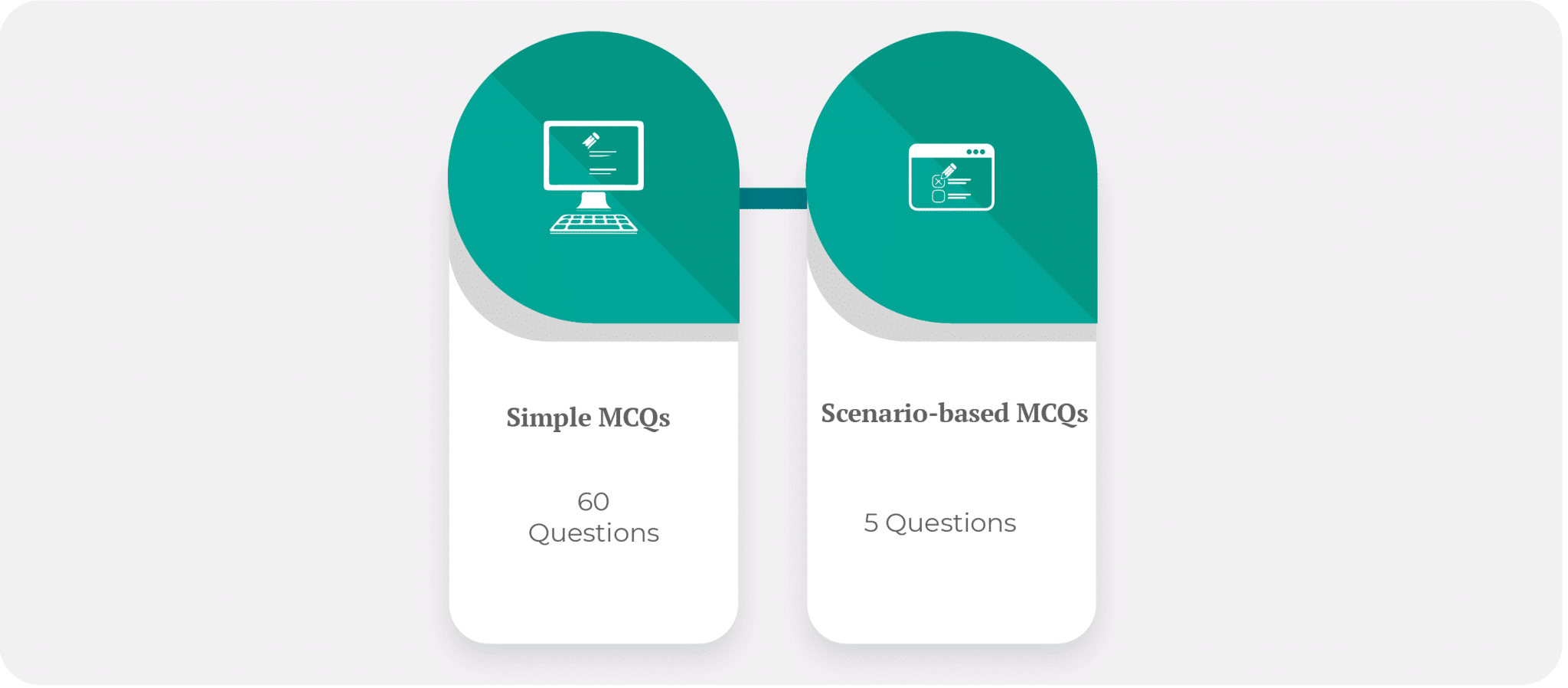
The simple MCQs are relevant to the type of exam chosen. Each test has 60 general questions based on a wide range of subject matter according to the different program settings. Candidates get the exam as per the setting they chose in the Sign Up form.
Winning Tip
Unanswered questions are marked as wrong so it’s advisable to attempt to answer all questions, even if you have to take a guess. This can enhance your score and increase your chances of passing the test.
Here is a sample CDA simple MCQ question:
Sample CDA MCQ question
Which of the following is most likely to help a child who avoids sand texture play in the sandbox?
- Telling the child he should participate as the rest of the children do.
- Telling the child’s friends that he is scared and having them encourage him to try.
- Empathizing with the child’s apprehension but explaining there is nothing to be afraid of.
- Encouraging the child to try on his own terms.
The correct answer is D.
Encouraging the child to try on his own terms – Encouraging the child to take a gradual approach to sand play can help to reduce fear or anxiety. This approach can involve playing with the sand in a way that the child feels comfortable with, such as playing with a toy on the edge of the sandbox, and gradually increasing their level of interaction with the sand over time. This approach allows the child to become more comfortable with the texture of the sand without feeling pressured or forced.
A. Telling the child he should participate as the rest of the children do – This approach may make the child feel pressured and forced to participate, leading to further anxiety or reluctance to engage in sand play.
B. Telling the child’s friends that he is scared and having them encourage him to try – This approach may lead to embarrassment for the child and may not be effective in reducing fear or anxiety related to sand play.
C. Empathizing with the child’s apprehension but explaining there is nothing to be afraid of – While empathy can be helpful, telling the child that there is nothing to be afraid of may not address their concerns and could potentially invalidate their feelings.
CDA Exam Scenario-based Questions
The test also contains five scenario-based MCQs. These are narratives with a photo followed by a question. Candidates are required to choose the best option based on the information they are given.
Scenario-based questions convey situations describing the conditions faced by an educator in the learning process or comprehensive development of a child. An evaluation is made based on the candidates’ skills and knowledge. It judges their decision-making and competency levels.
Winning Tip
Analyze the narrative and photo carefully before jumping to a conclusion. Sometimes there is more than one correct option. The purpose of the exam is to check your judgment skills so take time to understand the scenario. It’s best to tackle these questions first to avoid last-minute judgment pressure.
Here is a sample CDA scenario-based question:
Sample CDA scenario-based question
You are a teacher at a daycare center and you have noticed that one of your three-year-old students, Emily, has recently started displaying aggressive behavior towards her classmates. She has been pushing, hitting, and taking toys away from other children. When you speak to Emily’s parents, they are surprised by her behavior and do not know how to address it. How can you as a teacher help Emily and her parents address this behavior in a positive and effective manner?

- Consider implementing a punishment strategy such as taking away some of Emily’s toys and privileges in order to discourage her disruptive behavior.
- Encourage Emily’s parents and yourself to take a deep breath and wait for the behavior to change. Ignoring Emily’s disruptive behavior will provide her a cue that it is unwanted behavior that should not be carried out.
- Talking to Emily’s parents and collaborating on strategies to promote positive behavior at home. These behaviors are likely to influence her behavior at daycare.
- Partially restrict Emily from playing with other children. Emily would be allowed to observe other children playing and learn from their positive behavior.
The correct answer is C.
Talking to Emily’s parents and collaborating on strategies to promote positive behavior both at home and daycare is the most effective and positive way to address the issue. It’s important to understand that children’s behavior is often shaped by their home environment and parenting style. Collaborating with parents can help in identifying any issues at home that may be contributing to the behavior, and parents can work with the teacher to implement consistent positive strategies both at home and at daycare.
A is an incorrect response as punishment strategies are generally not effective in changing negative behavior in children. It is important to avoid punishing the child as it can lead to feelings of shame, guilt and may worsen the behavior.
B is also an incorrect response. Ignoring Emily’s disruptive behavior may not work as it provides no guidance for the child to learn positive behavior. It may also negatively affect the other children who are being affected by Emily’s behavior.
D is also an incorrect response. Partially restricting Emily from playing with other children may cause her to feel excluded and may worsen her behavior as a way to get attention. This approach may also negatively impact Emily’s social and emotional development.
Did you know?
There are several CDA credential settings candidates can choose from based on where they work in early childhood education, including Infant–Toddler (Center-Based), Preschool (Center-Based), Birth to Five (Center-Based), Family Child Care, and Home Visitor, and the exam for your selected setting typically includes 65 questions total—60 standard multiple-choice questions and 5 scenario-based multiple-choice questions.
CDA Preparation Strategies
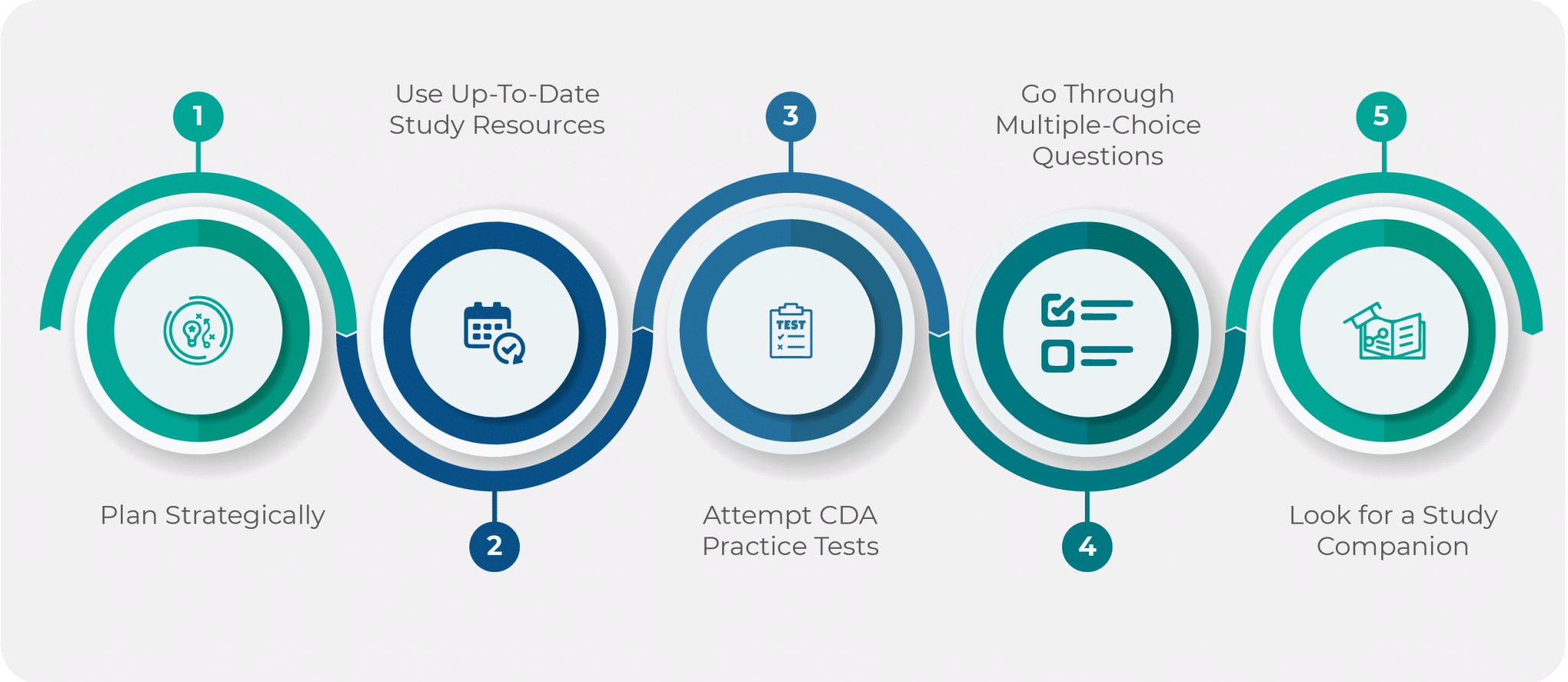
A focused plan and consistent practice can make your exam experience smoother. Use these strategies to stay organized, study efficiently, and feel confident on test day.
Plan strategically
Set a weekly study schedule, list the topics you’ll cover, and choose an exam date that gives you enough prep time. If you’ve received a Ready to Schedule notice, plan around the scheduling deadline listed in your candidate portal.
Use current study resources
Study the CDA Competency Standards for your credential setting and pair them with a structured course or workbook for practice. Before buying printed materials, confirm they match the current CDA settings and standards.
Take practice tests (then review)
Use practice questions to build pacing and confidence. After each quiz or mock exam, review every missed question and write a quick takeaway so you don’t repeat the mistake.
Improve multiple-choice technique
Read the question first, eliminate clearly wrong choices, and choose the best answer for the situation described. Practice this often so your approach feels automatic.
Add accountability (optional)
A study partner can help you stay consistent, talk through confusing topics, and sharpen your thinking for scenario-based questions.
Test Features
Test Fast Facts (tl;dr)
- Computer-based CDA exam
- 65 questions total
- 60 standard multiple-choice
- 5 scenario-based questions
- Time limit: 1 hour 45 minutes (most settings)
- Birth to Five is a separate exam sitting: 1 hour 55 minutes
- English or Spanish available
Exam format
The CDA exam is delivered through Pearson VUE as a computer-based test (typically at a test center). You’ll take the exam for the CDA setting you applied for.
Time on test day: About 2 hours total seat time (includes instructions/practice).
Question types
| Type of questions | Count |
|---|---|
| Standard multiple-choice | 60 |
| Scenario-based (narrative/photo) | 5 |
| Total | 65 |
CDA settings (choose what matches your job)
| Setting | Children’s ages |
|---|---|
| Infant–Toddler (Center-Based) | Birth–3 |
| Preschool (Center-Based) | 3–5 |
| Birth to Five (Center-Based) | Birth–5 |
| Family Child Care | Birth–5 |
| Home Visitor | Birth–5 |
Eligibility snapshot
To apply, candidates typically need training, recent experience, and a completed Professional Portfolio (requirements depend on the setting you apply for).
| Requirement | Minimum (typical) |
|---|---|
| Professional education | 120 training hours |
| Work experience | 480 hours (recent) |
| Professional Portfolio | Completed |
Fees & renewal
Online application fee: $525
Renewal: Every 3 years
Technical Facts
CDA requirements (overview)
To apply for a CDA, candidates typically need to meet age/education requirements, complete 120 hours of ECE training across the required subject areas, and document 480 hours of recent experience in the same setting/age group they apply for.
CDA process (2026)
The CDA process generally follows four steps: prepare, apply, complete assessments, and receive the decision. In 2026, candidates complete the CDA exam before scheduling the Verification Visit. The Verification Visit typically includes a portfolio/document review, an observation in your setting, and a reflective dialogue.
Renewal & test-day rules
CDA credentials are typically renewed on a 3-year cycle. On exam day, candidates follow Pearson VUE security rules (valid photo ID, prohibited items, and confidentiality). Always review the current requirements in your candidate portal and Pearson VUE account.
If you tell me whether this page is meant to be short (sales-focused) or long (guide-style), I’ll match the length across the rest of the blocks automatically.
Results Scale and Interpretations
The CDA credential decision is not based on a single test score. Instead, the Council reviews performance across the CDA functional areas using multiple assessment sources to determine whether a candidate meets the credentialing requirements. Your official outcome is delivered through the Council’s candidate portal and/or email after all required components are received and reviewed.
How results are evaluated:
- Cumulative decision: The Council considers results from the CDA exam and other required assessment components to reach a final credentialing decision.
- Functional-area focus: Exam results are evaluated across the CDA functional areas (not as one overall “percent correct” shown to candidates).
- No published passing score: The Council does not publish a universal cut score (for example, “X out of 65”) for candidates to target.
What your outcome means:
- Credential awarded: Your cumulative results met the program requirements.
- Credential not awarded: Your cumulative results did not meet the program requirements. Your notification typically includes available next steps, such as appeal guidance and/or retake instructions (as applicable).
CDA Test FAQs
The CDA program is a professional credential for early childhood educators working with children from birth through age 5. The Council reviews multiple assessment sources to decide whether a candidate meets credentialing requirements.
Eligibility is based on meeting the program’s requirements for education/training, work experience, and completing required application components. Candidates typically need:
1. A high school diploma/GED (or an approved student pathway, if applicable)
2. 120 hours of professional education covering the required CDA subject areas
3. 480 hours of recent experience in the same setting/age group as the credential setting selected
4. A completed Professional Portfolio (per current program requirements)
The process generally includes:
1. Meet eligibility requirements and prepare required documents (including the Professional Portfolio).
2. Submit your CDA application online and receive your scheduling notifications.
3. Complete the CDA exam through Pearson VUE.
4. Complete the Verification Visit if required for your pathway.
5. Receive the Council’s credentialing decision through official communication channels.
The CDA exam is a computer-based test delivered through Pearson VUE. It typically includes 65 questions total (standard multiple-choice plus scenario-based questions) and is timed.
Use the CDA Competency Standards for your credential setting as your foundation, then add structured practice (quizzes, practice tests, and timed mock exams). Focus on scenario-based questions, pacing, and applying best practices to real classroom or home-based situations.
Candidates pay an application fee when applying. For current fees, always confirm the amount in your candidate portal at checkout. As a reference point, the current online application fee is $525, and the online renewal fee is $250.
A Professional Development (PD) Specialist conducts the Verification Visit when required. The visit typically includes reviewing required documents/portfolio materials, observing you in your setting, and completing a reflective dialogue focused on strengths and professional goals.
The Professional Portfolio is a required collection of documents and reflections prepared by the candidate. It typically includes competency statements, education/training documentation, family questionnaires (as required), a professional philosophy statement, and a resource collection.
Funding may be available through state agencies, employers, or local workforce/early childhood initiatives. Availability and eligibility vary by location.
Timelines vary based on application completeness and the status of all required assessment components. Candidates are notified through the candidate portal and/or email when a decision is available.
Renewal reminders may be sent as a courtesy. You should still track your credential expiration date and renewal window in your account to avoid lapses.
Assessment fees are generally nonrefundable once submitted. Review the current policy shown during the application checkout process for the most accurate terms.
CDA Test Tips
Use these simple tips to make exam day smoother and reduce last-minute stress.
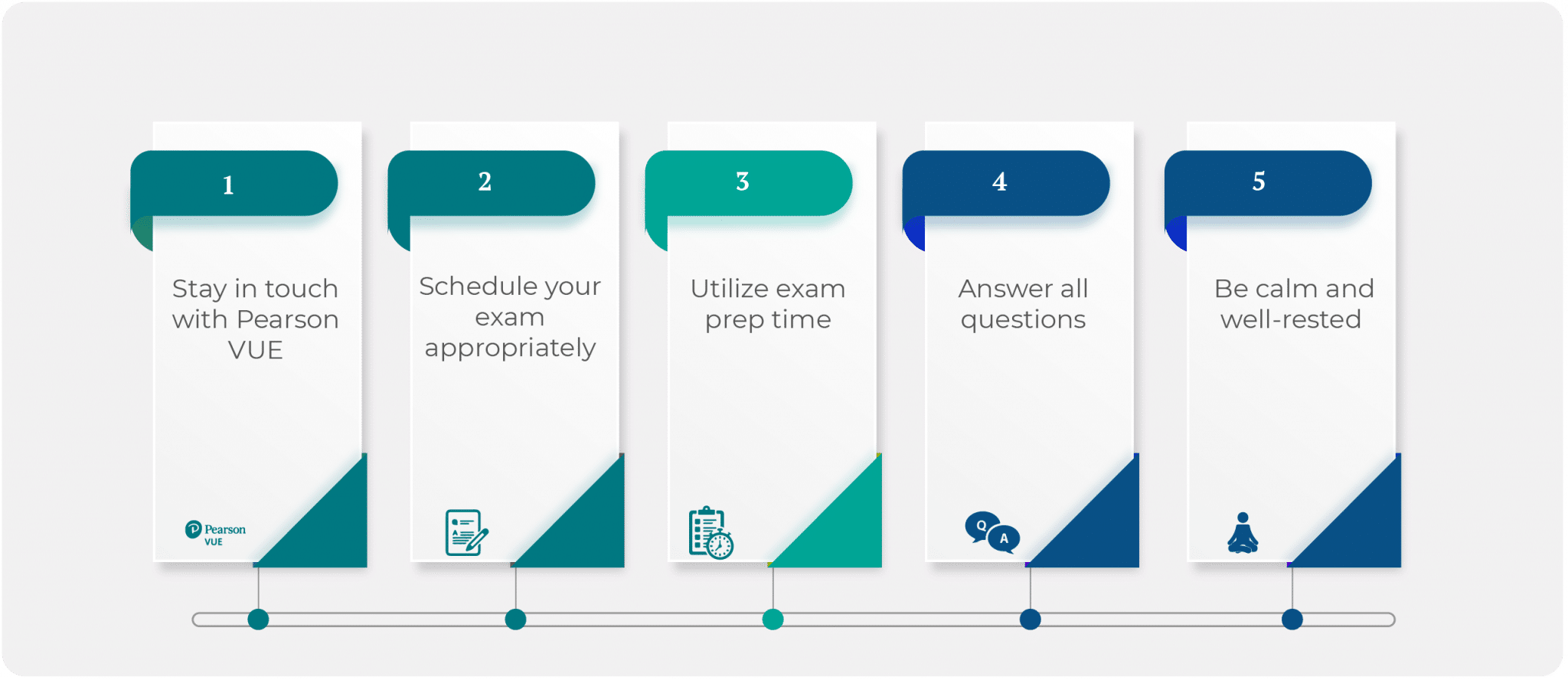
Manage everything in Pearson VUE
Use your Pearson VUE account to confirm your appointment details, check your test center information, and view any scheduling updates. Make sure your email address is current so you receive all confirmations and notices.
Schedule smart
Pick a test date that fits your study plan and schedule within the deadline shown in your candidate portal. Choose a location you can reach easily, and check directions, parking, and arrival time ahead of test day.
Use the instructions/practice time
Before the timed exam starts, you’ll have a short window to review instructions and complete the practice. Use it to get comfortable with the on-screen tools and pace.
Answer every question
If you’re unsure, eliminate clearly wrong options and make your best choice. Don’t leave questions blank.
Show up rested
Get good sleep, eat something that helps you stay focused, and arrive early so you can start calmly.
Administration
Test location: CDA exams are delivered through Pearson VUE (typically at a Pearson VUE test center) on behalf of the Council for Professional Recognition.
Scheduling: After you submit your CDA application online and become eligible to schedule, you’ll use Pearson VUE to choose your test date, time, and location. Follow the deadlines shown in your candidate portal notifications.
Test format: Computer-based exam with multiple-choice questions (includes scenario-based items).
Test materials: No outside materials are allowed. Everything you need is provided on-screen at the test center.
Cost: The CDA application is online-only. The current online application fee is $525 (paid in full at submission). Paper applications are no longer accepted.
Retake policy: If you do not meet the credentialing requirements, your notification will include next-step options, which may include retake guidance (as applicable).
Test Provider
Pearson VUE administers the CDA exam on behalf of the Council for Professional Recognition.
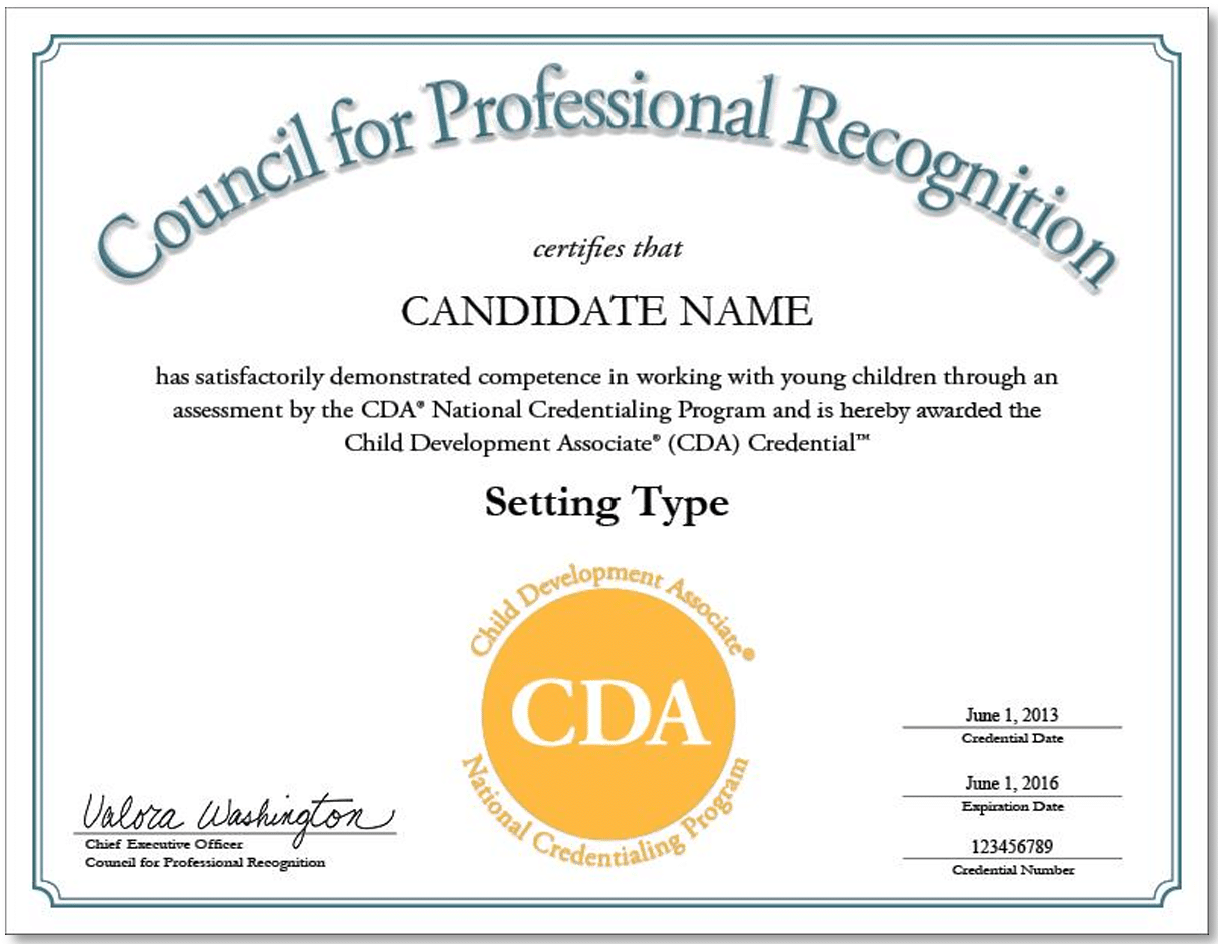
The Council for Professional Recognition oversees the CDA credentialing program and makes the final credentialing decision based on multiple assessment sources. The CDA is designed to evaluate an educator’s ability to apply best practices across the CDA functional areas.
Pearson VUE provides the secure testing platform and test center administration for the computer-based exam, including scheduling and on-site exam delivery.
Information Sources
Disclaimer – All information and preparation materials provided by iPREP are intended for tutoring and study purposes only. iPREP is not affiliated with, endorsed by, or sponsored by the Council for Professional Recognition, Pearson VUE, or any other organizations or trademarks referenced on this page.
Free CDA practice test: Get to know what the Child Development Associate (CDA) test will be like by practicing with these sample questions:
Question 1 of 5
You have a student in your class, 8-year-old Michael, who is struggling with his reading skills. He becomes easily frustrated during reading time, and has started to act out in class as a result. How might you best address this behavior?
- Work with Michael to develop an individualized plan that includes extra one-on-one support during reading time.
- Give Michael a break during reading time to participate in a calming activity before returning to the lesson.
- Implement a reward system for Michael to encourage him to keep trying and improving his reading skills.
- Assign Michael to a more advanced reading group to challenge him and boost his confidence.
The correct answer is A.
Working with Michael to develop an individualized plan that includes extra one-on-one support during reading time is the best approach. This will allow Michael to receive personalized attention and guidance to help him develop his reading skills, and will help him feel supported and understood in the classroom.
The other answer options may not address Michael’s underlying needs and may even exacerbate his frustration and acting out behaviors.
B – While it’s important to help Michael manage his frustration and stress during reading time, simply giving him a break to participate in a calming activity may not address his underlying reading difficulties. Michael may still struggle with reading when he returns to the lesson, which could lead to further frustration and acting out behaviors. A more effective approach would be to work with Michael to identify strategies and techniques that can help him improve his reading skills and manage his frustration and stress during reading time.
C – While it’s important to encourage and motivate students, implementing a reward system alone may not be effective in addressing Michael’s underlying difficulties with reading. Michael may feel pressured to perform to earn rewards, which could exacerbate his frustration and acting out behaviors if he is unable to meet the expectations. Additionally, a reward system may not address the root cause of Michael’s struggles and may not provide the support and guidance he needs to improve his reading skills.
D – While it’s important to challenge students and build their confidence, assigning Michael to a more advanced reading group may not be the best approach for addressing his difficulties with reading. Michael may feel overwhelmed and discouraged if the reading material is too challenging, which could lead to further frustration and acting out behaviors. Additionally, this approach may not provide Michael with the individualized support and guidance he needs to improve his reading skills.
Question 2 of 5
Jack and Jill are siblings who constantly argue and fight over toys, TV shows, and other things. Jack is the older sibling and tends to dominate most situations, while Jill often feels left out and overlooked. Their parents are getting frustrated and want to help the siblings learn how to get along better.
- Separate Jack and Jill and give them individual attention to avoid competition.
- Ask Jack to give Jill what she wants to make her happy and avoid conflicts.
- Talk to the parents about strategies they can use at home to encourage positive sibling relationships.
- Teach Jack and Jill how to compromise and work together to find mutually acceptable solutions.
The correct answer is D.
Teaching Jack and Jill how to compromise and work together to find mutually acceptable solutions is the best way for their parents to help them resolve their conflicts and improve their relationship.
Option A, separating Jack and Jill and giving them individual attention to avoid competition, is not the best approach as it may lead to feelings of favoritism and further fuel their competitive behavior. It is important to teach Jack and Jill how to work together and find ways to share and cooperate.
Option B, asking Jack to give Jill what she wants to make her happy and avoid conflicts, is not the best approach as it reinforces an unhealthy power dynamic in their relationship. It is important to encourage Jack and Jill to communicate and find mutually acceptable solutions instead of one-sided compromises.
Option C, talking to the parents about strategies they can use at home to encourage positive sibling relationships, is not the best approach as it puts the responsibility solely on the parents and does not involve Jack and Jill in the process of resolving their conflicts. It is important for Jack and Jill to learn how to work through their conflicts and build positive relationships on their own.
Overall, teaching Jack and Jill how to compromise and work together to find mutually acceptable solutions is the best way for their parents to help them resolve their conflicts and improve their relationship. This involves fostering open communication, encouraging empathy and understanding, and promoting collaboration and mutual respect between the siblings.
Question 3 of 5
You are a CDA in a preschool classroom with 4-year-old students. You have noticed that one of your students, Maya, seems to be struggling with basic literacy skills like recognizing letters and sounding out words.
What approach can you take to support Maya’s literacy development?
- Assign Maya additional reading and writing tasks during class time to help her catch up to the other students.
- Encourage Maya to practice literacy skills through interactive, play-based activities and games.
- Advise Maya’s parents to hire a private tutor for her to receive additional literacy support.
- Ignore Maya’s literacy struggles as it may discourage her and focus on other areas of development.
The correct answer is B.
The best approach to support Maya’s literacy development is encouraging Maya to practice literacy skills through interactive, play-based activities and games.
Play-based learning is a proven effective way to promote literacy skills in young children. Through play, children can learn the basic skills of literacy, such as recognizing letters and sounds, in a fun and engaging way. Encouraging Maya to practice literacy skills through interactive, play-based activities and games will allow her to develop her skills in a way that is enjoyable and effective. This approach can include games like scavenger hunts where she has to find letters, word games where she has to sound out words, and interactive stories where she can participate in reading and writing.
Option A, assigning Maya additional reading and writing tasks during class time, may not be the best approach as it may feel overwhelming and tedious for her, especially if she is already struggling with basic literacy skills. This may discourage her and further perpetuate her struggles.
Option C, advising Maya’s parents to hire a private tutor for her, may not be the most appropriate approach as it may create additional pressure and stress for Maya, and it may not address the root of the problem. Furthermore, it may not be financially feasible for all families.
Option D, ignoring Maya’s literacy struggles, is not a good approach as it may lead to further struggles and delay in her literacy development. It is important to address areas of struggle and provide support to help children succeed in all areas of development.
Question 4 of 5
Which of the following statements best demonstrates verbal sensitivity to a child’s feelings?
- “You seem upset that you can’t go outside to play. We have to wait until recess to go outside and play, but in the meantime, let’s find something else fun to do inside.”
- “Stop crying and whining. We will go outside to play after lunch, and that’s final.”
- “I can see that you’re feeling sad because we can’t go outside right now. It’s tough when you can’t do what you want to do. Why don’t we have a snack together and then see what we can do inside?”
- “I know you’re disappointed, but crying and yelling won’t help. Let’s finish lunch, and then we can talk about what we can do inside.”
The correct answer is C.
This option addresses the child’s feelings, acknowledges their emotions, and helps them find a way to cope with their sadness. Naming the child’s feelings can help them understand and cope with their emotions in a safe and healthy way. It also offers an alternative activity to help the child feel better.
Option A is a good option because it acknowledges the child’s feelings and suggests an alternative activity, but it could be more specific and direct in addressing the child’s concerns.
Option B is not sensitive to the child’s emotions and instead commands the child to stop crying and whining, which could escalate the child’s emotions.
Option D recognizes the child’s disappointment but is not as sensitive as option C. It also does not offer an alternative activity to help the child cope with their emotions.
Question 5 of 5
How can you help your toddlers become more independent during meal times?
- At this age, you can’t. They can feed themselves and that’s all they need to know.
- Encourage them to set the table, pass food to one another and participate in the cleanup process.
- They should become active in preparing the food and cooking, which will drive them to eat it themselves.
- None of the above.
The correct answer is B.
Encouraging toddlers to set the table, pass food to one another, and participate in the cleanup process can help them become more independent during meal times. By giving toddlers simple tasks to complete, they learn responsibility and gain a sense of accomplishment. Additionally, allowing toddlers to make choices about what they eat and how much they eat can also foster independence.
Option A is not the best approach because toddlers should be encouraged to learn and develop new skills at their own pace. Setting restrictions on what they can or cannot do might limit their potential. Some toddlers can definitely be more active in meals besides eating independently.
Option C is not the best approach because it is not developmentally appropriate for toddlers to be actively involved in food preparation and cooking, as it can be dangerous and they may not have the necessary skills to handle food and kitchen tools safely.
Option D is not the best answer because there are ways to help toddlers become more independent during meal times, as explained in option B.
Sample Flashcards
Boost your exam prep with these key concept flashcards.
About the course
Includes 4 full-length simulations (Per Setting.)
17 Learning hours · 4 Practice tests · 260 Questions · 30 Day access
Start by checking your readiness and choosing the CDA setting that fits your role. Then refresh the knowledge the CDA exam evaluates across six competencies and 13 functional areas, and learn how to handle both standard and scenario-based multiple-choice questions. Finish with full mock tests and targeted analysis so you can tighten decision-making and pacing.

Skills you will learn
Healthy learning environment · Physical and intellectual competence · Social and emotional development · Family relationships · Program management · Professionalism
Curriculum
Course Introduction
- Identify your CDA setting and baseline
- Two readiness assessments with feedback
- Timed and practice CDA assessment simulations
Study Guide & Subject Refresh
- Child development principles and learning environments
- Physical, cognitive, communication, and creative development
- Social-emotional support, guidance, and family partnerships
- Observation, program management, and professionalism refresh
Getting Ready For the CDA Exam
- Understand exam sections and expectations
- Multiple-choice strategies for best-answer selection
- Study planning, memorization, and time management
- Practice scenarios and case-based judgment
Mock Tests
- Three full mock test sets
- Timed and practice modes per setting
- Review explanations to target weak areas
Post-Mock Test Analysis
- Analyze performance patterns and missed concepts
- Prioritize functional areas for final review
Course Conclusion
- Final readiness check and next steps
- Plan scheduling and test-day logistics
Appendix: Additional Resources
- Recommended readings and further study resources
- Professional associations and organizations
- Stress management for exam preparation
- CDA exam FAQs and quick clarifications
Reviews

Ann N*****
February 19, 2026 at 9:00 PM
No, I haven't passed the test but I will do better next time. I need more practice on the reviews and test questions.
Karen P***
December 11, 2025 at 12:03 AM
This course was very informative. I felt I was getting a mini review with every mock test question I answered.
Barbara T*****
November 15, 2025 at 12:15 AM
This has been every helpful in my opinion of study and moving forward with this mindset will keep me on track.
Laura P****
November 14, 2025 at 6:35 PM
This course was very informative and easy to follow. The mock tests were simple to understand and covered all the subject areas needed to complete the course.
Maria Guadalue G****
November 13, 2025 at 9:46 PM
Los aprendisajes de Los niños me ayuda a entender mas sus comportamiento y las diferencias de cada niño y sober todo su conportamiento o temperamento
Laura P****
November 12, 2025 at 4:01 PM
The course was great, and I enjoyed the material provided. I took the mock tests and quizzes and the questions were the same. I am sure there are other questions.
Darceli g******
November 2, 2025 at 10:43 PM
Darcelis Maria super bien la mejor calidad y forma de hacer las cosas y super fácil y practico me encanta tienen superpotencial
Ariana R******
October 23, 2025 at 11:35 PM
El examen de práctica es muy bueno! Me encanta que también está en español, muy bien explicado! Lo recomendaría sin duda alguna!
Alejandra M******
October 13, 2025 at 4:54 AM
Me parece que las actividades que ponen para evitar el estrés son perfectas para ayudar a calmar los nervios y ayuda a la salud mental y física
Alejandra M******
September 25, 2025 at 6:54 PM
Este curso es excelente para ayudarte a prepararte para el examen de CDA tomarlo es una buena ayuda en tu desarrollo personal y da confianza para tu examen.