Reviewed by Tamir Rubin, Head of Product at iPREP • Updated February 2026
CSPDT Exam Sample Question
Topic: Cleaning, Decontamination, and Disinfection
Which one of the following is used in the manufacturing of bleach (decontamination product)?
- Ethyl alcohol
- Sodium hydroxide
- Sodium chloride
- Sodium hypochlorite
Multiple-Choice Questions
Assesses: Knowledge
- Select best answer from options
- Apply infection prevention and safety rules
- Interpret IFU-based processing requirements
- Identify correct decontamination disinfection steps
- Choose sterilization parameters and monitoring
Test Duration
Total time: 180 minutes • 150 multiple-choice questions (25 unscored)
Computer-based exam at a testing center. Passing standard: Scaled score of 70. Avg pace: ~70 seconds per question. Aim for steady progress and leave time to review flagged items.
Test Breakdown & Sample Questions
The CSPDT exam includes 150 multiple-choice questions total: 125 scored questions plus 25 unscored pretest questions. You have 3 hours to complete the exam.
| Topic | Percentage Weight | Approx. Scored Questions (out of 125) |
|---|---|---|
| Roles and Responsibilities | 13% | 16 |
| Life Science | 9% | 11 |
| Decontamination and Disinfection | 19% | 24 |
| Preparation and Handling | 16% | 20 |
| Sterilization | 18% | 23 |
| Sterile Storage, Inventory Management, and Distribution | 11% | 14 |
| Patient Care Equipment | 6% | 8 |
| Ethics | 8% | 10 |
Roles and Responsibilities
This domain covers about 16 scored questions (13% of the scored exam). Topics commonly include:
- Workplace hazards and safety practices (chemical, sharps, slips/trips, electrical, fire, biohazards)
- Standard precautions and safe handling of contaminated items
- Following manufacturer instructions for use (IFUs) for cleaning, assembly, packaging, and sterilization
- Department policies and procedures (infection prevention, safety, incident reporting, quality assurance)
- Regulatory and standards awareness (federal/state/local and facility requirements)
- Workflow and traffic flow to prevent cross-contamination (clean/dirty separation)
- Loaner instrumentation processes and documentation
- Ergonomics and safe body mechanics
- Professional standards (dress code, personal hygiene)
- Recognizing common symbols/markings on packaging and IFUs
Life Science
This domain covers about 11 scored questions (9% of the scored exam). Topics commonly include:
- Basic microbiology as it relates to cleaning, disinfection, and sterilization (including biofilm)
- How infections spread and how cross-transmission is prevented (hand hygiene, barriers, controls)
- Common microorganism types (bacteria, viruses, fungi, prions)
- Conditions that support microbial growth (temperature, moisture, time)
- Basic anatomy and physiology concepts relevant to infection prevention
Decontamination and Disinfection
This domain covers about 24 scored questions (19% of the scored exam). Topics commonly include:
- Cleaning chemistry and correct use (detergents/enzymatics/disinfectants; water quality considerations)
- Factors that affect cleaning effectiveness (soil type, time, temperature, mechanical action, concentration)
- Safe handling of chemicals and high-level disinfectants (PPE, ventilation, contact time, rinsing, disposal)
- Required documentation and monitoring for high-level disinfection (tests/records per facility policy)
- PPE selection and proper donning/doffing for the decontamination area
- Setup, operation, and routine checks of decontamination equipment (e.g., washers, ultrasonics, cart washers)
- Correct loading/unloading techniques to ensure cleaning contact and prevent damage
- Manual cleaning steps for complex devices (e.g., lumens, hinged instruments) and use of approved tools
- Preventing re-contamination after cleaning/disinfection and during transport to the clean area
Preparation and Handling
This domain covers about 20 scored questions (16% of the scored exam). Topics commonly include:
- Set assembly fundamentals (organization, protection of delicate items, accurate labeling)
- Packaging systems and appropriate selection for the sterilization method (pouches, wraps, rigid containers)
- Instrument identification basics (common parts/terms and safe handling)
- Use and placement of chemical indicators/integrators per facility policy and IFUs
- Inspection and functional checks (cleanliness, alignment, sharpness, insulation integrity as applicable)
- Care of instruments (approved lubricants, handling of new instruments, damage prevention)
- Package closures and tamper-evident methods
- Instrument materials/finishes and how they affect handling and processing
- Tray loading considerations (weight, density, arrangement) to support sterilant contact
- Documentation practices tied to assembly and packaging requirements
Sterilization
This domain covers about 23 scored questions (18% of the scored exam). Topics commonly include:
- Sterilization methods and appropriate use (per device IFUs and facility capability)
- Critical cycle parameters and sterility assurance concepts
- Safe operation of sterilizers (loading, unloading, cooling/drying, handling of loads)
- Cleaning and care of sterilization accessories and carts as required
- Recall procedures and response steps when a load is in question
- Recordkeeping and traceability (lot control, load documentation, labeling practices)
- Managing wet packs and other load-quality issues (recognition, causes, required actions)
- Quality monitoring and testing (e.g., routine tests, biological indicators, chemical indicators, documentation)
Sterile Storage, Inventory Management, and Distribution
This domain covers about 14 scored questions (11% of the scored exam). Topics commonly include:
- Factors that affect package integrity and shelf life (event-related considerations)
- Environmental and storage requirements (handling, shelving practices, protection from damage/moisture)
- Inventory control practices (rotation, tracking, accuracy)
- Distribution workflows (case carts, specialty carts, urgent needs)
- Receiving and storage of supplies (protecting sterile and non-sterile items appropriately)
- Tracking and documentation for high-value or specialty items
- Maintaining sterility during transport and delivery
Patient Care Equipment
This domain covers about 8 scored questions (6% of the scored exam). Topics commonly include:
- Collection and safe transport of used patient care equipment
- Disinfection/processing steps appropriate to the device and its IFU
- Storage and distribution practices that prevent damage and recontamination
- Tracking location and utilization per facility procedures
Ethics
This domain covers about 10 scored questions (8% of the scored exam). Topics commonly include:
- Professional conduct and accountability (safety, integrity, teamwork, compliance)
- Reporting and escalation of concerns (policy violations, safety risks, nonconformities)
- Patient, employee, and environmental safety responsibilities
- Following regulatory and facility expectations and supporting a culture of quality
Did you know?
The CSPDT exam includes 150 multiple-choice questions total: 125 scored questions plus 25 unscored pretest questions. It covers eight content areas, including Roles and Responsibilities, Life Science, Decontamination and Disinfection, and Sterilization. To earn CBSPD certification, you must achieve the scaled passing score of 70.
Preparation Strategies
The following strategy will help ensure proper preparation for attempting the certification examination:
- Familiarize yourself with the exam objectives: Make sure you understand what the exam covers by reviewing the exam objectives. You can find the exam objectives on the certification provider’s website.
- Review the recommended study materials: The certification provider usually offers study materials that cover the exam objectives. These materials may include books, training courses, or online resources.
- Opt for an online course: Although it is not compulsory to register for the CSPDT course, it can help you pass the exam. Online courses tend to be preferred over offline ones, as most offline courses are pretty rigid, and you must alter your schedule according to the class timing. Online courses are quite flexible, and you can choose your preferred class times. Additionally, all your study material is saved on a cloud drive that you can access at any time.
- Create a study plan: Create a study plan based on the time you have available before the exam. Break the material down into manageable sections and allocate time for each section.
- Practice with sample questions: Use sample questions or practice exams to get a feel for the type of questions you can expect on the exam. This will help you to identify areas where you need to focus your study efforts.
- Join a study group or discussion forum: Join a study group or discussion forum to learn from others preparing for the exam. You can share study tips, ask questions, and discuss difficult concepts.
- Review regularly: Review regularly to reinforce what you have learned. This will help you retain information and ensures you are prepared for the exam.
Test Features
Test Fast Facts (tl;dr)
- Time limit: 3 hours
- Total questions: 150 multiple-choice questions (125 scored + 25 unscored pretest)
- Content areas: 8 sections
- Question counts by section: varies by section (based on the scored exam)
- Question type: multiple-choice for all items
- How it’s delivered: computer-based testing at an authorized testing provider location (in some cases, an alternate format may be used if CBT isn’t available)
- Passing standard: a scaled passing score of 70
- What to bring: required identification (typically a valid, government-issued photo ID)
- Exam fee: $135 (exam fees and any late/processing fees, if applicable, are set by the program and can change)
Purpose of The Certification
CBSPD certification programs recognize individuals who meet competency-based standards measured by industry expectations.
It also helps to:
- Support consistent, job-relevant sterile processing competency
- Promote education and professional development in sterile processing practices
- Reinforce the importance of continuing education
- Encourage ongoing professional accountability
- Maintain a public registry of certified professionals (as applicable)
Possible to Make Changes in the Application
After registering, you receive a registration confirmation. If you notice an error (such as name or address), contact the CBSPD office as soon as possible to request a correction. Change requests may be time-limited, and additional fees may apply depending on the type of change.
Special Arrangements for Candidates With Special Needs
Reasonable accommodations may be available for eligible candidates under the Americans with Disabilities Act (ADA) at no additional charge.
To request accommodations, submit a written request well in advance of your exam date. Requests typically include:
- A letter from a qualified medical professional describing the functional limitations and recommended accommodations
- A letter from the candidate describing the requested accommodation and how it supports equal access
Accommodation requests are reviewed on a case-by-case basis.
Refund and Rescheduling Possible
Withdrawal, refund, and transfer/reschedule policies vary by exam window and administrative rules. If you need to withdraw or reschedule, submit your request as early as possible and expect that administrative and transfer fees may apply.
Re-Certification
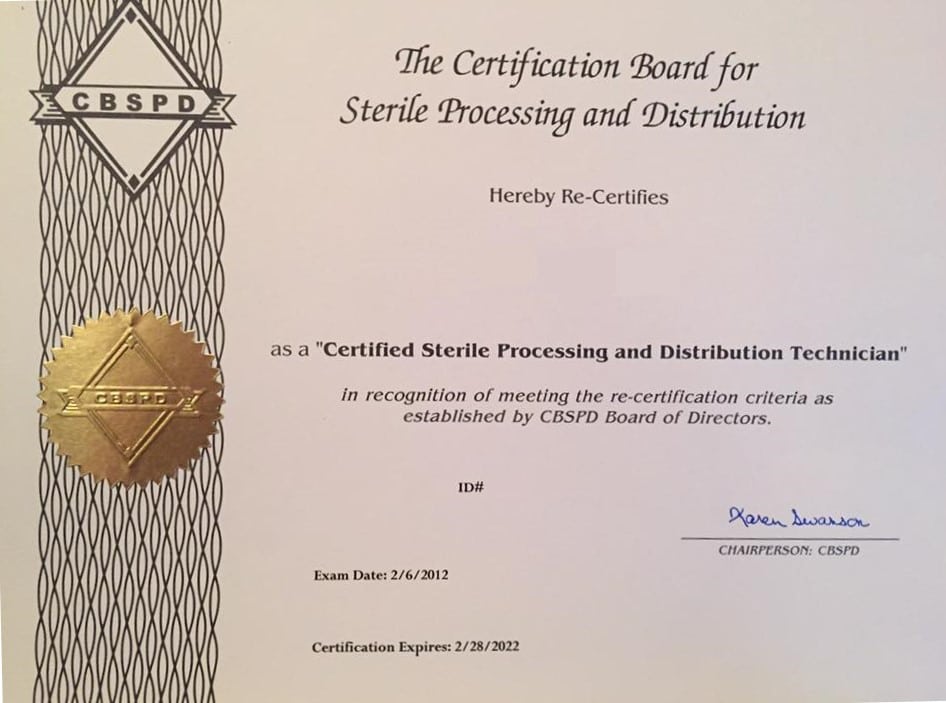
CBSPD certification is typically valid for five years. Recertification generally requires earning continuing education points during the cycle (commonly 100 points over five years) and submitting a recertification application before the credential expires.
Recertification fee: $135.
Technical Facts
Eligibility Criteria
CBSPD eligibility is based on meeting at least one approved pathway by the application deadline. Candidates must be able to read, write, speak, and understand English, since the exam is offered in English.
Eligible pathways typically include one of the following:
- 12 months of full-time employment (or equivalent part-time hours) in sterile processing and distribution activities, verified on the exam application.
- Completion of an SPD training course with a passing grade of 70 or higher, verified by course documentation.
- Related allied healthcare work plus SPD activities with at least 6 months of full-time employment (or equivalent part-time hours), verified on the exam application.
- 12 months of healthcare product sales or service work related to the SPD profession, verified on the exam application.
CSPDT vs. CRCST
| Certification | Issued by | Exam structure | Practical experience requirement | Validity |
|---|---|---|---|---|
| CSPDT (Certified Sterile Processing and Distribution Technician) | Certification Board for Sterile Processing and Distribution (CBSPD) | 150 multiple-choice questions in 3 hours | Eligibility is met through one of several accepted pathways | 5 years |
| CRCST (Certified Registered Central Service Technician) | Healthcare Sterile Processing Association (HSPA; formerly IAHCSMM) | 150 multiple-choice questions in 3 hours | 400 hours of hands-on experience (and other requirements set by HSPA) | 5 years |
CSPDT and CRCST are two different sterile processing certifications offered by different organizations. While both cover core sterile processing knowledge (such as decontamination, inspection, packaging, sterilization, and distribution), they differ in eligibility rules and certification requirements. Always confirm the current requirements for the credential you plan to pursue before applying.
Language and Geography
The exam is offered in English, and candidates are expected to have sufficient English proficiency to take the test. Reasonable accommodations may be available for eligible candidates when requested and approved in advance.
Computer-based testing is typically provided through an approved testing provider. In locations where computer-based testing is not available, testing may be offered in an alternate format at an approved site, based on program availability and local arrangements.
Results Scale and Interpretations
Exam Scores and Result Delivery Method
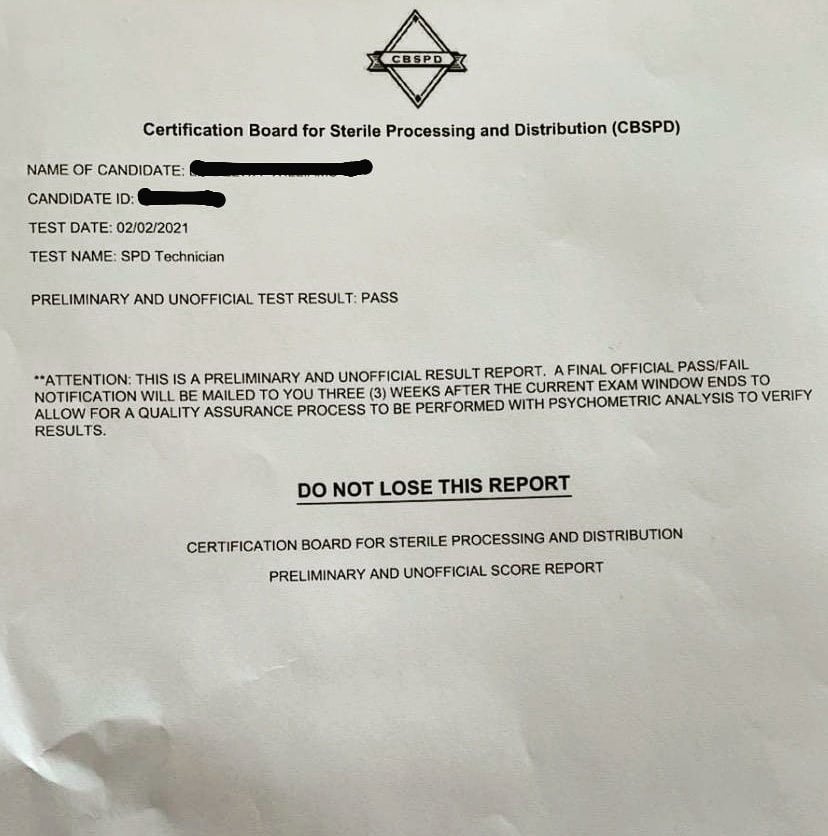
To pass the CSPDT certification exam, candidates must meet the scaled passing standard set by CBSPD. Results for computer-based testing are provided after the exam is completed. Passing candidates receive a pass result and are issued a certificate and ID number after the exam window closes. Candidates who do not pass receive a diagnostic report showing performance by content area.
When paper-and-pencil testing is used in locations where computer-based testing is not available, results are sent after the exam window and can take longer to process. For security reasons, final results are not released by phone or email.
Raw and Scaled Scores
CBSPD administers multiple versions of the exam. Because forms can differ slightly in difficulty, CBSPD uses a scaled score so results are comparable across forms. A scaled score at or above the passing standard is reported as pass, and a scaled score below the passing standard is reported as fail.
Determining Cut Score
The passing standard is set using a standard-setting process designed to reflect the performance of a minimally competent technician. Subject matter experts review exam content and recommended standards, and psychometric analysis is used to support fair scoring across exam forms.
FAQs
CBSPD is a certification organization for sterile processing and distribution professionals. It offers credentialing programs intended to support consistent competency and patient safety.
CBSPD offers multiple certifications, including Certified Sterile Processing and Distribution Technician (CSPDT), Certified Flexible Endoscope Reprocessor (CFER), and Certified Instrument Specialist (CIS).
CSPDT is a certification for professionals working in sterile processing and distribution. It validates foundational knowledge and job-related competency in core sterile processing practices.
Eligibility is met by completing at least one approved pathway by the application deadline. Pathways may include relevant sterile processing work experience, completion of an SPD training course with a qualifying grade, a combination of related allied healthcare work and SPD activities, or healthcare product sales/service related to the SPD profession. Requirements must be verified on the application.
The CSPDT exam is computer-based. It includes 150 multiple-choice questions total: 125 scored questions plus 25 unscored pretest questions. Candidates have 3 hours to complete the exam.
CSPDT certification is typically valid for five years. Recertification requirements are based on continuing education points earned during the cycle and submitting a recertification application before the credential expires.
Certification can help demonstrate job readiness and professional accountability in sterile processing. Some employers use certification as a hiring preference or for advancement.
Applications are submitted to CBSPD according to the program’s current process. Candidates generally submit required eligibility documentation, pay the exam fee, and schedule the exam after approval.
CBSPD uses a scaled scoring system. A scaled passing score of 70 is reported as pass.
CSPDT Test Tips
Following are a few tips that may prove helpful on the exam day:
- Study regularly: Studying regularly over a longer period can be more effective than cramming right before the exam. Make a study schedule and stick to it to cover all the material thoroughly.
- Take care of yourself: Get enough sleep and eat healthy foods in the days leading up to the exam. Being well-rested and alert can help you perform better on the exam.
- Arrive early and be prepared: On exam day, arrive early to allow time to get settled and mentally prepared. Bring all necessary materials, such as identification and any permitted items, and follow the exam rules and regulations.
- Take advantage of the CBSPD Technician Study Guide: The CBSPD has developed a study guide to aid individuals in preparing for the Technician Certification Examination. This guide comprehensively covers all content areas and includes a discussion on test-taking techniques and sample questions. It should be noted that the study guide is not intended to serve as a textbook.
- Effectively manage your time: You will have limited time to complete the exam, so it is important to manage your time effectively.
- Read instructions carefully: Take your time and read all instructions carefully before beginning the exam. Doing so will ensure that you understand what is expected of you. It will help you avoid mistakes or misunderstandings.
- Stay focused and manage your time: During the exam, be focused and manage time wisely. Answer the questions you know first. Go back to the more challenging ones later. Do not spend too much time on a single question. Avoid rushing through the exam.
Administration
- Test Administrators:
CBSPD partners with a third-party testing provider to deliver the exam at authorized test sites. - Test Schedule:
After approval, candidates schedule their exam appointment during the exam window listed for their administration period, based on available appointments. - Test Format:
Computer-based multiple-choice exam. In locations where computer-based testing is not available, testing may be offered in an alternate format at an approved site, based on program availability. - Test Materials:
No outside materials are allowed in the testing room. Candidates must present acceptable identification as required by the testing provider. - Cost:
$135 exam fee. - Retake Policy:
Candidates who do not pass must reapply/register for a new exam administration and pay the exam fee again. Attempt limits, waiting periods, and eligibility rules are determined by CBSPD and may change by administration period.
Test Provider
CBSPD is the certification organization that develops and oversees the CSPDT credential. CBSPD previously operated under a different name and later adopted the CBSPD name.
In addition to CSPDT, CBSPD offers other certification programs, including CSPM, CFER, CIS, and CASSPT.
Resources
Disclaimer – All prep materials and information on iPREP are created for tutoring and practice purposes. iPREP is not affiliated with CBSPD, PSI Services LLC, or any other organization mentioned on this page.
Free CSPDT practice test: Get to know what the Certification Board for Sterile Processing (CBSPD) and Distribution’s Certified Sterile Processing and Distribution Technician (CSPDT) exam will be like by practicing with these sample questions:
Question 1 of 20
Topic: Cleaning, Decontamination, and Disinfection
Which one of the following is used in the manufacturing of bleach (decontamination product)?
- Ethyl alcohol
- Sodium hydroxide
- Sodium chloride
- Sodium hypochlorite
The correct answer is D.
Sodium hypochlorite is also known as bleach. Ethyl alcohol is used as a disinfectant while sodium hydroxide is used in the manufacturing of soaps. Sodium chloride is used in the treatment of patients who take fluids.
Question 2 of 20
Topic: Cleaning, Decontamination, and Disinfection
Which one of the following only shows cleaning agents?
- Detergents, degreaser
- Grease, detergents
- Abrasives, oil
- Acids
The correct answer is A.
They have surfactants and solvent chemicals as an ingredient.
Question 3 of 20
Topic: Cleaning, Decontamination, and Disinfection
Which one of the following is not a disinfection method?
- Chlorination
- Ionizing radiation
- Ozone
- Ultraviolet
The correct answer is B.
Ionizing radiation is a sterilization method. Chlorination, ozone, and ultraviolet are all used in the disinfection process.
Question 4 of 20
Topic: Cleaning, Decontamination, and Disinfection
You are cleaning your living room with a vacuum cleaner. Which statement below describes the correct order so that the rooms become clean?
- Vacuuming the floor and then dusting.
- Dusting the room and then vacuuming.
- Only vacuum as dust is eliminated
- Dust today and then vacuum tomorrow.
The correct answer is B.
Dust the room first and then vacuum to eliminate any dust that may have settled on other surfaces.
Question 5 of 20
Topic: Preparation & Packaging
How often should the warehouse be disinfected?
- Weekly
- Monthly
- Daily
- Anually
The correct answer is D.
You should disinfect annually as long as your warehouse is kept clean.
Question 6 of 20
Topic: Preparation & Packaging
What is the best temperature for flowers in the preparation and packaging room?
- 35°F-50°F
- 25°F-30°F
- 33°F-37°F
- 40°F-42°F
The correct answer is C.
33°F-37°F. Most flowers require a temperature between 33°F to 37°F to survive. However, tropical flowers and blossoms require temperatures above 50°F. Thus, the only option that falls between 33°F to 37°F is C as there is no option for above 50°F.
Question 7 of 20
Topic: Preparation & Packaging
What is the oldest packaging material in the world?
- Metal
- Plastic
- Tin
- Glass
The correct answer is D.
Glass is the oldest packaging material. It was invented over 5,000 years ago.
Question 8 of 20
Topic: Preparation & Packaging
What type of pressure is used to package food and beverage products?
- High pressure
- Low pressure
- High temperature
- Low temperature
The correct answer is A.
The use of high pressure eliminates harmful microbes from packaged food and beverages.
Question 9 of 20
Topic: Sterilization Process
Microorganisms are destroyed using a steam reaction known as?
- Third-order
- First-order
- Second-order
- None of the above
The correct answer is B.
First-order sterilization is a process of destroying microorganisms by steam.
Question 10 of 20
Topic: Sterilization Process
Which of the following processes only shows sterilization methods?
- Heat, radiation, chemical agents
- Pasteurization, high pressure, heat
- Ultrasonic, heat, pasteurization
- All of the above
The correct answer is A.
Heat, radiation, and chemical agents are sterilization processes. Pasteurization is a disinfection method so options B and C are incorrect.
Question 11 of 20
Topic: Sterilization Process
I want to use batch sterilization for medical tools. What is the best temperature and then state a reason for your answer?
- 100°C
- 102°C
- 112°C
- 121°C
The correct answer is D.
The high temperature has high pressure which is used to kill microorganisms.
Question 12 of 20
Topic: Sterilization Process
Sterilization deactivates different spores of organisms. Which one is referred to as control?
- Asexual spores Endospores
- Exospores
- None of the above
The correct answer is B.
Endospores have high resistance to heat. It is also one of the hardiest microbial contaminants.
Question 13 of 20
Topic: Patient Care Equipment
Which item of clinical equipment can you use to stop a person’s bleeding?
- Air bellow
- MRI
- Penlight
- Hemostat clamp
The correct answer is D.
It is a surgical tool that compresses blood vessels to stop bleeding.
Question 14 of 20
Topic: Patient Care Equipment
Tom just told the doctor he is having difficulty reading from the blackboard. Which tool will the doctor first use to examine Tom’s pupil dilation?
- Penlight
- Draw sheet
- Retinoscope
- VT 1 vision screener
The correct answer is A.
A penlight is a small flashlight with an LED bulb that doctors use to examine the condition of the pupil.
Question 15 of 20
Topic: Sterile Storage and Inventory Management
Which statement describes the minimum required SPD sterile storage conditions?
- High humidity but a controlled temperature
- Controlled humidity and temperature
- Controlled humidity and high temperature
- Controlled temperature and humidity but not traffic limit
The correct answer is B.
A controlled humidity of 30%-60% and a temperature of 18°C-23°C (64°C-74°C) is the minimum required temperature range. For option D, traffic needs to be limited. For option A, high humidity is not required and for option C, high temperature is not required.
Question 16 of 20
Topic: Sterile Storage and Inventory Management
What is the substance inside the ABC extinguisher?
- Ammonium phosphate
- Carbon dioxide
- Water
- Ammonium nitrate
The correct answer is A.
Ammonium phosphate is a flame retardant.
Question 17 of 20
Topic: Documentation and Record Maintenance
Which of documentation is not useful to a company’s staff?
- Goal-oriented documents
- Information-oriented documents
- Products’ how-to guides
- Reference documents
The correct answer is C.
How-to guides are useful to clients. Goal-oriented documents remind the staff of the company’s goals. Information-oriented documents share different information about the products and staff use it to confirm items. Reference documents are used by staff to refer to a certain clause.
Question 18 of 20
Topic: Customer Relations
A person comes into the office shouting about being overcharged for their subscriptions. What is the best way to handle the issue as you are registering a new client?
- Take the person to your supervisor.
- Say that the overcharged amount will be deducted from next month’s subscription.
- Inform the person you cannot cancel the receipt.
- Ask for their receipt and confirm their claim.
The correct answer is D.
Before giving any definite answer, ask for the receipt and confirm that their claim is true.
Question 19 of 20
Topic: ethics
A sterile processing technician discovers a discrepancy in the inventory count of a high-demand surgical instrument. The technician realizes that a coworker, who is known to be experiencing financial difficulties, has been taking these instruments home for personal use without authorization. What is the most ethical course of action for the technician to take?
- Ignore the situation to avoid conflict and potential repercussions.
- Confront the coworker directly about the unauthorized actions.
- Report the incident to the supervisor or department manager.
- Purchase replacement instruments to cover up the discrepancy.
The correct answer is C.
The most ethical course of action for the technician is to select option C) Report the incident to the supervisor or department manager. This ensures that appropriate action is taken to address the unauthorized actions and maintain patient safety. Options A, B, and D are incorrect. Option A ignores the problem, option B may escalate the situation, and option D involves fraudulent actions and does not address the issue properly.
Question 20 of 20
Topic: Life science
Which of the following is NOT a characteristic of viruses?
- They are capable of independent reproduction.
- They require a host cell to reproduce.
- They can cause a wide range of diseases.
- They contain genetic material (DNA or RNA).
The correct answer is A.
Viruses are not capable of independent reproduction. They are obligate intracellular parasites that require a host cell to reproduce. Once inside a host cell, viruses utilize the cellular machinery of the host to replicate their genetic material and produce more virus particles. Viruses cannot carry out essential metabolic functions independently and rely on host cells for their replication and survival.
Sample Flashcards
About the course
Includes 14 practice tests (6 full-length simulations)
20 Learning hours · 14 Practice tests · 900 Questions · 400 Flashcards
This course builds exam readiness for the CBSPD CSPDT certification test by combining targeted practice across all eight content areas with realistic, full-length simulations. You’ll start by orienting to the exam format, then drill section-based questions with step-by-step video explanations. Finish with test-day guidance and CSPDT-style simulations to sharpen pacing and confidence under exam-like conditions.

Skills you will learn
Roles and Responsibilities · Life Science · Decontamination and Disinfection · Preparation and Handling · Sterilization · Sterile Storage, Inventory Management, and Distribution · Patient Care Equipment · Ethics
Curriculum
Course Introduction
- Course navigation and study workflow
- How to use practice and simulations
CBSPD-CSPDT Certification Exam Format
Section 1 – Roles and Responsibilities
- Safety, IFUs, and SPD workflow drills
Section 2 – Life Science
- Microbiology and infection prevention refresh
Section 3 – Decontamination and Disinfection
- Cleaning, disinfection, and PPE scenarios
Section 4 – Preparation and Handling
- Inspection, assembly, packaging, indicators practice
Section 5 – Sterilization
- Cycles, monitoring, recalls, load handling
Section 6 – Sterile Storage, Inventory Management, and Distribution
- Storage conditions, inventory, distribution workflows
Section 7 – Patient Care Equipment
- Processing and transport of care equipment
Section 8 – Ethics
- Professional conduct and compliance decisions
Preparation Strategies and Test-Day Tips
- Study plan aligned to exam outline
- Pacing, guessing, and review tactics
- Test-day checklist and identification tips
Full-Length CSPDT-Style Simulation Tests
- Six CSPDT-style simulations, timed and practice
- Review explanations and performance feedback
Course Conclusion
- Next steps and continued practice plan
Reviews

Ramsey R******
March 19, 2026 at 7:46 AM
So far this is everything I had hoped for! The full explanations of the answers whether correct or incorrect are invaluable! In conjunction with my classes, I’m sure to pass!
Daniel A****
August 2, 2025 at 11:00 PM
This service kicks butt! they give you everything you need to ace an exam. You do need an in-person sterile processing school to teach you the initial concepts, but this will get you ready for the exam itself. No complaints, totally worth the $30 for the responsiveness and interface.
jon l*
July 18, 2025 at 12:32 AM
The test questions don't really cover the sterilization techniques which is a large part of the exam. Sort of a disappointment. I was able to find better study material elsewhere.
Tammy D******
July 12, 2025 at 6:04 PM
I am trying to study for exam and I cant get to the part where they have multiple choice. All I see is flash cards. I don't want that. I paid 40 dollars for this . I need the multiple choice section which I had before ,
iPrep
July 12, 2025 at 6:17 PM
Hi Tammy. In the "Full-Length CSPDT-Style Simulation Tests" unit we have plenty of tests for you. Good luck on your test!
Lolita D****
April 25, 2025 at 1:07 AM
Thank you iPrep team!!! Whoever put this exam together, they knew just what they were doing. I love how the material of sterile processing regarding surgical instuments, medical devices, is well explain, emphasizing the importance of properly cleaning both simple and complex designed instruments, especially flexible scopes. Without cleaning correctly, sterilization can not be effective. Yes, I am on the same team as we want to reduce HAI and SSI from occuring in patients . Our goal is for the safety of patients.
Ashanti R*************
January 29, 2025 at 3:33 PM
This course helped me prepare for my certification in ways I could have never imagined. I will definitely use this site in the future when studying for my BS in Healthcare Admin/Mgmt.
Isabel E******
January 22, 2025 at 11:21 PM
This program is excellent to prepare you for the CSPDT exam! Thank you to iprep for this amazing program. Thank you so much!
Zandra L*****
January 19, 2025 at 7:34 AM
Really like the material, let’s see how it goes for me. First time to take it nervous but feel confident with this material
Jazsmin L******
January 17, 2025 at 9:12 PM
Iprep has helped me study so much for my upcoming exam, I was so nervous before but I'm starting to feel more confident! Thank you!