Reviewed by Tamir Rubin, Head of Product at iPREP • Updated August 2026
What is the Computer-Based Assessment for Sampling Personal Characteristics (CASPer)?
The Computer-Based Assessment for Sampling Personal Characteristics (CASPer) measures professionalism and social judgment for admissions. Most 2026–2027 test types use 11 scenarios: 4 video-response and 7 typed-response, with two questions each. Total time varies by cycle and test type, typically 65–85 minutes. (Test format updated: Feb. 2025)CASPer Sample Question
If you were the nurse, what steps would you take to address Ms. Smith’s concerns regarding her medical bills?
CASPer Test Sections
Section 1: Video Responses
4 video responses
- 4 video-response scenarios, two questions
- 30-second reflection per scenario
- 10-second prompt per question
- 1-minute recorded answer per question
- Questions shown one at time
- Optional 10-minute break after Section 1
Section 2: Typed Responses
7 typed responses
- 7 typed-response scenarios, two questions
- 30-second reflection per scenario
- Two questions shown together
- 3.5 minutes to type both
- Optional 5-minute break after first four
- Optional break after first four
Test Duration
Total time: varies by admission cycle/test type (typically 65–85 min)
The 2026–2027 standard format is typically 65–85 minutes; optional breaks can add up to 15 minutes if taken. Other test types and cycles can differ, so confirm your exact format and timing in your test account.
Test Breakdown & Sample Questions

CASPer uses scenario-based prompts. To avoid confusion, it helps to separate how the prompt is shown from how you respond.
Scenario delivery formats
- Video-based scenario: you watch a short video prompt.
- Word-based scenario: you read a written prompt.
Response modes
- Video response: you record yourself answering.
- Typed response: you type your answer.
How the current CASPer test is structured
| Section | Response mode | Scenario delivery format | Scenarios | Optional break |
|---|---|---|---|---|
| Section 1 | Video response | Video-based or word-based | 4 | 10 minutes after this section |
| Section 2 | Typed response | Video-based or word-based | 7 | 5 minutes after the first 4 scenarios |
What happens in each scenario
| Scenario type | Reflect page | Questions | How questions appear | Timing |
|---|---|---|---|---|
| Video-response scenario | 30 seconds | 2 | One at a time | Per question: 10 seconds to read + 1 minute to record |
| Typed-response scenario | 30 seconds | 2 | Both shown together | Per scenario: 3 minutes 30 seconds total to type both answers |
Video-Based Scenarios
In video-based scenarios, you watch a brief video of a realistic situation. You then answer two open-ended questions based on what you observed.
What these scenarios typically assess
- Ethical reasoning: noticing potential ethical issues and explaining a fair, responsible approach.
- Empathy and communication: recognizing others’ perspectives and choosing respectful, constructive language.
- Problem-solving and critical thinking: identifying options, weighing trade-offs, and proposing a practical next step.
What to expect
A prompt will set your role (for example, as a friend, teammate, or colleague). You’ll watch the video, then continue into the scenario workflow.
Time management (video-response scenarios)
- Reflect page: 30 seconds
- Questions: 2 (shown one at a time)
- Per question: 10 seconds to read + 1 minute to record your response
Key points to remember
Focus on the people involved, name the competing concerns, explain your reasoning clearly, and propose a realistic, respectful action.
Video-Based Scenario
Question 1: What are the ethical dilemmas faced by the nurse in this scenario?
Question 2: How should the nurse communicate with the agitated man to ensure that he understands the situation?
Detailed Explanation for Responses
Question 1: The nurse is facing several ethical dilemmas in this scenario:
- Allocating resources and prioritizing care: The nurse must decide how to allocate limited resources and staff time in an emergency room where patients have varying levels of urgency.
- Balancing patient needs and expectations: The nurse must balance the immediate needs of the agitated man with the critical condition of other patients, such as the one having trouble breathing.
Question 2: The nurse should communicate with the agitated man using the following strategies:
- Remain calm: By staying calm, the nurse can help to de-escalate the situation and encourage the man to do the same.
- Empathize: The nurse should acknowledge the man’s concerns and express understanding for his frustration.
- Explain the situation: The nurse should clearly explain the triage process, emphasizing that patients are seen based on the severity of their condition, and assure him that they are doing their best to attend to everyone as quickly as possible.
Please note that the Casper Test does not have definitive “right” answers, as it is designed to assess your thought process and judgment. The explanations provided here are just examples of well-reasoned responses that take into consideration ethics, communication, and problem-solving.
Word-Based Scenarios
Word-based scenarios present a short written description of a situation. You then answer two open-ended questions based on what you read.
What these scenarios typically assess
- Reading comprehension: understanding key details, context, and what’s being asked.
- Ethical reasoning and judgment: identifying the core issues and explaining a fair, responsible approach.
- Empathy and communication: recognizing perspectives and responding respectfully and constructively.
- Reflection and personal insight (sometimes): explaining how your values or past experiences shape your decision-making.
What to expect
You’ll read a brief prompt, then move into the scenario workflow.
Time management (typed-response scenarios)
- Reflect page: 30 seconds
- Questions: 2 (shown at the same time)
- Total typing time: 3 minutes 30 seconds to respond to both questions
Key points to remember
Read carefully, focus on the most important facts, explain your reasoning clearly, and keep your response practical, respectful, and well-structured.
Word-Based Scenario
Scenario: You are a medical student working on a group project with three other classmates. One of the members, Alex, has not been contributing to the project. The deadline is approaching and the rest of the group is concerned about how Alex’s lack of participation will affect the final grade. You have been nominated by the group to talk to Alex.
Question 1: What are the potential reasons for Alex’s lack of participation?
Question 2: How should you approach the conversation with Alex to discuss his lack of contribution?
Detailed Explanation for Responses
Question 1: There could be several potential reasons for Alex’s lack of participation:
- Personal issues: Alex might be facing personal challenges or health issues that are preventing him from contributing.
- Overwhelmed with work: Alex could be struggling to manage his time efficiently, possibly due to a heavy workload or other commitments.
- Lack of interest or motivation: It’s also possible that Alex is not interested in the project or lacks the motivation to contribute.
Question 2: When approaching the conversation with Alex, the following strategies should be employed:
- Be empathetic: Start the conversation by showing concern for Alex and asking if there is any reason for his lack of participation.
- Be clear and honest: Clearly express the group’s concerns regarding the project and how his lack of contribution is affecting the team.
- Offer help: Ask Alex if there is anything the group can do to support him in contributing to the project.
As with video-based questions, it’s important to remember that the Casper Test is assessing your thought processes and judgment. There are no absolute “right” answers, but thoughtful and well-reasoned responses are key.
Did you know?
CASPer focuses on how you think, not what you’ve memorized. In the current format, you complete 11 scenarios across a video-response section and a typed-response section, with two questions per scenario and a brief 30-second reflection before answering. With optional breaks, the test typically takes 65–85 minutes.
Casper Preparation Strategies
CASPer prep is mostly about clear thinking under time pressure—not memorizing content.
- Know the format & timing: so you can focus on answers, not surprises.
- Practice timed typing + 1-minute speaking: aim for clear, structured responses.
- Use a repeatable framework: acknowledge perspectives → name the main issue → choose a fair next step → explain why.
- Do realistic practice: answer sample scenarios on the clock, then revise for clarity.
- Get quick feedback: ask someone to check if you sound empathetic, practical, and concise.
- Set up your test environment: stable internet, quiet space, working camera/mic.
Test Features
Purpose
CASPer is designed to assess professional attributes that matter in people-focused roles—such as judgment, empathy, ethical decision-making, and communication—alongside academic measures used by schools.
Scenario-based format
You’ll respond to realistic situations presented in two ways:
- Video-based scenarios: you watch a short scene and answer open-ended questions.
- Word-based scenarios: you read a brief prompt and answer open-ended questions.
Timed experience
CASPer is a timed assessment designed to reflect real-world decision-making under pressure. The exact timing and flow can vary by test version and program requirements.
Online administration
The test is taken online. Plan for a quiet space, a reliable internet connection, and a device that meets the technical requirements provided in your exam account.
Language availability
CASPer is offered in multiple languages, depending on the program and test date you register for.
Test integrity
To support score validity, CASPer includes identity and security checks. The specific measures used can vary by location and testing setup.
Use in admissions
Many professional programs use CASPer as one part of a broader admissions review, alongside academic records and other application components.

Technical Facts
Test Fast Facts (tl;dr)
- Delivered online, take from home
- Typical total time: 65–85 minutes
- Two sections: video and typed
- Standard format: 11 scenarios—4 video-response, 7 typed-response; prompts may be video-based or word-based
- Two open-ended questions per scenario
- Timed: 1-min video, 3.5-min typed
- Needs webcam, mic, internet
Mode of Delivery
CASPer is delivered online. You take it on a computer from a quiet location with a reliable internet connection.
Test Length
Most test-takers finish in about 65–85 minutes, including the two sections and any optional breaks.
Scenario Timing (current format)
- Video-response scenarios: each question is timed separately (brief reading time, then a short recorded response).
- Typed-response scenarios: both questions share one timed typing window.
Technical Requirements
A laptop or desktop computer, reliable internet, and a working webcam and microphone are required for the entire test. Use the latest Chrome or Firefox and complete the System Requirements Check within six hours of your test start time.
Scoring and Results
Responses are evaluated by human raters. Applicants typically see a quartile score in their account after testing, while programs receive results through their admissions process.
Retake Policy
Applicants may take the same Casper test type only once per admissions cycle. A separate test is required for a different test type, country, language, or future admissions cycle. Retakes are considered only for verified technical issues reported to Acuity Insights within one week.
Common names for the Casper Test
The Casper Test is commonly referred to by the following names:
- Casper
- Computer-Based Assessment for Sampling Personal Characteristics
- CASPer Test
- CASPer Exam
It’s important to note that “Casper” is often used informally to refer to the test, while “Computer-Based Assessment for Sampling Personal Characteristics” is the full official name. The variations in capitalization (“CASPer” vs “Casper”) are often used interchangeably.
Results Scale and Interpretations
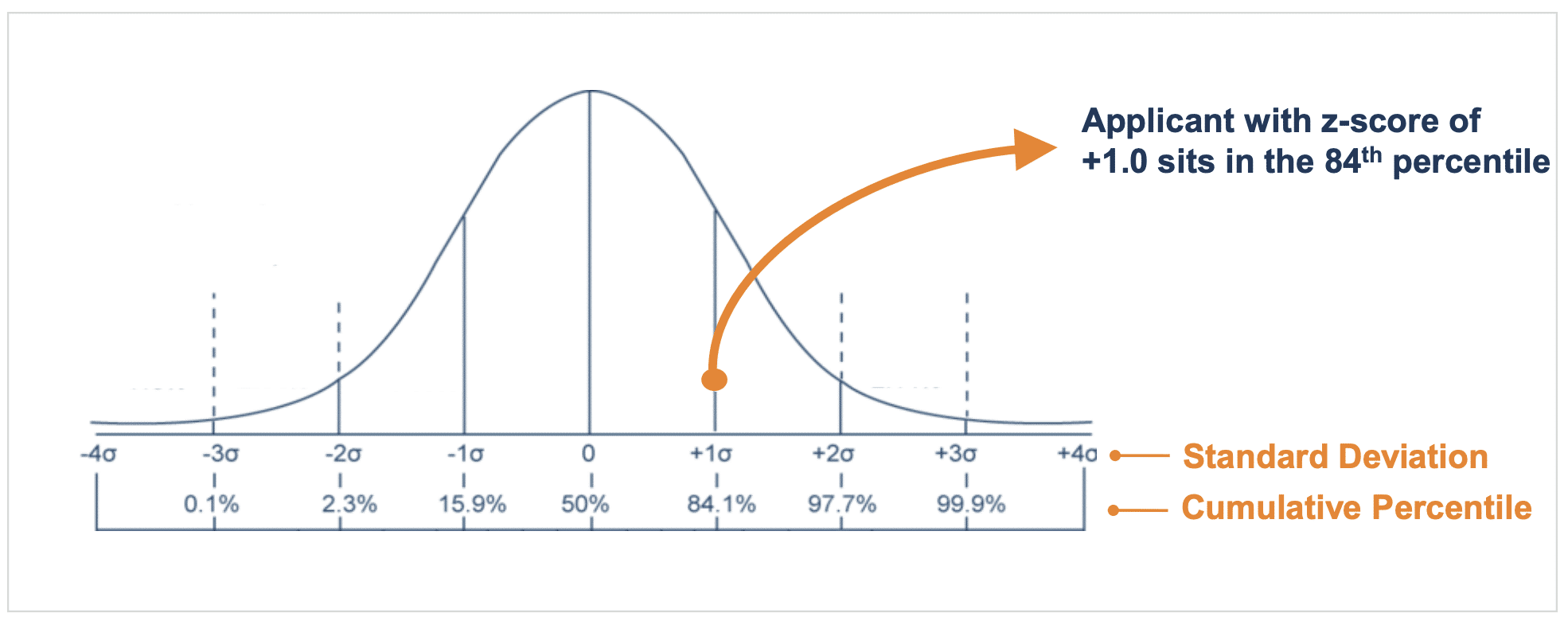
CASPer does not report a traditional “right/wrong” score. Instead, applicants typically receive a quartile result that shows how their overall performance compares to other test-takers in the same testing cohort.
What you receive
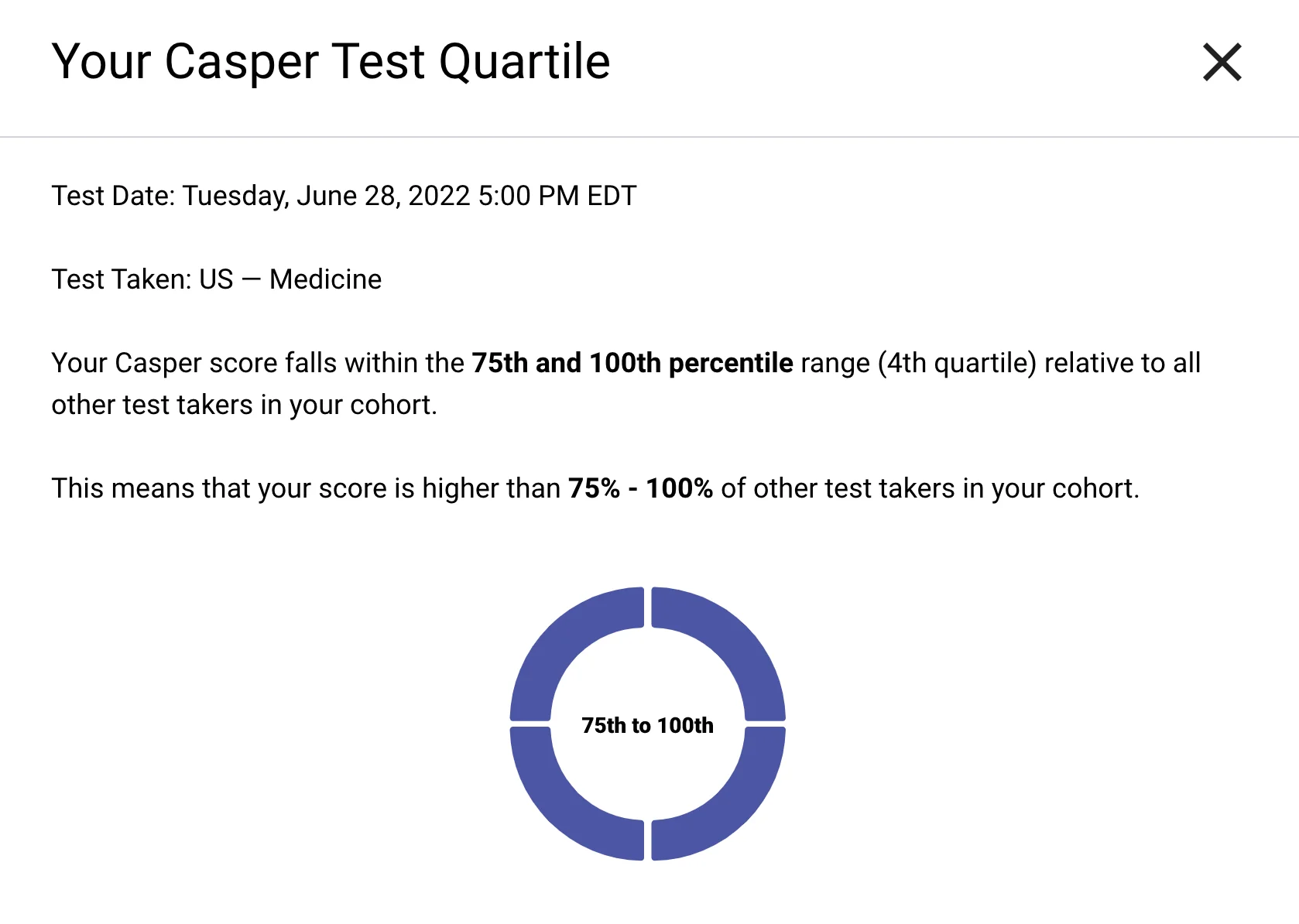
You typically see your quartile score (1st–4th) in your CASPer account after the test window (timing can vary by test date and program).
What programs receive
Programs you selected receive your results through their admissions process, usually before your quartile is released to you.
What a quartile means
Quartiles split results into four broad performance groups relative to other applicants who completed the same test type.
| Quartile | General interpretation |
|---|---|
| 1st | Lower relative performance |
| 2nd | Below the cohort midpoint |
| 3rd | Above the cohort midpoint |
| 4th | Higher relative performance |
How responses are evaluated
Responses are reviewed by trained human raters. Scoring focuses on the quality of your reasoning and communication (for example, how you consider perspectives, explain decisions, and propose practical next steps). Raters do not see your personal identifying information, and writing mechanics (like spelling) are not the primary focus.
Important to know
There is no universal “passing” quartile. Different programs may weigh CASPer differently within their overall admissions review.
Casper Test FAQs
CASPer is an online, scenario-based assessment used by many professional programs to evaluate personal and interpersonal skills such as judgment, empathy, and communication.
CASPer is designed to assess skills such as:
– Empathy and perspective-taking
– Ethical judgment
– Communication
– Problem-solving and decision-making
– Professionalism and collaboration
For most 2026–2027 Casper test types, CASPer is made up of 11 scenarios:
– 4 video-response scenarios
– 7 typed-response scenarios
Each scenario includes a 30-second Reflect page and 2 open-ended questions. Prompts may be video-based or word-based, and some test types use a different format.
Most test-takers finish in about 65–85 minutes (including any optional breaks).
– Video-response scenarios: questions appear one at a time. For each question, you have 10 seconds to read it and 1 minute to record your response.
– Typed-response scenarios: both questions appear together. You have 3 minutes 30 seconds total to type both answers.
You typically do not receive a traditional numerical score. Applicants usually receive a quartile result (1st–4th) that shows how their performance compares within their testing cohort.
Yes. The best prep is to learn the format, practice responding under time limits (typed and video), and get comfortable explaining your reasoning clearly and respectfully.
Programs use CASPer as one piece of a broader admissions review, alongside other parts of your application. How it’s used varies by program.
CASPer is primarily used for admissions. If an employer asks for it, follow that organization’s instructions.
Applicants may take the same Casper test type only once per admissions cycle. A separate test is required for a different test type, country, language, or future admissions cycle. Retakes are considered only for verified technical issues reported to Acuity Insights within one week.
You need a laptop or desktop computer, reliable internet, the latest Chrome or Firefox, and a working webcam and microphone for the entire test. Complete the System Requirements Check within six hours of your test start time.
No. Once time runs out and you move on, you can’t return to review or change previous answers.
CASPer is available in multiple languages, but options vary by program and test date. Check the options shown when you register.
Use the support options provided in your CASPer account or test platform for your test date.
Quartiles place results into four broad performance groups relative to others who took the same test type:
– 1st quartile
– 2nd quartile
– 3rd quartile
– 4th quartile
A lower quartile does not mean you failed. It means your responses were rated lower relative to other test-takers in your cohort.
Programs weigh CASPer differently. Some may consider it more heavily than others, and there is no universal “required” quartile across programs.
Casper Test Tips
- Do a quick format refresh: Review the two sections and timing so nothing feels new once the test starts.
- Warm up your typing and speaking: Do 2–3 timed practice prompts (typed and video) right before you begin.
- Answer with a simple structure: Acknowledge perspectives → state the main issue → propose a fair next step → explain why.
- Watch the clock:
- Video responses: keep each recorded answer focused and complete within the minute.
- Typed responses: split your time across both questions—don’t perfect the first and rush the second.
- Be clear and specific: Use short paragraphs and concrete actions (who you’d speak to, what you’d say, what you’d do next).
- Set up your space: Quiet room, good lighting, stable internet, and working camera/mic. Close extra tabs/apps.
- Stay calm: If a prompt surprises you, use the reflection time to pick a direction and commit to a reasonable, respectful plan.
Administration
Test location: CASPer is taken online. Choose a quiet, private space with a stable internet connection, good lighting, and minimal interruptions.
Test schedule: CASPer is offered on specific dates. You’ll select an available date during registration in your CASPer account, so register early to get the date that fits your programs.
Test format: The test is scenario-based (video-based and word-based prompts) with open-ended responses. You’ll complete both recorded video responses and typed responses. There are no multiple-choice questions.
Test materials: You may use blank paper and a pen/pencil for notes during the test. If you use paper, keep it blank before the test and follow the on-screen instructions for handling it.
Cost: There is a registration fee, and additional distribution fees may apply depending on how many programs you send results to. Pricing is shown during registration.
Retake policy: Applicants may take the same Casper test type only once per admissions cycle. A separate test is required for a different test type, country, language, or future admissions cycle. Retakes are considered only for verified technical issues reported to Acuity Insights within one week.
Test Provider
CASPer is developed and administered by Acuity Insights (formerly Altus Assessments). Acuity Insights provides admissions assessments used by many professional programs to better understand applicants’ personal and interpersonal skills alongside academic criteria.
In addition to Casper, Acuity Insights also offers other admissions tools, including Duet, that some programs may require as part of a broader application review. Requirements vary by program, so check your Acuity Insights account and each program’s instructions.
Information Sources
- Acuity Insights
- Association of American Medical Colleges (AAMC)
- American Association of Colleges of Osteopathic Medicine (AACOM)
- Association of American Veterinary Medical Colleges (AAVMC)
Disclaimer – iPREP provides independent CASPer preparation materials for educational/tutoring purposes only. iPREP is not affiliated with, endorsed by, or sponsored by Acuity Insights (the owner of CASPer) or any of the organizations mentioned above.
Free Casper Practice Test
Start with free Casper practice questions that give you a clear feel for the scenario-based format used in the real assessment. The free practice introduces common Casper-style tasks such as ethical judgment, empathy, communication, perspective-taking, professionalism, and decision-making under time limits.
Use the free practice to understand the question format, pacing, and level of reflection required before moving into full preparation. For complete practice, iPREP’s full Casper course includes realistic typed and video-response scenarios, step-by-step explanations, video lessons, and targeted practice for the main Casper test sections.
Quick links:
Video-Based Scenarios
Video-Based Scenario 1 of 2
Question 1: If you were the nurse, what steps would you take to address Ms. Smith’s concerns regarding her medical bills?
Question 2: How would you handle Ms. Smith’s concerns about her pain not improving?
Detailed Explanation for Responses
Question 1: If you were the nurse, the right steps to address Ms. Smith’s concerns regarding her medical bills would include:
- Acknowledging her concerns: It’s important to recognize and validate the patient’s concerns.
- Referring to a social worker: As a nurse, you can refer the patient to a social worker who specializes in helping patients with financial matters.
- Providing Information: Inform the patient about potential financial assistance programs or payment plans that the hospital may offer.
Question 2: To address Ms. Smith’s concerns about her pain not improving, you should:
- Express Empathy: Let her know that you understand her discomfort and distress.
- Inform the Doctor: Tell her that you will inform the doctor about her ongoing pain so that the doctor can reassess her condition and make any necessary adjustments to her treatment plan.
This scenario assesses the test-taker’s ability to handle a patient’s concerns both empathetically and efficiently, and demonstrates the importance of communication and resourcefulness in healthcare settings.
Note that the Casper Test does not have definitive “right” answers, as it is designed to assess your thought process and judgment. The explanations provided here are just examples of well-reasoned responses that take into consideration ethics, communication, and problem-solving.
Video-Based Scenario 2 of 2
Question 1: If you were the doctor, how would you approach the conversation with Ms. Johnson regarding her stress and headaches?
Question 2: What other information would you seek from Ms. Johnson to better understand and address her condition?
Detailed Explanation for Responses
Question 1: If you were the doctor, you should approach the conversation with Ms. Johnson with empathy, patience, and attentiveness. Begin by acknowledging her concerns, and express understanding about the discomfort caused by severe headaches. Provide clear explanations about the possible links between stress and headaches and offer a combination of medical and lifestyle interventions.
Question 2: To better understand and address her condition, you should seek information about the frequency and duration of her headaches, any triggers she has identified, her current stress levels, her work environment, sleep patterns, and any history of headaches or similar issues in her family.
This scenario assesses a test-taker’s ability to approach a patient’s concerns with empathy and understanding, and to consider both medical and lifestyle interventions to address a health issue.
Note that the Casper Test does not have definitive “right” answers, as it is designed to assess your thought process and judgment. The explanations provided here are just examples of well-reasoned responses that take into consideration ethics, communication, and problem-solving.
Word-Based Scenarios
Word-Based Scenario 1 of 3
Scenario: You are a medical student and have just finished a long day at the hospital. As you are leaving, you notice a fellow medical student, who you know has been struggling with their workload, crying in the hallway. They look overwhelmed and extremely stressed.
Question 1: What would you do in this situation?
Question 2: What resources or advice could you provide to your fellow student to help them manage their stress and workload?
Detailed Explanation for Responses
Question 1: This question is testing your empathy and interpersonal skills. A thoughtful response might be to say that you would approach the fellow student and ask if they are okay or if they need to talk. Expressing genuine concern and offering a listening ear can be helpful in such situations.
Question 2: This question assesses your ability to problem solve and provide support. You could mention advising them to speak with a faculty advisor or to seek counseling services if they are feeling overwhelmed. Additionally, suggesting time management techniques or study groups might also be helpful.
Remember, the CASPer test is not looking for textbook answers but rather responses that reflect your character, ethics, and problem-solving skills. Being genuine, thoughtful, and demonstrating an understanding of the complexities of human interaction and emotions is key to performing well on the test.
Word-Based Scenario 2 of 3
Scenario: You are a student in a university. During a group project, you notice that one of your group members, Jane, has included a graph in the presentation that is clearly plagiarized from a well-known research paper. The rest of the group doesn’t seem to have noticed or is choosing to ignore it. The presentation is due tomorrow.
Question 1: What would be your immediate course of action upon discovering the plagiarism?
Question 2: If Jane refuses to acknowledge the issue or make changes, what steps would you take next?
Detailed Explanation for Responses
Question 1: This question is testing your integrity and ability to address ethical issues. A thoughtful response could be that you would immediately bring up the issue with Jane privately and express your concern about the plagiarism. Explain the importance of academic integrity and suggest working together to either create an original graph or properly credit the source.
Question 2: This question assesses your commitment to ethics and your problem-solving skills. You could say that if Jane refuses to address the issue, you would bring it up with the rest of the group. If the group is unresponsive, it might be necessary to approach the professor or teaching assistant to discuss the issue, ensuring that you have done your part to maintain academic integrity.
Word-Based Scenario 3 of 3
Scenario: You are a volunteer at a local community center. The center is organizing a charity event to raise funds for a new playground. You notice that one of the other volunteers, Mark, has been taking some of the donated items that were meant for the auction and putting them in his car. You are not sure what his intentions are with these items.
Question 1: What is your initial reaction and what would you do upon noticing Mark’s actions?
Question 2: If Mark tells you that he believes the items would not bring in much money and he plans to use them personally, how would you respond?
Detailed Explanation for Responses
Question 1: This question is testing your ability to handle a potentially unethical situation. A thoughtful response could be that your initial reaction is concern, and you decide to approach Mark privately. You could ask him politely if he needs help and inquire about what he plans to do with the items. This gives Mark an opportunity to explain his actions without being immediately confrontational.
Question 2: This question assesses your ability to address an ethical issue and communicate effectively. You could say that you would explain to Mark the importance of integrity and remind him that the items were donated for a good cause. Suggest that he should discuss his concerns about the items with the event organizer instead of making unilateral decisions.
Free Speed Typing Practice
Practice typing efficiently under time pressure to ensure that your responses during the Casper Test are clear, concise, and well-organized.
About the course
Includes 12 practice tests (6 full-length simulations)
18 Learning hours · 12 Practice tests · 49 Video-based Scenarios · 37 word-based scenarios
This course builds CASPer readiness from the ground up: you’ll learn the test structure, sharpen the core judgment skills CASPer targets, then apply them in realistic scenario practice. You’ll work with both video-response and typed-response styles, using repeatable frameworks to stay clear, fair, and consistent under tight time limits. Full-length mock simulations help you rehearse pacing, communication, and decision-making the way the real exam requires.

Skills you will learn
Ethical reasoning · Conflict resolution · Empathy · Clear communication
Curriculum
1. Course Introduction
- Understand CASPer structure and timing
- Baseline assessment in timed and practice
2. Study Guide & Subject Refresh
- CASPer format: video vs typed responses
- Medical ethics and professional judgment basics
- Typing efficiency under strict time limits
- Self-reflection for authentic, consistent answers
3. Analyzing and Responding to Casper Scenarios
- Break down scenarios using key issues
- Structure clear, ethical, empathetic responses
- Practice video responses: concise, camera-ready
- Debrief answers to refine judgment
4. Practice with Realistic Scenarios
- Scenario-based practice with realistic prompts
- Video-based scenarios with guided review
- Word-based scenarios with typed simulations
- Debrief patterns: ethics, communication, problem-solving
5. Getting Ready for the Exam
- Build stamina for back-to-back scenarios
- Manage anxiety and stay composed
- Time-split strategies for two-question prompts
- Set up webcam, mic, and workspace
6. Mock Tests
- Full-length simulations mirroring official sections
- Timed and practice modes for each mock
- Mix situational and policy-based scenarios
- Simulate test-day conditions end-to-end
7. Post-Mock Test Analysis
- Review decisions, tone, and clarity
- Identify strengths and priority fixes
8. Casper Scoring Breakdown & Insights
- Quartile scoring: interpretation and limitations
- What strong responses typically demonstrate
9. Course Conclusion
- Final readiness checklist and next steps
- Plan ongoing practice and reflection
10. Appendix: Additional Resources
- AI tutor feedback and practice support
- Typing tools and warm-up drills
- Ethical case studies for deeper reasoning
- Reflective writing and recommended readings
Reviews

Julia A*******
September 6, 2026 at 9:40 AM
Great course! I love all the examples provided, and how to critically evaluate of weak vs strong responses, as its beneficial to know both aspects.
Bharath G****
July 30, 2026 at 6:06 AM
Very thoughtful and provides great insights. Valuable tool to prep for students giving the confidence to take on the tests understanding common mistakes, dos & donts and valuable tips/pointers. Must have to support students for great outcome.
Amanda I*******
January 14, 2025 at 5:43 AM
The course is really thorough in explaining all the parts of the exam, what you need to pay attention to and what you need to do to be successful. Also, the mock tests do a great job of simulating the timed pressure you will be under during the exam.
Heather H*******
January 9, 2025 at 8:57 AM
This course was extremely helpful! I found the mock tests and expert answers really strengthened my knowledge and supported my learning!
Malak Y*****
January 8, 2025 at 12:00 AM
I really love this site as it will give you all the toold and practice needed to ace your test. It helps you diminish your stress and gain confidence!
zaid o**
January 7, 2025 at 9:37 PM
A very helpful resource. provides a lot of practices questions and examples. helps you feel prepared and confident. Highly recommended
Rebecca T******
January 6, 2025 at 6:43 PM
Amazing resource. I think it really helped me to prepare for the Casper and I feel really confident about it!
Hien V*
January 6, 2025 at 6:07 PM
Amazing and generous number of practice problems that greatly helped me get comfortable with the type of problems on the test and improved my speed!
S M
January 6, 2025 at 12:00 AM
This course has been an amazing help in preparing me for my test! I'll consider iPrep again for future tests.
Rama A******
January 3, 2025 at 7:10 PM
Such a great resource. Provided so many practice scenarios and questions as well as tips to help me feel prepared.