Reviewed by Tamir Rubin, Head of Product at iPREP • Updated July 2026
What is the Air Force Officer Qualifying Test (AFOQT)?
The Air Force Officer Qualifying Test (AFOQT) measures aptitudes used to select candidates for officer commissioning and specific commissioned officer training programs. The computer-based schedule includes 516 questions across verbal, math, reading, situational judgment, self-description, science, table reading, instrument, block counting, and aviation subtests; total time varies by delivery/version. (Test form T transition: May 2015)AFOQT Verbal Analogies Sample Question
HUMOR is to LAUGH as…
- BREEZE is to DRIFT
- CONTEMPLATION is to WANDER
- CONCUSSION is to INJURY
- THERAPY is to ALLEVIATE
- INCITEMENT is to RETRACT
AFOQT Sections
Verbal Analogies
25 questions • 8 minutes
- Identify word relationships under time pressure
- Recognize synonym, antonym, and category patterns
Arithmetic Reasoning
25 questions • 29 minutes
- Solve multi-step word problems with arithmetic
- Set up equations from given details
Word Knowledge
25 questions • 5 minutes
- Choose closest meaning among answer choices
- Demonstrate broad vocabulary and nuance
Math Knowledge
25 questions • 22 minutes
- Apply algebra and geometry fundamentals accurately
- Work with expressions, equations, and inequalities
Reading Comprehension
25 questions • 24 minutes
- Understand passages, details, and implied meaning
- Answer inference and main-idea questions
Situational Judgment Test
16 questions • 35 minutes
- Judge responses to leadership workplace scenarios
- Select most effective action for outcome
Self-Description Inventory
240 items • 45 minutes
- Rate statements about typical attitudes
- No right answers; respond consistently
Physical Science / General Science
20 questions • 10 minutes
- Recall basic physics and chemistry principles
- Apply scientific reasoning to short questions
Table Reading
40 questions • 7 minutes
- Read x–y graphs quickly and precisely
- Locate coordinates and compare values
Instrument Comprehension
25 questions • 5 minutes
- Infer aircraft orientation from cockpit instruments
- Use compass and altitude indicators correctly
Block Counting
30 questions • 5 minutes
- Visualize stacked blocks in three dimensions
- Count hidden faces adjacent to target
Aviation Information
20 questions • 8 minutes
- Know aviation terms, rules, and concepts
- Understand flight mechanics and aircraft basics
Test Duration
Total time: varies by delivery/version (often up to ~300 min)
Includes a 15-minute break after Situational Judgment, before Self-Description Inventory; timed subtests otherwise run in sequence. Confirm your official schedule, since another published version differs.
Test Breakdown & Sample Questions
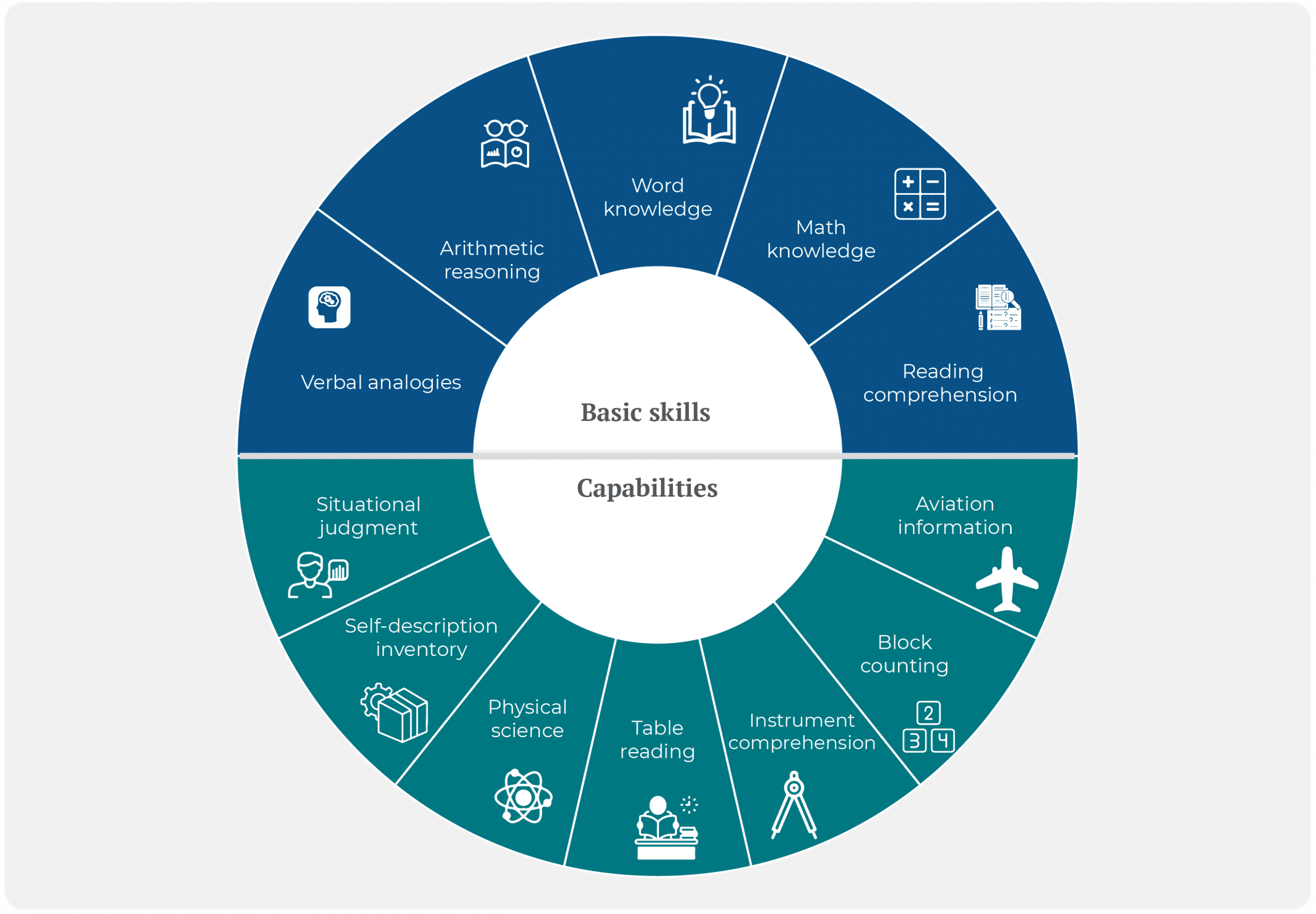
The current AFOQT includes 12 timed subtests and 516 questions. The exam lasts about five hours including breaks, and each subtest is timed.
| Subtest | Time | Questions |
|---|---|---|
| Verbal Analogies | 8 minutes | 25 |
| Arithmetic Reasoning | 29 minutes | 25 |
| Word Knowledge | 5 minutes | 25 |
| Math Knowledge | 22 minutes | 25 |
| Reading Comprehension | 24 minutes | 25 |
| Situational Judgment | 35 minutes | 16 |
| Self-Description Inventory | 45 minutes | 240 |
| Physical Science | 10 minutes | 20 |
| Table Reading | 7 minutes | 40 |
| Instrument Comprehension | 5 minutes | 25 |
| Block Counting | 5 minutes | 30 |
| Aviation Information | 8 minutes | 20 |
| Total | 516 |
Most of the test is multiple-choice, with the exception of the Self-Description Inventory, which is presented as an inventory (no “right/wrong” answers).
The different sections are combined to measure performance across composite areas commonly reported as:
- Pilot
- Combat Systems Officer
- Air Battle Manager
- Academic Aptitude
- Verbal
- Quantitative
- Situational Judgment
For more on this, please see the Results Scale and Interpretation section.
Verbal Analogies
In this section, you will have 8 minutes to answer 25 multiple-choice questions, each with 5 possible answers. There are 5 types of verbal analogies in this test, which measure your ability to reason and see relationships among words. They are:
- Synonym/Definition
- Antonym
- Functional/Relationship
- Classification
- Part-to-Whole
Your Verbal Analogies score will be used as part of the following composites: Air battle manager, academic aptitude, and verbal.
Winning Tip for Verbal Analogies
Identify the parts of speech or the tense in each analogy, and ensure that your answers align. For example, if the analogy shows the relationship between a verb and an adjective, the correct answer will show the same relationship in the same order.
AFOQT Verbal Analogies Sample Question
INSULT is to AGGRAVATION as…
- DEMONSTRATION is to RIOT
- DESTINY is to SOLUTION
- RIDDLE is to DISAMBIGUATION
- EMBRACE is to MITIGATION
- NEGATION is to ERUPTION
The correct answer is EMBRACE is to MITIGATION.
Explanation: The analogy underlying this question is A is an action that may lead to a typical response B.
The example: if someone INSULTS someone else, it typically leads to AGGRAVATION of the situation (fight/discontent/etc.)
The correct option: if someone EMBRACES someone else, it may lead to MITIGATION of stress/wrath/etc.
Why the distractors are not the correct answer:
Option A – RIOTS may happen during DEMONSTRATIONS, but they are not the typical outcome of demonstrations.
Options B & E – cannot be naturally associated with the provided example
Option C – a RIDDLE typically makes things more ambiguous. DISAMBIGUATION means that things become less ambiguous.
Arithmetic Reasoning
In this section, you have 29 minutes to answer 25 multiple-choice questions, each with 5 options for answers. The questions are word problems, and the directions include a formula sheet where needed.
Your Arithmetic Reasoning scores will be used as part of the following composites: academic aptitude and quantitative.
Winning Tip for Arithmetic Reasoning
Read each question carefully to identify what is being asked of you. Some questions can be confusing.
AFOQT Arithmetic Reasoning Sample Question
A football game made $1,300 from tickets. If tickets were sold at either $2 or $4.5, and an equal number of each ticket were bought, how many $2 tickets were bought?
- 175
- 185
- 220
- 200
- 160
The correct answer is 200.
Explanation: This question tells us that a total of $1,300 was collected by selling two types of tickets—$2 tickets and $4.50 tickets—in equal numbers. We need to find how many $2 tickets were sold. Let X be the number of each type of ticket.
- Set up the equation:
($2*X) + ($4.50*X) = $1,300
Combine like terms:
(2+4.5) X = 6.5 X = 1,300 - Solve for X:
X = 1,300 / 6.5
Because dividing by 6.5 can be tricky, multiply the numerator and denominator by 2 to get:
1,300 * 2 / 6.5 * 2 = 2,600 / 13 = 200 - Interpret the result:
X = 200 means 200 $2 tickets were sold.
Tips for a quick solution:
- If you see two ticket prices with the same quantity, you can add the prices first:
2 + 4.5 = 6.5.
Word Knowledge
This section measures your knowledge of words and their meanings. You will be given a word and asked to choose which of the five options is closest in meaning to the original word. You will have 5 minutes to answer 25 multiple-choice questions.
Your Word Knowledge score will be used as part of the following composites: combat systems officer, academic aptitude, and verbal.
Winning Tip for Word Knowledge
There is no context for the words in this section. If you aren’t immediately familiar with a word, imagine using it in a sentence and see if any of the options fit into the sentence.
AFOQT Word Knowledge Sample Question
Which word is most different in meaning than the other words?
- advocate
- champion
- proponent
- supporter
- adversary
The correct answer is adversary, meaning an enemy or opponent.
All the other words mean to back someone in a manner that is helping. An advocate is someone who defends or maintains a cause or a group. A champion is someone who battles for another’s rights or honor. A proponent is someone who argues in favor of something. A supporter is someone who promotes the interests of a person.
Math Knowledge
You have 22 minutes to complete 25 multiple-choice math questions. This section measures your knowledge of mathematical terms and principles. Make sure to learn the definitions of the following terms:
- Tangent
- Parallel
- Perpendicular
- Integer
- Rational/irrational number
- Mixed number
- Fraction
- Reciprocal
You should also be familiar with the following concepts:
- Working with trinomials
- Multiplying and factoring
- Mixed numbers with fractions and decimals
- Order of operations
- Division with decimals
- Standard mx+b equation for a line
Your Math Knowledge score will be used as part of the following composites: Pilot, combat systems officer, air battle manager, academic aptitude, and quantitative.
Winning Tip for Math Knowledge
When possible, try to eliminate potential answers, making it easier to find the right answer. If needed, work out problems on scratch paper.
AFOQT Math Knowledge Sample Question
Simplify the expression:
(x3 + 2) (x3 – x2) – x3 + x4
- x9 + x6 + x4 + 2x3 – x2
- x6 – x5 + x4 + x3 – 2x2
- x6 – x5 + 2x3 – 2x2
- x6 + x5 – x3 – 2x2
The correct answer is x6 – x5 + x4 + x3 – 2x2.
We need to distribute the factors to the terms inside the related parentheses:
| (x3 + 2) (x3 – x2) – x3 + x4 | Remember the FOIL method (First, Out, In, Last) |
| (x3 * x3) + (x3 * -x2) + 2x3 + (2 * -x2) – x3 + x4 | For two exponents of the same base, an + am = an+m |
| x3+3 – x3+2 + 2x3 – 2x2 – x3 + x4 | |
| x6 – x5 + 2x3 – 2x2 – x3 + x4 | Reorder and collect similar terms |
| x6 – x5 + x4 + 2x3 – x3 – 2x2 | |
| x6 – x5 + x4 + x3 – 2x2 |
Tip:
- It is easy to forget about – x3 + x4 at the right as it was not part of the factoring process. Always make sure that you work with all the parts of the polynomial.
Reading Comprehension
You will have 24 minutes to complete 25 multiple-choice questions in this section. You will be asked to read 5 passages that are 500-600 words long and answer 4-6 questions for each passage.
Your Reading Comprehension score will be used as part of the following composites: Academic aptitude and verbal.
Winning Tip for Reading Comprehension
Read the questions first so you know what information to pay attention to while reading the material. However, double-check your answers against the paragraph before submitting your test.
AFOQT Reading Comprehension Sample Question
There is meaning behind certain colors. Let’s examine the meaning behind two colors that seem to be used quite a bit – red and black. Red is generally associated with energy, power, strength, and determination. Red is commonly used in many sports uniforms because of all the above-mentioned ideas associated with it. Then there is black, which is associated with power. There are other things black is associated with such as evil, death, and elegance, and in sports, the focus is on its meaning of power. These two colors, red and black, are common in almost every NFL team’s uniform. Sixteen out of the thirty-two teams in the NFL have these colors in their uniform. That is very telling considering the meanings of these two colors.
The word “telling” in the paragraph most nearly means:
- Significant
- Speaking
- Obvious
- Out of the ordinary
The correct answer is A.
“Telling” is an adjective that means something significant, which has a striking or revealing effect. It is not obvious but rather indicative of much otherwise unnoticed. While “to tell” has a close meaning to “to speak”, in the context of the paragraph, “telling” has a different meaning.
Situational Judgment
This section evaluates your judgment compared to an officer in the Air Force. For each situation described, you will be asked to identify which of the five options listed is the best response to the situation, and which one is the least effective response.
You will have 35 minutes to answer 16 questions.
Your Situational Judgment score will be used as part of the following composite: Situational judgment.
Winning Tip for Situational Judgment
Before starting this section, imagine yourself as an officer in the Air Force, and base your answers on how an officer should react in these circumstances.
AFOQT Situational Judgment Sample Question
When handing out assignments to employees, which of the following criteria would be the best one for a manager to use?
- Allow employees to choose the assignments they feel they do best
- Assign less critical work to slow employees
- Assign tiring activities to new employees
- Assign tasks based on employee skills
The correct answer is D.
Option A is incorrect because while we do recognize the importance of empowering employees, this is unsustainable. If every employee selected the assignments they wanted to work on, there would be assignments that no one chooses.
Option B is also incorrect because there will be times when it is advantageous to have a slower, more thorough employee work on something critical. Remember, the question is asking for the best criteria.
Option C is incorrect because it is not good practice to dump tiring work on new employees.
Option D is the safest answer. It shows that as a manager you will be utilizing the resources you have available.
Self-Description Inventory
This section measures your personal style and attitudes. You will be given a statement and asked how you feel about the statement, based on a Strongly Agree – Strongly Disagree scale. You will have 45 minutes to respond to 240 statements.
| A | B | C | D | E |
|---|---|---|---|---|
| Strongly Disagree | Moderately Disagree | Neither Agree nor Disagree | Moderately Agree | Strongly Agree |
The Self-Description Inventory is not used in the composite scores.
Winning Tip for Self-Description Inventory
While there are no wrong answers, you can use this section to your advantage. Imagine yourself in the role you want, and base your responses on the way you would feel while in that role.
AFOQT Self-Description Inventory Sample Statement
Read the statement and, based on your first impression, record how well it describes you.
I value creativity and innovation in my work
- Strongly Disagree
- Moderately Disagree
- Neither Agree nor Disagree
- Moderately Agree
- Strongly Agree
The specific personality trait assessed by the statement “I value creativity and innovation in my work” is likely “Creativity.”
Reflection on Creativity and Its Implications
- Agreeing:
Strong agreement reflects an individual who thrives on originality, out-of-the-box thinking, and adaptability. They are likely to excel in roles requiring problem-solving, strategic innovation, or new approaches to challenges, such as research, design, or leadership in dynamic environments. However, they may sometimes struggle with strict rules or repetitive tasks, which could feel limiting to their creative nature. - Neutral:
A neutral response suggests someone who values creativity situationally. They can adapt to creative problem-solving when needed but are also comfortable following established processes. This balance can make them versatile, suitable for roles requiring both innovative thinking and adherence to structured procedures. - Disagreeing:
Disagreement indicates a preference for traditional, proven methods over experimentation or innovation. These individuals may excel in roles requiring consistency, precision, and adherence to established standards, such as technical operations or administrative tasks. However, they might face challenges in rapidly changing or highly creative environments.
Physical Science
In this section, you have 10 minutes to answer 20 multiple-choice questions. Physical science includes astronomy, physics, chemistry, and earth sciences (meteorology and geology).
Your Physical Science score is not used in the composites.
Winning Tip for Physical Science
To do well in this section, you will need a broad understanding of astronomy, chemistry, physics, and meteorology. Remember, this section isn’t used to determine whether you are qualified to serve but to help determine your eligibility for different Air Force jobs.
AFOQT Physical Science Sample Question
A sound which has a frequency below 20 Hz is known as:
- High sound
- Ultraviolet sound
- Low sound
- Loud sound
- Infrasonic sound
The correct answer is: E. infrasonic sound
Infrasonic sounds have a frequency below 20 Hz.
Table Reading
This section measures your ability to read a table quickly and accurately. You will have 7 minutes to answer 40 questions.
Your Table Reading score will be used as part of the following composites: Pilot, combat systems officer, and air battle manager.
Winning Tip for Table Reading
The layout of these questions on the test can be confusing. Practice on a few simulated tests to familiarize yourself with the format so you can move through this section quickly.
AFOQT Table Reading Sample Question
Quickly and accurately read the table below. The X values are the column headers, and the Y values are the row labels. For each question, locate the block where the given X and Y values intersect, note the number in that block, and select it from the answer options.
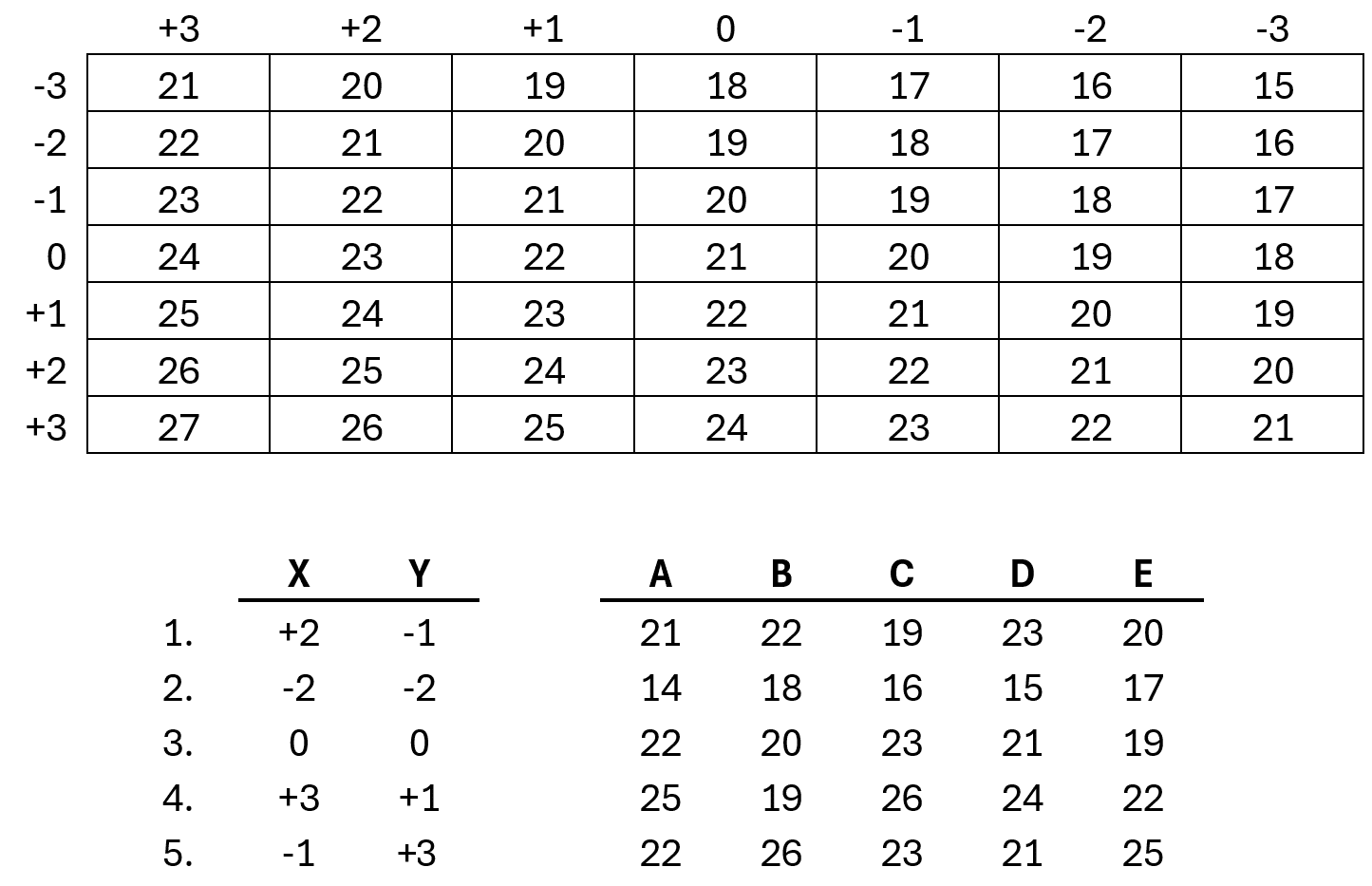
In Table Reading Questions, you’re presented with data in a dense table and asked to locate specific information quickly. You have only 7 minutes to answer 40 questions, so speed and accuracy are crucial. This question format is designed to look complicated and trick you—practice is key to becoming comfortable and succeeding.
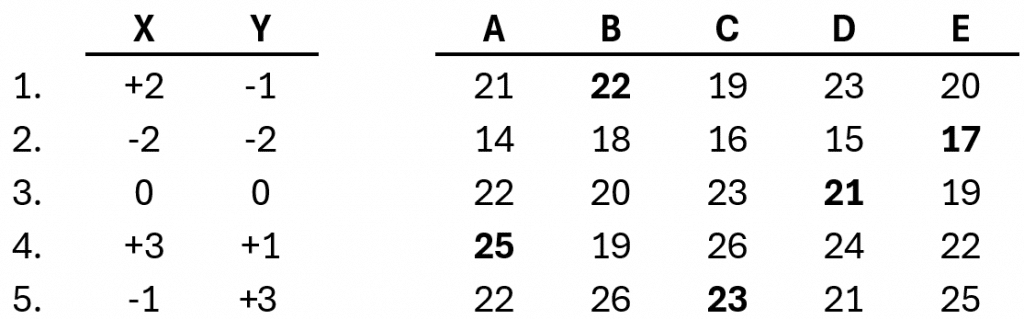
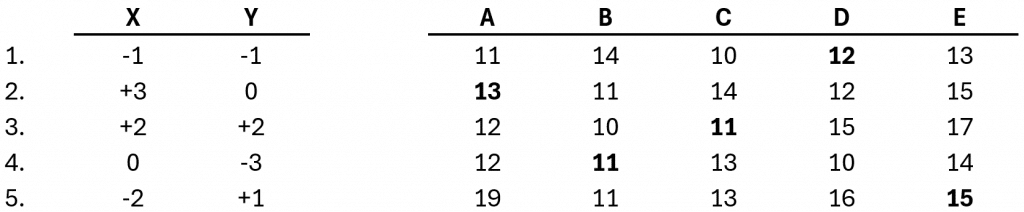
The correct answers are as follows:
Quick Tips & Solutions
- Pinpoint Axes Quickly – Identify the horizontal (X) and vertical (Y) axes so you can find the correct row and column without confusion.
- Locate Zero First – Zero-zero is at the center. Dividing the table into quadrants (positive/negative axes) narrows down the area you need to check.
- Use a Pointer Technique – Employ both hands to track. Follow one axis with a finger or pencil so you don’t have to memorize both row and column at once.
- Say It Out Loud – Quietly voice the row and column numbers to avoid mixing them up—especially under time pressure.
- Move On Promptly – Once you confirm the right coordinate or value, proceed immediately to the next question. Staying too long on one item can hurt your overall time.
- Practice One at a Time – Before the actual test, train by answering a single question as quickly as possible, then step away. This helps you develop speed without sacrificing accuracy.
Instrument Comprehension
You will have 5 minutes to answer 25 questions in this section, which measures your ability to determine the position of an airplane in flight. The section contains rules which need to be used throughout the section.
Each question shows the artificial horizon and a compass. You will be asked to determine which of the four planes matches the instruments.
Your Instrument Comprehension score will be used as part of the following composites: Pilot and air battle manager.
Winning Tip for Instrument Reading
While studying, familiarize yourself with the relationship between the artificial horizon and the compass.
AFOQT Instrument Comprehension Sample Question
This question tests your ability to determine an airplane’s position using flight instruments. Each question includes:
- Artificial Horizon Dial: Shows climb, dive, and bank angle.
- The horizon line tilts with bank.
- The white pointer indicates the degree of bank.
- The airplane indicator shifts up or down for climb or dive.
- Compass Dial: Displays the airplane’s heading.
Your task:
- Choose the airplane that best matches the instrument readings.
- You are always viewing from the north at the same altitude.
- East is to your right as you view the airplanes.
Select the correct airplane based on its bank, climb/dive, and heading.
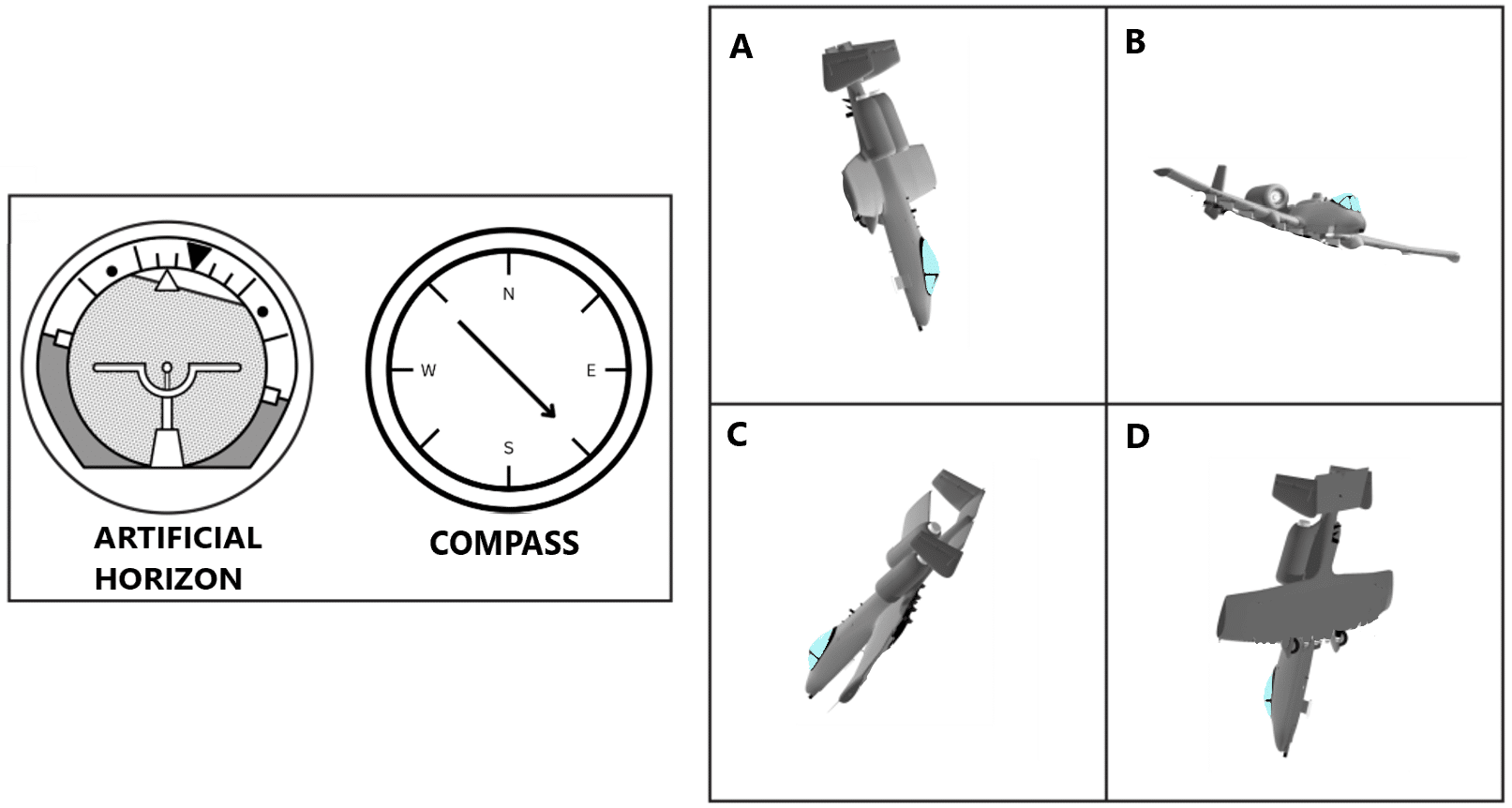
The correct answers is:
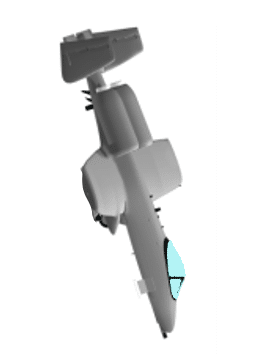
Quick Tips & Solutions
Familiarize yourself with artificial horizon and compass readings in advance. Understanding them well is key to making fast, accurate decisions.
Understand the Artificial Horizon
- The lighter area represents the sky; the darker area represents the earth.
- A “carrot” or arrow typically points “up” (sky) on the gauge. If the center of the airplane symbol is above the horizon line, you’re climbing. If below, you’re descending.
Check Bank Angle
- If the arrow (or carrot) tilts left, the aircraft is banking right, and vice versa. A level arrow means no bank—straight flight.
Compass Heading
- The compass dial shows your heading in degrees relative to north. If the dial reads “090,” the aircraft is heading east, and so on.
Time Management
- Speed is crucial. Answer each question by quickly matching the pitch (up or down) and roll (left or right) with the compass heading. Don’t linger—trust your instruments and move on.
Be Consistent
- The subtest uses the same plane and viewpoint for every question, so once you know the rules (e.g., arrow orientation, compass labeling), apply them uniformly to save time.
Practice Makes Perfect
- Familiarize yourself with artificial horizon and compass readings in advance. Understanding them well is key to making fast, accurate decisions.
Block Counting
This section measures your ability to see into a 3-dimensional pile of blocks. You will be asked to identify the number of blocks that touch the block you are being asked about. You have 5 minutes to answer 30 questions.
Your Block Counting score will be used as part of the following composites: Combat systems officer and air battle manager.
Winning Tip for Block Counting
You don’t have much time in this section, so count quickly. Make sure not to forget about blocks that may be beneath the block you are counting.
AFOQT Block Counting Sample Question
Determine how many blocks the numbered block touches.
Blocks only touch if their faces connect—corner touches don’t count.
Not all blocks are the same size and shape.
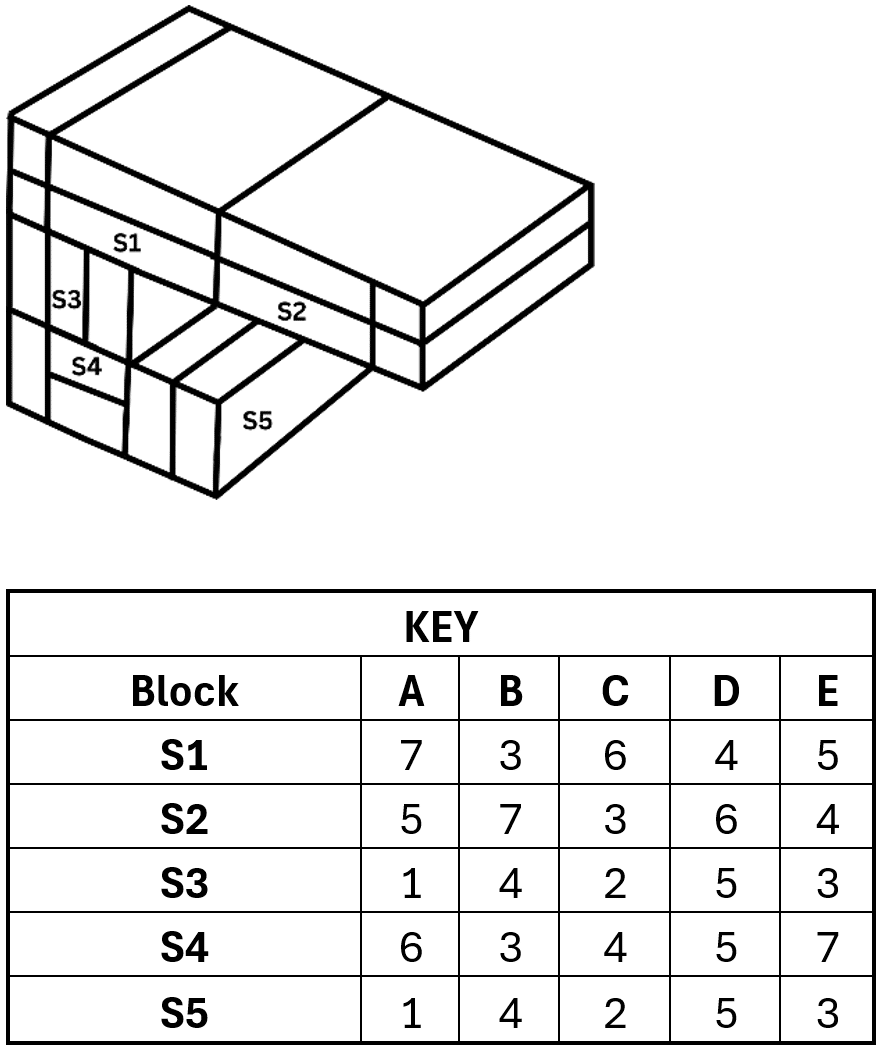
The correct answers are:
E, C, B, D, A
- S1 – E (5)
- S2 – C (3)
- S3 – B (4)
- S4 – D (5)
- S5 – A (1)
In this block-counting question, you must determine how many blocks come into contact with a specific block labeled S. By systematically checking each side—top, left, right, and bottom—you avoid double-counting or missing hidden blocks.
- S1 touches 5 blocks.
- One above, one on each side, two below.
- S2 touches 3 blocks.
- One above, one on each side, none below.
- S3 touches 4 blocks.
- One above, one on each side, one below.
- S4 touches 5 blocks.
- Two above, one on the left, one below.
- S5 touches 1 blocks.
- None above, one on the left, none below.
- Trick: Due to the floating formation, from a glance you may think S5 is touching S2(above).
Tips for a Quick Solution:
Guessing Strategy: In multiple-choice settings, the correct answer often isn’t the extreme high or low. If rushed, pick a middle number to increase your chances.
Divide and Conquer: Focus on one block at a time, listing what’s above, below, and on each side.
Watch for Hidden Blocks: Sometimes blocks are partially obscured or underneath others.
Track Carefully: If allowed, mark blocks off as you count; this helps avoid double-counting.
Aviation Information
This section measures your knowledge of aviation. You will either answer questions or fill in the blanks for questions relating to flying a plane. You must answer 20 questions in 8 minutes.
Your Aviation Information score will be used as part of the following composites: Pilot and air battle manager.
Winning Tip for Aviation Information
You have some time in this section, so read the questions carefully and answer as quickly as you can.
AFOQT Aviation Information Sample Question
When an aircraft descends below its glide slope on an ILS (Instrument Landing System) approach, which indicator would signal this deviation?
- The vertical speed indicator
- The glide slope indicator
- The heading indicator
- The attitude indicator
- The altimeter
The correct answer is B. The glide slope indicator.
Explanation:
Glide Slope Indicator: Part of the ILS system, it specifically displays whether an aircraft is above, on, or below the ideal glide path. A deviation below the glide slope will be immediately apparent on this indicator.
Why Other Options Are Incorrect:
- (A) Vertical Speed Indicator: Shows rate of climb or descent, not exact glide slope deviation.
- (C) Heading Indicator: Reflects the aircraft’s directional heading, unrelated to vertical glide path.
- (D) Attitude Indicator: Displays pitch and roll, but not precise glide slope alignment.
- (E) Altimeter: Measures altitude above sea level; it doesn’t indicate if the aircraft is on the correct descent profileJet engines produce more thrust.
Did you know?
The AFOQT is a timed 12-subtest exam used to measure aptitude for officer training; publicly available schedules can differ (one commonly cited e-testing schedule lists 516 questions, while the U.S. Air Force information pamphlet schedule totals 470 items). A strong practice test should cover the core academic subtests—Verbal Analogies, Arithmetic Reasoning, Word Knowledge, Math Knowledge, and Reading Comprehension—plus the remaining subtests that assess judgment, science, aviation knowledge, and spatial/aviation-related skills.
AFOQT Preparation Strategies
The AFOQT is fast-paced and highly timed, so your best gains usually come from training speed and accuracy in the subtests that matter most for your goals.
Core academic subtests
Start with Verbal Analogies, Word Knowledge, Arithmetic Reasoning, Math Knowledge, and Reading Comprehension. These are the backbone of most prep plans. Build accuracy first, then train pacing with timed sets.
Rated and aviation/spatial subtests
If you’re targeting aviation-related roles, put extra time into Table Reading, Instrument Comprehension, Block Counting, and Aviation Information. These sections improve with repetition and targeted drills.
Inventory, judgment, and science subtests
Self-Description Inventory and Situational Judgment reward consistency and clear decision-making. Physical/General Science is usually best improved through broad review plus timed practice.
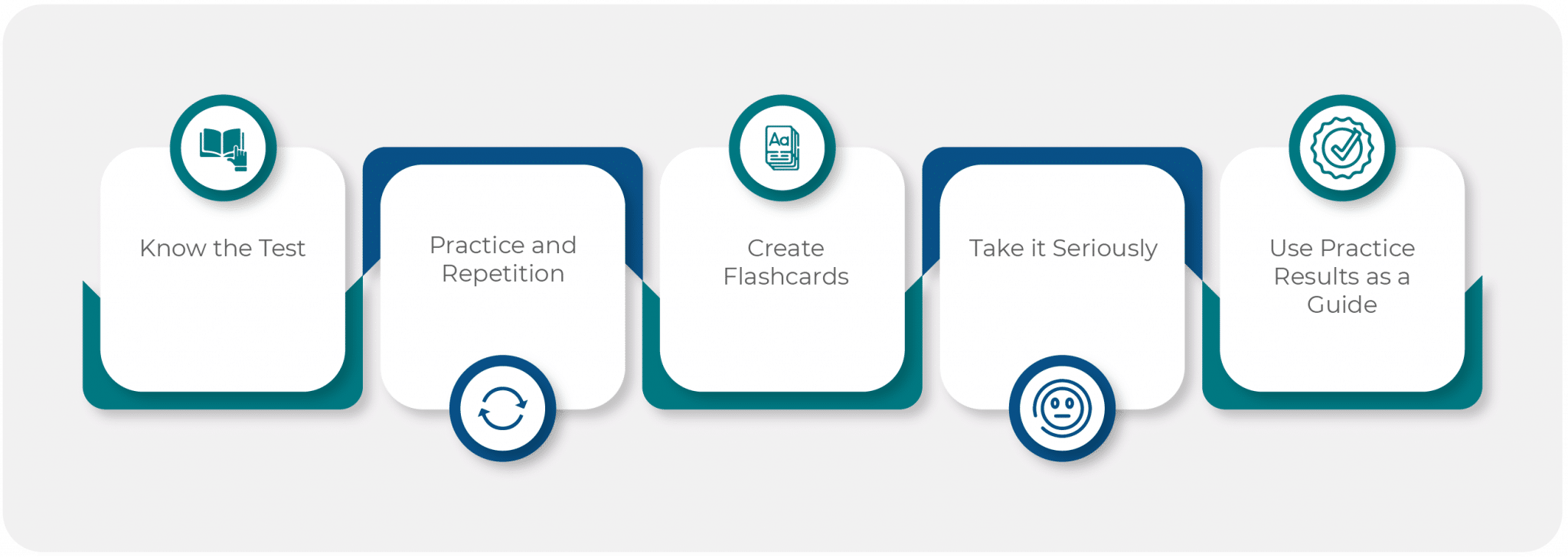
Know the format
Time pressure is a major challenge. Learn each subtest’s instructions and question style so you spend test time answering, not decoding.
Practice like test day
Use timed sets and occasional full-length practice sessions. Train pacing (when to move on, when to guess) and get comfortable switching between different subtests.
Build quick recall
Use flashcards for vocabulary, math formulas, and common arithmetic mistakes. Short daily review beats occasional cramming.
Use results to focus
After each practice test, identify your top 2–3 weak areas (accuracy or pacing) and drill those until they stop being your bottleneck.
Test Features
AFOQT vs. ASVAB
Both the AFOQT and the ASVAB are standardized military tests, but they serve different purposes.
The ASVAB is used for enlistment screening and job qualification across the services.
The AFOQT is Air Force–focused and is used as part of the selection process for officer commissioning programs (and, for some candidates, rated career screening).
Validity of AFOQT Scores
AFOQT score validity is tied to the score version accepted by the Air Force. Some score versions are considered valid and do not expire, while older versions may not be accepted for current selection decisions.
S Form vs. Form T
Older AFOQT forms are not treated the same as current score versions. If you have a prior score, confirm in your commissioning portal or with your recruiter whether your score version is accepted for your application cycle.
eAFOQT
The AFOQT is commonly delivered as a computer-based exam through approved testing locations. Delivery method and scheduling depend on your program and testing site.
AFOQT vs. TBAS test
The Test of Basic Aviation Skills (TBAS) is a separate assessment used for pilot and RPA-related candidate screening. It focuses on psychomotor skills, spatial ability, and multitasking, and is typically taken on a computer.
| Feature | AFOQT | TBAS |
|---|---|---|
| Typical time frame | ~5 hours | ~75 minutes |
| Questions/tasks | 516 or 470 (by schedule) | 48 questions + computer tasks |
| Sections | 12 subtests | 5 areas |
| Audience | Officer candidates | Pilot/RPA candidates |
| Format | Computer or paper (by site) | Computer |
Technical Facts
AFOQT Test Facts (tl;dr)
- 12 subtests; 516 or 470
- Timed; plan ~5 hours
- Core academic subtests matter most
- Retest after 90 days
- Up to 3 attempts
- Best composites are kept
Registering for the AFOQT
How you register depends on your commissioning path.
- If you’re in Air Force ROTC, your detachment will typically coordinate your AFOQT testing timeline as part of your program requirements.
- If you’re not in ROTC, registration is usually handled through your commissioning program point of contact (often a recruiter or program office). They’ll confirm eligibility and provide instructions for scheduling at an approved testing site.
Passing and failing
There isn’t an official “pass/fail” result for the AFOQT. Instead, you receive scores that are compared to minimum requirements for your commissioning program (and, if applicable, for rated pathways). If your scores don’t meet the required minimums, you may not be eligible to move forward.
Results Scale and Interpretations
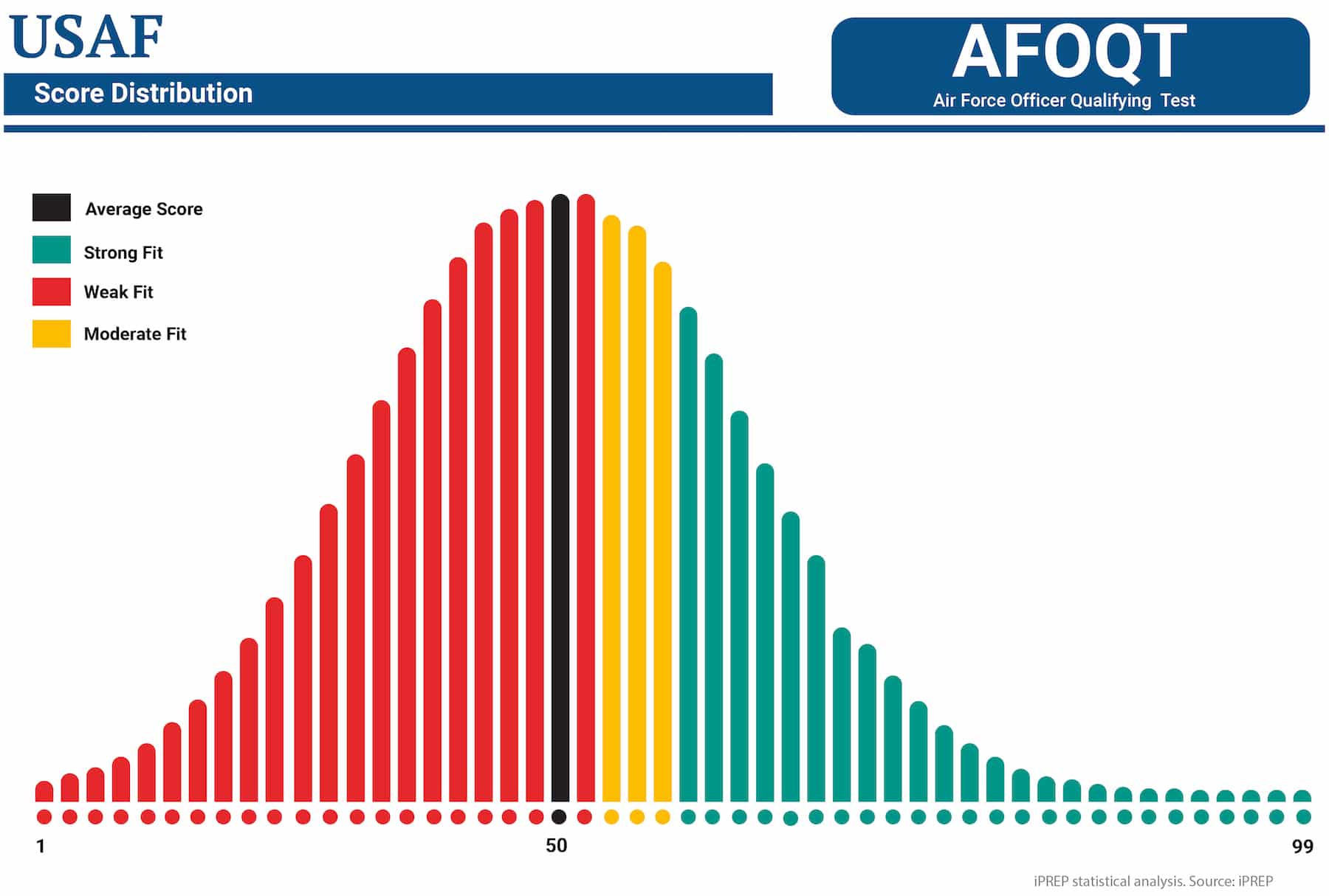
On the AFOQT, your performance in each subtest is converted into standardized scores so evaluators can compare results across test takers. Scores are reported on a 1–99 percentile scale, where higher scores indicate stronger performance relative to the reference group.
What scores you receive
Composite score labels can vary by source and score version, but most candidates receive:
- Verbal
- Quantitative
- Academic Aptitude
- Pilot (for rated screening, when applicable)
- A navigator/rated composite that may be reported as Navigator-Technical or as role-specific rated composites (such as CSO/ABM), depending on program reporting
Verbal and Quantitative composites
Your Verbal score is based on Verbal Analogies, Word Knowledge, and Reading Comprehension. Your Quantitative score is based on Arithmetic Reasoning and Math Knowledge.
Minimum qualifying scores
Minimum requirements can vary by commissioning source and target career path, but a commonly used baseline is:
- Verbal: 15
- Quantitative: 10
For rated pathways, programs commonly use a minimum of 25 on the applicable rated composite (for example, Pilot and other rated composites, when required).
How scores are used
Evaluators use your composite scores as one part of an overall selection process. If you are applying for rated pathways, additional screening tools may apply. For example, pilot applicants may also be evaluated using TBAS results and documented flight hours as part of a pilot selection score (such as PCSM or an equivalent method used by the program).
If you test more than once, the official score of record is typically based on your best composite results across attempts, not necessarily your most recent test.
When do I see my score?
Score posting time varies by testing site and delivery method, but many test takers see results within a few days to a couple of weeks.
AFOQT FAQs
The AFOQT is used by the U.S. Air Force as part of the selection process for officer commissioning programs and, when applicable, rated career screening.
You’ll take a timed, 12-subtest exam that measures verbal and math skills along with aviation/spatial skills. Most questions are multiple-choice, and you’ll also complete a self-description inventory and a situational judgment section (formats vary by test schedule/source).
It can be challenging because it covers multiple skill areas under tight time limits. With consistent practice—especially timed practice—most candidates can improve significantly.
They’re different tests for different goals. The ASVAB is used for enlistment and job qualification, while the AFOQT is used for officer commissioning considerations and may include rated-screening components.
Current Pearson VUE/eAFOQT information lists 516 questions. Older Air Force practice pamphlets may show 470 items, but they include outdated subtest information and should not be used as the current format.
“Good” depends on your program and target role. At a minimum, many programs use 15 Verbal and 10 Quantitative as baseline qualifying scores. Competitive targets are usually higher, especially for rated pathways.
Score validity depends on the score version accepted by the Air Force/program you’re applying to. Some score versions are accepted and do not expire, while older versions may not be accepted for current selection decisions.
There isn’t an official fail result, but if your scores don’t meet minimum requirements for your program or role, you may not be eligible to move forward. Many candidates retest to improve scores.
Yes. Retesting is typically allowed after a waiting period. Current policy commonly requires at least 90 days between attempts, allows up to three administrations, and generally requires a waiver for the third attempt.
The AFOQT isn’t reported as pass/fail. Programs set minimum composite score requirements, commonly including 15 Verbal and 10 Quantitative as a baseline for eligibility.
The AFOQT is a difficult test because it covers a wide range of topics within a tight time frame. However, with studying and practice, you should be able to do well on the test.
Start with a diagnostic practice test, then focus on your weakest areas first. Use timed sets to build pacing, and schedule steady practice sessions each week so you’re improving both accuracy and speed.
Expect arithmetic word problems and math fundamentals commonly associated with arithmetic reasoning and math knowledge (for example: operations, fractions/decimals, ratios, algebra basics, and geometry basics).
A calculator is not typically permitted. Follow your test center’s rules and the instructions provided on test day.
AFOQT scores are an important part of the overall selection process. Strong scores can improve competitiveness and keep more options open, especially for rated pathways.
Most subtests are multiple-choice. The self-description inventory uses an inventory-style response format, and situational judgment uses scenario-based response choices (exact format can vary by schedule/source).
AFOQT Test Tips
The AFOQT is a long, timed exam with multiple subtests back-to-back. Plan for a multi-hour appointment (often around 5 hours including check-in, instructions, and breaks), and treat test day like an endurance event.
Don’t leave answers blank
There’s no advantage to leaving an item unanswered. If you’re stuck, eliminate what you can and make your best guess.
Pace each subtest
Most subtests are short and time-pressured. Move quickly, don’t get anchored on one hard question, and save “deep thinking” for items you can realistically solve within the time limit.
Stay organized with your answers
Whether your test is computer-based or paper-based, keep tight alignment between the question you’re on and the answer you select. If you skip and return, use a simple system (mark, move, return) so you don’t lose time or mis-bubble.
Use your breaks strategically
Use breaks to reset—water, quick snack if allowed, and a short mental “clean slate” before the next subtest. Don’t review mistakes in your head between sections.
Take care of the basics
Sleep well, eat a steady-energy meal, and arrive early with what your test site requires. Small comfort issues become big distractions over several hours.
Practice the way you’ll test
Before test day, complete timed practice sets and at least one full-length practice session. The goal is to make the instructions, pacing, and section switches feel routine.
Administration
Test location: If you’re in Air Force ROTC, your detachment typically coordinates where you test. If you’re not in ROTC, your commissioning program point of contact (often a recruiter or program office) will direct you to an approved testing location. Testing is commonly delivered through authorized computer-based testing sites, depending on availability.
Test schedule: ROTC cadets typically test on a program timeline (often around the sophomore/POC period). Other applicants test when directed by their recruiter or program office based on application requirements and seat availability.
Test format: The AFOQT may be delivered as computer-based testing or, in some locations, paper-based testing. Your scheduling instructions will confirm the format you will receive.
Test materials: You’ll be provided the materials required for your test format. Follow test center instructions for what is allowed (for example, scratch paper may be provided). Personal calculators are typically not permitted.
Cost: The testing fee, if any, is handled by your commissioning program/testing arrangement. Confirm details with your recruiter or program office.
Retake policy: Retesting is typically allowed after at least 90 days between attempts. Candidates are generally limited to three administrations, with a waiver required for the third attempt.
Test Provider
The AFOQT is developed by the U.S. Air Force and administered through approved Air Force testing channels. Depending on your program and location, testing may be delivered at an ROTC detachment/testing site or through an authorized computer-based testing provider (such as Pearson VUE) using Air Force scheduling instructions.
Information Sources
Disclaimer – All information and prep materials on iPREP are created for tutoring and practice purposes. iPREP is not affiliated with the U.S. Air Force (owner of the AFOQT), Pearson VUE, or any other companies, trademarks, or test providers mentioned on this page.
Free AFOQT Practice Test
Start with free AFOQT practice test questions that give you a clear feel for the aptitude areas tested on the Air Force Officer Qualifying Test. The free practice introduces common AFOQT-style tasks such as verbal analogies, arithmetic reasoning, word knowledge, math knowledge, reading comprehension, table reading, instrument comprehension, block counting, aviation information, and situational judgment.
Use the free practice to understand the question format, pacing, and level of accuracy expected before moving into full preparation. For complete practice, iPREP’s full AFOQT course includes realistic practice questions, step-by-step explanations, video lessons, and targeted practice for the main AFOQT subtests.
Question 1 of 12 – Verbal Analogies
HUMOR is to LAUGH as…
- BREEZE is to DRIFT
- CONTEMPLATION is to WANDER
- CONCUSSION is to INJURY
- THERAPY is to ALLEVIATE
- INCITEMENT is to RETRACT
The correct answer is BREEZE is to DRIFT.
Explanation: The analogy underlying this question is A may make something B.
The example – humor may make people laugh.
The correct option – a breeze may cause things (leaves, feathers, etc.) to drift on it. While “waft” may be the more accurate verb, “drift” still adheres to the meaning and structure of the analogy.
Why the distractors are not the correct answer:
Option B – contemplation may make one wonder, with an “O” The word that appears in this option is wander.
Option C – a concussion is a type of injury. A concussion doesn’t make an injury.
Option D – therapy may alleviate pain or stress. However, this pair of words doesn’t maintain the structure of the analogy. The second word of the analogy represents something that happens to something in light of the first word. In option D, therapy directly causes alleviation, therefore it is not the right analogy.
Option E – incitement is supposed to motivate, not to make someone retract from something.
Tips for a quick solution:
Word analogies always maintain the part of speech of each of the words in the analogy. For example, if the original example is “NOUN is to VERB,” the correct answer must also be in the form of “NOUN is to VERB.” If you notice that any of the answers is in a different form (e.g. “NOUN is to NOUN”), you can immediately eliminate it as a possible answer. At times, this technique can immediately remove 2-3 options.
Nonetheless, in some cases, a word might have two meanings which belong to different parts of speech. Many verbs are also nouns. Many nouns are also adjectives. Considering that, use the above-mentioned tip only in cases where you are certain of the part of speech of every word.
Question 2 of 12 – Math Knowledge
Consider the following formula:
(3A – (2B + C)) – 2 = BC + A
If B = 5 and C = 6, what is the value of A?
- 6
- 12
- 16
- 24
The correct answer is 24.
In order to solve this question correctly, you need to remember the order of operations (PEMDAS):
- Parentheses
- Exponents
- Multiplication/Division
- Addition/Subtraction
In addition, you should remember that if a minus sign precedes parentheses, it applies to all the values within the parentheses and not only to the first value. Although it is not necessary to apply this to this question, the solution below includes this demonstration.
In order to find a solution, we need to isolate A.
| (3A – (2B + C)) – 2 = BC + A | Remove the inner parentheses |
| (3A – 2B – C) – 2 = BC + A | Place values B = 5; C = 6 |
| (3A – 2*5 – 6) – 2 = 5*6 + A | Multiplication within the parentheses first. As there is no factor to the parentheses, it can be resolved. |
| 3A – 10 – 6 – 2 = 30 + A | Note that subtraction must be done left to right and do not forget that there is a minus sign before the number 10 |
| 3A – 18 = 30 + A | Collect As at the left and numbers at the right |
| 3A – A = 30 + 18 | |
| 2A = 48 | Divide by 2 to find A |
| A = 24 |
Question 3 of 12 – Word Knowledge
Which word is most different in meaning than the other words?
- flammable
- insidious
- combustible
- ignitable
- inflammable
The correct answer is insidious, meaning proceeding in a gradual, subtle way, but with harmful effects.
All the other words mean that something can be burned. Although the prefix “in-” is used before the word flammable, this does not mean that the item cannot light on fire suddenly. However, due to this confusion, it is more common to state that something is flammable. Inflammable means can ignite without an external fire source like a match. Insidious may resemble in sound “incendiary,” which also means flammable.
Question 4 of 12 – Arithmetic Reasoning
A restaurant served 170 meals on a busy evening. This was 200% of the number of meals they usually serve on a regular evening. How many meals do they usually serve on a regular evening?
- 370
- 340
- 85
- 75
- 30
The correct answer is 85.
Explanation:
This is a “reverse percentage” type of question.
Let the usual number of meals be x. The problem tells us that the number of meals served on the busy evening, 170, is 200% of the usual number of meals.
Since 200% is equivalent to multiplying by 2, we can write this relationship as:
170 = 200% * X
This equation represents the relationship described in the problem.
If possible, the best way is to convert the percent value to fraction or decimal form.
In this case, 200% means “two times”, which simply means to multiply a value by 2. Using this conversion, you can simply solve:
170 = 200% * X convert % value
170 = 2 * X divide both sides by 2
170/2 = X
X = 85
Tips for a quick solution:
Suppose you do not remember the percentage-fraction conversion by heart. In that case, it is usually worthwhile trying to convert the percentage value to a fraction with a denominator of 100 and then reduce it to the smallest numbers.
In our case, 200% is 200/100, and if reduced by 100, you get 2.
Question 5 of 12 – Reading Comprehension
There is meaning behind certain colors. Let’s examine the meaning behind two colors that seem to be used quite a bit – red and black. Red is generally associated with energy, power, strength, and determination. Red is commonly used in many sports uniforms because of all the above-mentioned ideas associated with it. Then there is black, which is associated with power. There are other things black is associated with such as evil, death, and elegance, and in sports, the focus is on its meaning of power. These two colors, red and black, are common in almost every NFL team’s uniform. Sixteen out of the thirty-two teams in the NFL have these colors in their uniform. That is very telling considering the meanings of these two colors.
Black is a common color for sports uniforms because it reflects positively on the __________ of the team.
- Elegance
- Strength
- Power
- Evil
The correct answer is C.
The second paragraph focuses on the traits associated with the red and black colors. You should look for the traits associated with black to answer the questions.
Of the four answers, three are associated with black – elegance, power, and evil. However, the paragraph emphasizes that in the context of sports, black is chosen as a uniform color for its association with “power.” “Power” is also associated with red. If you are not a careful reader, it might lead you to eliminate it from being the correct answer.
Tip: As you may assume that colors should reflect on positive, sports-related traits, answers B and C strike as better candidates for the correct answer. If you reach such a conclusion, it might be sufficient to search for those specific words in the text and to try to affirm or contradict them as the correct answer.
Question 6 of 12 – Situational Judgement
One of your team members complains that she is being overworked compared to her coworkers and is having trouble meeting deadlines. You should:
- Ask if she is dealing with other pressures from outside the workplace
- Review her recent assignments to see if she is right
- Tell her that everyone on the team is swamped with work, and it is being assigned equally
- Tell her she is the most capable member of the team, which is why she gets more assignments than her coworkers
The correct answer is B.
Option A is incorrect because it is insulting and implies that she is misunderstanding the situation.
Option C is wrong because it shows that you assume that you are correct.
Option D is incorrect because it might seem to them to be a punishment rather than a reward.
Additionally, the question didn’t tell you that the employee was a top performer, so choosing this answer requires that you make that assumption.
Option B shows that you are objective and willing to investigate her complaint.
Question 7 of 12 – Self-Description Inventory
Read the statement and, based on your first impression, record how well it describes you.
I enjoy analyzing complex problems before taking action
- Strongly Disagree
- Moderately Disagree
- Neither Agree nor Disagree
- Moderately Agree
- Strongly Agree
The specific personality trait assessed by the statement “I enjoy analyzing complex problems before taking action” is “Analytical Thinking.”
Reflection on Analytical Thinking and Its Implications
- Agreeing:
A strong agreement reflects a highly analytical individual who values logic, structure, and understanding before acting. These candidates are likely detail-oriented, strategic, and deliberate, excelling in roles that require thorough planning or problem-solving, such as technical or intelligence positions. However, they might be perceived as overly cautious or slow to act under time pressure. - Neutral:
A neutral response suggests flexibility—someone who can analyze problems when necessary but is also comfortable making decisions with limited information. These individuals balance analysis and action, which is advantageous for roles requiring adaptability and quick thinking, such as operational leadership. - Disagreeing:
Disagreement indicates a preference for intuitive or action-oriented decision-making. These individuals are likely quick, decisive, and confident under pressure, making them well-suited for fast-paced or high-stakes roles like piloting. However, they may risk overlooking critical details in complex situations.
Question 8 of 12 – Physical Science
A current supplied by a battery or a cell is an example of:
- Open circuit
- Alternative current
- Closed circuit
- Both AC and DC current
- Direct current
The correct answer is: E. Direct current
Explanation: Direct current (DC) flows constantly in one direction. For example, the current from a battery or a cell is DC current.
Question 9 of 12 – Table Reading
Quickly and accurately read the table below. The X values are the column headers, and the Y values are the row labels. For each question, locate the block where the given X and Y values intersect, note the number in that block, and select it from the answer options.
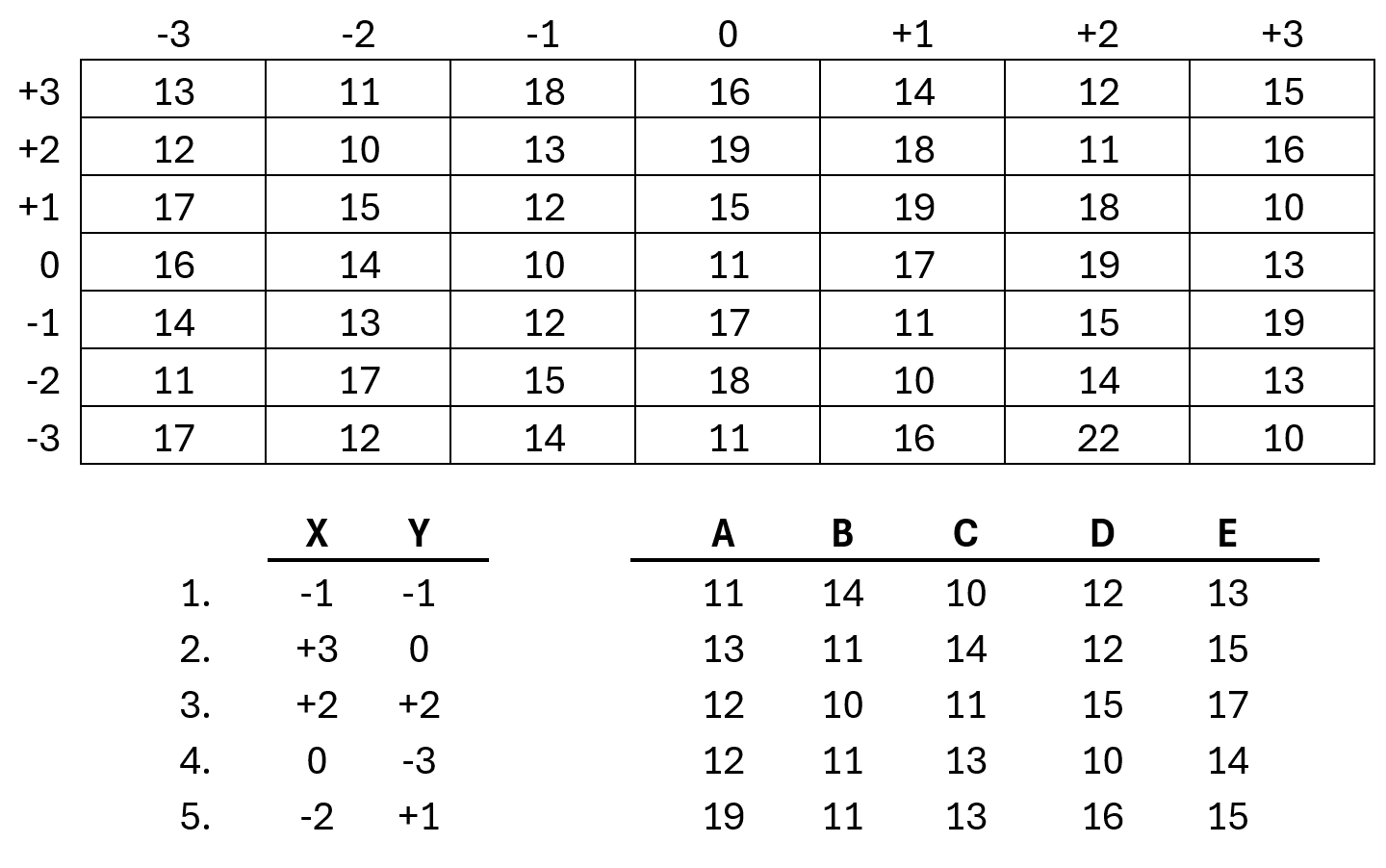
In Table Reading Questions, you’re presented with data in a dense table and asked to locate specific information quickly. You have only 7 minutes to answer 40 questions, so speed and accuracy are crucial. This question format is designed to look complicated and trick you—practice is key to becoming comfortable and succeeding.
The correct answers are as follows:
Quick Tips & Solutions
- Pinpoint Axes Quickly – Identify the horizontal (X) and vertical (Y) axes so you can find the correct row and column without confusion.
- Locate Zero First – Zero-zero is at the center. Dividing the table into quadrants (positive/negative axes) narrows down the area you need to check.
- Use a Pointer Technique – Employ both hands to track. Follow one axis with a finger or pencil so you don’t have to memorize both row and column at once.
- Say It Out Loud – Quietly voice the row and column numbers to avoid mixing them up—especially under time pressure.
- Move On Promptly – Once you confirm the right coordinate or value, proceed immediately to the next question. Staying too long on one item can hurt your overall time.
- Practice One at a Time – Before the actual test, train by answering a single question as quickly as possible, then step away. This helps you develop speed without sacrificing accuracy.
Question 10 of 12 – Instrument Comprehension
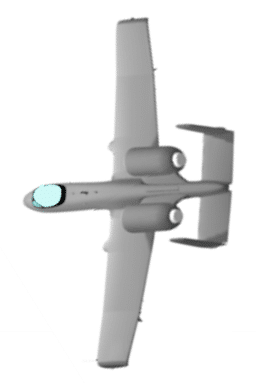
This question tests your ability to determine an airplane’s position using flight instruments. Each question includes:
- Artificial Horizon Dial: Shows climb, dive, and bank angle.
- The horizon line tilts with bank.
- The white pointer indicates the degree of bank.
- The airplane indicator shifts up or down for climb or dive.
- Compass Dial: Displays the airplane’s heading.
Your task:
- Choose the airplane that best matches the instrument readings.
- You are always viewing from the north at the same altitude.
- East is to your right as you view the airplanes.
Select the correct airplane based on its bank, climb/dive, and heading.
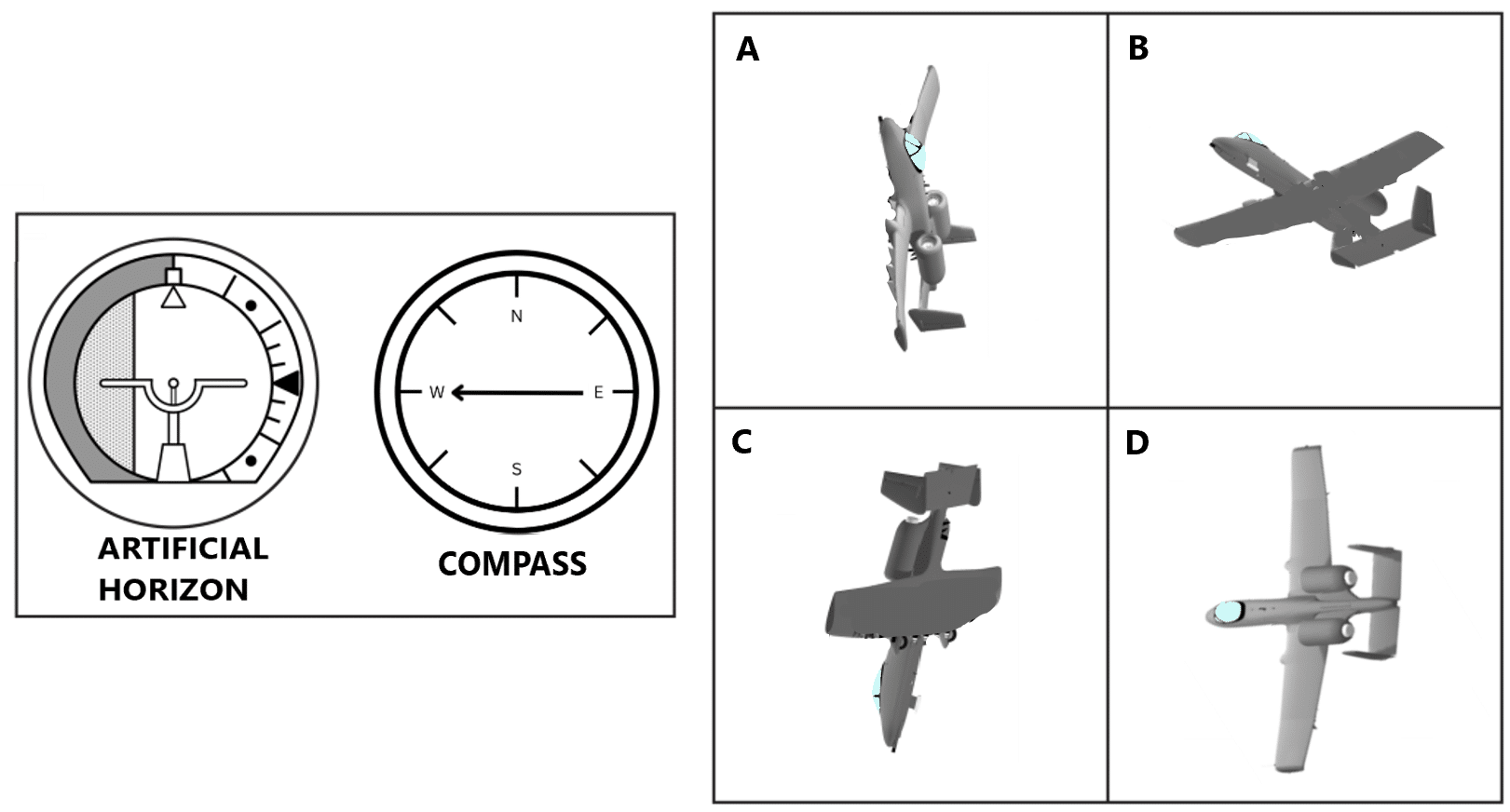
The correct answers is:
Quick Tips & Solutions
Familiarize yourself with artificial horizon and compass readings in advance. Understanding them well is key to making fast, accurate decisions.
Understand the Artificial Horizon
- The lighter area represents the sky; the darker area represents the earth.
- A “carrot” or arrow typically points “up” (sky) on the gauge. If the center of the airplane symbol is above the horizon line, you’re climbing. If below, you’re descending.
Check Bank Angle
- If the arrow (or carrot) tilts left, the aircraft is banking right, and vice versa. A level arrow means no bank—straight flight.
Compass Heading
- The compass dial shows your heading in degrees relative to north. If the dial reads “090,” the aircraft is heading east, and so on.
Time Management
- Speed is crucial. Answer each question by quickly matching the pitch (up or down) and roll (left or right) with the compass heading. Don’t linger—trust your instruments and move on.
Be Consistent
- The subtest uses the same plane and viewpoint for every question, so once you know the rules (e.g., arrow orientation, compass labeling), apply them uniformly to save time.
Practice Makes Perfect
- Familiarize yourself with artificial horizon and compass readings in advance. Understanding them well is key to making fast, accurate decisions.
Question 11 of 12 – Block Counting
Determine how many blocks the numbered block touches.
Blocks only touch if their faces connect—corner touches don’t count.
All blocks are the same size and shape.
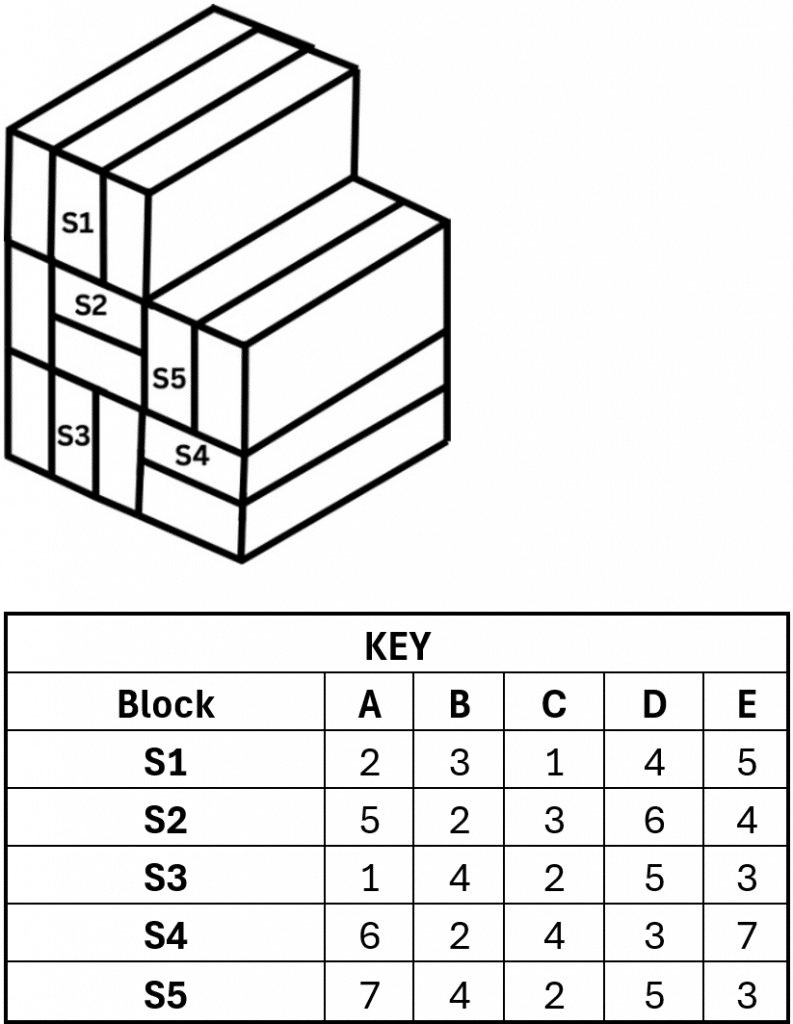
The correct answers are:
- S1 – B (3)
- S2 – A (5)
- S3 – E (3)
- S4 – C (4)
- S5 – B (4)
Explanation:
In this block-counting question, you must determine how many blocks come into contact with a specific block labeled S. By systematically checking each side—top, left, right, and bottom—you avoid double-counting or missing hidden blocks.
- S1 touches 3 blocks.
- None above, one on each side, one below.
- S2 touches 5 blocks.
- Two above (including S1), one on each side, one below.
- S3 touches 3 blocks.
- One above, one on each side, none below.
- S4 touches 4 blocks.
- Two above, one on the left, one below.
- S5 touches 4 blocks.
- None above, two on the left, one on the right, one below.
Tips for a Quick Solution:
Guessing Strategy: In multiple-choice settings, the correct answer often isn’t the extreme high or low. If rushed, pick a middle number to increase your chances.
Divide and Conquer: Focus on one block at a time, listing what’s above, below, and on each side.
Watch for Hidden Blocks: Sometimes blocks are partially obscured or underneath others.
Track Carefully: If allowed, mark blocks off as you count; this helps avoid double-counting.
Question 12 of 12 – Aviation Information
What is the primary reason for using a jet engine instead of a piston engine in modern commercial aircraft?
- Jet engines are more fuel-efficient at lower altitudes
- Jet engines are quieter
- Jet engines produce more thrust
- Jet engines are easier to maintain
- Jet engines operate better in colder weather
The correct answer is C. Jet engines produce more thrust.
Explanation:
Jet engines produce more thrust than piston engines, enabling modern commercial aircraft to handle heavier payloads and achieve higher speeds. This thrust advantage is critical for large passenger jets operating on long routes.
Why Other Options Are Incorrect:
- (A) More Fuel-Efficient at Lower Altitudes: Jet engines are most efficient at higher altitudes, not lower ones.
- (B) Quieter: Jets generally produce significant noise; they’re not chosen for their quiet operation.
- (D) Easier to Maintain: Maintenance can be more involved and expensive for jet engines compared to piston engines.
- (E) Better in Colder Weather: Cold weather tolerance is not the main advantage; thrust output for large airliners is.